Van's Air Force

The definitive Van's Aircraft support community! Buying, building or flying an RV? Join our exclusive family of mentors and enthusiasts!

Electrical Puzzler...

Good article from Juan.

However, I am at a loss as to explain the measurements from Walt *and* why sticking a very large cap in my installation (12KuF) made no difference in the behavior.

Admittedly, I am lazy and I lack the right tools to measure the ripple voltage and frequency. I did take a run at it with my Fluke 87 Mk.V and came up with .050mVac and 12.90Hz at 1200RPM, 16A with the EarthX battery charged up and online --- but that didn't make much sense either.

Both the Plane Power and B&C Alternators use a WYE winding with center tap diodes -- 8 diodes total.

I used a different formula for determining frequency -- F = (rpm*poles)/120, maybe that's the error (ref. Juan Grube)...
The capacitance calculation followed from there -- C = I/2f*Vr, Vr is the desired Ripple Voltage, I is the current, F is the frequency in Hz.

For a 1200 RPM scenario, I would need a 47000uF cap to deliver 20A at .5V ripple. 2500 RPM, this drops to 22600uF, same current and ripple.

Big cap on order from Mouser - will be here today; I'll install it and rerun the test and see what happens...
 
Hi Walt, can you give me the part number or source or manufacturer of that cap?

I'd like to use 33,000uF or higher for my estimated 10A+ current draw to keep engine running (EFI pumps, injectors and ignition coils).

The energy stored in a capacitor is pretty small compared to a battery. The equation is 1/2CV^2. A 33,000uf capacitor would supply [email protected] volts for about 0.4 seconds.
 
Last edited:
Good article from Juan.

However, I am at a loss as to explain the measurements from Walt *and* why sticking a very large cap in my installation (12KuF) made no difference in the behavior.

Admittedly, I am lazy and I lack the right tools to measure the ripple voltage and frequency. I did take a run at it with my Fluke 87 Mk.V and came up with .050mVac and 12.90Hz at 1200RPM, 16A with the EarthX battery charged up and online --- but that didn't make much sense either.

Both the Plane Power and B&C Alternators use a WYE winding with center tap diodes -- 8 diodes total.

I used a different formula for determining frequency -- F = (rpm*poles)/120, maybe that's the error (ref. Juan Grube)...
Yes, the ripple frequency is the big question. Looking at Walt's scope picture it looks more like 30Hz, but that doesn't make sense either.
If each of the three windings on the alternator only makes one sine curve per rotation we get: 3 x 2 (full bridge rectifier) = 6 ripples per rotation.
RPM to rotation/sec is divide by 60. So Freq is still 6/60 or RPM/10. So your formula should still be correct.
1,000 engine RPM * 3.545 ratio = 3545 alternator RPM. Or 354.5Hz ripple frequency.
The capacitance calculation followed from there -- C = I/2f*Vr, Vr is the desired Ripple Voltage, I is the current, F is the frequency in Hz.
That is for one-phase full bridge rectifier.
For a three-phase (what we have) multiply by 0.12 or so.
For a 1200 RPM scenario, I would need a 47000uF cap to deliver 20A at .5V ripple. 2500 RPM, this drops to 22600uF, same current and ripple.

Big cap on order from Mouser - will be here today; I'll install it and rerun the test and see what happens...
 
Last edited:
The energy stored in a capacitor is pretty small compared to a battery. The equation is 1/2CV^2. A 33,000uf capacitor would supply [email protected] volts for about 0.4 seconds.
Yes, but fortunately the output from a three-phase alternator never reaches zero volts (only drops to 0.866 of the peak voltage). And it looks like our alternators outputs at more than 300Hz (0.003 seconds between peaks). So that requires a much smaller capacitor than I originally calculated.
 
Man, I feel really stupid following this thread. You guys are on another level.
Don't feel bad. We're just working our way though our confusions. :)
Like:
How fast does the alternator spin?
What does its loaded output look like if not smoothed by a battery or a capacitor?
 
Admittedly, I am lazy and I lack the right tools to measure the ripple voltage and frequency. I did take a run at it with my Fluke 87 Mk.V and came up with .050mVac and 12.90Hz at 1200RPM, 16A with the EarthX battery charged up and online --- but that didn't make much sense either.
Considering you can get an o'scope quite sufficient for these purposes for less than $50, it doesn't make any sense not to use one to see what's really going on.
Just a random example:

Or for less than $20 if you want to put it in a case yourself and power it from an USB port:

Oh, do get one with probes or connectors. I see that some of them uses a small connector.
 
However, I am at a loss as to explain the measurements from Walt *and* why sticking a very large cap in my installation (12KuF) made no difference in the behavior.
You can stick as many capacitors as you can source in your airplane and it wont change a thing. A regulator is a closed-loop device with a feedback circuit (field) that relies on field current to work thru the battery as a low-impedance component. A cap not only blocks DC its purely reactive in impedance so it wont work as you may think it will work to smoothen the output of the alternator. A battery and a capacitor both hold a charge but the difference is their reactive impedance or in the case of a battery the lack of reactive impedance (actually resistive impedance.)

Bottom line: don't disconnect the alternator from the battery. Alternator switches really just create load dumps which shorten the lives of alternators and regulators and serve no purpose in stopping a real OV condition. I don't use/install them as they cause more problems than they solve.

The only use case for a cap in a 12V aircraft electrical system might be to eliminate some noise from a specific component but more often than not they don't work well for this purpose.
 
Last edited:
You can stick as many capacitors as you can source in your airplane and it wont change a thing. A regulator is a closed-loop device with a feedback circuit (field) that relies on field current to work thru the battery as a low-impedance component. A cap not only blocks DC its purely reactive in impedance so it wont work as you may think it will work to smoothen the output of the alternator. A battery and a capacitor both hold a charge but the difference is their reactive impedance or in the case of a battery the lack of reactive impedance (actually resistive impedance.)

Bottom line: don't disconnect the alternator from the battery. Alternator switches really just create load dumps which shorten the lives of alternators and regulators and serve no purpose in stopping a real OV condition. I don't use/install them as they cause more problems than they solve.

The only use case for a cap in a 12V aircraft electrical system might be to eliminate some noise from a specific component but more often than not they don't work well for this purpose.
Disagree, caps in DC circuits are used extensively to reduce ripple and noise .
 
Disagree, caps in DC circuits are used extensively to reduce ripple and noise .
Disagree all you want to. You cap as installed is doing nothing. Otherwise you should be able to show that it is doing something with your oscilloscope. Specifically what frequency of noise is it filtering?
 
Disagree all you want to. You cap as installed is doing nothing. Otherwise you should be able to show that it is doing something with your oscilloscope. Specifically what frequency of noise is it filtering?
Don’t plan on doing additional testing just to prove you wrong. The alternator is just like any other power supply that uses a rectifier bridge, all of which use filter caps to smooth the DC output.
 
Disagree all you want to. You cap as installed is doing nothing. Otherwise you should be able to show that it is doing something with your oscilloscope.

Don’t plan on doing additional testing just to prove you wrong. The alternator is just like any other power supply that uses a rectifier bridge, all of which use filter caps to smooth the DC output

Don’t plan on doing additional testing just to prove you wrong. The alternator is just like any other power supply that uses a rectifier bridge, all of which use filter caps to smooth the DC output.
I really don't care if you don't want to prove me wrong but I can say with certainty installing a large cap to mitigate a battery going offline doesn't do anything. Like I said disagree all you want to.
 
You can stick as many capacitors as you can source in your airplane and it wont change a thing. A regulator is a closed-loop device with a feedback circuit (field) that relies on field current to work thru the battery as a low-impedance component. A cap not only blocks DC its purely reactive in impedance so it wont work as you may think it will work to smoothen the output of the alternator. A battery and a capacitor both hold a charge but the difference is their reactive impedance or in the case of a battery the lack of reactive impedance (actually resistive impedance.)

Bottom line: don't disconnect the alternator from the battery. Alternator switches really just create load dumps which shorten the lives of alternators and regulators and serve no purpose in stopping a real OV condition. I don't use/install them as they cause more problems than they solve.

The only use case for a cap in a 12V aircraft electrical system might be to eliminate some noise from a specific component but more often than not they don't work well for this purpose.
That certainly is quite a different viewpoint.
Let's start with the difference between a battery and a capacitor.
You're saying that a battery is purely resistive -- in other words no inductance and no capacitance? If no capacitance how does it hold a charge?
I've always thought of a battery as a huge capacitor.

I want to learn. Is there some ways you can explain or expand on it?

BTW, we're not advocating running alternator without battery, we simply want to ensure that OVP does not trigger by reducing ripple voltage if battery fails open or connections to battery fail. (And perhaps spare some loads from excessive ripple voltages.)

P.S. I'm thinking in terms of old school voltage supplies: transformer, bridge rectifier, filter capacitor, series regulator. Trying to think of undesirable functioning by regulating the AC source voltage (field winding in alternator) rather than voltage drop over the DC series regulator. Both regulators will look at the final output, whether smoothed by battery or filter capacitor. Regulating the AC source (alternator) may introduce bit of a loopback delay, but how would that be a problem?
Edit: Come to think of it -- modern switchmode power supplies does regulate the AC voltage (by duration -- PWM or frequency, but still...).
 
Last edited:
That certainly is quite a different viewpoint.
Let's start with the difference between a battery and a capacitor.
You're saying that a battery is purely resistive -- in other words no inductance and no capacitance? If no capacitance how does it hold a charge?
I've always thought of a battery as a huge capacitor.

I want to learn. Is there some ways you can explain or expand on it?
Correct. A battery does have reactive impedance but its typically minimal compared to its resistive impedance.

Resistive impedance – due to internal resistance from electrodes, electrolytes, and connectors.
Reactive impedance – due to capacitance and inductance within the battery.

Capacitance is not what holds the charge in a battery. The charge is stored through chemical energy, not electrostatic charge separation like in a capacitor.
 
Correct. A battery does have reactive impedance but its typically minimal compared to its resistive impedance.

Resistive impedance – due to internal resistance from electrodes, electrolytes, and connectors.
Reactive impedance – due to capacitance and inductance within the battery.

Capacitance is not what holds the charge in a battery. The charge is stored through chemical energy, not electrostatic charge separation like in a capacitor.
OK, but how does it make a difference from the viewpoint of a regulator? In both cases electrons flow in and out of the battery or capacitor.
 
BTW, we're not advocating running alternator without battery, we simply want to ensure that OVP does not trigger by reducing ripple voltage if battery fails open or connections to battery fail. (And perhaps spare some loads from excessive ripple voltages.)

You have to assume that there will be load dump conditions and your OVP device has to be able to deal with them gracefully. Large capacitors will not solve this problem. The way this is done nowadays in modern automotive electronics is with high-current capacity mosfets and a monitoring circuit that will regulate the supply into a critical circuit to prevent it from being damaged.
 
You have to assume that there will be load dump conditions and your OVP device has to be able to deal with them gracefully. Large capacitors will not solve this problem. The way this is done nowadays in modern automotive electronics is with high-current capacity mosfets and a monitoring circuit that will regulate the supply into a critical circuit to prevent it from being damaged.
Well, I guess we could make each load device resistant to 100's of volts. Or insert a power conditioning device in the path to critical busses. But another possible failure point.
Big unknown here is how fast an alternator and regulator acts.
As for load dumps by battery disconnecting -- unless battery is recharging after starting the engine, which I expect would normally be on the ground, I don't see much of an issue there. As for other load dumps, such as turning off pitot, lights and flap motor, again that would depend on how fast the alternator/regulator works. But that is something that can be observed on an o'scope -- to be checked both at idle and high RPMs.

Not saying a capacitor is the Holy Grail here, but a possible quick and dirty solution subject to testing.

Another issue with adding a big capacitor not fully addressed is its inrush current. I'm leaning towards placing it near the alternator and following it with a high current diode to battery and busses. In that way it will gradually charge as the alternator ramps up.

Also, having learned that maximum ripple on a three-phase full-bridge rectified alternator is less than 13.4% of output voltage, one could set the OVP trigger point high enough -- perhaps 18V -- and/or make it slow enough that it can handle common load dumps without triggering. Again requires experimenting on each different airplane.
 
I really don't care if you don't want to prove me wrong but I can say with certainty installing a large cap to mitigate a battery going offline doesn't do anything. Like I said disagree all you want to.
I think Socrates figured this out....
"The man who thinks he knows everything knows nothing, he will not attempt to expand his knowledge and grow in further wisdom. If he thinks he knows everything, he will be led by believing there isn't anything left to learn. He will have a closed mind if anyone suggests otherwise."
 
Something I haven't seen discussed in this thread is the possibility that the AC voltage Brian observed is not ripple from the rectifier but from the voltage regulator. An alternator / voltage regulator combo is a power supply with a feedback control loop. There are a lot of trade-offs that go into designing that control loop, affecting things like how quickly it responds to step loads, regulation accuracy, ripple, etc. Since different voltage regulators have different designs (ICs and supporting components), they may have very different behavior when the battery is disconnected. If the operating conditions fall too far outside of the assumptions made by the regulator designer, the control loop may become unstable. Think pilot induced oscillation. Rectifier ripple frequency should closely track engine RPM but I'd guess oscillation from the control loop does not. If the problem is control loop instability, there might be ways to address it that don't involve massive filter caps.
 
I think we could be getting wrapped around the axle worrying about the ripple voltage. It’s likely the load dump of the energy stored in the alternator causing your overvoltage.
It’s happening in tens of milliseconds after the switch is opened. The energy stored in the alternators inductance is proportional to I^2. Walt’s test at 2 amps and yours at 10 amps mean there is 25 times more energy to be dissipated in your case. If you are going to measure it you have to measure the transient when the switch is opened. The other point is the ripple period wouldn’t likely be long enough for the typical 5ms OVP response time.
BTW the OVP doesn’t trip on my B&C 40A/EarthX 680 system if I turn off the master with the alternator on with a 3 amp load.
 
Last edited:
I think we could be getting wrapped around the axle worrying about the ripple voltage. It’s likely the load dump of the energy stored in the alternator causing your overvoltage.
It’s happening in tens of milliseconds after the switch is opened. The energy stored in the alternators inductance is proportional to I^2. Walt’s test at 2 amps and yours at 10 amps mean there is 25 times more energy to be dissipated in your case. If you are going to measure it you have to measure the transient when the switch is opened. The other point is the ripple period wouldn’t likely be long enough for the typical 5ms OVP response time.
BTW the OVP doesn’t trip on my B&C 40A/EarthX 680 system if I turn off the master with the alternator on with a 3 amp load.
Very good points.
I have now learned that a 3-phase alternator's output will not drop below 0.866 of it's ripple peaks.
Also measured that on my Mitsubishi alternator the ripple frequency is 36 times the rotational speed or 0.6 times alternator RPM. So ripple in itself won't trip the OVP.
Adding or removing loads appear to be much more likely to trigger OVP depending on how fast the voltage regulator acts. And with "The energy stored in the alternators inductance is proportional to I^2" it becomes interesting to calculate size of capacitor needed to absorb that. In other words, spike from voltage regulator overshooting after adding a load is probably much less than spike from stored energy in alternator after load dump.

BTW, the cheap handheld oscilloscopes I mentioned in earlier posts turns out to be not trustworthy! If anyone have one that is trustworthy (never displays signal not actually measured) I'd like to know the brand and model.
 
@CarloJ , @Mikeyb Others...

Update:
Determining root cause is fundamental in resolving issues, designing a better mousetrap, ad nauseum.

Over the past two weeks I've been working on instrumenting the buss and reverse engineering the regulator/alternator system and come to a couple of interesting findings --
#1. These "cheap" handheld scopes, or at least the two that I tried, aren't sufficient to the task of measuring ripple current (FNIRSI 2C53P, FNIRSI 1014D)
#2. The regulator in the PP Alternator is still a bit of a mystery -- I decapped a similar version, a Transpo IN254, to see what was what, and the markings on the IC were not visible. However, there are 3 MOSFETs (Advanced Power Electronics AP9980GH) adjacent and a smattering of popcorn parts (C's, R's, D's, L's). Next up is for me to build the schematic, netlist and see what I can find that will "fit in the hole" of the mystery 14 pin, SOJ package.

The theory --
@CarloJ - Yes, I think the behavior/issue is a result of the regulator design and operation.

In the test (or failing) case, the alternator is producing about 188 Watts of power (14.5V * 13A); the aircraft loads sum to about .9 Ohms ( = 13A/14.5V).

The term "load dump" has been suggested, but I submit that there is no "load dump" happening when the battery master is turned off. The alternator current is still sitting around 10A - 13A with the battery online or offline.

The alternator regulator operates by adjusting the field current/voltage using the buss voltage and B+ voltage as inputs into the control loop. Documentation from ND, elsewhere, indicates that the regulator sits is on the "ground" side of the field/rotor coil (referred to as "A - circuit"). The field current flows into the rotor field winding first, then into the regulator, which will increase or decrease the circuit resistance and thus current flow on the way to the ground...

Removing the battery from the buss has the effect of removing some capacitance and impedance (resistance) which will change the amplitude of the ripple and any A/C (transistor, diode switching "noise") riding on the B+ output, the buss, and Field/Sense input.

FWIW - B&C LR3D, which is a Linear regulator, doesn't exhibit the OV trip behavior with the battery removed from the buss. The PlanePower, ND etc. could be a switching regulator of some stripe.

So, is it noise (mV) or is it a bigger swing (V) that's throwing the regulator controller for a loop ( LOL -- see what I did there ? :) ) which then causes the OV protection to trip?

Experimentation continues, and getting to root cause is fun! This is fun!

---

Oh yeah, I bought a another new scope in support of this project -- woo hoo!
 
Last edited:
@CarloJ , @Mikeyb Others...

Update:
Determining root cause is fundamental in resolving issues, designing a better mousetrap, ad nauseum.

Over the past two weeks I've been working on instrumenting the buss and reverse engineering the regulator/alternator system and come to a couple of interesting findings --
#1. These "cheap" handheld scopes, or at least the two that I tried, aren't sufficient to the task of measuring ripple current (FNIRSI 2C53P, FNIRSI 1014D)
#2. The regulator in the PP Alternator is still a bit of a mystery -- I decapped a similar version, a Transpo IN254, to see what was what, and the markings on the IC were not visible. However, there are 3 MOSFETs (Advanced Power Electronics AP9980GH) adjacent and a smattering of popcorn parts (C's, R's, D's, L's). Next up is for me to build the schematic, netlist and see what I can find that will "fit in the hole" of the mystery 14 pin, SOJ package.

The theory --
@CarloJ - Yes, I think the behavior/issue is a result of the regulator design and operation.

In the test (or failing) case, the alternator is producing about 188 Watts of power (14.5V * 13A); the aircraft loads sum to about .9 Ohms ( = 13A/14.5V).

The term "load dump" has been suggested, but I submit that there is no "load dump" happening when the battery master is turned off. The alternator current is still sitting around 10A - 13A with the battery online or offline.

The alternator regulator operates by adjusting the field current/voltage using the buss voltage and B+ voltage as inputs into the control loop. Documentation from ND, elsewhere, indicates that the regulator sits is on the "ground" side of the field/rotor coil (referred to as "A - circuit"). The field current flows into the rotor field winding first, then into the regulator, which will increase or decrease the circuit resistance and thus current flow on the way to the ground...

Removing the battery from the buss has the effect of removing some capacitance and impedance (resistance) which will change the amplitude of the ripple and any A/C (transistor, diode switching "noise") riding on the B+ output, the buss, and Field/Sense input.

FWIW - B&C LR3D, which is a Linear regulator, doesn't exhibit the OV trip behavior with the battery removed from the buss. The PlanePower, ND etc. could be a switching regulator of some stripe.

So, is it noise (mV) or is it a bigger swing (V) that's throwing the regulator controller for a loop ( LOL -- see what I did there ? :) ) which then causes the OV protection to trip?

Experimentation continues, and getting to root cause is fun! This is fun!

---

Oh yeah, I bought a another new scope in support of this project -- woo hoo!
I suspect most regulators are of the switching variety, as they are solid state copies of the old points based VR's of yester year. As the volts drop, the ponts close to supply current. As the volts go up, the points open, stopping current flow. Pretty cool, as I think this was the first iteration ofmodern PWM and they could achieve impressive frequencies for the day. Unsure if modern solid state stuff uses PWM or just switches on and off more quickly, but I guess that is one and the same. that level of distinction is above my pay grade.
 
SUCCESS!!!
After much trial and error, I achieved the "impossible" (as some had suggested)-- Running without a battery attached.
There are a couple of kinks to work out - fine tuning and explaining an oddity on the G3X/GEA 24, but I am confident that I can now mitigate the failure mode of either the Master Contactor/Relay failing -OR- The Earthx BMS taking the battery off the buss.

The solution ended up being a 53KuF / 35V (-10% +75%) E-Cap (...this cap measured at 48KuF...). Link to Savvy, data of interest starts around 10:30:
https://apps.savvyaviation.com/flights/shared/flight/9444884/eb9b3f11-4812-42a8-b959-9feffd361c68


Recapping (pun intended): Voltage rose to 15.4V, then settled down, then back to 15.8V, then 15.4V as I played with increasing RPM and adding loads (pitot heat, lights, wig wag). the OV in the Alternator never tripped off.

Of note -- The ripple voltage measured about 50mV with the capacitor installed and the battery connected -- jumping to 1V when the battery was disconnected.

Odd thing #1:
I noted an odd anomaly ( you can see it on the Savvy link also) with the measured current on the G3X/GEA 24 that I believe is related to the amplitude of the ripple voltage. Volts would indicate 15.4 or so and then the AMPs would drop from 10-ish to 0, then up a bit. Ohm's Law says this isn't possible - so I think there may be an input / synchronIzation / sample rate issue with the GEA 24 and the shunt hi/lo inputs.

Odd thing #2:
I had originally run this test with a 60KuF / 50V (-10% +75%) E-Cap. Here's link, data at 01:32:
https://apps.savvyaviation.com/flights/shared/flight/9444885/6d5e4605-2c09-46bc-8556-d676d72b2ff0
The volts got above 16 and the OV *never tripped*, but the AMPS indicated 0 -- See Odd thing #2.

Questions:
The ESR for the 60K cap is 11.9 mOhm, the 53K cap is 15.9 mOhm. So why does a smaller cap do a better job at holding down the alternator volts? Why does a current shunt measure 0V when there is very clearly a Voltage potential and loads in the circuit down downstream of the current shunt?

Next Steps:
Amp-Clamp or Hall Effect device instead of the shunt to verify currents. Ohm's law and the fact I can see the strobes running tells me that there is current flowing...

Have a great week y'all
 
SUCCESS!!!
After much trial and error, I achieved the "impossible" (as some had suggested)-- Running without a battery attached.
There are a couple of kinks to work out - fine tuning and explaining an oddity on the G3X/GEA 24, but I am confident that I can now mitigate the failure mode of either the Master Contactor/Relay failing -OR- The Earthx BMS taking the battery off the buss.

The solution ended up being a 53KuF / 35V (-10% +75%) E-Cap (...this cap measured at 48KuF...). Link to Savvy, data of interest starts around 10:30:
https://apps.savvyaviation.com/flights/shared/flight/9444884/eb9b3f11-4812-42a8-b959-9feffd361c68


Recapping (pun intended): Voltage rose to 15.4V, then settled down, then back to 15.8V, then 15.4V as I played with increasing RPM and adding loads (pitot heat, lights, wig wag). the OV in the Alternator never tripped off.

Of note -- The ripple voltage measured about 50mV with the capacitor installed and the battery connected -- jumping to 1V when the battery was disconnected.

Odd thing #1:
I noted an odd anomaly ( you can see it on the Savvy link also) with the measured current on the G3X/GEA 24 that I believe is related to the amplitude of the ripple voltage. Volts would indicate 15.4 or so and then the AMPs would drop from 10-ish to 0, then up a bit. Ohm's Law says this isn't possible - so I think there may be an input / synchronIzation / sample rate issue with the GEA 24 and the shunt hi/lo
Odd thing #2:
I had originally run this test with a 60KuF / 50V (-10% +75%) E-Cap. Here's link, data at 01:32:
https://apps.savvyaviation.com/flights/shared/flight/9444885/6d5e4605-2c09-46bc-8556-d676d72b2ff0
The volts got above 16 and the OV *never tripped*, but the AMPS indicated 0 -- See Odd thing #2.

Questions:
The ESR for the 60K cap is 11.9 mOhm, the 53K cap is 15.9 mOhm. So why does a smaller cap do a better job at holding down the alternator volts? Why does a current shunt measure 0V when there is very clearly a Voltage potential and loads in the circuit down downstream of the current shunt?

Next Steps:
Amp-Clamp or Hall Effect device instead of the shunt to verify currents. Ohm's law and the fact I can see the strobes running tells me that there is current flowing...

Have a great week y'all

What’s volts 1 and 2?
What’s the Alt off flag represent?
 

Attachments

  • IMG_0524.png
    IMG_0524.png
    383.3 KB · Views: 14
  • IMG_0525.png
    IMG_0525.png
    379.7 KB · Views: 14
Capacitor ripple current is more important than ESR in this application. What are those specs?
The cap I used has a ripple current rating of 12.2amps and ESR of 27mohms.
I believe the reg design in the PP unit has much more trouble dealing with the higher ripple voltage and consequently has trouble maintaining a stable output.
 
Last edited:
Capacitor ripple current is more important than ESR in this application. What are those specs?
The cap I used has a ripple current rating of 12.2amps and ESR of 27mohms.
I believe the reg design in the PP unit has much more trouble dealing with the higher ripple voltage and consequently has trouble maintaining a stable output.
Walt -
The 53K (DCMC533U035BB2B) comes in at 11.6A & 15.9mOhms.

I'll dig around for something with more oomph.
 
I thought the light came on if the alternator output went low. No? When is the battery disconnected?
In the savvy data, the Volts 1 jumps from 14.4 to 15+ when the battery is disconnected.

The ALT Off signal only happens when the Field current is interrupted -- either by turning off the Alt Switch, Tripping the Field Breaker, or Triggering the OV protection in the alternator. The Lamp "output" in the alternator is pulled to ground when the alternator is in an active circuit and the field is turned off and there is voltage present on the B+ lead -- either by virtue of the battery driving the buss, or the alternator outputting current. If you look at the schematic you can see the Lamp bulb sits between the buss and the alternator.

The GEA 24 input is configured to "Active Lo" - it records a "1" (True) in the data, even tho the actual input is Lo...
 
In the savvy data, the Volts 1 jumps from 14.4 to 15+ when the battery is disconnected.

The ALT Off signal only happens when the Field current is interrupted -- either by turning off the Alt Switch, Tripping the Field Breaker, or Triggering the OV protection in the alternator. The Lamp "output" in the alternator is pulled to ground when the alternator is in an active circuit and the field is turned off and there is voltage present on the B+ lead -- either by virtue of the battery driving the buss, or the alternator outputting current. If you look at the schematic you can see the Lamp bulb sits between the buss and the alternator.

The GEA 24 input is configured to "Active Lo" - it records a "1" (True) in the data, even tho the actual input is Lo...

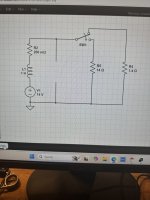
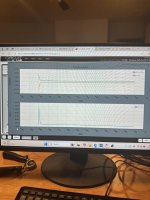
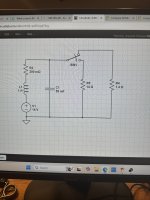
When you put a giant capacitor in parallel with a giant inductor you make a giant oscillator. I used 1F and 55K UF in this model and it gives an LRC response time of around a second which is reasonably close to what your data shows. The circuit shown switches between a 10 amp and 1 amp load. The circuit on the left is without a capacitor and shows the typical positive going load dump response. Sorry for the crappy images but the currents are on the top trace and the voltage on the bottom.

The one on the right is with the capacitor. It oscillates above and below the set point like your data shows. It’s possible this response, the regulator response and the data logger frequencies are aliasing.
 

Attachments

  • IMG_1396.jpeg
    IMG_1396.jpeg
    3.5 MB · Views: 8
  • IMG_1397.jpeg
    IMG_1397.jpeg
    1.7 MB · Views: 15
  • IMG_1393.jpeg
    IMG_1393.jpeg
    3.5 MB · Views: 12
  • IMG_1395.jpeg
    IMG_1395.jpeg
    1.7 MB · Views: 14
Last edited:
Brian congrats nailing it down. Where in the circuit did you add the cap?
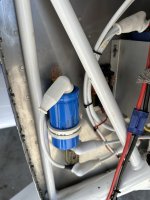
I put the cap at the firewall end of the B+ lead where it attaches to the ANL. I figured if/when the cap fails (short) it will blow the ANL.

IMG_6949.jpeg
 
If you want the ANL to act as protection against blown cap you need to move it to the other side of the ANL.
 
If you want the ANL to act as protection against blown cap you need to move it to the other side of the ANL.
The wiring is a little confusing in the picture; the alternator feed point is at the top lug of the ANL, the loads (shunt, relays, battery, buss) connect to the bottom.

If the alternator is doing the driving -- then a shorted cap will pop the ANL. If the alternator is off, then there isn't any current flowing through the cap, or ANL so nothing will short or pop.
 
Back
Top