Van's Air Force

The definitive Van's Aircraft support community! Buying, building or flying an RV? Join our exclusive family of mentors and enthusiasts!

Need Loctite Explanation/Advice

kirkbauer

Well Known Member
OK, I'm getting into the fuel and brake sections of my RV-10 build and it's not a topic I'm particularly familiar with. I have the Beringer wheels/brakes from Van's which come with hoses from Flightline Systems, and I also purchased the Flightline fuel hose kit with wingroot filters. I have read through Sections 5, 36, and 37, as well as the Flightlines and Beringer instructions, and checked the wiki. But I still feel a bit lost on how to properly make the connections. And this is an area I want to make sure I get correct.

First, I think that most of the connections are using flared tips -- for example, the connections on the electric fuel pump. I also thought that I should not use any sealing method on those, but section 5 does say to use Loctite 565 on tapered fittings. I would love some clarity on that. I also have Loctite 648 which I used on the Andair fuel selector valve screws (the screws, right, not the fuel line connections?). Finally, I have Loctite 567 that the Flightlines instructions says to use on the fitting to the brake fluid reservoir.

The Beringer instructions mention Loctite 243 and 271 for use on the wheels (I'm not there yet but wanted to mention it).

Can anybody give me some broad guidance on when and where to use the various Loctites? The only thing I know for sure is to make sure it stays on the threads and does not get into the lines.
  • Loctite 243: for the wheels -- anything else?
  • Loctite 271: for the wheels -- anything else?
  • Loctite 565: do I need it?
  • Loctite 648: do I use for anything other than the screws on the Andair valve?
  • Loctite 567: do I use for anything other than the brake reservoir?
Are there other Loctites I need? I have not made it to the firewall-forward portion yet.
 
Maybe this will help.

Loctite is a brand name, not a specific type of thread lock adhesive or thread sealant. They make A LOT of different types of products. And, it does get confusing when the name Loctite is thrown out there without an associated product number.

The type most are familiar with is the thread lock, used to prevent threaded connections from backing out and coming loose. You can usually find three of these in hardware stores....basically low strength (easily removable), medium strength (a bit harder to remove), and high strength (as in this one is not ever coming back off). This type of thread lock is used on straight threads (aka machine threads). It is NOT used on the flared connections (tubing or fitting) used in brake, fuel, and oil systems. Also NOT used to seal tapered pipe threads.

The other Loctite you are referring to is a thread sealant, used for tapered pipe threads. Its job is to seal the small space between male and female pipe threads where fluid (like gasoline, oil, brake fluid, etc.) will leak through. This type of thread sealant does not harder over time and will not act as a thread lock. It is selected to be resistant to whatever fluid is running through that particular system. Use this type on pipe threads only.

I can't speak to the various Loctite numbers you have listed (not without looking all of them up), but depending on whether it is a thread sealant or thread lock will indicate where it is to be used. It does seem that the Flightline Systems recommended Loctite 565 use on tapered threads must be a thread sealant......not a thread lock. You might be able to get by with one or two thread sealants, and low strength and medium strength thread lock. Or you end up with a collection like I did, before tossing the stuff that didn't work or I didn't like. ;)

It sounds like Beringer and Andair are recommending their respective preferred thread lock.....probably different strengths for different screw diameters.

And, just to add to the confusion, there are other brands of thread locks and thread sealants out there, each with their own numbering systems different from the produce numbers Loctite has come up with.

If you ever get into an industry where any type of Loctite material is used (adhesives, thread locks, thread sealants, printed circuit board conformal coatings, or whatever else they come up with), you get very familiar with their tech support, website, sales rep, etc. At least we only have a few to deal with in airplane building.:)
 
Last edited:
I use aviation form a gasket #2 for all fuel, brake fluid, oil etc pipe threads.there is an equivalent locktite product, but most good automparts stores have this stuff


After reading more of this thread, seems there are better products than aviation forma gasket#2. I have been educated by the masters. Thanks for enlightenment YMMV.
 
Last edited:
567 for pipe threads on fluid fittings, 242/243 for thread locking purposes.

OK, I like using 567 on all of the pipe threads since it is something simple that I won't mess up (obviously keeping it out of the pipes). But I just want to confirm since these instructions say to only use it on the brake line reservoir.

Thank you!
 
Loctite 567 on all NPT threads (tapered). Pretty much the gold standard for thread sealant.

NOTHING on AN flare fittings or their respective B nuts.

As far as thread lock goes, it depends. As previously posted, there are many flavors, and each has a specific use. Best to follow manufacturers recommendations here.
 
  • Like
Reactions: HFS
OK, I'm getting into the fuel and brake sections of my RV-10 build and it's not a topic I'm particularly familiar with. I have the Beringer wheels/brakes from Van's which come with hoses from Flightline Systems, and I also purchased the Flightline fuel hose kit with wingroot filters. I have read through Sections 5, 36, and 37, as well as the Flightlines and Beringer instructions, and checked the wiki. But I still feel a bit lost on how to properly make the connections. And this is an area I want to make sure I get correct.

First, I think that most of the connections are using flared tips -- for example, the connections on the electric fuel pump. I also thought that I should not use any sealing method on those, but section 5 does say to use Loctite 565 on tapered fittings. I would love some clarity on that. I also have Loctite 648 which I used on the Andair fuel selector valve screws (the screws, right, not the fuel line connections?). Finally, I have Loctite 567 that the Flightlines instructions says to use on the fitting to the brake fluid reservoir.

The Beringer instructions mention Loctite 243 and 271 for use on the wheels (I'm not there yet but wanted to mention it).

Can anybody give me some broad guidance on when and where to use the various Loctites? The only thing I know for sure is to make sure it stays on the threads and does not get into the lines.
  • Loctite 243: for the wheels -- anything else?
  • Loctite 271: for the wheels -- anything else?
  • Loctite 565: do I need it?
  • Loctite 648: do I use for anything other than the screws on the Andair valve?
  • Loctite 567: do I use for anything other than the brake reservoir?
Are there other Loctites I need? I have not made it to the firewall-forward portion yet.
515 and 518 seal aluminum flanges
 
My build is Beringer and some TS Flightlines FWF hoses.
I'm not an expert on all the products listed, but just in case...

Two types of fittings involved.
Flare. No products of any kind used. Lots of them on Beringer brakes. Some parts have an NPT into the part and a flare for the hose fitting. Different torque numbers for both. You need to hold one while torquing the other.

Tapered aka NPT (National Pipe Thread). I used 567 on any pipe fitting on the airplane. Stay away from the first two threads. It's a good all around product. Good for fuel, oil and heat.

242/243 are two versions of non-permenant thread Locker. Not typically used on fittings. They are good for fasteners where you want a little extra thread holding power like those tiny 6-32 and 4-40 screws.
 
Maybe this will help.

Loctite is a brand name, not a specific type of thread lock adhesive or thread sealant. They make A LOT of different types of products. And, it does get confusing when the name Loctite is thrown out there without an associated product number.

The type most are familiar with is the thread lock, used to prevent threaded connections from backing out and coming loose. You can usually find three of these in hardware stores....basically low strength (easily removable), medium strength (a bit harder to remove), and high strength (as in this one is not ever coming back off). This type of thread lock is used on straight threads (aka machine threads). It is NOT used on the flared connections (tubing or fitting) used in brake, fuel, and oil systems. Also NOT used to seal tapered pipe threads.

The other Loctite you are referring to is a thread sealant, used for tapered pipe threads. Its job is to seal the small space between male and female pipe threads where fluid (like gasoline, oil, brake fluid, etc.) will leak through. This type of thread sealant does not harder over time and will not act as a thread lock. It is selected to be resistant to whatever fluid is running through that particular system. Use this type on pipe threads only.

I can't speak to the various Loctite numbers you have listed (not without looking all of them up), but depending on whether it is a thread sealant or thread lock will indicate where it is to be used. It does seem that the Flightline Systems recommended Loctite 565 use on tapered threads must be a thread sealant......not a thread lock. You might be able to get by with one or two thread sealants, and low strength and medium strength thread lock. Or you end up with a collection like I did, before tossing the stuff that didn't work or I didn't like. ;)

It sounds like Beringer and Andair are recommending their respective preferred thread lock.....probably different strengths for different screw diameters.

And, just to add to the confusion, there are other brands of thread locks and thread sealants out there, each with their own numbering systems different from the produce numbers Loctite has come up with.

If you ever get into an industry where any type of Loctite material is used (adhesives, thread locks, thread sealants, printed circuit board conformal coatings, or whatever else they come up with), you get very familiar with their tech support, website, sales rep, etc. At least we only have a few to deal with in airplane building.:)
Should be a sticky or an article in kitplanes. Excellent!
 
Should be a sticky or an article in kitplanes. Excellent!
Im late to the party, but rule of thumb is 567 (PTFE) sealer on tapered NPT threads, no sealer on flared AN fittings. For the Beringer banjo bolts, NO sealer on the threads, the crush washers do the sealing against the flat surfaces. .
Tom
 
My build is Beringer and some TS Flightlines FWF hoses.
I'm not an expert on all the products listed, but just in case...

Two types of fittings involved.
Flare. No products of any kind used. Lots of them on Beringer brakes. Some parts have an NPT into the part and a flare for the hose fitting. Different torque numbers for both. You need to hold one while torquing the other.

Tapered aka NPT (National Pipe Thread). I used 567 on any pipe fitting on the airplane. Stay away from the first two threads. It's a good all around product. Good for fuel, oil and heat.

242/243 are two versions of non-permenant thread Locker. Not typically used on fittings. They are good for fasteners where you want a little extra thread holding power like those tiny 6-32 and 4-40 screws.
Note that 242/243 is a medium strength thread locker, generally good for fasteners in excess of 1/4" diameter. It is possible to shear a 4-40 screw and possibly a 6-32 using it, however most people have good results with about any size faster.

For the tiny screws, like the ones used on the Andair valve, they actually make loctite 222 which is a light duty thread locker for small screws which will hold them secure but reduces the chance of stripping the head or shearing the screw during removal...
 
For the tiny screws, like the ones used on the Andair valve, they actually make loctite 222 which is a light duty thread locker for small screws which will hold them secure but reduces the chance of stripping the head or shearing the screw during removal
And if you happen to wear a wristwatch with a metal bracelet that uses tiny screws, 222 is perfect for those too.
 
Note that 242/243 is a medium strength thread locker, generally good for fasteners in excess of 1/4" diameter. It is possible to shear a 4-40 screw and possibly a 6-32 using it, however most people have good results with about any size faster.

For the tiny screws, like the ones used on the Andair valve, they actually make loctite 222 which is a light duty thread locker for small screws which will hold them secure but reduces the chance of stripping the head or shearing the screw during removal...
Good to know. Like I said, I'm no expert. I have used blue 242 on smalls before. Not easy to remove for sure.
 
Ok i qm a little ocd about shorts and stuff when it comes to battery power. Loctite makes a conformal coat called loctite 9600 to insulate exposed circuits. Anybody use this stuff on exposed circuits or connections?
I also saw that harbor frieght sells liquid electrical tape. I was thinking of using this on the main contactor terminals on master relay. I am just fearful a loose washer would cause a short from battery positive to ground. Tell me i am over thinking this.
 
Does andair actually call out for 648 on the screws? The 600 series green loctites are high strength bearing retaining compounds and you cannot disassemble without heat. It’s some serious stuff.

The 200 series are for threaded fasteners that don’t have any other thread locking feature (nut plate, lock nut, etc). Purple is low strength, blue is medium strength, red is high strength. The red stuff usually needs heat to get the fastener out.
 
Does andair actually call out for 648 on the screws? The 600 series green loctites are high strength bearing retaining compounds and you cannot disassemble without heat. It’s some serious stuff.

The 200 series are for threaded fasteners that don’t have any other thread locking feature (nut plate, lock nut, etc). Purple is low strength, blue is medium strength, red is high strength. The red stuff usually needs heat to get the fastener out.
Does andair actually call out for 648 on the screws?
Yes - little card in the box says to use “screws stagged or Locktite 648”


Loctite website search didn’t even show 648. Somewhere it shows as not for retail consumers, but it’s available online from other sites.
 
Last edited:
The valve has indentations to stake the screws. Common practice on all sorts of machines. Still not easy to remove, but they will break free.
 
Lots of good advice here! The 2 types that Walt suggests will cover you for 99% of your needs. I went through the KAI and engine MFG (Rotax in my case) TM's to extract a list of ALL the thread locks and sealants they specified, then I bought "one of everything" on the list. Turns out I've used only the two Walt mentioned. All the others have sat on my shelves and expired. Two things you DO NOT want to use are "Fuel Lube" and "Permatex #2" for ANYTHING. Trust me on this. Refer to many other threads on these topics if you wish.
All the best on your build!
Dave
 
Ok i qm a little ocd about shorts and stuff when it comes to battery power. Loctite makes a conformal coat called loctite 9600 to insulate exposed circuits. Anybody use this stuff on exposed circuits or connections?
I also saw that harbor frieght sells liquid electrical tape. I was thinking of using this on the main contactor terminals on master relay. I am just fearful a loose washer would cause a short from battery positive to ground. Tell me i am over thinking this.

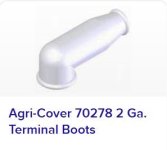
there are better ways....
 

Attachments

  • boot.jpg
    boot.jpg
    9.8 KB · Views: 12
Two things you DO NOT want to use are "Fuel Lube" and "Permatex #2" for ANYTHING. Trust me on this.

The Loctite products that have been recommended are certainly good options. However, Permatex Aviation #2 has been a go-to choice for a long time and proven to be a good product if used in appropriate circumstances. Any product can be misused and result in bad outcomes, it is imperative the builder be informed as to how to match product with application.
 
Lots of good advice here! The 2 types that Walt suggests will cover you for 99% of your needs. I went through the KAI and engine MFG (Rotax in my case) TM's to extract a list of ALL the thread locks and sealants they specified, then I bought "one of everything" on the list. Turns out I've used only the two Walt mentioned. All the others have sat on my shelves and expired. Two things you DO NOT want to use are "Fuel Lube" and "Permatex #2" for ANYTHING. Trust me on this. Refer to many other threads on these topics if you wish.
All the best on your build!
Dave
Just wondering if you include Krytox in the never use category?
 
After reading more of this thread, seems there are better products than aviation forma gasket#2.

There are newer products. I've not bought a tube of #2 in decades, but I'm still working through a bottle of #3. Like Sam, it's long been my go-to for NPT threads, and it appears it will outlast me.

Not knocking 567. Yeah, I have some of that too. ("Hello everyone, my name is Dan, and I'm a junkie")

I am just fearful a loose washer would cause a short from battery positive to ground. Tell me i am over thinking this.

You're over-thinking this.

Two things you DO NOT want to use are "Fuel Lube" and "Permatex #2" for ANYTHING.

Lucifer laughs with every sale of EZ Turn.

Just wondering if you include Krytox in the never use category?

BillL recommended Krytox some years ago for fuel cap o-rings. Best stuff ever. Tiny little tube, and expensive, so even us rednecks automatically know to use it sparingly.

Break.

If I may, an old note: https://www.vansairforce.net/threads/tip-npt-thread-sealant.130852/#post-1023623
 
OK, thank you everybody. When I wrote the first post, I had very little understanding of the fact that 567 is for pipes while the rest are primarily for screws. I also had not correlated the fact that, for example, 242 is the same as Blue Loctite. I made the following summary for myself and thought I would post it.

My only remaining question: I saw 515/518 mentioned to "seal aluminum flanges" -- when and where would I want to do that? So far I have only been using fuel tank sealant on trailing edges and in a few places under the fuselage to try to keep engine oil out of the cabin.

Type
Use
567non-flared NPT pipe threads (not tapered, banjo)
648Screws/parts -- assume it is non-removable
Red (262, 268, 271, 272)Screws/parts -- requires heat/chemicals to remove
Blue (242, 243, 248)Screws/parts -- high torque to remove (min 1/4" diameter)
Purple (222)Screws/parts -- low torque to remove
 
Actually, I found a great use for EZ-Turn. My old 4x4 always had a drip from the oil filter. I could never get it tight enough to stop. A few oil changes back, I applied a EZ-Turn to the gasket. No more leaky!

Another home use
Our plumber was having a horrible time installing a gasket on a heating system pump. Non potable water. I applied a thin coat either side. The gasket stayed in place. No more falling gasket.

No use on the airplane.
 
OK, thank you everybody. When I wrote the first post, I had very little understanding of the fact that 567 is for pipes while the rest are primarily for screws. I also had not correlated the fact that, for example, 242 is the same as Blue Loctite. I made the following summary for myself and thought I would post it.

My only remaining question: I saw 515/518 mentioned to "seal aluminum flanges" -- when and where would I want to do that? So far I have only been using fuel tank sealant on trailing edges and in a few places under the fuselage to try to keep engine oil out of the cabin.

Type
Use
567non-flared NPT pipe threads (not tapered, banjo)
648Screws/parts -- assume it is non-removable
Red (262, 268, 271, 272)Screws/parts -- requires heat/chemicals to remove
Blue (242, 243, 248)Screws/parts -- high torque to remove (min 1/4" diameter)
Purple (222)Screws/parts -- low torque to remove

One nit: NPT threads are all tapered and use sealant. AN fittings are 37° flared fittings and are assembled dry. Banjo are a separate type as well and use copper gaskets. All three have different installation procedures. Sealant (567) is only used on NPT fittings.

515/518 is used for sealing machined surfaces to keep oil in. Engine cases and the like. Doubtful you'll need any.
 
I was chasing a fuel leak on an RV-12 today and discovered a regular Carnival of Curiosities. Ended up taking it all apart to start over.

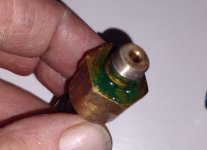
Anyone recognize this green stuff? I'm guess wicking Loctite, but for tapered threads on a sensor?

Green Stuff.jpg

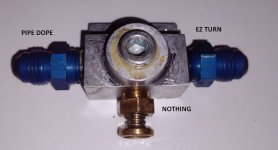
Love this one. Someone just couldn't decide...

Triple Play.jpg

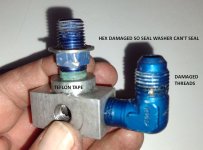
Oh wait, there's more. Different fitting. Yep, that's teflon tape. And it was tightened with a badly adjusted Cresent wrench, so the rounded and deformed hex ensured the seal washer couldn't seat. EZ Turn on the NPT threads of the elbow. Cross threaded the flare nut, which ate the threads on the elbow, so they took it back off and smeared EZ turn on the flare too.

Teflon Tape.jpg

Don't be that guy.
 
Lucifer laughs with every sale of EZ Turn.

Unfortunately I did not do a deep forum dive on EZ Turn before replacing a leaking fuel tank drain (CAV-110), and installed the replacement using EZ-Turn on the threads.

I did not drain the fuel tank and just did a very quick swap letting some avgas soak the arm. It's been 6 months and there is no leak so far.

The original drain had 567 and somehow it started to dissolve and stain the wing behind the drain (could be from the residual 567 that was left on the exposed threads)

I wonder what is the best way to reclaim the soul from the devil, or should I just let the EZ Turn stay in place for now? It is my understanding (I could be wrong) that 567 has to be applied on dry threads so I would have to drain the fuel tank.
 
Unfortunately I did not do a deep forum dive on EZ Turn before replacing a leaking fuel tank drain (CAV-110), and installed the replacement using EZ-Turn on the threads.

I did not drain the fuel tank and just did a very quick swap letting some avgas soak the arm. It's been 6 months and there is no leak so far.

The original drain had 567 and somehow it started to dissolve and stain the wing behind the drain (could be from the residual 567 that was left on the exposed threads)

I wonder what is the best way to reclaim the soul from the devil, or should I just let the EZ Turn stay in place for now? It is my understanding (I could be wrong) that 567 has to be applied on dry threads so I would have to drain the fuel tank.
During phase 1, I swapped sumps several times due to tiny aluminum particles caught in the ring, making them drip.

I had extra sump available, and the threads were dry when the 567 was applied. I swapped the sumps with full tanks, as you did. I have never had so much as a drip from the threads since the last swap. Going on 5 years, now. Maybe there is something to applying the 567 to dry threads...
 
It seems 567 can get rinsed out by fuel before it cures when swapping with full tanks. I'm probably overthinking it..
 
I was chasing a fuel leak on an RV-12 today and discovered a regular Carnival of Curiosities. Ended up taking it all apart to start over.

Anyone recognize this green stuff? I'm guess wicking Loctite, but for tapered threads on a sensor?

View attachment 79622

Love this one. Someone just couldn't decide...

View attachment 79623

Oh wait, there's more. Different fitting. Yep, that's teflon tape. And it was tightened with a badly adjusted Cresent wrench, so the rounded and deformed hex ensured the seal washer couldn't seat. EZ Turn on the NPT threads of the elbow. Cross threaded the flare nut, which ate the threads on the elbow, so they took it back off and smeared EZ turn on the flare too.

View attachment 79624

Don't be that guy.

Eeeewwwww. Those are just downright ugly!
 
567 for the (rarely used) stainless NPT fittings, 565 for steel or aluminum NPT fittings. Keep in mind this *warning* on using aluminum to aluminum fittings.

Did I miss the part in the provided thread about 567?
I have used both 565 and 567 but I think 567 provides a slightly better lubrication so I have changed to 567 on both Aluminum and steel fittings.
 
It seems 567 can get rinsed out by fuel before it cures when swapping with full tanks. I'm probably overthinking it..
Don't know about that; I had probably swapped them four times with full tanks, never even a drip. The current ones have been installed for going on five years, not a single drip. They were also installed with full tanks. Note that in all cases, the 567 was applied to dry threads...
 
Don't know about that; I had probably swapped them four times with full tanks, never even a drip. The current ones have been installed for going on five years, not a single drip. They were also installed with full tanks. Note that in all cases, the 567 was applied to dry threads...
In fact I was working on some of the fuel fittings and filter cleaning today and tried to remove the old 567 with fuel damped towel, it is removable but I would not call it rinsed. It gets cleaned/removed somewhat but far short of rinsed. What I especially like about 567 as opposed to permatex is that it will remain semi soft and does not harden.
 
I wonder what is the best way to reclaim the soul from the devil, or should I just let the EZ Turn stay in place for now?

Actually, that's a reasonable application for EZ turn. Hard to rinse it off while re-inserting the drain fitting.

That feature is also the problem. In theory, EZ-Turn doesn't dissolve in fuel, so any excess which might escape into the fuel system has the potential to clog something.

Of course there is also the joy of finding the tube smashed in a tool box drawer, and absolutely everything in there being sticky, forever :)
 
Lots of good advice here! The 2 types that Walt suggests will cover you for 99% of your needs. I went through the KAI and engine MFG (Rotax in my case) TM's to extract a list of ALL the thread locks and sealants they specified, then I bought "one of everything" on the list. Turns out I've used only the two Walt mentioned. All the others have sat on my shelves and expired. Two things you DO NOT want to use are "Fuel Lube" and "Permatex #2" for ANYTHING. Trust me on this. Refer to many other threads on these topics if you wish.
All the best on your build!
Dave
What's wrong with Permatex#2? Van's identifies Permatex#2 in Section 5 as one of the products acceptable for sealing NPT joints.
 
I use #2 for permant instalations like brakeand oil fittings. The only trouble with it is it is hard to clean off fittings that are being redone, so the ptfe based stuff is better if you think the fittings might come apart. jMHO
 
I use #2 for permant instalations like brakeand oil fittings. The only trouble with it is it is hard to clean off fittings that are being redone, so the ptfe based stuff is better if you think the fittings might come apart. jMHO
I used #2 on my master cylinder brake line fittings, which were brand new...two weeks after bleeding the brakes, 6 out of 8 fittings began to leak...

Took it all apart and used 567; no more leaks in almost 5 years.
 
I used #2 on my master cylinder brake line fittings, which were brand new...two weeks after bleeding the brakes, 6 out of 8 fittings began to leak...

Took it all apart and used 567; no more leaks in almost 5 years.

Few questions for future maintenance considerations:

- Did you use new AN fittings in place? or,
- Did you reuse the same AN fittings, just cleaned/different sealant?
- Did you track if they were clocked/turned in the same # of times?

I've generally been using 567, but have a tube of #2 I was going to switch to, just because I have it.
 
Few questions for future maintenance considerations:

- Did you use new AN fittings in place? or,
- Did you reuse the same AN fittings, just cleaned/different sealant?
- Did you track if they were clocked/turned in the same # of times?

I've generally been using 567, but have a tube of #2 I was going to switch to, just because I have it.
They were brand new fittings, brand new master cylinders, and clocked exactly one time. After that fiasco, I switched to 567 and have not had a leak on any fitting in almost 5 years.
 
Back
Top