Van's Air Force

The definitive Van's Aircraft support community! Buying, building or flying an RV? Join our exclusive family of mentors and enthusiasts!

BRS Chute Installation for RV10

BRS RV10 Update

Received the chute and rocket today so now have the complete kit. Here are the published numbers on the documents:

System Weight: 51 pounds
Repack/rebuild time for chute and rocket: 10 years
Aircraft Gross weight: 2,866 LB
Deployment Speeds: 163.3 kt TAS
Model: RV10SI-09

I'll post pictures of the kit in the next few days.

Bruce
 
A sample size of one data point is included here for your consideration.

While the Glasair Sportsman and RV10 are obviously different aircraft, one Sportsman owner had the WARP retrofitted to his aircraft. He reports no change in speeds, and just a touch over 50lbs reduction in useful load. In that particular aircraft the larger impact is the aftward shift in empty C of G, thus potentially having a greater limiting factor on cargo carrying capacity as the aircraft may run out of C of G range before it runs out of useful load.
 
A sample size of one data point is included here for your consideration.

While the Glasair Sportsman and RV10 are obviously different aircraft, one Sportsman owner had the WARP retrofitted to his aircraft. He reports no change in speeds, and just a touch over 50lbs reduction in useful load. In that particular aircraft the larger impact is the aftward shift in empty C of G, thus potentially having a greater limiting factor on cargo carrying capacity as the aircraft may run out of C of G range before it runs out of useful load.

I'm thinking this could be countered mostly by going to Lithium batteries and locating it on the firewall. Other builders have commented in that past that such a move required 20~30lbs of ballast in the baggage area when flying solo, so this may not be as dramatic of a change on CG on the RV-10 with appropriate reshuffling of components.
 
batteries

You may want to research how much room there is on the -10 firewall for batteries...it is pretty tight, especially if you have the stock oil filter and a standby alternator...
 
Pricing and Release Date

Just received an email from BRS:

They are publicly launching the parachute system on Feb 15, 2019. Early bird launch price (for the first 50 units) of $25,990. First come, first served. You can place orders now.

Weight: 82lbs
Dimensions: 20.6" x 19.8" x 18.3"
 
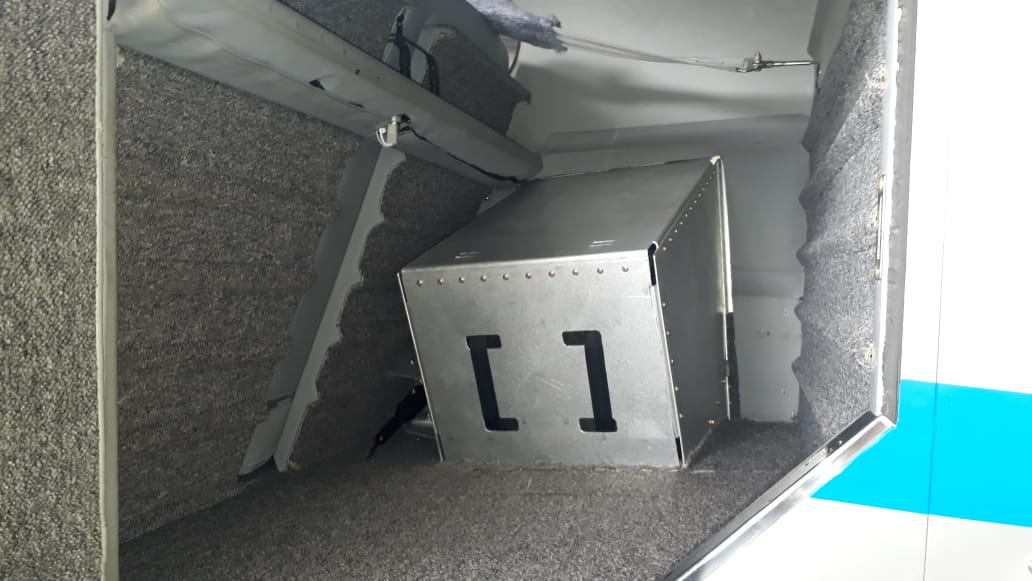
I sent an email to BRS to ask for more pictures and some more details on their installation, especially what kind of CG impact they found mounting it behind the bulkhead to see if that's something that I could do. Looking at the email they sent out now, it looks like it takes up slightly more than half of the baggage compartment, and weighs 82lbs, which basically renders the baggage compartment useless.

I want a parachute, but this is a bit too much of a tradeoff.
 
They replied surprisingly fast.

Here's a photo they sent of the installation. They claim it's 1/3 of the cubic footage, 1/2 of the floor space.
pgnKspP.jpg


Went back with more questions about CG impact, weight etc.
 
I promised an update and never delivered.

BRS did get back to me very quick on my request.

BRS is using 83.53 lbs and 169.38" to calculate W&B for retrofit aircraft. Obviously, on new builds, you would just weigh the aircraft. BRS said via email that the structure has additional support and/or bypasses baggage area structure, so you are only limited by CG on how much weight in the baggage area.

I'll let y'all make up your own mind on whether this works for you or not.
 
Last edited:
Does anyone know why the system is so expensive? Seems to be about 10k more than the 172/182 kits. I don?t know if I can justify it for that price.
 
2,000 RV kits sold

Hello, There have been 2,000 RV-10 kits sold and I have read that Vans says the RV-10 continues to be one of the best sellers in recent years.
 
Numbers

According to Van?s, there are currently 919 flying -10s. Still pales incomparison to the number of 172/182 aircraft out there...
 
Up to date statistics

Hi guys
Anyone has some statistics on how many actually installed?
Do you believe they might reconsider the price?

Oren
 
Any update from those who have already purchased?

Any updates from those that have purchased the kit? Pictures of the installation and the general kit would be appreciated! Also what are your thoughts on W/B? having a chute back there beats the heck out of water ballast when flying solo!
 
The additional installation and metal work on the fuselage is not very eye pleasing in these pictures

https://brsaerospace.com/rv-10/

Has any one explore the option of running the BRS straps through the top surface of the canopy so that it can be well hidden under a light layer of fiberglass without affecting the aircraft contour/structure?
 
Unless it is tested in flight, there is simply know if this thing will work.

If it doesn't work and becomes a "streamer", you would have been better off gliding to a landing, even a crash landing.

I appreciate all of your concern but you might be better off putting that money into maintenance and additional training, if safety is your top priority.
 
Could it be that there have only been about 800 RV-10 kits sold versus the THOUSANDS of Cessnas?
That would only matter if they were making BRS kits for every Cessna. I doubt the sales rate for retrofitting 172's is as high as the installation rate in new-build RV-10's.
 
Install rate

I would be curious as to the install rate in new RV-10s.

I am not interested in installing one in mine as giving up half the baggage area and 80+ pounds of payload is not appealing...

I am also curious as to the data on structural or flight control failure pertaining to the RV-10, as those would be valid reasons to have the chute...
 
Has anyone used a chute other than BRS? There are at least two other options:

Magnum Ballistic Parachutes This is who TAF uses in their Sling line of airplanes.

Galaxy Recovery Systems This is who Pipistrel uses in their airplanes.

I found one guy who posted here that he was putting a Magnum chute in his RV-10. I have PM'd and emailed him, but no reply. (Appears he hasn't been active on VAF in years.)

These other options appear to be lighter and less-expensive than BRS's offering (both in terms of purchase and repack), and are trusted by numerous manufacturers.

Would love to hear from anyone who have used any non-BRS chute on a Vans plane, especially an RV-10.
 
Last edited:
I know this is an old thread but I am currently looking in to other than BRS options to put on my RV10. I am sure that BRS is a great product BUT how to justify such a high price for RV10 ?

Anyway I am looking in to one Russian made system (MVEN) which has been successfully installed in to RV10 by person I know and also in to Galaxy GRS systems which looks very attractive and interesting to me. Important to note that these two above utilize different principle of ejecting the chute and for the first one some additional structural work is required.

After research it turns out that except Russian MVEN there are no other than BRS flying installs of chutes on RV10 available.
As someone said here until it is tested you never know if it will work on particular RV10 design so there are no enough information at this point to conclude.
 
Cirrus vs RV-10

I know this is an old thread but I am currently looking in to other than BRS options to put on my RV10. I am sure that BRS is a great product BUT how to justify such a high price for RV10 ?

Anyway I am looking in to one Russian made system (MVEN) which has been successfully installed in to RV10 by person I know and also in to Galaxy GRS systems which looks very attractive and interesting to me. Important to note that these two above utilize different principle of ejecting the chute and for the first one some additional structural work is required.

After research it turns out that except Russian MVEN there are no other than BRS flying installs of chutes on RV10 available.
As someone said here until it is tested you never know if it will work on particular RV10 design so there are no enough information at this point to conclude.

Cirrus...over 100 emergency pulls. RV-10 - 0...and no structural failures.

Rest my case,
 
I don't see any updates in the past four years. Does anyone have suggestions on installing a BRS system in a new build RV10? The company website is not helpful or updated, no response via email or phone.

Marty

RV10 current Build 2024
 
I don't see any updates in the past four years. Does anyone have suggestions on installing a BRS system in a new build RV10? The company website is not helpful or updated, no response via email or phone.

Marty

RV10 current Build 2024
What information do you need? Copy of the installation manual? Send me list of your questions and I'll get answers for you. I'm still in touch with the design team in Brazil.

Bruce
 
I have an RV10 with the BRS system installed. I'm very happy with the product and installation. This is my 4th airplane with a parachute. My wife and I feel vey strongly that it is a good option There is a weight penalty but we understood that and also have an AC system as well. We're currently on a cross country trip from Tulsa to Niagara Falls and then upstate New York and both systems have kept us comfortable and happy.
Working with BRS was not an issue, no complaints.
 
I have an RV10 with the BRS system installed. I'm very happy with the product and installation. This is my 4th airplane with a parachute. My wife and I feel vey strongly that it is a good option There is a weight penalty but we understood that and also have an AC system as well. We're currently on a cross country trip from Tulsa to Niagara Falls and then upstate New York and both systems have kept us comfortable and happy.
Working with BRS was not an issue, no complaints.
What is your W&B like? I’m thinking of putting one in my build. Is aft c of g an issue? Do you ever fly with 4 people?
 
What is your W&B like? I’m thinking of putting one in my build. Is aft c of g an issue? Do you ever fly with 4 people?
You could play around with some sample W&B calculations. It would be like carrying 80 pounds in the baggage area all the time.

That said, realize that everything you load in the -10 moves the cg aft. If you start out with a light engine and light prop, you will likely get to the aft cg limit before you reach max gross weight, reducing the payload capability of the aircraft. The chute, in this case, makes the problem worse as there are limited ways to move the cg forward.

If you choose a heavier engine and prop, you will likely reach the gross weight before the aft cg. The consequence here is you will probably want to carry some ballast when solo to shift the cg into a more comfortable range. Having the chute, in this case would help balance the heavier engine and prop.

Using a simple spread sheet, you could treat the chute weight as baggage and see what different scenarios look like.
 
We went with a 2 blade prop (heavier) and moved the batteries to the firewall. We considered spacers on the engine mount or prop hub but ended up not needing that. The plane is heavy due to the parachute and A/C. I can carry 4 but not big people and minimal bags.
I know that max gross weight is set by the builder but I'm not much of a test pilot so I'm on the cautious side.
 
Curious

I have always been curious as to the reasoning behind the chute. Not to start a primer war but here is a discussion question:

What would be a valid reason to pop the chute?

I'm curious to see what people would consider dire enough to use it...
I use to have a Cirrus and now have a RV10. The training by Cirrus is really well done. There are specific parameters as to when the chute can be deployed and its amazing how low you can be and still utilize it. I can tell you that I felt more comfortable flying the Cirrus in the mountains, at night, or low IFR. There are so many things that can happen that will force an off airport landing. I blew an oil cooler and landed with 3 quarts of oil just a couple of months ago. I got lucky and made it to an airport which is close to a national forest where there aren’t to many landing options. The chute has saved a lot of lives.
 
I use to have a Cirrus and now have a RV10. The training by Cirrus is really well done. There are specific parameters as to when the chute can be deployed and its amazing how low you can be and still utilize it. I can tell you that I felt more comfortable flying the Cirrus in the mountains, at night, or low IFR. There are so many things that can happen that will force an off airport landing. I blew an oil cooler and landed with 3 quarts of oil just a couple of months ago. I got lucky and made it to an airport which is close to a national forest where there aren’t to many landing options. The chute has saved a lot of lives.
While it may be true that there have been saves, it amounts to propaganda as there is no data concerning the same issues successfully dealt with without the chute.

If it makes you feel better, then install it.
 
While it may be true that there have been saves, it amounts to propaganda as there is no data concerning the same issues successfully dealt with without the chute.

If it makes you feel better, then install it.
Nope not interested in installing it. I just have higher personal limits now. The question I was answering was “the reason behind the chute”.
 
What information do you need? Copy of the installation manual? Send me list of your questions and I'll get answers for you. I'm still in touch with the design team in Brazil.

Bruce
Hi Bruce,

I’m glad to hear that you’re still in touch with the design team in Brazil. I’ve sent a few emails to BRS on a RV-7A install but no response. I found a Kit Plane article install for RV-9A from 2018 and would like to see if they still offer this solution.


If there’s any official data or guidance specific to the RV-7A, (i.e. do they still offer the solution) that you can ask that would be great to see!

Thx in advance,
~Brian
 
Curious

I have always been curious as to the reasoning behind the chute. Not to start a primer war but here is a discussion question:

What would be a valid reason to pop the chute?

I'm curious to see what people would consider dire enough to use it...
I came from a SR-22 to my RV-6A 10 years ago. The Cirrus was just too expensive for me to operate and maintain. The only thing I miss about the Cirrus is the chute. It is a poor man's autoland. I haven't tracked the statistics since I sold mine, but as of then every time the chute had been deployed within operating parameters everyone survived the landing, including a nationally-publicized event when a MD hangared next door to my Cirrus pulled his over the Caribbean due to an engine failure following maintenance. His daughter was on board. The same can't be said for every forced landing in a RV or any other aircraft that I know of, including the Cirrus. I also had a Cirrus acquaintance named Manfred, who suffered an engine failure flying solo VFR on a beautiful day and didn't pull the chute. He died landing the plane under control in a field. He left behind a wife and teenage daughter. I am certain if he had been carrying a passenger on board he would have pulled and still be alive today. You have to train for chute pulls so it is automatic. Personally I had decided at the outset that the minute that engine failed or I lost control of the airplane, I was making decisions about the insurance company's airplane, not mine. That's how the insurers wanted you to think about it. If the chute was available, I would sell the 6A and buy or build a RV-10 with one in a heartbeat.
 
I came from a SR-22 to my RV-6A 10 years ago. The Cirrus was just too expensive for me to operate and maintain. The only thing I miss about the Cirrus is the chute. It is a poor man's autoland. I haven't tracked the statistics since I sold mine, but as of then every time the chute had been deployed within operating parameters everyone survived the landing, including a nationally-publicized event when a MD hangared next door to my Cirrus pulled his over the Caribbean due to an engine failure following maintenance. His daughter was on board. The same can't be said for every forced landing in a RV or any other aircraft that I know of, including the Cirrus. I also had a Cirrus acquaintance named Manfred, who suffered an engine failure flying solo VFR on a beautiful day and didn't pull the chute. He died landing the plane under control in a field. He left behind a wife and teenage daughter. I am certain if he had been carrying a passenger on board he would have pulled and still be alive today. You have to train for chute pulls so it is automatic. Personally I had decided at the outset that the minute that engine failed or I lost control of the airplane, I was making decisions about the insurance company's airplane, not mine. That's how the insurers wanted you to think about it. If the chute was available, I would sell the 6A and buy or build a RV-10 with one in a heartbeat.
As has been discussed numerous times before, the data you reference in “saves” is about as skewed as it gets. You have no data concerning successful emergency landings without the chute…

That said, it remains a personal preference whether to install one or not. If you want one, install it.
 
  • Like
Reactions: Mel
As has been discussed numerous times before, the data you reference in “saves” is about as skewed as it gets. You have no data concerning successful emergency landings without the chute…

That said, it remains a personal preference whether to install one or not. If you want one, install it.
He provided two "data" points. One incident where not having the chute likely would have ended badly (water landing with the gear down usually doesn't end well). The other incident likely would have been better if the chute was used. Granted its only 2 but I wouldn't call them skewed.

Airplanes are compromises. Some will trade useful load for fancy paint, luxury interiors, ac's, etc. Others will trade it for additional safety tools like triple screen, triple redundant, avionics and electrical systems, or parachutes. I don't understand why people in the first group feel they need to argue against the second.
 
Hi Bruce,

I’m glad to hear that you’re still in touch with the design team in Brazil. I’ve sent a few emails to BRS on a RV-7A install but no response. I found a Kit Plane article install for RV-9A from 2018 and would like to see if they still offer this solution.


If there’s any official data or guidance specific to the RV-7A, (i.e. do they still offer the solution) that you can ask that would be great to see!

Thx in advance,
~Brian
Brian,
I'd start here. He should be able to point you in the right direction if he doesn't handle the 7A.
André Carvalho Cateb
Project Manager
TEL/FAX: +55 (31) 3491-1853
CEL: +55 (31) 991-826-785
SKYPE: jazz.aero
www.jazzaero.com.br
 
He provided two "data" points. One incident where not having the chute likely would have ended badly (water landing with the gear down usually doesn't end well). The other incident likely would have been better if the chute was used. Granted its only 2 but I wouldn't call them skewed.

Airplanes are compromises. Some will trade useful load for fancy paint, luxury interiors, ac's, etc. Others will trade it for additional safety tools like triple screen, triple redundant, avionics and electrical systems, or parachutes. I don't understand why people in the first group feel they need to argue against the second.
Not to get into the meat of the old thread but the problem is the data in successful outcomes without a chute are really not documented, which is the reason it is skewed. BRS can and will tell you all about every save...which is great. The issue is that they don't tell you how many emergency landing were completed successfully without the chute, thus the skewed data.

Again, it is a personal preference on whether to install one; if you want one, by all means install it. Just remember that it is NOT a silver bullet for everything.
 
As has been discussed numerous times before, the data you reference in “saves” is about as skewed as it gets. You have no data concerning successful emergency landings without the chute…
Trying to avoid drifting toward "never ending debate", I would say that perhaps the BRS/WARPS decision is part of the "aircraft mission" combined with personal risk tolerance against select threats. Please let me know if I am missing something, but considering the all shapes and sizes of stuff that the miltary can air-drop out of the back of their transports, I am not sure what "data" is needed to determine if a parchute is helpful if doing a forced landing in the forest or mountains. Many failure modes can have multiple courses of action and I agree the 'chute may not be the best option in all circumstances, but I suggest there can be occasional circumstances when it may just be your best bet.
 
Trying to avoid drifting toward "never ending debate", I would say that perhaps the BRS/WARPS decision is part of the "aircraft mission" combined with personal risk tolerance against select threats. Please let me know if I am missing something, but considering the all shapes and sizes of stuff that the miltary can air-drop out of the back of their transports, I am not sure what "data" is needed to determine if a parchute is helpful if doing a forced landing in the forest or mountains. Many failure modes can have multiple courses of action and I agree the 'chute may not be the best option in all circumstances, but I suggest there can be occasional circumstances when it may just be your best bet.
I won't argue that there are a few specific reasons to have the chute, namely inhospitable terrain like mountains. Forest is a gray area in most of the US, imo. I fly the entire CONUS for work; there are few places where an emergency site is not available from a reasonable cruise altitude. This obviously doesn't include an engine failure right after takeoff, and that is a completely different discussion. Also, if you are limiting yourself to flying over high density city dwellings, I would call that a valid reason.

You are correct, though, it IS mission driven.

Besides inhospitable terrain, what other reasons would you deploy the chute? Not flame bait, just curious. In our aircraft, engine failure is a possibility but thankfully infrequent (from altitude). I would not consider this emergency a reason to deploy in the area where I fly, mostly east of the rockies. The desert areas west of the rockies, either. Structural failure I suppose would be a reason but how many RVs have suffered structural failure (that wasn't pilot induced)? The other biggie is flying VMC into IMC. I would argue that this scenario should be preventable but it happens. That is where even a rudimentary autopilot is priceless.

The other thing that needs to be remembered is that you need altitude to deploy that chute successfully. For your own knowledge, it is reasonably easy to come up with a minimum altitude that a successful deployment will happen...and, in reality, is may be higher (potential much higher) than what BRS would state.

So what other situations would you deploy? Genuinely interested. I have had this same discussion with instructors that I have mentored that train in the Cirrus...it makes for an interesting conversation.
 
So what other situations would you deploy? Genuinely interested. I have had this same discussion with instructors that I have mentored that train in the Cirrus...it makes for an interesting conversation.
What is the ratio of successful forced landings vs fatalities in un successful attempts. I don't know but it sure seems like plenty of pilots die when the plane becomes a glider. Even in good wx and reasonably good terrain under them.

Much smaller data set, but it sure seems like the survival rate from chute pulls (weather tied to the plane or to the pilots back) is better.
 
So what other situations would you deploy? Genuinely interested. I have had this same discussion with instructors that I have mentored that train in the Cirrus...it makes for an interesting conversation.
Well you would probably know better than me, but my understanding is that probability of survival is logrithmically better with both low speed and also with low impact angle. Any time both can't be assured in my opinion would present a strong case to at least consider the 'chute handle. Whether the issue is preventable/likely doesn't mean it's not possible and this is where the risk tolerance bit comes in IMO. I don't think the decision is clear-cut, but perhaps rather, which is less bad. Loss of SA in IMC, Loss of engine low IMC or inhospitable terrain, flight control jam/failure, flutter/important part of airplane breaks off, etc are what first comes to mind when I would at least consider the 'chute. Each situation would be different of course...

The other thing that needs to be remembered is that you need altitude to deploy that chute successfully. For your own knowledge, it is reasonably easy to come up with a minimum altitude that a successful deployment will happen...and, in reality, is may be higher (potential much higher) than what BRS would state.
If you can easily calculate the deployment envelope more accurately, that would be great! (I know this is in the RV-10 section), but it would be awesome if you can PM with what you think for an 1800lb GW RV that I'm building. (y)
 
I can see the appeal of a chute in certain situations. But considering my mission profile and the odds of needing a chute in order to walk away from the smoking hole in the ground is a really small number --- certainly smaller than what a Challenger/S15 filter can catch (....see what I did there? ;) )

Having built a few of these things and repaired others, I fall into the camp of "save the airplane in order to save yourself." "Fly to the scene of the crash." (Remain a pilot and not a passenger for as long as possible, etc.).

Pulling the chute doesn't guarantee survival, let's just agree on that. Knowing when/how/where to use it is another data point that needs to be factored into all the other decisions in a crises -- choose wrongly and you (and your airplane) could end up as a tightly wrapped nylon burrito on the bottom of a lake somewhere.

Just my $.02
 
What is the ratio of successful forced landings vs fatalities in un successful attempts. I don't know but it sure seems like plenty of pilots die when the plane becomes a glider. Even in good wx and reasonably good terrain under them.

Much smaller data set, but it sure seems like the survival rate from chute pulls (weather tied to the plane or to the pilots back) is better.
We are not talking about a personal parachute.

Again, you are using an incomplete data set for your conclusion. BRS ONLY talks about the saves, and the successful outcome of every other emergency landing is not available. You cannot make a valid conclusion without both sides of the story...though there are some that will try...
 
Well you would probably know better than me, but my understanding is that probability of survival is logrithmically better with both low speed and also with low impact angle. Any time both can't be assured in my opinion would present a strong case to at least consider the 'chute handle. Whether the issue is preventable/likely doesn't mean it's not possible and this is where the risk tolerance bit comes in IMO. I don't think the decision is clear-cut, but perhaps rather, which is less bad. Loss of SA in IMC, Loss of engine low IMC or inhospitable terrain, flight control jam/failure, flutter/important part of airplane breaks off, etc are what first comes to mind when I would at least consider the 'chute. Each situation would be different of course...


If you can easily calculate the deployment envelope more accurately, that would be great! (I know this is in the RV-10 section), but it would be awesome if you can PM with what you think for an 1800lb GW RV that I'm building. (y)
To your first point, what is the ratio of chute equipped aircraft to all others? Something to think about. Several of your reasons to deploy were mentioned. In RVs, how many flight control jam or failures have there been, where a chute would deploy successfully? How many flutter events or "important parts break off" events have there been in RVs?

I am certainly NOT saying that a chute is necessarily a bad idea but the failures you are citing are very rare, if even existent, in the RV community.

As far as the deployment altitude, pick a failure, let's say complete engine failure. You will have a rate of descent, call it around 1000 fpm. How long will it take you to troubleshoot the problem, AFTER the startle factor. Don't use the "3 second" startle factor; after observing EAA's simulator scenario, it isn't realistic, and the time is usually much longer. How much time are you burning in making the decision to deploy, realizing you are descending the whole time? Now that you have made the decision to deploy and pull the handle, physics take over. BRS has the numbers for the time it takes for the rocket to fire and pull the chute. Then there is the required time for the chute to actually open and hopefully stabilize the descent rate. BRS also has the numbers for the stabilized rate of descent. If you research it, you may find that it is actually more than you would think. So, add up all the times and, using your initial descent rate, calculate the altitude that you have lost in that time. You will then have an idea of the minimum successful deployment altitude. I can guarantee you that it will be higher than what a test pilot, knowing that it is going to happen, with the decision to deploy already made, will post.

This is also one of the best cases; do the same analysis with your example of losing SA in IMC. What do you think the descent rate will be in a steep spiral? Guarantee it will be more than 1000 fpm!

These are just some things to consider. Again, NOT saying to disregard the chute if it makes you more comfortable...

Like I said, this topic always generates some very interesting conversations but I think, more importantly, it causes people to think more about it.

 
Back
Top