Van's Air Force

The definitive Van's Aircraft support community! Buying, building or flying an RV? Join our exclusive family of mentors and enthusiasts!

considering EarthX battery, thoughts?

seagull

Well Known Member
I am thinking of replacing my PC680 with the EarthX, a few questions.
Has anyone that has done this have any regrets?
Is there a filler piece made or 3D print part so I can use the standard PC680 battery box?
Is it possible to hook up the panel light warning to the Dynon Skyview instead of having the panel light.
Thanks.
 
The The Van's Store page for the PC-680 battery specifically states that they don't approve swapping between the two, due to W&B concerns. EarthX does sell the ETX680C, which is the same capacity with a package that is smaller in height (but about ½" wider). If you wanted to have the advantages of LFP without concerns of messing up your W&B, you could throw a hunk of steel/lead beneath the battery to bring it back up to the same weight, as long as you can make it fit.

If you have enough GPIO inputs left on your Skyview then yes, you can connect it and have it indicate. EarthX's site has the connection guide for both Dynon and Garmin EFISes in their manual.
 
I did and I sure don't regret it.. It fit right into the existing battery box. The only thing that needed modification was the hold down bar.
 
I have bought three for three of my planes I have owned. Never been disappointed in that decision.
 
I am thinking of replacing my PC680 with the EarthX, a few questions.
Has anyone that has done this have any regrets?
Is there a filler piece made or 3D print part so I can use the standard PC680 battery box?
Is it possible to hook up the panel light warning to the Dynon Skyview instead of having the panel light.
Thanks.
The reduction in battery weight of the EarthX is one of the biggest advantages. Not sure why you would consider it a disadvantage. I had an RV8 with the battery in the rear. I started using the PC680 and found it to be inadequate in cold starts. I switched to a Concord battery, and had to deal with an increased rearward CG with NO increase in cranking performance. Do a weight and balance for your plane with the EarthX and I'm certain you will still be within proper limits. I did not have to do any extensive modifications on my battery platform, only a minor change to the hold down clamp. For me, the EarthX was head and shoulders above all the rest ! AND, unlike the others I had installed, it lasted far longer. Trust me........ you WILL NOT regret installing one.
 
The Earthx is heat sensitive however. At ? 105 f it shuts down. I sold an rv-9a with an earthx that worked great for me at altitude always, but the buyer in central california had it expand from heat (swell) at the sea level 100 degree days he was flying in all the time. He replaced it with a lead battery/odyssey.
Cal
 
The Earthx is heat sensitive however. At ? 105 f it shuts down. I sold an rv-9a with an earthx that worked great for me at altitude always, but the buyer in central california had it expand from heat (swell) at the sea level 100 degree days he was flying in all the time. He replaced it with a lead battery/odyssey.
Cal
Sorry, earthx says up to 140 degrees is tolerable. But is can be an issue in tightly cowled rv’s.
Cal
 
The Earthx is heat sensitive however. At ? 105 f it shuts down. I sold an rv-9a with an earthx that worked great for me at altitude always, but the buyer in central california had it expand from heat (swell) at the sea level 100 degree days he was flying in all the time. He replaced it with a lead battery/odyssey.
Cal
That hasn't been my experience. The spec sheet for the 680c that I have says the operating temp is -22 degrees F to +140 degrees F and storage temp is -40 to +158.

I put a black dot thermal sticker on it to see if I might want to add a heat shield around it and it sees temps somewhere around 150 after shutdown. It's less than a year old, but so far I have no indications that it isn't happy.

Edit- to answer the other part of the OP's question, they come with closed cell foam inserts to take upon any extra space in an oversize battery box.
 
My EarthX fit in the battery box where a PC680 was. The only issue that I had was that the wires run along the top of the battery. I bought the adapters and it all worked perfectly.

1737217663140.png
 
I got the Etx680, it fits perfectly into the stock battery box for the 2015 -12. The foam pieces will fit left & right to pad the sides. I am still working on a better bracket design to go over the top. The stock bracket will be right over the battery posts and even with the terminal adapters it is too close.
 
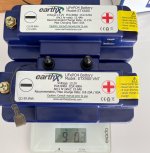
I have 2 EarthX batteries, 900VNT (vented) in the rear (modified battery box) and a 680 in front.
The 680 is in the insulated box sold by EarthX and has a cooling blast tube.
The blast tube is blocked winter time, (0°C or less)
Both batteries, just over 9 pounds total.
Love them, would repeat if built another RV.
 

Attachments

  • IMG_5511 (1).jpeg
    IMG_5511 (1).jpeg
    1.2 MB · Views: 45
Last edited:
I am thinking of replacing my PC680 with the EarthX, a few questions.
Has anyone that has done this have any regrets?
Is there a filler piece made or 3D print part so I can use the standard PC680 battery box?
Is it possible to hook up the panel light warning to the Dynon Skyview instead of having the panel light.
Thanks.
I am so done with lead batteries. I believe the FAA finally approved EarthX for certified planes (somebody will fact check)
 
The Earthx is heat sensitive however. At ? 105 f it shuts down. I sold an rv-9a with an earthx that worked great for me at altitude always, but the buyer in central california had it expand from heat (swell) at the sea level 100 degree days he was flying in all the time. He replaced it with a lead battery/odyssey.
Cal
Years ago (in the early days of EarthX), I helped a friend install two EarthX batteries "firewall forward" in his RV8. I added temperature probes to monitor the temperature. I seem to recall that the hottest noted temps were around 120F. He has had NO temperature problems. Here in SC, we also have 100F+ during the summer as well.

I am NOT saying that your friend's batteries didn't suffer from too much heat. I am just saying that we have several existence proofs of them work and much more than 105F as well and surviving. Maybe your friend's under cowl temp exceeded the 140F.
 
The reduction in battery weight of the EarthX is one of the biggest advantages. Not sure why you would consider it a disadvantage. I had an RV8 with the battery in the rear. I started using the PC680 and found it to be inadequate in cold starts. I switched to a Concord battery, and had to deal with an increased rearward CG with NO increase in cranking performance. Do a weight and balance for your plane with the EarthX and I'm certain you will still be within proper limits. I did not have to do any extensive modifications on my battery platform, only a minor change to the hold down clamp. For me, the EarthX was head and shoulders above all the rest ! AND, unlike the others I had installed, it lasted far longer. Trust me........ you WILL NOT regret installing one.
The higher voltage/current capability of the Ex will help to overcome high resistance in the starter circuit and an inefficient current hungry PM starter.
Personally I’m gonna stick with good old lead acid with long time history/reliability and maintain my starter circuit/electrical system.
An RV12 should not need an Ex to start, and their high current draw during charge may tax the charging system.
 
Last edited:
I'm curious about the "weight and balance reasons" that Van's is concerned about. By my math, in my legacy RV-12, there's simply no way to get past the 85.39" aft CG limit without severely overloading the baggage area... even with 10 lbs less at the front of the firewall it would still be tough without a very light pilot. Does that seem right, or are my numbers fishy?
 
I'm curious about the "weight and balance reasons" that Van's is concerned about. By my math, in my legacy RV-12, there's simply no way to get past the 85.39" aft CG limit without severely overloading the baggage area... even with 10 lbs less at the front of the firewall it would still be tough without a very light pilot. Does that seem right, or are my numbers fishy?
I did the same calculation and came up with the same result.
Add to the “fear” many -12’s are considering using those lightweight 3 blade props. The prop is a lot lighter than the 2 blade Sensenich and a lot further forward than the battery station but nobody is talking about a dangerous CG shift.
 
The Earthx is heat sensitive however. At ? 105 f it shuts down. I sold an rv-9a with an earthx that worked great for me at altitude always, but the buyer in central california had it expand from heat (swell) at the sea level 100 degree days he was flying in all the time. He replaced it with a lead battery/odyssey.
Cal
Wrong, read the specs. It's now in many certified aircraft. Upper operating limit 140 F, 30-minute limit 150 F. Install thermocouples to monitor, I did.
 
My 9A used to have PC680 which the builder replaced with a ETX680~2 years ago, with approx 150 hours on the EarthX so far. I have zero issues to report from the last 6 months of flying. The operating temp range is wider than the Odyssey (140F vs 113F max for the PC680). It does get hot up here in the summer. Other than the cost, LiFePO4 EarthX is superior in every way as far as I can tell, while the lead batteries are in the "good enough" category.
 
The operating temp range is wider than the Odyssey (140F vs 113F max for the PC680).
Are the failure modes from excess heat the same for both batteries? My only concern about moving to the EarthX is that I don’t really have a good idea about how it goes wrong, and whether it presents any increased risk vs the AGM.
 
The operating temp range is wider than the Odyssey (140F vs 113F max for the PC680). It does get hot up here in the summer. Other than the cost, LiFePO4 EarthX is superior in every way as far as I can tell, while the lead batteries are in the "good enough" category.
Temperature range for the PC680/ODS-AGM 16L with metal jacket is: -40°F to 176°F
(the Van's battery box has the same function as metal jacket model)
I think there is little doubt that after shut down on a hot summer day under cowl temps will exceed 140F limit on the Ex.
BMS shut down, don't want my battery disconnecting for any reason.

https://www.odysseybattery.com/wp-c...allation-operation-and-maintenance-manual.pdf

LifePO4 torture tests:
 
Last edited:
Temperature range for the PC680/ODS-AGM 16L with metal jacket is: -40°F to 176°F
(the Van's battery box has the same function as metal jacket model)
I think there is little doubt that after shut down on a hot summer day under cowl temps will exceed 140F limit on the Ex.
BMS shut down, don't want my battery disconnecting for any reason.

https://www.odysseybattery.com/wp-c...allation-operation-and-maintenance-manual.pdf
…and here we go again. There is a builder here that actually HAS put thermocouples on his batteries and has the data.

The BMS has been discussed ad nauseum..
 
…and here we go again. There is a builder here that actually HAS put thermocouples on his batteries and has the data.

The BMS has been discussed ad nauseum..
Well then post that data Bob, otherwise your post adds nothing to the conversation.

I corrected a mis-statement about Odyssey temp range which is much higher than Ex.
It would be much easier if folks actually did the research before posting.
 
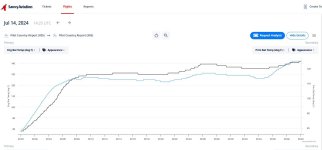
This is fairly typical of a flight in Florida mid-summer or was typical. I have 2 batteries FWF one plans position and the other lower pilot side. As I've stated here before mounting a battery lower FWF is not optimal. Mirror image high would have been the better place but the battery is in an already busy lay-out. I typically would see temps of the upper battery in the low 120's and temps in the lower battery low 140 F. Initially I would test each battery depleting it to ~ 20% of its amp-hr. rating every 3 months. Saw little change and altered the frequency to every CI. Every OSH I would talk to the people at Earth X and was told repeatably these temps were not a safety issue, but the life of my batteries would decline. In the meantime, I tried reengineer the cooling process using a number of different battery box configuration and insulation. Really nothing proved very effective. I was using 2 - 3/4 in blast tubes from early on. Last year after ~ 600 hrs.' and 4 years flying (6-year-old battery) the battery mounted low failed the 80% ampacity test. It was replaced at that time. Upper battery still tested 90% plus. In the last 3 months I have replaced the 2 - 3/4 blast tubes by splitting the 2 in SKEET tube going to the pilot side heat muff and routing a 2 in SKEET tube to the face of the battery. This has proven to work well and now see temps never above 100 F. Previously the most strenuous time for battery temps was taxing and worse holding short waiting to take-off. I have shut down the engine holding short and with the oil door closed have never seen temps in the lower battery location rise and the upper batter location max I've seen was an additional 9 Deg F. I do use Anti-Splat heat shields to help with reflective heat for the lower battery. Would love to hear of any flights were the BMS switched off (lots of users out their now), talking to Earth-X that is almost impossible. I've seen pilots crank their engines for much longer than Earth-X recommends and to date never a BMS shut-down. Taking 20 lbs. off my nose centers the CG and love the feel. Amazing technology!
 

Attachments

  • Screenshot 2025-01-20 091909.jpg
    Screenshot 2025-01-20 091909.jpg
    63.7 KB · Views: 28
I went from the PC680 to EarthEx and no regrets, its a much better cranking battery and a shed load lighted. The EarthEx batter didn't really for the original battery box that well so i swapped it out for the EarthEx battery box and all is good.
 
Temperature range for the PC680/ODS-AGM 16L with metal jacket is: -40°F to 176°F
The product spec sheets have 113F for the PC680 and 140F for the ETX680 in the same configuration (ie without enclosures) .

I would not assume the Van's battery bracket provides the same protection as the Odyssey OEM box. That would be fudging the numbers ;)
 

Attachments

This is fairly typical of a flight in Florida mid-summer or was typical. I have 2 batteries FWF one plans position and the other lower pilot side. As I've stated here before mounting a battery lower FWF is not optimal. Mirror image high would have been the better place but the battery is in an already busy lay-out. I typically would see temps of the upper battery in the low 120's and temps in the lower battery low 140 F. Initially I would test each battery depleting it to ~ 20% of its amp-hr. rating every 3 months. Saw little change and altered the frequency to every CI. Every OSH I would talk to the people at Earth X and was told repeatably these temps were not a safety issue, but the life of my batteries would decline. In the meantime, I tried reengineer the cooling process using a number of different battery box configuration and insulation. Really nothing proved very effective. I was using 2 - 3/4 in blast tubes from early on. Last year after ~ 600 hrs.' and 4 years flying (6-year-old battery) the battery mounted low failed the 80% ampacity test. It was replaced at that time. Upper battery still tested 90% plus. In the last 3 months I have replaced the 2 - 3/4 blast tubes by splitting the 2 in SKEET tube going to the pilot side heat muff and routing a 2 in SKEET tube to the face of the battery. This has proven to work well and now see temps never above 100 F. Previously the most strenuous time for battery temps was taxing and worse holding short waiting to take-off. I have shut down the engine holding short and with the oil door closed have never seen temps in the lower battery location rise and the upper batter location max I've seen was an additional 9 Deg F. I do use Anti-Splat heat shields to help with reflective heat for the lower battery. Would love to hear of any flights were the BMS switched off (lots of users out their now), talking to Earth-X that is almost impossible. I've seen pilots crank their engines for much longer than Earth-X recommends and to date never a BMS shut-down. Taking 20 lbs. off my nose centers the CG and love the feel. Amazing technology!
I don't think the issue is in flight temps. My concern would be the heat in the 5 minutes after shut down. I have never measured this, but would be shocked if it was under 140 on a 100* day. A better test would be to measure the battery temp 5 minutes after shut down.
 
The product spec sheets have 113F for the PC680 and 140F for the ETX680 in the same configuration (ie without enclosures) .

I would not assume the Van's battery bracket provides the same protection as the Odyssey OEM box. That would be fudging the numbers ;)
Pretty sure that 113 is a typo. Many decades of experience with lead acid batteries under car hoods (temps well above 113 even just sitting in the sun, let alone running) doesn't keep them from providing long service lives.
 
The product spec sheets have 113F for the PC680 and 140F for the ETX680 in the same configuration (ie without enclosures) .

I would not assume the Van's battery bracket provides the same protection as the Odyssey OEM box. That would be fudging the numbers ;)
I asked Odyssey about that many moons ago, they said the battery box provides the same protection from heat/expansion as their metal jacket. Perhaps you can reach out to them to verify this.
 
Perhaps you can reach out to them to verify this.
The best I can do is compare the published datasheets. Even if true about Vans enclosure (would it provide the same benefit to the Lithium battery then?) I have no interest in switching back to lead acid.
 
Well then post that data Bob, otherwise your post adds nothing to the conversation.

I corrected a mis-statement about Odyssey temp range which is much higher than Ex.
It would be much easier if folks actually did the research before posting.
Well Walt, it isn’t my data to post…but it is valid data. If the builder who has it chooses to post it, that is up to him. He frequents these boards…

Maybe when the outside temps get above 0 I will pull the cowl and install my thermocouples, which I planned for. I will then post my data…
 
My top paint is black and the temps under the cowl can exceed 300 degrees on a hot summer day, for example after making a short stop and restarting in the blazing sun. I realize this is very harsh for the battery lifespan but it did not fail so far. I try to not make a habit out of it..
 
To clarify, this is the -12 forum, my plane is a -12 so a fit into another model isn’t really relevant. The -12 battery box integrates the oil tank so changing it out would be a large task. This is my reason for asking about the fit. I now have the battery and it fits fine in the same place the lead acid battery fit before. I am designing a simple top bracket so that it will not interfere with the new battery post positions. Vans uses the EarthX in the -12is so I don’t expect the heat in the cowl is a concern. Thanks for all the input. I’ll be back in a few days with pics of the top bracket.
 
Pretty sure that 113 is a typo. Many decades of experience with lead acid batteries under car hoods (temps well above 113 even just sitting in the sun, let alone running) doesn't keep them from providing long service lives.
Not a typo 45C = 113F.
See the PC680 spec sheet attached in previous post:
Operating temperature range -40°F / -40°C to 113°F / +45°C
 
I don't think the issue is in flight temps. My concern would be the heat in the 5 minutes after shut down. I have never measured this, but would be shocked if it was under 140 on a 100* day. A better test would be to measure the battery temp 5 minutes after shut down.
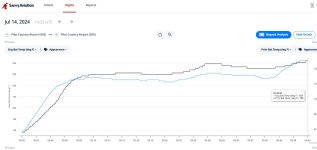
I was skeptical at first even with using this battery chemistry for over 10 years in other applications. That is why I wanted to obtain the data and avoid speculation. That is also why every 3 months (oil change) I would check the ampacity of each battery as I was told by Earth X this would be the first sign of a faltering battery. Since I operate an electrically dependent engine wanted to make sure my batteries were ok. As previously explained on the ground taxiing or worse waiting to depart is where I see the batteries rise in temperature the fastest and the battery mounted low is the worse of the 2. (See below) Fortunately after I shut down the battery mounted low MIGHT go up a degree or 2 (From 142 to 144 in this case) while the battery mounted up high on the firewall might go up 8 to 9 degrees F (From 125 to 134 F in this case) over a 10-minute period then the temps start to come down both battery locations. This on a 14-angle valve 390. X05 is the middle of Florida data from July 14th, OAT in the low 90's. These are within the Earth-X 30-minute max 150 F rating. After 5 years in operation and 7 years on the battery the top battery recently checked out at 87% ampacity. The battery located low was replaced at 6 years and 600 hours most in the Florida sun and heat. I also am using the Earth X warning lights, and they correlate pretty well with the imbedded thermocouples of mine. Screenshot 2025-01-20 150153.jpg
 
I was skeptical at first even with using this battery chemistry for over 10 years in other applications. That is why I wanted to obtain the data and avoid speculation. That is also why every 3 months (oil change) I would check the ampacity of each battery as I was told by Earth X this would be the first sign of a faltering battery. Since I operate an electrically dependent engine wanted to make sure my batteries were ok. As previously explained on the ground taxiing or worse waiting to depart is where I see the batteries rise in temperature the fastest and the battery mounted low is the worse of the 2. (See below) Fortunately after I shut down the battery mounted low MIGHT go up a degree or 2 (From 142 to 144 in this case) while the battery mounted up high on the firewall might go up 8 to 9 degrees F (From 125 to 134 F in this case) over a 10-minute period then the temps start to come down both battery locations. This on a 14-angle valve 390. X05 is the middle of Florida data from July 14th, OAT in the low 90's. These are within the Earth-X 30-minute max 150 F rating. After 5 years in operation and 7 years on the battery the top battery recently checked out at 87% ampacity. The battery located low was replaced at 6 years and 600 hours most in the Florida sun and heat. I also am using the Earth X warning lights, and they correlate pretty well with the imbedded thermocouples of mine. View attachment 78962
Very detailed testing here. I applaud you for taking the steps to insure that your battery will be safe and able to deliver good service. Also appreciate you sharing it for others as well.
 
Not a typo 45C = 113F.
See the PC680 spec sheet attached in previous post:
Operating temperature range -40°F / -40°C to 113°F / +45°C

It may or may not be a typo, but not really relevant. I suspect that the temps posted by dmattmul above are similar to what most 4 cyl vans models see for battery temps. Regardless of whether or not the 113* limit for odyssey is correct, there are 1000's of 4 cyl RVs out there flying with 18ah sealed lead acid batteries operating in conditions similar to those posted here and most owners see a solid 3-5 years of faithfull service from them. So, experience tells us that 113* is not a realistic hard limit on SLA batteries. I suspect that if kept under 113, they will have a longer life, just as keeping your CHTs below 425 will likely add some time to thei life. But that doesn't mean they will not otherwise provide a reasonable life when run above that #.

I use powersonic PS series SLA batteries, which are fundamentally identical to odyssey. Here is a qouted snip from their TDS:

Wide Operating Temperature Range Power-Sonic batteries may be discharged over a temperature range of -40°C to +60°C (-40°F to + 140°F) and charged at temperatures ranging from -20°C to +50°C (-4°F to +122°F).

Maybe odyssey just drops the spec to 113 to reduce warranty claims. As I mentioned above, there are not many powered vehicle applications that can keep battery temps below 113. A dark colored RV sitting on the ramp on a sunny 100* day is likely to see 113 under the cowl without the engine running.
 
Last edited:
Not a typo 45C = 113F.
See the PC680 spec sheet attached in previous post:
Operating temperature range -40°F / -40°C to 113°F / +45°C
Per Odyssey, not that you're really interested, but with the metal battery box or with the integrated metal jacket, these are the limits:
(if you don't trust me, reach out to them yourself, PS: I just submitted a technical request to confirm, will post their answer)

Temperature range for the PC680/ODS-AGM 16L with metal jacket is: -40°F to 176°F
(the Van's battery box has the same function as metal jacket model)
 
Last edited:
Lots of discussion, but the RV-12iS has been using the ETX680 since the beginning and nobody has reported any issues.

After my 950hrs in 4 years, there doesn't seem to be any degradation in performance. At 70F, it still takes about 3 minutes to recharge the battery after a startup - after letting the plane sit for 7 days.

Save yourself the 11.3 lbs, get the arm of the battery and recalculate the W&B. Stick a temperature strip on it if you're concerned about it overheating, but its been fine mounted in the upper/co-pilot side of the firewall. That said, the cowl in the RV-12 is a little different than the 12iS.
 
The higher voltage/current capability of the Ex will help to overcome high resistance in the starter circuit and an inefficient current hungry PM starter.
Personally I’m gonna stick with good old lead acid with long time history/reliability and maintain my starter circuit/electrical system.
An RV12 should not need an Ex to start, and their high current draw during charge may tax the charging system.
I have the same concern as Walt regarding the extra stress on the alternator, particularly right after start when the alternator isn't spinning fast enough to cool itself. Google, "lithium batteries and alternator temperature". You'll find that the recreational vehicle and boat crowd has experienced this issue. For those applications, they're installing controllers between the regulator and alternator that adjust field current based on temperature sensors on the alternator(s). I believe that B&C also has a regulator that can do this. Lithium is the future, but for now sticking with AGM.
 
I have the same concern as Walt regarding the extra stress on the alternator, particularly right after start when the alternator isn't spinning fast enough

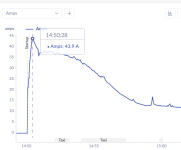
there is short peak in alternator current right after startup but well below the rated capacity (60A).
There is nothing wrong with running AGM if you like the lower cost and OK with the extra weight and lower cranking power, but why invent the problems where they don't exist?

1737486457092.png
 
I have the same concern as Walt regarding the extra stress on the alternator, particularly right after start when the alternator isn't spinning fast enough to cool itself. Google, "lithium batteries and alternator temperature". You'll find that the recreational vehicle and boat crowd has experienced this issue. For those applications, they're installing controllers between the regulator and alternator that adjust field current based on temperature sensors on the alternator(s). I believe that B&C also has a regulator that can do this. Lithium is the future, but for now sticking with AGM.
Since this is the -12 forum…

Rotax 912 engines don't have alternators. They have a permanent magnet generator connected directly to the crankshaft at the back of the engine. I forget whether it's the case on the -ULS engines, but the stator on the -iS engine is oil cooled (and there's a SB to inspect this right now).
 
Put an EarthX in my constant speed 7A I built to keep down the nose weight. Great for 4 years but then would shut down from high current draw in a cold soaked start. Replaced it and the old one has been faithfully starting my riding mower and jump starting car since. Guess the Lycoming just drew too many amps once the battery had some age.

I have the Odyssey in my current legacy 12. The weight and balance stock and more so once I switched to the lighter E-Prop has always had an aft bias. Solo with full fuel the plane is baggage limited. Just means going to Oshkosh my camping gear is my passenger. Do a new W&B to share so we know. Mine is attached. Could only have 40# before the change and 24# now.
 

Attachments

The product spec sheets have 113F for the PC680 and 140F for the ETX680 in the same configuration (ie without enclosures) .

I would not assume the Van's battery bracket provides the same protection as the Odyssey OEM box. That would be fudging the numbers ;)
Temperature range for the PC680/ODS-AGM 16L with metal jacket is: -40°F to 176°F
(the Van's battery box has the same function as metal jacket model)


Just a quick follow up as promised in regard to temperature ratings, I sent a request to Energy systems about the temp spec of the PC680/SBS J16, if the battery is installed in the Van's steel battery box, the following was their response:

Question: Would the steel battery box that's sold by Van's Aircraft provide the same protection as the metal sleeve?

Reply: Yes, as long as the sleeve is made for the particular battery. We produce the SBS and the Odyssey batteries.
Please let me know if you have any questions.

Robert “Russ” Coller

Applications Engineer
ENERGY SYSTEMS
 
Put an EarthX in my constant speed 7A I built to keep down the nose weight. Great for 4 years but then would shut down from high current draw in a cold soaked start. Replaced it and the old one has been faithfully starting my riding mower and jump starting car since. Guess the Lycoming just drew too many amps once the battery had some age.

I have the Odyssey in my current legacy 12. The weight and balance stock and more so once I switched to the lighter E-Prop has always had an aft bias. Solo with full fuel the plane is baggage limited. Just means going to Oshkosh my camping gear is my passenger. Do a new W&B to share so we know. Mine is attached. Could only have 40# before the change and 24# now.
It's not the engine but the starter. Any chance you have a Sky-Tec light weight starter? They suck amps! NL much nicer on batteries.
 
Hi everyone,

I have an ETX900 installed in my RV-7 with a Lycoming IO-390. Yesterday was the aircraft’s 4th flight — it only has 6 hours on it so far. I was flying in northern Argentina, surface temperature was around 32°C (89.6°F). We flew for 1.6 hours, and after landing I had to do a fairly long taxi due to airport procedures.
I shut the engine down, and after about 5 minutes tried to start it again. As soon as I hit the starter, the prop rotated maybe 20 degrees and then everything went dead — the battery shut off.
I couldn’t check the battery LED since I have the fault wire connected directly to the G3X, which was off at the time. However, after a few hours I had master power again. I removed the cowling and everything looks normal, so I’m assuming the BMS tripped due to high temperatureBefore my next flight I plan to install a thermocouple to an independent monitoring system to log the battery temperature in real time. I’ll report back with my findings to share with the community.
 
Back
Top