Van's Air Force

The definitive Van's Aircraft support community! Buying, building or flying an RV? Join our exclusive family of mentors and enthusiasts!

Excitement on Climb Out (rough running engine)

mfleming

Well Known Member
Patron
Yesterday we had a bit of a break in the weather, so I decided to exercise the -7.

All was normal with the run-up except the #2 cylinder was lagging behind the others in EGT/CHT. I've noticed this for a while but everything was running well so no action taken.

The takeoff roll was normal as was the initial climb out but at about 500' the engine started running rough. Enough so that I was looking to return to the runway ASAP. All the vital signs looked good, so I climbed to 5000' (a coupled hundred feet below pattern altitude) and did a short approach. On the ground I did a couple run ups and mag checks...all good except the #2 was lagging the others.

As an aside, the engine has been getting harder to start hot or cold.
I have some ideas on what it might be but I'll share those later as to not introduce bias.

EDIT: IO-360-M1B 230 hrs since new, Impulse mag on the left, P-Mag on the right. Auto plugs on the P-mag, massive electrode plugs on the mag.

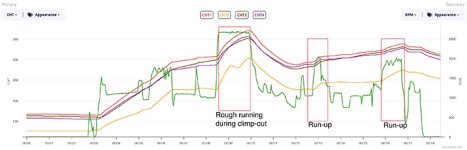
Hers the data log from start-up to shutdown. The green is RPM on both logs.
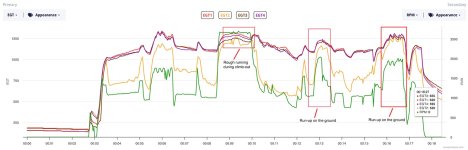
Chart-EGT.jpg

Chart-CHT.jpg
 
Last edited:
Carb or injected? Type of mags: tractor or electronic? Type of spark plugs: Aviation or auto?

Doesn't look like #2 is getting proper fire across the piston: improper fuel amount or fuel not being ignited properly. Fouled plugs would be my first guess...........:unsure:
 
Carb or injected? Type of mags: tractor or electronic? Type of spark plugs: Aviation or auto?

Doesn't look like #2 is getting proper fire across the piston: improper fuel amount or fuel not being ignited properly. Fouled plugs would be my first guess...........:unsure:
I edited the original post to include this info.
I'll be surprised if the plugs are fouled but it's a possibility. Normally when I pull the plugs they're cleans as can be.
 
Michael

How many hours on the engine? Have you done a wobble test on the valves? No2 exhaust, always seems to be the one to cause problems on RV’s
I know my superior IO-360 needed the valve guide reamed at around 350 hours.

Regards Peter
 
Michael

How many hours on the engine? Have you done a wobble test on the valves? No2 exhaust, always seems to be the one to cause problems on RV’s
I know my superior IO-360 needed the valve guide reamed at around 350 hours.

Regards Peter
That was my initial thought when he said #2! It’s always #2 ;)
However, the EGT’s don’t seem to follow that theory. When my #2 stuck, low hours as well, #2 EGT dropped off aggressively. This doesn’t seem to show that but not all sticky valves behave the same me thinks.
 
Michael

How many hours on the engine? Have you done a wobble test on the valves? No2 exhaust, always seems to be the one to cause problems on RV’s
I know my superior IO-360 needed the valve guide reamed at around 350 hours.

Regards Peter
No trouble shooting done yet. Updated the engine hours in the OP. 230 hrs since new.
 
Yesterday we had a bit of a break in the weather, so I decided to exercise the -7.

All was normal with the run-up except the #2 cylinder was lagging behind the others in EGT/CHT. I've noticed this for a while but everything was running well so no action taken.

The takeoff roll was normal as was the initial climb out but at about 500' the engine started running rough. Enough so that I was looking to return to the runway ASAP. All the vital signs looked good, so I climbed to 5000' (a coupled hundred feet below pattern altitude) and did a short approach. On the ground I did a couple run ups and mag checks...all good except the #2 was lagging the others.

As an aside, the engine has been getting harder to start hot or cold.
I have some ideas on what it might be but I'll share those later as to not introduce bias.

EDIT: IO-360-M1B 230 hrs since new, Impulse mag on the left, P-Mag on the right. Auto plugs on the P-mag, massive electrode plugs on the mag.

Hers the data log from start-up to shutdown. The green is RPM on both logs.
View attachment 76749

View attachment 76750
I vote for the #2 exhaust valve.

Good luck
 
Glad you made it down without any incident and safe.

Looks like less likely it is the exhaust valve since all your EGTs are tracking pretty consistent in the graph. Most of the reported Exhaust valve issue has been with the IO390 engine and more likely happens right when the engine is cold.

Any chance of a bit of water has got to your tank and made it to the engine at that time? If your EGTs track with past behavior, I would check water, or mag issue. Also check the fuel filter including the one that is in your fuel injection/throttle body.
 
Glad you made it down without any incident and safe.

Looks like less likely it is the exhaust valve since all your EGTs are tracking pretty consistent in the graph. Most of the reported Exhaust valve issue has been with the IO390 engine and more likely happens right when the engine is cold.

Any chance of a bit of water has got to your tank and made it to the engine at that time? If your EGTs track with past behavior, I would check water, or mag issue. Also check the fuel filter including the one that is in your fuel injection/throttle body.
I sumped the tanks immediately after landing...no water.
The #2 does track but it trends low most of the time.
 
Last edited:
Wow, that's pretty invasive but better than pulling a cylinder I guess.
Yes, reaming is invasive but just the wobble test isn't invasive at all. After having done the wobble test now 6 times and with the right tools like the Valve Wizard, it takes about 30 minutes including putting everything back if the test is good. First time took about 2 hours. Feeding the rope into the cylinder (rope trick) seems to take a lot of the time!
 
If it is the #2 exhaust valve sticking at 230 hrs...what is going wrong? Am I operating the engine in a way that might be exasperating the sticking?
 
I dumped the tanks immediately after landing...no water.
The #2 does track but it trends low most of the time.
Keep in mind that the possibility of water in the system still exist. If there was any water, it got burnt off during that period otherwise would continue to run rough. Also, check your fuel flow rater for that period.
Looking at the graph, there is little indication that any cylinders have dropped as a result of sticking valve which typically causes a big drop in EGT however It is not a bad idea to check it out.
On a couple of cold days, go to the hanger and run the engine and pay attention to the EGT right after start up. Sticking exhaust valve will show itself more when it is cold, hence the expression of morning sickness

Good luck
 
Just a follow up.
It is indeed a sticky valve. I finally received a valve spring tool and remove the spring using the rope method. The valve needs to be removed with a drift 🫣. Luckily there’s no damage to the piston or pushrod.
Now I’m waiting on a reamer and wobble test fixture. I’ll post the repair photos when I’m done.
Edit: factory new IO-360-M1B with 230 hrs TT
 
Sorry i didnt analize he data completely but i hd an ACS key switch go bad duting phse1.: on climb both mags p leads would short to ground above 2000 rpm. Below 1700 rpm engine ran fine. Turns out key mag switches are knon for this arcover failure. I changed out switch for a cessna switch and all is fine. Search my name and there is more details on here it kills me i have a cessna key for my rv .
 
Just a follow up.
It is indeed a sticky valve. I finally received a valve spring tool and remove the spring using the rope method. The valve needs to be removed with a drift 🫣. Luckily there’s no damage to the piston or pushrod.
Now I’m waiting on a reamer and wobble test fixture. I’ll post the repair photos when I’m done.
Edit: factory new IO-360-M1B with 230 hrs TT
Last April, we had #2 exhaust valve stick on a cold start in our RV7a with an IO360M1B with 165 hours on new Lycoming. Reamed out crude and it has been flying great since. I was very surprised that this happened so soon.
 
Inquiring minds want to know: what's the deal with the #2 cylinder in particular that (at least anecdotally) seems to make it more prone to exhaust valve problems?
It’s #2. Always #2. Should do a poll on what cylinders folks g have seen stick. I was just thinking exactly this yesterday. What makes #2 so susceptible?
 
Not on my IO-360-M1B, and I‘ve had the exhaust valve stick twice on Cylinder #2. Cylinder #3 is the warmest on my engine. See Post #19 for details.
That's interesting. Some have suggested that there's some inherit oil delivery flaw to #2 as a possible cause for sticking valves. It was just a guess from what I saw.
 
Not on my IO-360-M1B, and I‘ve had the exhaust valve stick twice on Cylinder #2. Cylinder #3 is the warmest on my engine. See Post #19 for details.
Same here. I have the baffle spacer installed on #3 as well.
My last “stick” was #4 but it “cleared itself” leading me to believe it was just a piece of carbon or something that wasn’t a build up of material in the guide.
Oh the beauty of an air cooled engine.
 
I know on my engine the cht spread is less than 10F. I wonder if it’s either an oil issue or uneven cooling across cylinder #2.
On my RV-10 I made a cooling slot to duct air down the front of #2. Only time will tell if this helps.

Regards Peter
 
OK, a final follow up.
So the -7 is back in the air and working beautifully.
I received the McFarlane valve guide clean-out reamer and the Sydow wobble test rig and got right to work. Pushing the exhaust valve out of the guide and holding onto it with mechanical fingers certainty test one patience! Lycoming Service Instruction No. 1425A thoroughly cover the reaming procedure and spells out which size reamer to use. Service Bulletin No. 388C covers the wobble check procedure and mine spec'ed out perfect. Technically one should use an inside micrometer and measure the guide bore but I didn't have one. The first engine run bummed me out as the engine was rough but that ended up to be a bad spark plug. The second run ran perfect after swapping the plug out.
It's a bummer that after only 230 hours I had a sticky valve but I guess that's not that uncommon. All in all a great learning experience and I accumulated more tools ;- )
 
Last edited:
I experienced almost an identical incident to the original post which has brought me to this discussion....and I am adding one more example of a sticking exhaust valve on Cylinder #2 to the thread:

RV-7 with new IO-360-M1B, 400 hours tach time. Always lean aggressively on the ground and run lean of peak in cruise. Exhaust cylinder #2 was almost stuck - other 3 were perfect. All intake valves were fine.

Having experienced stuck valves in two other multi-user partnership shared aircraft before my RV-7, I have been pretty sensitive to stuck valve issues and have been focused on leaning since 0 hrs on this IO-360 purchased through Vans. Being the only operator of this RV-7 and focused on leaning to prevent sticking, I figured that I wouldn't have a stuck valve, so I was shocked to discover #2 exhaust valve almost fully stuck at 400 hours. I am now familiar with the rope trick and will be checking this often. Seems like the other valves - or at least one other valve - would be sticking as well if this was due to rich mixture, dirty oil or one of the other culprits mentioned because all exhaust valves experience those same operating conditions....#2 seems to be problematic for sure. Cyl #2 is not the hottest on my setup - turns out that #4 in front of the oil cooler is, but all are within about 10-15 degrees of CHT at all times (take off & cruise). Just figured that I'd pile on to the discussion with another Cylinder #2 example.

Alex
 
I experienced almost an identical incident to the original post which has brought me to this discussion....and I am adding one more example of a sticking exhaust valve on Cylinder #2 to the thread:

RV-7 with new IO-360-M1B, 400 hours tach time. Always lean aggressively on the ground and run lean of peak in cruise. Exhaust cylinder #2 was almost stuck - other 3 were perfect. All intake valves were fine.

Having experienced stuck valves in two other multi-user partnership shared aircraft before my RV-7, I have been pretty sensitive to stuck valve issues and have been focused on leaning since 0 hrs on this IO-360 purchased through Vans. Being the only operator of this RV-7 and focused on leaning to prevent sticking, I figured that I wouldn't have a stuck valve, so I was shocked to discover #2 exhaust valve almost fully stuck at 400 hours. I am now familiar with the rope trick and will be checking this often. Seems like the other valves - or at least one other valve - would be sticking as well if this was due to rich mixture, dirty oil or one of the other culprits mentioned because all exhaust valves experience those same operating conditions....#2 seems to be problematic for sure. Cyl #2 is not the hottest on my setup - turns out that #4 in front of the oil cooler is, but all are within about 10-15 degrees of CHT at all times (take off & cruise). Just figured that I'd pile on to the discussion with another Cylinder #2 example.

Alex
Out of curiosity, what oil pressure do you run? I ask because there is speculation that higher OP (in the 85-90 psi range) helps to minimize the the sticking valve issue. By the way, I have always run Camguard.
 
Last edited:
Not to start a cultural war, but there was some discussion re camguard in another thread. The web site claims that it helps with keeping the valve guides clean. among other things. Curious if the folks who experienced a stuck valve use the camguard routinely.
 
I purchased my engine during my RV-7 build from Vans in 2020 and my oil pressure setting was set at the factory (engine started flying in Nov 2021). The oil pressure is about 60 psi during initial start up and idle, it always jumps up to above 90psi (92-95 psi) during 2700 RPM takeoff (limited to 30 sec), and then settles in to 76 psi during cruise. I have an oil shutter and target 180 degF for my oil temperatures during cruise (shutter is full open during takeoff and landing).

The IO-360-M1B operating manual states 95 psi max, 55 min, 25 idle and 115 start and warm-up. I could possibly crank it up from the factory settings, but my numbers as set from the factory seem spot-on per the Operating Manual, so I haven't changed them because I am not sure of any unintended consequences of running higher oil pressures. Checking and reaming my valves is a known risk so my plan was to stick with that going forward and leave my oil pressure as-is.

The other data in question is that I ran Phillips Victory 20W50 for the first 300 tach hours and then switched to Phillips X/C 20W50 with Camguard for the most recent 100 tach hours. I fly on average about 150 hours per year and that is spread out pretty evenly over the 12 months. I live in the Phoenix area, so summers are pretty dang hot but I am careful about keeping CHT's at or below 400-410 on take off in the summer (they don't exceed that when OAT gets below 90) and then target about 350-360 during cruise. I also fly to Colorado regularly in the winter, so the engine does see a wide spread of operating and starting temperatures.

Although running rich seems to be a definite causal factor, after doing everything I could to avoid valve sticking but still ending up experiencing this, I have been scratching my head and digging in a bit over the past 6 weeks as to what the heck happened and personally I'd be hard pressed to say that it's anything that I as an end-user operator did or can change at this point: it seems to be an inherent part of the Lycoming design and exhaust valve implementation, regardless of what oil pressure, oil weight, Camguard, etc. It seems like some cylinder / valve setups are just born with the issue at manufacturing regardless of how they are operated. Reading between the lines to me it always sounded like Lycoming still recommends a 400 hour check even if you have the new and improved exhaust valve guide material with an increased chrome content for improved wear characteristics. My guess is that the increased chrome guides helps with bell-mouth wear but doesn't help with the sticking issue, and that's why I actually decided to do a 400 hour check even though I have the new guides....and I'm glad that I checked. That's just my opinion and may be a coping mechanism for me to emotionally deal with a stuck valve....an actual study and data would be great to see.

1741021417660.png
 
I purchased my engine during my RV-7 build from Vans in 2020 and my oil pressure setting was set at the factory (engine started flying in Nov 2021). The oil pressure is about 60 psi during initial start up and idle, it always jumps up to above 90psi (92-95 psi) during 2700 RPM takeoff (limited to 30 sec), and then settles in to 76 psi during cruise. I have an oil shutter and target 180 degF for my oil temperatures during cruise (shutter is full open during takeoff and landing).

The IO-360-M1B operating manual states 95 psi max, 55 min, 25 idle and 115 start and warm-up. I could possibly crank it up from the factory settings, but my numbers as set from the factory seem spot-on per the Operating Manual, so I haven't changed them because I am not sure of any unintended consequences of running higher oil pressures. Checking and reaming my valves is a known risk so my plan was to stick with that going forward and leave my oil pressure as-is.

The other data in question is that I ran Phillips Victory 20W50 for the first 300 tach hours and then switched to Phillips X/C 20W50 with Camguard for the most recent 100 tach hours. I fly on average about 150 hours per year and that is spread out pretty evenly over the 12 months. I live in the Phoenix area, so summers are pretty dang hot but I am careful about keeping CHT's at or below 400-410 on take off in the summer (they don't exceed that when OAT gets below 90) and then target about 350-360 during cruise. I also fly to Colorado regularly in the winter, so the engine does see a wide spread of operating and starting temperatures.

Although running rich seems to be a definite causal factor, after doing everything I could to avoid valve sticking but still ending up experiencing this, I have been scratching my head and digging in a bit over the past 6 weeks as to what the heck happened and personally I'd be hard pressed to say that it's anything that I as an end-user operator did or can change at this point: it seems to be an inherent part of the Lycoming design and exhaust valve implementation, regardless of what oil pressure, oil weight, Camguard, etc. It seems like some cylinder / valve setups are just born with the issue at manufacturing regardless of how they are operated. Reading between the lines to me it always sounded like Lycoming still recommends a 400 hour check even if you have the new and improved exhaust valve guide material with an increased chrome content for improved wear characteristics. My guess is that the increased chrome guides helps with bell-mouth wear but doesn't help with the sticking issue, and that's why I actually decided to do a 400 hour check even though I have the new guides....and I'm glad that I checked. That's just my opinion and may be a coping mechanism for me to emotionally deal with a stuck valve....an actual study and data would be great to see.

View attachment 82091
Lyc has had problems with heat shedding on exhaust valves since the beginning. Imho it is the anemic oil flow to the rockerbox. Either way, when the valves get too hot, the guides get too hot. When the guides get hot enough, the oil turns to coke.. That is the hard crunchy black stuff that came out with your reamer.

Lyc keeps playing with exotic materials in the valves and the guides, but refuses to address the root cause, which is lifter without bypass channels to send oil to the exh valve.

This is not a mixture issue, but a valve heat issue.
 
Last edited:
Not to start a cultural war, but there was some discussion re camguard in another thread. The web site claims that it helps with keeping the valve guides clean. among other things. Curious if the folks who experienced a stuck valve use the camguard routinely.
Yes, sticky valve while using CAMGAURD.
 
Not to start a cultural war, but there was some discussion re camguard in another thread. The web site claims that it helps with keeping the valve guides clean. among other things. Curious if the folks who experienced a stuck valve use the camguard routinely.
I was using Camguard also...no help with preventing this sticky valve.
 
Lyc has had problems with heat shedding on exhaust valves since the beginning. Imho it is the anemic oil flow to the rockerbox. Either way, when the valves get too hot, the guides get too hot. When the guides get hot enough, the oil turns to coke.. That is the hard crunchy black stuff that came out with your reamer.

Lyc keeps playing with exotic materials in the valves and the guides, but refuses to address the root cause, which is lifter without bypass channels to send oil to the exh valve.

This is not a mixture issue, but a valve heat issue.
Any idea why this is more common on #2? I wonder if Savvy could pick this up considering how much data they have...
 
Have a buddy that’s an A&P and IA for a large aviation company that does photo and terrain mapping. They use a variety of planes including C-206s and C-414s. They do a lot of long missions and the bosses are always trying to save fuel so directed the pilots to run exclusively LOP and they had very frequent stuck valves. He insisted they start running peak or ROP and they stopped having exhaust valve issues completely. Yes it cost more fuel but way outweighed the extra maintenance costs and aircraft downtime and lost contracts. I’m not a mechanic, just repeating what I heard so don’t shoot the messenger.
 
Any idea why this is more common on #2? I wonder if Savvy could pick this up considering how much data they have...
No. I do know that there is variability in the fit of components in the lfter assemblies. Because there is no bypass channel for oil to feed the pushrod, the only oil that gets there is oil that bleeds past the clearances. So, looser fitting parts will flow more oil than tight fitting parts. More oil on valve = cooler valve. This is my best geuss as to why some get this and some don't.

I couldn't even guess why some guys seem to get #2 more often. Though will say that the sample size here at VAF is quite small, so can't read much into that. Plenty of folks here have stuck valves other than 2.
 
Last edited:
Back
Top