Van's Air Force

The definitive Van's Aircraft support community! Buying, building or flying an RV? Join our exclusive family of mentors and enthusiasts!

Glide testing. Critique my test plan.

agent4573

Well Known Member
With the RV14 post bringing up some good points about engine out glide vs prop spinning glide, I figured this might be a decent area to go get some no kidding data on. I'm a flight test engineer, I have an airplane, seems like a good match. So here's the general plan....

Airplane: 2022 RV7, IO370, 9:1 CR, Whirlwind 300 prop, full SDS ignition and injection.

Setup for test: weight/cg TBD but near max gross. Non-leaned ground IDLE RPM set to 700 RPM. Prop fine pitch adjusted to ~2625 static, governor set to ~2650. All prop spinning testing done with the mixture in the non-leaned condition.

Test plan: climb to ~9k PA over the field, slowly cool the engine, then IDLE glide from about 8k with prop forward at 90, 85, 80, 75, 70, 65, 60. Goal is to get more than one of these done per descent, but to get at least 500ft of stabilized glide on each condition. 90 kias prop forward, I'm at like a 20 degree dive though and a massive ROD, so we'll repeat as needed and increase the time on condition to 1000ft if needed. Will stop testing at 2500 ft, slowly warm the engine back up with min power to sustain level flight, then climb back up and do it again.

Repeat the above with the prop pulled all the way back.

Repeat the above with the engine off, except start slow and increase speeds. Testing will stop once I reach a speed where the prop starts to windmill.

Airport I'll be testing at is Hollister CA, with a 5000ft runway in case the engine doesn't fire back up plus a crossing runway if needed. Wife will be copilot and note taker/time hacker/technique critiquer. All data will be recorded on the g3x and posted here so people can check my post flight analysis.

Time frame: sometime between now and new years.

Looking for inputs and suggestions so I don't miss anything. Thanks.
 
My thoughts. I like the plan but you need rotation in order to have control of the prop and once you stop the prop- I really doubt you will get it windmilling again. It will take a bump of the starter. I’d like to see the data when your done though.
 
The engine will cool down really fast with the prop stopped. Don't plan on a easy restart. Stopped three blade will be more drag than two blade. My person limits would be 7000' minimum runway and first restart attempt at 5000' AGL
Personally I would only do it solo.
 
Since all these runs will take time I’d suggest recording the fuel on board for each run. When you’re done you can apply a first order (square root of weight) correction during data analysis. I also agree with the last poster: you may find it difficult (e.g., on the edge of stall speed) to stop the prop. And, once stopped, you’ll need the starter to get it moving again.
 
My thoughts. I like the plan but you need rotation in order to have control of the prop and once you stop the prop- I really doubt you will get it windmilling again. It will take a bump of the starter. I’d like to see the data when your done though.
Toolmanmike,
I bumped my starter recently with the prop turning slowly (by mistake).
The starter disintegrated with big chunks of the casting coming off.
$650 lesson.
Daddyman
 
Toolmanmike,
I bumped my starter recently with the prop turning slowly (by mistake).
The starter disintegrated with big chunks of the casting coming off.
$650 lesson.
Daddyman
I don't think he'll have this problem. The prop will either be windmilling pretty fast, or not at all, at the speeds he's testing.
BTW, in aircraft with a push-to-start button, and toggle switches for mags, I have seen some clever solutions to the accidentally hitting the start button. The one I liked had DPDT switches for the mags; the extra poles ran 12 volt power to the starter switch, but only when the left mag (impulse) was switched on, and only when the right mag (non-impulse) was simultaneously switched off.
 
With the engine off, from a test hazard standpoint, this is not a low risk test if assessed prior to mitigation. Approach with caution, over planning is better than under. Based on my experience working with tests of this type, I offer the following (potentially incomplete) considerations and rhetorical questions:

With respect to data quality, I'd recommend trying to do repeated configuration pairs of descents on opposing headings as close to perpendicular to the opposing winds as possible.

Double check your low pitch setting. Your description for descent deck angle at 90 kias is a bit surprising, that's not much above best glide.

With respect to restarts, I'd recommend starting at the high airspeed and stepping down, rather than the planned opposite. My experiences with engine off had the prop windmilling quite happily and restarting without a fuss once fuel was reintroduced. Ensure you understand the minimum RPM required for the ignition system to fire. How about your fuel system config? Do you want to keep the HP pumps going while the engine is off? Recommend creating checklists for, respectively, shutting down, restarting, and securing the engine.

Plan now for if the prop is barely windmilling whether you want to increase airspeed to try to drive RPM higher or slow to try to stop it so you can engage the starter.

Consider where you're going to start the test relative to the airport. Recommend starting away, headed towards the airport, distance based on geography and expected glide ratios. You mention stopping at 2500 ft, but what does that mean? Recommend having a knock off altitude: test point is over, time to restart the engine. Recommend having an abort altitude: no more restart attempts, it's time to land engine off. Consider securing fuel/ignition cutoffs at this point to avoid surprise restart/hiccups at an inopportune time. Consider having knockoff and abort geography points, ideally tied to altitude, for if your glide has passed the airport or you're descending quicker than anticipated, giving you opportunity mitigate.

Consider your instrumentation, I believe the G3X can display a dynamic glide ring; how can you integrate this into your decision making to make life simple during the test?

What's your radio tuned to? Who is operating it?

What kind of headset are you using? Noise cancelling headsets can mask sounds that may be informative.

Practice power off 180s/approaches to the runway(s) you anticipate using. Use multiple different entry points (location, speed, altitude) to the pattern. Use the altitude consumed in this practice to inform your decision altitudes.

Brief risks and decision altitudes. Are you going to wear chutes, and if so, at what point do you bail? At what point do you decide you can't make the airport and land in a field? Which one(s)? You mention taking your wife, are you both comfortable with the risks individually, and for each other?

Consider what wind/weather conditions are disqualifying for this test.

Good luck. Be safe.
 
Are you totally comfortable landing dead stick incase it doesn’t start? Does your wife understand and accept the risks? Why do you set your prop governor at 2650 instead of 2700? That’s probably 10 or 15 hp you are leaving behind. I would get that prop governor set to the full 2700 and low pitch stops set to 2650 static. I agree 20 degrees nose low seems excessive at idle.
 
A lot of good thoughts have already been expressed. The only thing I’ll add (having done a lot of this kind of testing, is that there is no reason to have an extra body onboard - why risk two people when you only have to risk one? Since you’ve got G3X recording, that’s all you need - the data will be far more accurate in post-flight reduction than anything you or your wife will scribble down. I rarely do manual data collection anymore.

If you’re current with dead-stick landings, the risks are much lower….but I still wouldn’t take an extra body, even if it is another test pilot - there’s no up-side, only increased risk.

Oh - my experiments also says that you’ll probably want 1,000’ stabilized data-takes. it is hard to get stabilized with the descent rates you’re going to have in just 500’.

Paul
 
Agent,

What Trevor said :) , I'm over the top of an Eglin Aux field with two runways. Lessons learned, for what they are worth: 30 seconds on parameters wing's level and 360 degrees of turn, on parameters using 45 degrees of bank (if you are interested in maneuvering glide performance). Load the expert version of the TLAR app (if you are an iOS guy) and that will help with energy management in the event of non-start post run. Paul is correct, one body on board for high-risk DT is sufficient, but kudos to your wife! Ballast for MAGW, if desired. Don't be surprised if your alternator belt (assuming you have one) squeals a bit when you bump the starter. Don't bother with a windmill re-start, but ensure KIO altitude is high enough to effect one, if required (min 3K' AGL), you can correct all of the data down to SL. Depending on pitch, a windmill is going to require 125-150 indicated. Select the highest speed option for data recording. If you have a camera mounted, dictation is more effective than notes--you can compile those when you debrief the "film" (dating myself):


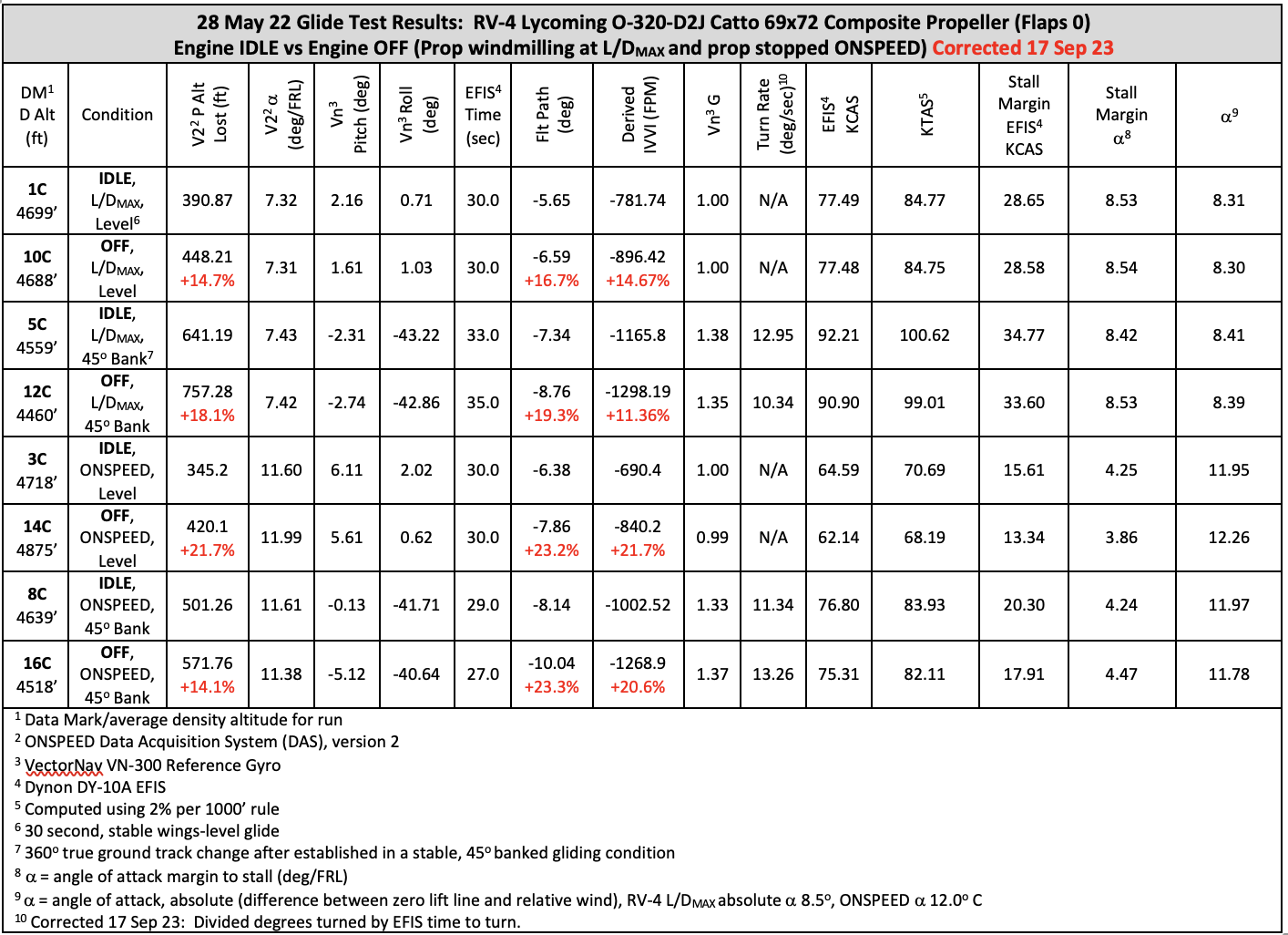
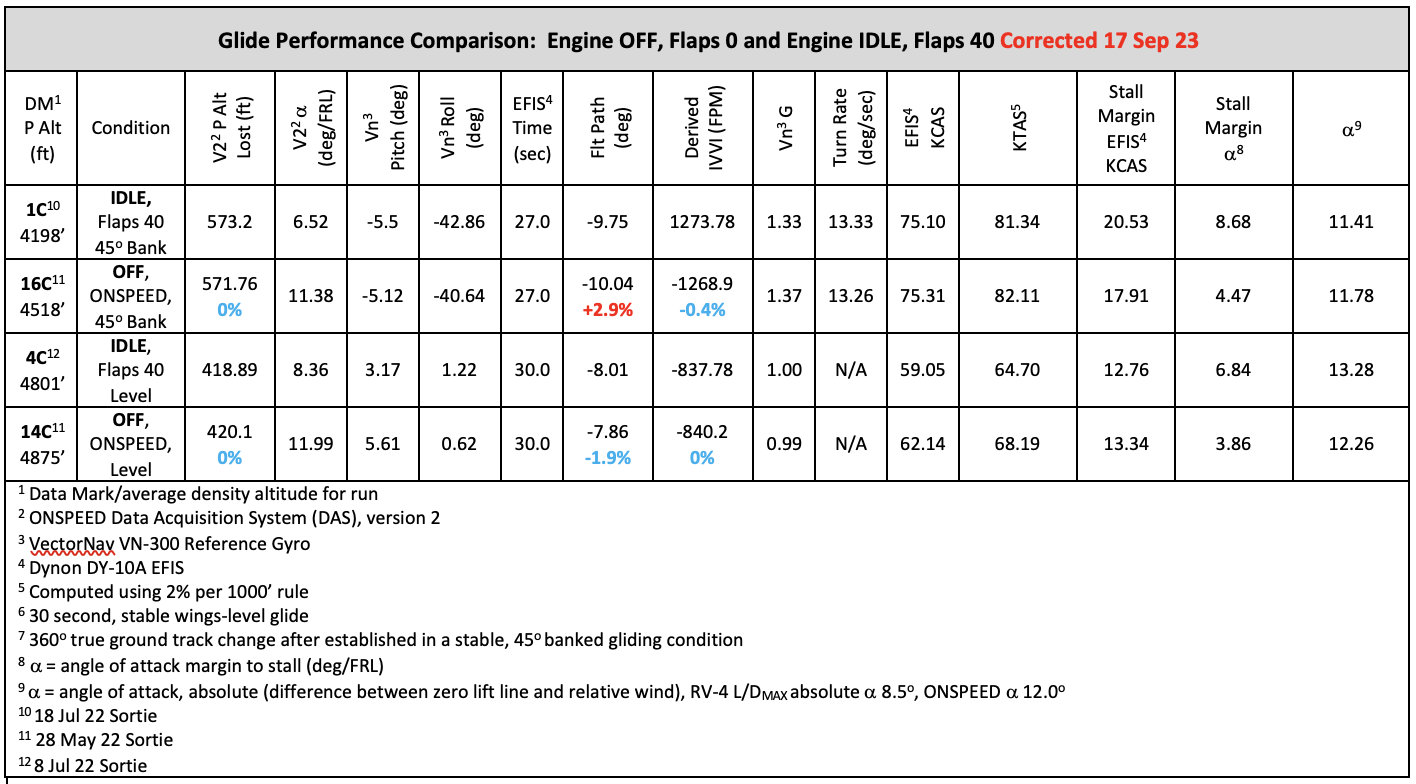
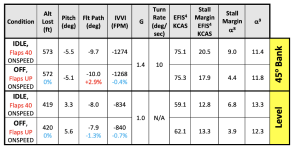
Tabulated Test Results for an RV-4 with a two-blade, composite (light weight) fixed pitch prop. I wasn't flying a sawtooth, as we already knew on speed and L/Dmax alpha, but basic technique is the same. Stall margin AOA is body angle: delta between relative wind and fuselage reference line (canopy rail). For wing's level testing, you can derive flight path angle from VVI, so recommend you consider aligning your AHRS zero pitch reference with your canopy rail, and you'll have apples to apples comparison with with this table. 7 and 4 use 23013.5 section. Alpha column is absolute AOA--that would be more tactically useful if it was body angle. The purpose of the test was to determine residual thrust effect in IDLE vs OFF (difference in red font). We ran similar tests with a controllable prop in a Glassair Sportsman. The benefit of running tests in IDLE and OFF will allow you to determine a "training flap" setting to add drag when practicing engine off at low altitude (Second table below) as well as deriving a zero-thrust MP/RPM.

3c039a_efce600501654b029f02597dc811d9d8~mv2.png


3c039a_90f003f9c77e4841900f55c2a08bd0de~mv2.png


Interested to see your data. Fixed pitch is pretty caveman simple: windmills at L/Dmax and stops on speed. If you don't have alpha, consider flying 1.3 Vs at test weight (on speed) as one of your sawtooth points...increase by 19% for 45 deg bank if you are running any maneuvering hacks.

Drop an email or PM with questions/BS flags/etc. Happy to share any data we have.

Cheers,

Vac

P.S. FlyONSPEED.org is looking for a FTE, BTW. Bonus whiskey if proficient in Python :)
 
Last edited:
With the RV14 post bringing up some good points about engine out glide vs prop spinning glide, I figured this might be a decent area to go get some no kidding data on. I'm a flight test engineer, I have an airplane, seems like a good match. So here's the general plan....

Airplane: 2022 RV7, IO370, 9:1 CR, Whirlwind 300 prop, full SDS ignition and injection.

Setup for test: weight/cg TBD but near max gross. Non-leaned ground IDLE RPM set to 700 RPM. Prop fine pitch adjusted to ~2625 static, governor set to ~2650. All prop spinning testing done with the mixture in the non-leaned condition.

Test plan: climb to ~9k PA over the field, slowly cool the engine, then IDLE glide from about 8k with prop forward at 90, 85, 80, 75, 70, 65, 60. Goal is to get more than one of these done per descent, but to get at least 500ft of stabilized glide on each condition. 90 kias prop forward, I'm at like a 20 degree dive though and a massive ROD, so we'll repeat as needed and increase the time on condition to 1000ft if needed. Will stop testing at 2500 ft, slowly warm the engine back up with min power to sustain level flight, then climb back up and do it again.

Repeat the above with the prop pulled all the way back.

Repeat the above with the engine off, except start slow and increase speeds. Testing will stop once I reach a speed where the prop starts to windmill.

Airport I'll be testing at is Hollister CA, with a 5000ft runway in case the engine doesn't fire back up plus a crossing runway if needed. Wife will be copilot and note taker/time hacker/technique critiquer. All data will be recorded on the g3x and posted here so people can check my post flight analysis.

Time frame: sometime between now and new years.

Looking for inputs and suggestions so I don't miss anything. Thanks.
MINIMUM SINK AIRSPEED ON A TYPICAL RV IS ABOUT 15% SLOWER THAN A "MAXIMUM DISTANCE GLIDE" AIRSPEED. I set my "Smart Glide" on the G3X to maximum distance airspeed.
DAR Gary
 
Are you going to ask for permission or beg for forgiveness.
Not sure I follow the question.

Since all these runs will take time I’d suggest recording the fuel on board for each run. When you’re done you can apply a first order (square root of weight) correction during data analysis. I also agree with the last poster: you may find it difficult (e.g., on the edge of stall speed) to stop the prop. And, once stopped, you’ll need the starter to get it moving again.
We'll top the tanks off before the test and the FT-60 is recorded in the G3X data. Should be able to account for burnt fuel post-flight pretty easily.
With the engine off, from a test hazard standpoint, this is not a low risk test if assessed prior to mitigation. Approach with caution, over planning is better than under. Based on my experience working with tests of this type, I offer the following (potentially incomplete) considerations and rhetorical questions:

With respect to data quality, I'd recommend trying to do repeated configuration pairs of descents on opposing headings as close to perpendicular to the opposing winds as possible.

Double check your low pitch setting. Your description for descent deck angle at 90 kias is a bit surprising, that's not much above best glide.

With respect to restarts, I'd recommend starting at the high airspeed and stepping down, rather than the planned opposite. My experiences with engine off had the prop windmilling quite happily and restarting without a fuss once fuel was reintroduced. Ensure you understand the minimum RPM required for the ignition system to fire. How about your fuel system config? Do you want to keep the HP pumps going while the engine is off? Recommend creating checklists for, respectively, shutting down, restarting, and securing the engine.

Plan now for if the prop is barely windmilling whether you want to increase airspeed to try to drive RPM higher or slow to try to stop it so you can engage the starter.

Consider where you're going to start the test relative to the airport. Recommend starting away, headed towards the airport, distance based on geography and expected glide ratios. You mention stopping at 2500 ft, but what does that mean? Recommend having a knock off altitude: test point is over, time to restart the engine. Recommend having an abort altitude: no more restart attempts, it's time to land engine off. Consider securing fuel/ignition cutoffs at this point to avoid surprise restart/hiccups at an inopportune time. Consider having knockoff and abort geography points, ideally tied to altitude, for if your glide has passed the airport or you're descending quicker than anticipated, giving you opportunity mitigate.

Consider your instrumentation, I believe the G3X can display a dynamic glide ring; how can you integrate this into your decision making to make life simple during the test?

What's your radio tuned to? Who is operating it?

What kind of headset are you using? Noise cancelling headsets can mask sounds that may be informative.

Practice power off 180s/approaches to the runway(s) you anticipate using. Use multiple different entry points (location, speed, altitude) to the pattern. Use the altitude consumed in this practice to inform your decision altitudes.

Brief risks and decision altitudes. Are you going to wear chutes, and if so, at what point do you bail? At what point do you decide you can't make the airport and land in a field? Which one(s)? You mention taking your wife, are you both comfortable with the risks individually, and for each other?

Consider what wind/weather conditions are disqualifying for this test.

Good luck. Be safe.
Appreciate the inputs. There's a lot of good points there and I have some follow-up questions.
1. Sink rate/glide is with respect to the air mass and indicated airspeed, so why do you suggest repeats with 180 degree headings and perpendicular runs to the winds? Not sure what that buys you unless you're using GPS speed or ground speed in the post flight?
2. Our phase 1 testing showed a best glide of 73 KIAS. Nowhere close to what other RV's are showing of ~90 KIAS for best glide. We have adjusted the low pitch stops since then, but only by about 25 rpm. Recompleting our glide calculations is part of why we want to re-do this testing.
3. The altitude comments are valid. I'll set up away from the airport to be in a high key position no lower than 4000' (where the engine restarts would begin) and be in a low-key dead stick setup by 2500' (where restart attempts would stop). We'll add a high altitude build-up for restart technique development and determine minimum speed to stop the prop, and minimum speed for windmill RPM >300 before we start into the glide testing. The SDS won't fire below that, and above that I'm confident it will start easily.
4. Radio would be on CTAF. If the wife comes along for the testing, she'll be the one communicating.

Are you totally comfortable landing dead stick incase it doesn’t start? Does your wife understand and accept the risks? Why do you set your prop governor at 2650 instead of 2700? That’s probably 10 or 15 hp you are leaving behind. I would get that prop governor set to the full 2700 and low pitch stops set to 2650 static. I agree 20 degrees nose low seems excessive at idle.
Using as a reference, each 100 RPM gets you ~8 hp at sea level and ~4hp at altitude. The math backs that up too, assuming constant torque between 2650 and 2700, you lose 4 hp due to the RPM. But, point taken. My last few data sets are 1Hz, so I likely missed the peak, but I see 2650 static, and 2630 for most of the climb. I'm happy with the static, but I'll back the governor off for the full 2700 RPM.

A lot of good thoughts have already been expressed. The only thing I’ll add (having done a lot of this kind of testing, is that there is no reason to have an extra body onboard - why risk two people when you only have to risk one? Since you’ve got G3X recording, that’s all you need - the data will be far more accurate in post-flight reduction than anything you or your wife will scribble down. I rarely do manual data collection anymore.

If you’re current with dead-stick landings, the risks are much lower….but I still wouldn’t take an extra body, even if it is another test pilot - there’s no up-side, only increased risk.

Oh - my experiments also says that you’ll probably want 1,000’ stabilized data-takes. it is hard to get stabilized with the descent rates you’re going to have in just 500’.

Paul
Will shoot for 1000' ft or 30 seconds of stabilized data based on yours and Vac's comment. I'll discuss the risks with the wife. Our entire careers have been spent with a control room and chase planes. I'm an FTE, not a test pilot, so my workload will be high during these tests to start with. It helps having one person dedicated to running the test, and one person dedicated to flying the airplane. Trying to hit all the parameters and manage the systems will require a lot of heads-down flying, having an extra set of eyes to keep a look outside, call the floor, and verify test technique is value added. I don't think its beyond my skill to accomplish, but we will assess risks vs skill and mitigate to the best of our abilities. It is a very valid point you make.

Vac,
Your post was too long to quote. I'll verify the AHRS matches the canopy rail angle, just so we can compare data sets. I like the idea of determining the residual thrust effects, so I'll modify the test plan slightly. What do you mean "7 and 4 use 23013.5 section"? We don't have absolute AoA on the aircraft, just the G3X AoA display which is a relative display that gives X degrees of warning before stall. Happy to take your air data boom off your hands if you're done with it though.

Ballast aircraft for ~1825lbs at test start, stop testing at 1775lbs to center around max gross for most 7's. We're tagged at 1900 GW, so this is legal for our plane.

1. Reset AHRS to match canopy rail angle, or at least document the angle difference so we can remove the offset-post flight. Re-complete stall testing to calibrate G3X built in AoA display and capture data for 1.3Vs testing.
1. Develop engine restart procedures for both windmill and prop stopped at high altitude.
2. Capture 30 seconds or 1000' at each airspeed (60-90 plus 1.3Vs @ max gross) with engine running prop fine and engine running prop coarse.
3. Capture 360 turn 45 degree bank at the end of each airspeed point for maneuvering effects.
4. Capture engine off prop stopped data at each airspeed.
5. Capture engine off prop wind milling (fine/coarse) for any airspeed <=90 that supports wind milling.
6. Once engine off best glide speed is determine, investigate various MP/RPM/flap configurations to determine zero thrust conditions for prop stopped and prop wind milling, if applicable.

 
Last edited:
It might be an idea to give Ross (SDS) a call concerning restart procedures. It could be possible to keep the system powered preserving FI & timing, and just turning power off the coils during the windmilling tests. He might also have ideas for the dead engine restart process.
 
Agent,

Took me a sec to get past the screen name, no excuse :oops:. How embarrassing is that? You can start with "hey Boomer, we got this..." :cool: You guys will do great as a team!

Stopping a controllable prop is more a function of inertia, the two-bladed metal types can require a stall to get there (which is why an old CAFE study found that the benefit of trying to stop one below 3K' AGL isn't worth the trade-off between handling requirements and drag reduction), but the Whirlwind has composite blades so it will be interesting to see what happens as you get into the 1.2-1.3 Vs region--she may "auto feather" for you; but you won't know until you try it. At L/Dmax, even my uber light Catto spins, so pitch will be a factor at that condition.

Good overall flow.

Consider making your first test/learning point a shut down and re-start the engine with gobs of altitude to train your hands in the proper technique, do it with the prop windmilling on first attempt, and stop the prop for the second drill. Ralph has some wise advice--worth some system study. Advice below assumes engine will restart if a tank runs dry, which it may or may not.

For the first drill, just establish an 80-90 KIAS glide (close enough to L/Dmax for gov't work, flaps 0). Prop max RPM. Trim. There are minimal thrust effects on trim in low power glide, so you if you've got it set, you can relax pitch pressure throughout and just keep the wing's level. Trim will maintain your alpha for you. Prior to shutdown, note mixture position. Kill the engine with the mixture control and all switches and valves in normal cruise position. To restart, reposition the mixture where it was prior to shutdown. It's the same as running a tank dry, engine should simply restart. Pull one of your ear cups off, so you can hear what's going on. May be hard to tell if the engine is running, so just move the throttle and check the gauges. Throttle up further if in doubt.

For the second drill, same initial condition. Trim. Note mixture position, pull the mixture. Maintain altitude this time until the airplane stalls. The prop will stop as you slow down at some point. Once it does, relax pressure and set up your glide condition. Reposition mixture. Engage starter. Engine should start normally.

After you've done those drills, press with glide testing. It's more of a building block approach, but you'll do better hitting your glide test points after you've got confidence in basic re-starts. If you've already practiced those, then un-regard. I've had a couple of self-inflicted gunshot wounds where I screwed up the mixture control (too rich) or switchology and ended up dead sticking it in. If in doubt, open up the throttle during re-start. I have a knock it off altitude, at which point I just commit to the dead stick if I screw something up or the engine doesn't restart for any other reason. I use high key for that decision point.

I can't recall which version Kacy has, but text me and I'll have Jeff add you to the beta list for TLAR app if we haven't done that already (we have some extra capes in beta). Prior to your engine off sortie, pick an airport and fly some random IDLE glides and get familiar with the guidance. I've quit flying different configurations and fly all engine out stuff regardless of altitude in a single condition (on speed or maximum endurance glide). If the engine is running, I use Flaps 40 to compensate for residual thrust. If it's off, flaps 0 on speed. You could just as easily use L/Dmax in lieu of on speed, you'll just have to lose some of that smash after high key. The app lets you set the condition and pick a maneuvering bank angle:


Cheers,

Vac
 
Last edited:
Not sure I follow.
Well, shutting down a perfectly good engine carries a bit of risk; I think most people would consider doing so would put you in an “emergency” situation…BUT…you are wanting to do it for testing purposes, and you are trying to make a plan to mitigate the risk.

Definitely not a procedure for everyone.
 
With the RV14 post bringing up some good points about engine out glide vs prop spinning glide, I figured this might be a decent area to go get some no kidding data on. I'm a flight test engineer, I have an airplane, seems like a good match. So here's the general plan....

Airplane: 2022 RV7, IO370, 9:1 CR, Whirlwind 300 prop, full SDS ignition and injection.

Setup for test: weight/cg TBD but near max gross. Non-leaned ground IDLE RPM set to 700 RPM. Prop fine pitch adjusted to ~2625 static, governor set to ~2650. All prop spinning testing done with the mixture in the non-leaned condition.

Test plan: climb to ~9k PA over the field, slowly cool the engine, then IDLE glide from about 8k with prop forward at 90, 85, 80, 75, 70, 65, 60. Goal is to get more than one of these done per descent, but to get at least 500ft of stabilized glide on each condition. 90 kias prop forward, I'm at like a 20 degree dive though and a massive ROD, so we'll repeat as needed and increase the time on condition to 1000ft if needed. Will stop testing at 2500 ft, slowly warm the engine back up with min power to sustain level flight, then climb back up and do it again.

Repeat the above with the prop pulled all the way back.

Repeat the above with the engine off, except start slow and increase speeds. Testing will stop once I reach a speed where the prop starts to windmill.

Airport I'll be testing at is Hollister CA, with a 5000ft runway in case the engine doesn't fire back up plus a crossing runway if needed. Wife will be copilot and note taker/time hacker/technique critiquer. All data will be recorded on the g3x and posted here so people can check my post flight analysis.

Time frame: sometime between now and new years.

Looking for inputs and suggestions so I don't miss anything. Thanks.
you might check with the FAA to see how they feel about intentionally shutting down the engine...and your insurance company...but with that said I used to dead stick my Rans s7-s in to a landing....for 'testing' purposes....over a big airport...I'm sure you will be fine...
 
Appreciate the inputs. There's a lot of good points there and I have some follow-up questions.
1. Sink rate/glide is with respect to the air mass and indicated airspeed, so why do you suggest repeats with 180 degree headings and perpendicular runs to the winds? Not sure what that buys you unless you're using GPS speed or ground speed in the post flight?
If the air was perfectly still, it wouldn't matter, all motion is then relative to the air. If you weren't moving, and the air was, then your motion is only that of the wind. But really your motion is some vector combination of motion with the air and motion relative to the air. In this test, you have a specific motion relative to the air that you're trying to measure. If you're perpendicular to the wind then you're minimizing your movement with respect to the air mass for directions other than your intended measurement and thereby remaining within the same moving segment of air mass as closely as practical; if you're directly into/against the wind then you're penetrating or running ahead and maximizing your motion with respect to that moving segment of air mass. Put another way, the wind is caused by something, a gradient, and flying perpendicular to the wind doesn't transverse that gradient.

Repeats because data isn't perfect. 180° to try to cancel out discrepancies that may be driven by imperfect alignment and geography; it also has a side benefit of helping to keep you in a more concentrated test area.

This is standard procedure for climb flight testing recommended in AC 23-8C; in this regard a descent is just a climb with a negative rate.
 
See Post #4 above! ;)
Well, you know what the FAA is going to say and if something happens, you know what the insurance company is going to say.

Part of the substantial risks involved; these risks can’t really be mitigated.

Everything will be ok…until it’s not.
 
Well, shutting down a perfectly good engine carries a bit of risk; I think most people would consider doing so would put you in an “emergency” situation…BUT…you are wanting to do it for testing purposes, and you are trying to make a plan to mitigate the risk.

Definitely not a procedure for everyone.
I can see concern of shutting down an engine in-flight, I'm not trying to argue there aren't risks involved, but it doesn't make it an immediate emergency in my mind. Loss or failure an engine is an emergency. A shut-down motor can progress into an emergency if it won't restart and you have nowhere to land.

FAA requires all power units to go through in-air restarts during the certification process, and zero notification is required to the FAA prior to attempting this testing. Part 830 reporting requirements only apply if the something goes wrong and there is damage to people or property, or if the engine loss was caused by one of the reportable situations. The FAA doesn't care about an engine loss leading to a forced landing unless the damage minimum is reached for Part 91 operations.


Even Continuous Airworthiness Maintenance Program aircraft aren't required to report the shutdown of a single engine in flight.

The insurance question did raise an eyebrow, so I went digging and there is not a exemption for testing required to determine the performance of an aircraft.
 

Attachments

  • Untitled.png
    Untitled.png
    60.7 KB · Views: 15
I shut down engines often in singles with fixed pitch props and have stopped the rotation and restarted without issue but I have never done it with a constant speed prop on a recip. I’m sure it will work unless your starter fails. Then be ready to explain why.
 
If the air was perfectly still, it wouldn't matter, all motion is then relative to the air. If you weren't moving, and the air was, then your motion is only that of the wind. But really your motion is some vector combination of motion with the air and motion relative to the air. In this test, you have a specific motion relative to the air that you're trying to measure. If you're perpendicular to the wind then you're minimizing your movement with respect to the air mass for directions other than your intended measurement and thereby remaining within the same moving segment of air mass as closely as practical; if you're directly into/against the wind then you're penetrating or running ahead and maximizing your motion with respect to that moving segment of air mass. Put another way, the wind is caused by something, a gradient, and flying perpendicular to the wind doesn't transverse that gradient.

Repeats because data isn't perfect. 180° to try to cancel out discrepancies that may be driven by imperfect alignment and geography; it also has a side benefit of helping to keep you in a more concentrated test area.

This is standard procedure for climb flight testing recommended in AC 23-8C; in this regard a descent is just a climb with a negative rate.

Makes sense. The primary concern is wind-shear or getting from one air-mass to a different air-mass. Going 90 degrees to the wind and/or repeating on 180 degree headings minimizes these risks. To your first point, I'll try to get this testing done in a calm morning before the on-shore wind becomes an issue. Hopefully I can find a stable air-mass, but will take that into consideration if I can't find a calm morning.
 
I can see concern of shutting down an engine in-flight, I'm not trying to argue there aren't risks involved, but it doesn't make it an immediate emergency in my mind. Loss or failure an engine is an emergency. A shut-down motor can progress into an emergency if it won't restart and you have nowhere to land.

FAA requires all power units to go through in-air restarts during the certification process, and zero notification is required to the FAA prior to attempting this testing. Part 830 reporting requirements only apply if the something goes wrong and there is damage to people or property, or if the engine loss was caused by one of the reportable situations. The FAA doesn't care about an engine loss leading to a forced landing unless the damage minimum is reached for Part 91 operations.


Even Continuous Airworthiness Maintenance Program aircraft aren't required to report the shutdown of a single engine in flight.

The insurance question did raise an eyebrow, so I went digging and there is not an exemption for testing required to determine the performance of an aircraft.
Don’t get me wrong, I never suggested not doing the testing; just highlighting some of the potential risks.

If, heaven forbid, something doesn’t go according to plan, you can absolutely count on the FAA to ask “why did you shut the engine down?” Years ago I sat on the wrong side of that table; the FAA WILL take everything they can, throw it against the wall, and whatever sticks is what they WILL pursue. As far as my issue, I was collateral damage; no window, no control seat, no responsibility but the FAA went after all of us anyway.

As for insurance, they will find ANY reason they can to get out of paying a claim. We had a C-172RG at our flight school that had a catastrophic engine failure. The insurance company found one sentence buried within the whole of the policy that excluded “catastrophic” engine failure and denied a $65k claim. You better know EXACTLY what your policy says.

Again, these are worst case scenarios and if your testing goes as planned, there will be nothing to talk about. If the testing doesn’t go as planned, well, expect the worst.
 
About 25 years ago (probably longer--faulty memory is likely), Van gave a talk to the Society of Experimental Test pilots. The gist was leveraging the expertise of the test community to help develop techniques to assist builders flight test their airplanes. That has evolved over the years and now we have the EAA test cards. With the excellent engineering inherent in Van's airplanes, especially the newer models, other than variation in power plant/propeller configuration, flight test is more "production test" than developmental or operational test--i.e., the purpose of flight test is to make sure everything works as intended and the airplane is properly rigged.

What we sometimes forget is that if the airplane has an experimental type certificate, we are all experimental test pilots whether we have been to school or not. Since most of us learn to fly in a certified airplane (either FAR 23 or MILSPEC), we take a lot of things for granted. In this case, a certified/MILSPEC airplane will restart in flight. It's engineered to do that. In the case of an airplane built in a garage, the answer is "it depends." Won't know that it will until it's tested in flight. The test we are discussing in this thread is developmental flight test. The OP is a talented flight test engineer, as is his wife. Both are well versed in operational risk management. One the primary jobs of a flight test engineer is to develop what we call "run cards" or design the experiment for the pilot to fly. This discussion is designed to support run card development, and there are some excellent points brought up.

Flight test techniques applicable to our airplanes are detailed in AC 23-8C "Flight Test Guide for Certification of Part 23 Airplanes." There are some other good military pubs as well, but the AC is the best reference our community has if anyone is interested in going beyond the EAA test cards. There is only one way to determine engine-off glide performance, measure residual thrust, determine zero-thrust power settings, develop a technique for prop-stopped glide and validate in-flight restart procedures…

The tests discussed in this thread are in the spirit of true experimental aviation, but certainly not for everybody. The test pilot/engineer's job is to do this so that we a) know the thing works as intended; and b) everyone else doesn't have to. Because there is always some variation on our EAB airplanes, some level of experimenting is always required by each of us. We all have our own acceptable level of risk, and how we manage it. The OP is commended for starting a discussion we can all learn from. This forum is an awesome resource!

Cheers,

Vac
 
Last edited:
After the RV14-engine failure (documented on VAF) at altitude I've been thinking about how to safely approach this issue. At 600 hrs. now TT probably good to validate the performance. Owned a SGS 1-34 sailplane so comfortable flying without an engine. EFII fuel and ignition system. I like the smart glide feature, using Garmin. Set up 1,000 fpm decent needed initially for glide ring. After several simulated engine outs (keeping the engine running) realized 1,000 FPM even at best glide would not make my intended landing. This was obviously best-case scenario and unlike the 14-engine failure a windmilling prop under power provides decent stretch. Have tried now 3 engine out scenarios using 1,200 fpm from 8,000 ft. and it's close, engine power and wind milling. This is best glide (84 knots) I'm a little surprised 1,200 FPM doesn't make it, they feel so slippery, no flaps. Once SMART GLIDE lets me know I can make the field I engage it but today would have come up several thousand ft short.

What are others using for FPM decent best glide for a RV-14?

I understand we want to be conservative with our glide ring but one needs to be fairly close to an airport for Smart Glide to engage. The more conservative the closer Smart Glide needs to be to engage.

Once on the ground I have tested how to shut down the engine with EFII and that seems to be pull both fuel pump breakers and within 10 to 15 secs the engine will stop. To restart push both fuel pump breakers in, wait 15 to 20 secs and restart the engine. Seems to work well. I'm sure in flight will be a little more exciting. If anyone has a better procedure let me know. I plan to take this in baby steps and most likely my next event will be pulling the fuel pump breakers on a high final land and do a re-start.

Constructive comments welcome.
 
Last edited:
Quick follow up, for my 14A appears using 1,250 FPM my glide ring is close. (I passed over the threshold at 750 ft) This is with an engine at idle that can taxi my airframe at 15 mph level grade no wind so still producing some positive forward motion vs a prop windmilling producing drag. The sight picture from 8,500 ft appears I should make the runway with ease. Engine off no way. Today I was able to hold best glide as this was not an emergency. Maybe very different if pressure is on.
 
What do you predict? A denial of coverage?
Yep. They will do everything in their power to not pay; they do not have your best interests in mind.

The first question they would ask is why one would shut down a perfectly good engine. Does you policy cover being a test pilot?

All hypothetical, of course, but it’s been my experience over the years…
 
Does you policy cover being a test pilot?
I mean, you must think it doesn’t — because there would have to be an exclusion, right? Is there one? I sort of doubt it, but I’m ready to sit corrected.

I have no idea about the relevant policy here, but in my experience people wildly overestimate the circumstances under which aviation insurers will deny hull coverage.
 
Yep. They will do everything in their power to not pay; they do not have your best interests in mind.

The first question they would ask is why one would shut down a perfectly good engine. Does you policy cover being a test pilot?

All hypothetical, of course, but it’s been my experience over the years…
That line of reasoning would lead one to believe that all insurance is useless during Phase 1 then…. And I doubt that is true.
 
I mean, you must think it doesn’t — because there would have to be an exclusion, right? Is there one? I sort of doubt it, but I’m ready to sit corrected.

I have no idea about the relevant policy here, but in my experience people wildly overestimate the circumstances under which aviation insurers will deny hull coverage.
Well, it cost me the price of a C-172RG…

It also cost me a $40k roof on my house.

Let’s not discuss what they did with my truck when my wife was side swiped by a teenager…

Then there was the fire in my parents house that they tried to weasel out of.

Needless to say, none of those experiences were hypothetical…

Point is, you better know EXACTLY what is in your policy. Every. Single. Line.

You can bet they do.
 
That line of reasoning would lead one to believe that all insurance is useless during Phase 1 then…. And I doubt that is true.
But how often do you shut off a perfectly good engine during phase 1? Not sure there is a test card for that…
 
Riddle me this: why is rhis test important enough to risk an airplane? I get the data will be cool. But I dont think it will help flight planning. Nobody should be planning to use all the fuel on board and then gliide in to get an extra 50 miles range. i think the time would be bettr spent trying to figure out settings to get 25 or evenee 30:nmpg burn rate. So that unexpected winds aloft eill give settings to maximizes fuel over destination eithout resorting to a glide. In my plane, I know pulling back power either w throttle or LOP i can maximize range of remaining fuel on board. And be assured of an airport that most likely hss fuel available.
 
Well, it cost me the price of a C-172RG…

It also cost me a $40k roof on my house.

Let’s not discuss what they did with my truck when my wife was side swiped by a teenager…

Then there was the fire in my parents house that they tried to weasel out of.

Needless to say, none of those experiences were hypothetical…

Point is, you better know EXACTLY what is in your policy. Every. Single. Line.

You can bet they do.
You do not need to convince me that insurance companies in general are problematic. Believe me. But none of the experiences you describe has any bearing on what we’re discussing.

I stand by my observation that people wildly overestimate the circumstances under which insurers will deny hull coverage. I’m not saying they never do it. But let’s talk about the known cases in which they have.
 
But how often do you shut off a perfectly good engine during phase 1? Not sure there is a test card for that…
Guess you’ve never done Phase 1 on a motor glider? 😉

Seriously though - I have shut down the engine on airplanes many, many times during flight testing, and I have thousands of actual and simulated glider landings. With a good landing spot underneath you it’s just not a big deal if it’s something you have trained for. I’m absolutely not saying that anyone should (or needs to) do it - but let’s not give folks the impression that it’s an impossible task reserved only for experimental test pilots.
 
But how often do you shut off a perfectly good engine during phase 1? Not sure there is a test card for that…
I'm not sure what's in the EAA task based cards but, outside of that program, strictly speaking the Phase 1 cards are whatever you write them to be. Practically speaking, I expect that not many people perform in flight shut downs. AC 90-89C recommends testers determine the best glide speed, though it doesn't specify how to go about it. We get/have to determine what testing is appropriate.

Riddle me this: why is rhis test important enough to risk an airplane? I get the data will be cool. But I dont think it will help flight planning.
This data is not used for routine flight planning, it's for emergency planning. Open the AFM/POH for a CAR3 or Part 23 certificated aircraft and you'll find data defining the best glide speed and descent rate for emergencies; these numbers require testing to determine/validate. There's no legal requirement to do this for experimental, amateur built aircraft; it's up to each builder/owner to decide whether to do this type of testing.

There are certainly arguments to be made that the risk of this test is not worth it for an individual builder. Particularly in the current era of excellent instrumentation with dynamic glide rings based on what the aircraft is actually doing (assuming that, in the emergency, that stuff still works). But how much do you want to learn on the fly, in the middle of the emergency vs in a controlled test? What speed should you fly, for your aircraft? Is the difference between 85 and 90 KIAS negligible, or the difference between making the field and not? Is the prop going to windmill, or stop? Is doing this testing at idle close enough rather than shutting off the engine? How well do you want to know (and document) your airplane? These are all questions we get to ask and answer for ourselves as experimenters.
 
Quick follow up, for my 14A appears using 1,250 FPM my glide ring is close. (I passed over the threshold at 750 ft) This is with an engine at idle that can taxi my airframe at 15 mph level grade no wind so still producing some positive forward motion vs a prop windmilling producing drag. The sight picture from 8,500 ft appears I should make the runway with ease. Engine off no way. Today I was able to hold best glide as this was not an emergency. Maybe very different if pressure is on.
This post was meant to inform/question that our RV's probably have less of a glide ratio than we think. From 8,500 ft to 4,000 ft difficult to pick out a proper landing spot. Below that becomes easier but time is quickly running out. At 1,000 ft I've got less than a minute and a little less than 1.5 miles to figure it out before ground meets airframe. Each pilot can evaluate the risk vs reward of turning off their engine in flight, I'm still gathering data and debating myself. Still would like to hear what others are using for their glide ring set-up and if they can make this at idle. Thanks
 
You do not need to convince me that insurance companies in general are problematic. Believe me. But none of the experiences you describe has any bearing on what we’re discussing.

I stand by my observation that people wildly overestimate the circumstances under which insurers will deny hull coverage. I’m not saying they never do it. But let’s talk about the known cases in which they have.
Ok, let’s look at the c172 example. It was an unintentional, catastrophic engine failure. The insurance company DENIED the claim. Now you are going to INTENTIONALLY shutdown that engine. You think they are going to write the claim check without argument?

Good luck.
 
Guess you’ve never done Phase 1 on a motor glider? 😉

Seriously though - I have shut down the engine on airplanes many, many times during flight testing, and I have thousands of actual and simulated glider landings. With a good landing spot underneath you it’s just not a big deal if it’s something you have trained for. I’m absolutely not saying that anyone should (or needs to) do it - but let’s not give folks the impression that it’s an impossible task reserved only for experimental test pilots.
Nope, no motor gliders…but that is irrelevant because shutting an engine off is normal procedure in those aircraft. Phase 1 testing SHOULD include that kind of testing in that airframe.

An RV is a different animal; how many people are going to ever shut down their operating engine in flight?

Pretty sure the insurance company would be asking the same question…
 
Ok, let’s look at the c172 example. It was an unintentional, catastrophic engine failure. The insurance company DENIED the claim. Now you are going to INTENTIONALLY shutdown that engine. You think they are going to write the claim check without argument?

Good luck.
They denied the claim for the engine, or for the whole thing? What were the grounds?
 
They denied the claim for the engine, or for the whole thing? What were the grounds?
The whole aircraft, which was totaled. Landed in a clear cut area in northern Wisconsin. Private pilot, 110 hours and a family member. They walked away with bruises and scratches. Apparently they found a way to say that catastrophic engine failures were not covered.

So I say again, know your policy. Read. Every. Line. You can bet they have…
 
MINIMUM SINK AIRSPEED ON A TYPICAL RV IS ABOUT 15% SLOWER THAN A "MAXIMUM DISTANCE GLIDE" AIRSPEED. I set my "Smart Glide" on the G3X to maximum distance airspeed.
DAR Gary
With fairly mild assumptions, largely applicable here, theory says,
(Vmin sink)^2 = sqrt(3)*(VbestL/D)^2

or Vmin sink = 0.76 * VbestL/D

I’ll be interested to see what the testing reveals IRL.

Edit: corrected error in the first equation above as pointed out by Vac in post #48 below. Thanks Vac!
 
Last edited:
Apparently they found a way to say that catastrophic engine failures were not covered.
Engine failure generally isn’t covered. I mean, if I throw a rod while taxiing, I don’t think I have an insurance claim for a new engine. But you’re saying they also paid nothing for the other damage to the aircraft, caused by the resulting crash? That seems unusual to me, but again, I’m ready to be educated.
 
Engine failure generally isn’t covered. I mean, if I throw a rod while taxiing, I don’t think I have an insurance claim for a new engine. But you’re saying they also paid nothing for the other damage to the aircraft, caused by the resulting crash? That seems unusual to me, but again, I’m ready to be educated.
Correct. They paid nothing on the claim.
 
Quick clarification:

The AOA for min sink (or maximum endurance glide) = AOA for minimum power = the square root of 3 x AOA for L/Dmax = 1.73 x AOA for L/Dmax.

The VELOCITY for min sink (max endurance glide) = VELOCITY for minimum power = 1 divided by the 4th root of 3 x VELOCITY for L/Dmax = .76 x VELOCITY for L/Dmax.

The math is explained concisely here for those interested: Some Comments on Angle of Attack Systems Calibration.

I'm looking forward to see the results of the testing conducted by the OP and the lessons they learned :cool:.

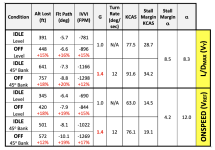
Here are the results of similar testing in an RV-4 with a fixed pitch propeller. The data in these charts were taken from the tabulated data shown in post 11 above to show the basic relationships for some risk management points to ponder. Testing was conducted to develop a drag correction method to eliminate residual thrust at IDLE power, so low-altitude testing could be conducted where repetitive engine-off testing was too high risk (at least for this pilot). In this case, we are looking at both glide conditions: maximum range and maximum endurance wing's level and at an optimum bank angle for maneuvering. Overall, engine off (vs IDLE) performance is about 20% worse overall. Thus if you were to practice and finely tune your Mark I eyeball using IDLE power even under demanding, edge of the envelope RIGHT STUFF conditions flying by the seat of your finely tuned pants using superior judgment and an analog clock while being engaged by an SA-8 in severe icing, you would still never see the actual sight picture you'll see the first time you dead stick the airplane. OK, tongue was firmly planted in the cheek for the first half of the last sentence, but the part in bold is dead serious. It's why we test.

Screenshot 2024-08-08 at 11.23.33 AM.png

Apples and oranges vs an RV-7 with a controllable prop, but the two airplanes share a common airfoil, planform and flap configuration. The results clearly show the contribution of residual thrust produced by the idling fixed pitch propeller in the RV-4. Some follow-on testing with flaps deployed resulted in developing a configuration (flaps 40 in this case) that could be safely employed at low-altitude. The reason the stall margin (difference between actual speed and stall speed) increases with bank angle (g-load) is because these tests are flown at a constant angle of attack. In this case the AOA is the difference between the relative wind and the fuselage reference line (canopy rail):

Screenshot 2024-08-08 at 11.23.45 AM.png

As we said above, with the OP's RV-7, it is also possible to develop a zero-thrust manifold pressure/RPM combination that would produce similar results, but only after baseline engine off performance is determined.

I only bring this up as an example of operational risk management in test. We accept some risk during high altitude testing (where we employ risk mitigation options and use a build-up approach) to mitigate risk testing in the low-altitude environment AND, as a fringe benefit have developed a training technique that allows me to practice dead stick approaches with the proper site picture. In the spirit of Paul's post, whether we built our airplanes or not, they are experimental, says so right on the type certificate. How we choose to think of ourselves as pilots (or mechanics or engineers regardless of our "real life" background) is a personal decision and so is the way we manage risk. It's awesome to learn from one another, and it's very cool to have a test and technique discussion like this one!

Here's to a happy, healthy 2025 with some good flying,

Vac
 
Last edited:
What reason did they give?
There was one short sentence, buried in the middle of the policy, which they contend excluded catastrophic engine failures. It was an interpretative position on their part and they basically said, "get a lawyer if you want to fight it". Due to potential cost, timing and personal issues, we decided not to pursue it; instead, we parted what was left of the airplane.

Lesson learned. Know every line of your policy.
 
Quick clarification:

The AOA for min sink (or maximum endurance glide) = AOA for minimum power = the square root of 3 x AOA for L/Dmax = 1.73 x AOA for L/Dmax.

The VELOCITY for min sink (max endurance glide) = VELOCITY for minimum power = 1 divided by the 4th root of 3 x VELOCITY for L/Dmax = .76 x VELOCITY for L/Dmax.

The math is explained concisely here for those interested: Some Comments on Angle of Attack Systems Calibration.

I'm looking forward to see the results of the testing conducted by the OP and the lessons they learned :cool:..

View attachment 77689
Vac,
Quite right and thanks for the (gentle) correction of my post above (#45) which I have edited to remove my error.

Also, thanks for posting your real world data for the RV-4.

Peter
 
Back
Top