Van's Air Force

The definitive Van's Aircraft support community! Buying, building or flying an RV? Join our exclusive family of mentors and enthusiasts!

Using mouse milk

Tankerpilot75

Well Known Member
A good friend suggested I use mouse milk on my exhaust pipe connections to keep them loose and help prevent exhaust pipe cracking. My questions are:

1. how much mouse milk should be applied to these connections?
2. since mouse milk is a penetrating oil and flammable should the oil be allowed to dry before running the engine?
3. how often should the exhaust joints be lubricated?
4. what is the best way to apply mouse milk?
 
I apply mouse milk every time the bottom cowl is off or nearly every time. Just a few drops at the join and it burns off quickly after the exhaust gets hot. I had not noticed excessive smoke or smell as a result. My bottle of mouse mike comes in a way that I was able to insert a very thin straw and that way I can get it to the right place in the tight area.
Hope this helps
Happy new year
 
Out of curiosity, is there an alternative product for this use? Surely something else equivalent has come along since all the old timers were using nothing but Mouse Milk.
 
The instructions that Vetterman exhaust comes with recommends to use MM everytime the cowl is off. I put it in a small syringe and put a few drops on each joint then give pipes a good shake to make sure the ball joints are loose. It is very thin and evaporates quickly.
 
I've always poo-poo'ed the Mouse Milk ritual. It may penetrate and lubricate the ball joints in the exhaust, but it will burn off with the first engine run. So it just seems like applying it once every 25 hrs could not have much effect on exhaust system joints staying loose.

It would seem more important to support the exhaust well, connected to the engine, not the motor mount, so that the whole engine and exhaust can move as a unit.
The main source of stress on the exhaust is then the thermal expansion of the cylinders, which moves the down-pipes of a cross-over system apart by something like 0.080".

On the other hand, my exhaust on my 200 hp angle-valve 360 just developed a couple of cracks at 800 hrs. despite having it well supported. So...I don't know. I confessed to Klint at Vetterman that I had never put Mouse Milk on the joints and he said, 'don't feel bad, it probably would not have made any difference." But it doesn't cost much, only takes a minute. I guess I'll start doing just to follow the ritual.
 
Another vote for the MM ritual.

At 450 hrs my exhaust system ball joints had become seized, which caused the exhaust hangers to fail. After cleaning the accumulated crud out of the ball joints and repairing the hangers, I’ve been adding a cleansing squirt of MM to those joints every time the cowl is off. Now at 1050 hrs the ball joints remain freely articulating.

My other learning from this was to adapt my pre-flight routine to include giving the exhaust pipes a shake, to confirm articulation and hanger integrity. Maybe it’s this keeping the joints free and the MM ritual is a placebo, or maybe both are helping as intended. But the MM is not doing any harm and I’m getting the outcome I need.
 
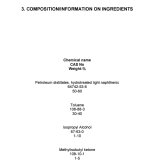
Mouse Milk below. With these ingredients, what can it do beyond a very temporary solvent effect?

ScreenHunter_2582 Dec. 31 20.50.jpg
 
Mouse Milk below. With these ingredients, what can it do beyond a very temporary solvent effect?
I agree.

Is there anything better that has the ability to wick down into the ball joints and has any meaningful lubricating properties for, I dunno, 25 hours at those temperatures? I've used MM and anti-sneeze. I dunno that the anti-seize penetrates far enough to do much or that the mouse milk will stay around for long enough to do anything.
 
I don’t believe MM lubricates the joint at all, except very short term. I do theorize that the solvents dissolve or dislodge the exhaust deposits that, overtime, can seize the joint.

I do know that I can feel a difference in pliability at the joint after it is applied. You can “feel” a bit of grittiness which I believe are exhaust deposit related.
I have used it from day one and the joints have stayed free.
I apply it at each CI.

I think any solvent would work if there is any benefit at all. I will keep using MM as it’s easy to apply and one small bottle is a life time supply for that job.
I’m not willing to stop using it to see if my ball joints freeze up. ;)
So, we may never know.

Steve - I beleive you need the exhaust to have some movement mid span of the exhaust flange and the exhaust support. That is a lot of mass hanging off of the flange and guess it might need to move a bit to dissipate vibration and engine movements. The Biplane has a similar design and uses the “spring” style ball joints. Just a guess.
 
I think it is more about eliminating corrosion and not lubricating. been using the mouse for 25 years on the original system. all is well. lube whenever the cowl is off.
While 316 stainless is very corrosion resistant, it can corrode under high heat. I’ll buy your theory. However, MM is burned off completely in a very short time, so whatever work it is doing is short lived. Keeping exhaust deposits from building up could very well reduce the chance of it corroding. I like it.
 
I also have been using the McFarland thin anti seize. Cost more, but has a silver graphite that goes into the joint and doesn’t burn off. Just use a little amount each time the cowl is off.
 
Now that the magic properties of Mouse Milk is debunked :), check out this fun video from Project Farm re anti-seize compounds.
It is a pity Loctite et al does not have a liquid based spray on/in product. Liquid Film flunked.
 
How do you get it into the joints?
The builder of my RV when teaching me to do the oil change removed the heavy springs holding the joints, separated and cleaned them up nicely and applied the anti-seize. I don't believe this needs to be done at *every* oil change. Will check in a while how it holds up. I have some copper based anti-seize which is rated for 2000F.
 
My theory is this…MM burns off

However…it penetrates the joint to loosen any binds. Everyone knows the exhaust shakes the most during the start…the combination of the shake and penetrate during that start, frees stuff up.

I’m guessing residual carbon from MM burning up could act as a lube also 🤔
 
To apply Mouse Milk, dip a small screwdriver in the bottle and drag the tip around the joint. It will wick right in.
 
I used a nickel based anti seize.
Nickel based anti seize is my go-to. Yes it is expensive but a can will last forever. It is also the recommended anti seize inside jet engines. Jet engines get hot enough to melt stuff. Nickel based anti seize it is designed to provide the thread a nickel coating, even when everything is glowing barbeque red hot.
 
Zinc base anti-seize.
I used a nickel based anti seize.
Nickel based anti seize is my go-to.

What brand and where do you buy your zinc and/or nickel based anti seize?

I confessed to Klint at Vetterman that I had never put Mouse Milk on the joints and he said, 'don't feel bad, it probably would not have made any difference."

What does Vetterman recommend using?
I have been using mouse milk for 20 years and joints are still free and smooth but always looking to find something better.
 
What brand and where do you buy your zinc and/or nickel based anti seize?
Well, to come clean, I typed zinc but meant to type nickel. Nickel has a greater temperature range. I'm using Permatex 77134; it's widely available online from places that will deliver in 2 days... Copper as also mentioned above has a high heat range, but I'm not sure the difference matters. If your exhaust is stainless steel, nickel may be superior to copper as it is less likely to cause galvanic corrosion.
 
How do you get it into the joints?
Laugh if you will, but I dilute the nickel anti-seize with mouse milk and use a syringe to get the joint wet all the way around - like soldering a copper pipe joint. I can not say it is penetrating though and only do it on annual. Mouse milk with a tube on a syringe gets to the joints easily and makes less mess - applied anytime the cowl is off. I have ball joints on each down pipe and when the exhaust has been off for other reasons they all get taken to the vice and exercised with nickel stuff. They are usually stuck pretty well. FWIW.
 
Edit...
Turns out shippers don't like syringes.
You can get them from any pharmacy.
 
Last edited:
It is interesting that some of the commenters here report that their ball joints stay free with Mouse Milk. So perhaps it is doing something. On the other hand, BillL says his are usually pretty stuck. Mine do not stay free, at least at the force level of just trying to see if I can move them. Maybe just the periodic lube and wiggle is enough to keep them from locking up.
 
I got a sample size bottle of D A M Exhaust Lube as a door prize at the Cessna 140 convention a couple years ago. I have not used any yet. On their webpage it just says
“low viscosity liquid is blended with molybdenum-disulfide and other special micro-lubricants to produce a protective dry lubricant film. This film embeds into the stainless steel and keeps your joints lubricated for years!”
It actually feels and looks like graphite.

Anybody using this?
 
Last edited:
The MSDS for mouse milk lists a few solvents and lubricating oil. The solvent probably loosens the accumulated crud, evaporates, and leaves some oil film. Not a whole lot of magic there :)
 
I got a sample size bottle of D A M Exhaust Lube as a door prize at the Cessna 140 convention a couple years ago. I have not used any yet. On their webpage it just says
“low viscosity liquid is blended with molybdenum-disulfide and other special micro-lubricants to produce a protective dry lubricant film. This film embeds into the stainless steel and keeps your joints lubricated for years!”
It actually feels and looks like graphite.

Anybody using this?
The site also says that copper, nickel anti-seize and especially graphite is bad for stainless steel at high temperatures. Their compound is roughly 75% naptha (as a wicking vehicle), 10% molybdenum-disulfide (MoS2), and 15% trade secret ingredients. Does the MouseMilk MSDS list any "trade secret" ingredients? My guess is that some DIY concoction of naptha as a vehicle (or acetone, toluene, etc) plus dissolved MoS2 grease will yield the majority of the effectiveness of the commercial products. Molybdenum particles left after the carrier burns off are extremely high heat resistant and protect the SS from corrosion...so I'm told. I just bought a bottle of MouseMilk to try out.
 
The site also says that copper, nickel anti-seize and especially graphite is bad for stainless steel at high temperatures. Their compound is roughly 75% naptha (as a wicking vehicle), 10% molybdenum-disulfide (MoS2), and 15% trade secret ingredients. Does the MouseMilk MSDS list any "trade secret" ingredients? My guess is that some DIY concoction of naptha as a vehicle (or acetone, toluene, etc) plus dissolved MoS2 grease will yield the majority of the effectiveness of the commercial products. Molybdenum particles left after the carrier burns off are extremely high heat resistant and protect the SS from corrosion...so I'm told. I just bought a bottle of MouseMilk to try out.
I am not sure what is in Mouse Milk, but it has worked for me on 2 garden hose connections that were aluminum and corroded to the hose bib's and the attached sprayers via some kind of electrolysis. I tried acetone/ATF mix, Sea Foam Deep Creep, and PB Blaster, all to no avail. Furthermore, I thought I was going to have to replace the hose bib but thought to give it one more try with the Mouse Milk. That did the trick.
 
Back
Top