Van's Air Force

The definitive Van's Aircraft support community! Buying, building or flying an RV? Join our exclusive family of mentors and enthusiasts!

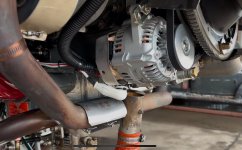
How to set up cooling for internally regulated alternator? Anyone have reliability issues due to heat?

I've been informed by someone who actually tested it, that the black corrugated tubing restricts airflow terribly. I used it (5/8 ID, 3/4 OD) to cool my alternator and measured temps as high as 180F. Use smooth inside wall tubing (scat)!
Not doing so is probably what will cost me 100's of repair hours and thousands of $ in replacement parts (incl propeller). Well, that and piloting skills. More about that later when NTSB is done and I have bench tested alternator and done battery autopsy.
Oh, and those of you that have battery forward of firewall, do put a temp probe on it and check temps against battery manufacturer's specs, especially if you have only electronic FI and/or ignition (no mags).
I apologize if you posted details elsewhere about the accident, but the alternator overheating and failing caused the battery to also fail which then caused loss of ignition and the crash?

Which battery and what ignition/fuel setup? trying to learn and understand to be safer flying my RV. Thanks
 
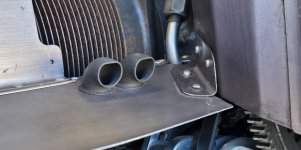
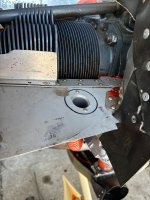
Promised picture of blast tube inlet.
I chose to cold form a small scoop out of concern that the air moving across the tube may have a siphon effect. However, I have no proof, or understanding of how the air moves across the ramp to know if it is necessary, helpful, or a waste of time.View attachment 75672

Not exactly like yours, but I had an opening with no scoop. Little cooling. Added a scoop and dramatically cooler.
(Temp graphs at link below)
 
I apologize if you posted details elsewhere about the accident, but the alternator overheating and failing caused the battery to also fail which then caused loss of ignition and the crash?

Which battery and what ignition/fuel setup? trying to learn and understand to be safer flying my RV. Thanks
Not yet posted elsewhere. I'm slow. I just wanted to get the warning out about having battery on the hot side of the firewall and of using the (cheap) corrugated tubing for cooling blast tube. Relevant to alternator cooling and flight-critical for airplane with no magnetos!

Finn
 
Not exactly like yours, but I had an opening with no scoop. Little cooling. Added a scoop and dramatically cooler.
(Temp graphs at link below)
Good to know. My pea brain wasn’t convinced that airflow over the top of the tube was providing forced air. Thanks for providing the real world data. So, for those that put blast tubes in the inlet ramp, blast air may not be flowing.
I feel good about my little scoop.
 
Good to know. My pea brain wasn’t convinced that airflow over the top of the tube was providing forced air. Thanks for providing the real world data. So, for those that put blast tubes in the inlet ramp, blast air may not be flowing.
I feel good about my little scoop.
Not having that little scoop cost me a $1000 alternator repair. Education can be expensive!
 
I wonder if people with carbureted vs fuel injected engines have a difference in alternator life. On my O-360 carb one of the exhaust pipes is right next to the alternator. I put a small heat shield on it, and plan to make a bigger one.

I have a rough running list of things that affect alternator cooling:
  • Inlet duct vs no inlet duct. Duct is better.
  • SCAT tubing vs black corrugated tubing. SCAT tubing is better.
  • Exhaust proximity and heat shield. Fuel injected engines have exhaust pipes further from alternator, and heat shields will reduce heat transfer.
  • Aiming tube at the back vs having a duct to direct flow. In theory, having a duct will be more effective and not have flow spill over the edges.
 

Attachments

  • IMG_6811.jpeg
    IMG_6811.jpeg
    408.3 KB · Views: 54
I wonder if people with carbureted vs fuel injected engines have a difference in alternator life. On my O-360 carb one of the exhaust pipes is right next to the alternator. I put a small heat shield on it, and plan to make a bigger one.

I have a rough running list of things that affect alternator cooling:
  • Inlet duct vs no inlet duct. Duct is better.
  • SCAT tubing vs black corrugated tubing. SCAT tubing is better.
  • Exhaust proximity and heat shield. Fuel injected engines have exhaust pipes further from alternator, and heat shields will reduce heat transfer.
  • Aiming tube at the back vs having a duct to direct flow. In theory, having a duct will be more effective and not have flow spill over the edges.
Ah, but do you have a scoop on the inlet?
 
Ah, but do you have a scoop on the inlet?
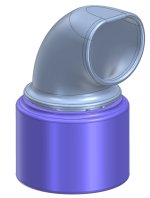
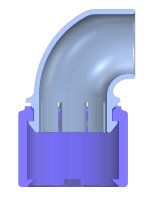
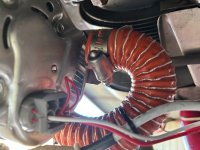
Attached is a scoop design I did a while back. It's made to hold .83" dia corrugated tubing like many of us use. It requires a .750" dia hole in the baffle to fit. You need to file a small notch into the aluminum for clocking, and the parts snap together. The ones below are made via MJF- PA-12 nylon, but SLS PA-12 would be fine too. Those shown have been installed for about 1.5 years.

1735350994793.jpeg1735351039368.jpeg1735351054624.jpeg
 

Attachments

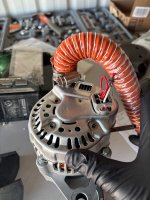
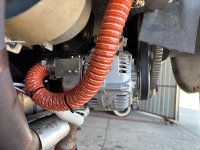
I upgraded from 0.83" corrugated tubing to 1" scat tubing, as PP recommends. I also build a bracket to aim the scat tubing right at the heat fins.

I'm also working on machining a metal duct to cover the back of the alternator and increase air flow. Photo of the 3d printed prototype attached. I also plan to do a test with and with out a scoop.
 

Attachments

  • IMG_7134.jpeg
    IMG_7134.jpeg
    2.4 MB · Views: 52
  • IMG_7132.jpeg
    IMG_7132.jpeg
    2.2 MB · Views: 54
  • IMG_7129.jpeg
    IMG_7129.jpeg
    2.5 MB · Views: 55
  • IMG_7135.jpeg
    IMG_7135.jpeg
    2.4 MB · Views: 46
  • IMG_7094.jpeg
    IMG_7094.jpeg
    2.1 MB · Views: 57
  • Like
Reactions: MED
I upgraded from 0.83" corrugated tubing to 1" scat tubing, as PP recommends. I also build a bracket to aim the scat tubing right at the heat fins.

I'm also working on machining a metal duct to cover the back of the alternator and increase air flow. Photo of the 3d printed prototype attached. I also plan to do a test with and with out a scoop.
I am interested in the temperature differences you find with/without a scoop.
 
I had alternator reliability issues with an internally regulated PP that began failing regularly when hot. My plane now has an externally regulated B&C alternator.

With a new internal regulator fitted my old alternator lives on in another aircraft with more than 1000hrs on it. When it begins failing again I think it’ll be time for its new owner to replace the regulator once more - or change to externally regulated.

Can anyone explain to me what the difference is between internally and externally regulated alternators?
Are there alternative alternators without this issue?
Is this an issue with rv10s?

Is there something unique about rvs ? I have not heard of this directed cooling being needed in certified (I came from a 172).
 
Can anyone explain to me what the difference is between internally and externally regulated alternators?
Are there alternative alternators without this issue?
Is this an issue with rv10s?

Is there something unique about rvs ? I have not heard of this directed cooling being needed in certified (I came from a 172).
It seems to be an issue related to some PP alternators in some installations. The B&C alternators don't seem to have this problem. I have a PP and don't (yet) have this problem. If you are making a decision about an alternator, you don't need to buy the PP and go through all this hassle - just buy the Monkworkz or the B&C alternator.


Heat is generally not good for electronics, and there are a couple of ways to deal with it - avoid heat from the exhaust pipes, and cool the alternator. I've seen some pictures of people with the exhaust pipes right next to the alternator without a heat shield - this will most certainly cook the alternator and its electronics. Very bad. Adding cooling but no heat shield seems ineffective. If you have good shielding, and still get high temps on your alternator, some cooling air will of course cool the alternator. Could help.

The exact failure modes of the PP alternators are not fully understood (at least by me) and the effectiveness of the mitigations proposed also don't seem to be confirmed to ensure success. We've heard about failures in the electronics and failures in the bearings - both most likely caused by heat. As mentioned, too much heat is generally a bad thing.

I have not heard of any failures of properly installed B&C or Monkworkz alternators, but we've heard of dozens of PP alternators failing. As mentioned, I've got a PP with no blast tube, and I'm watching it closely. So far so good.
 
If you are making a decision about an alternator, you don't need to buy the PP and go through all this hassle - just buy the Monkworkz or the B&C alternator.
This.
I have not heard of any failures of properly installed B&C or Monkworkz alternators, but we've heard of dozens of PP alternators failing.
Not just alternators — also PP external voltage regulators. My relatively youthful one took a dump on me.
 
Back
Top