I ran across something interesting today, and I wonder if others have seen it. I wanted to get this written out while it's still fresh in my my memory.
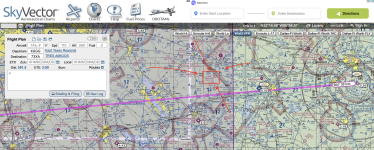
This morning I launched out of Longview TX KGGG for home 73XA VFR with flight following at 8500, due to higher headwinds aloft. Preflight, taxi and takeoff were normal, as was the climb through about 4000. Shortly thereafter I noticed my CHT's, or more exactly THREE of my four CHT's, were rising rapidly. I caught this as they were climbing through 400F, and assumed I was in detonation in those cylinders. I turned my mixture stupid fat rich to about 10.0 to stop it - and it slowed it down, but they did not drop as expected. I slowed my climb rate to 500/min to gain airspeed for cooling, and the CHT's were still climbing as I was coming up through about 7000'. With the mixture stupid rich I was able to stabilize temps at 423, 428, 318, and 405. Yep, those numbers are right - #3 was just happy. I know those temps are not what some would consider excessively high, but they are about 50 degrees high for me in normal climb, and more like 80-100 degrees high for running that rich. But now my oil temp was climbing through 230. Clearly I had some kind of issue going on. I have piston oil squirters, so high CHT's mean high oil temp, but I should have been able to dump the heat with 38F ambient air in a 110 KIAS climb. I changed tanks in case it was some kind of fuel contamination and kept troubleshooting, it wasn't the fuel.
As I leveled off at 8500 and built airspeed, I continued troubleshooting, swinging the mixture to deep LOP at about 17.0, and could keep the CHT's stable there as well. My cruise airspeed was down about 12-15 knots from usual, that makes sense for lower power hard-LOP, and any attempt to approach "normal" mixture numbers resulting in rapid increases of CHT's (still 3 out of 4 running hot) and oil temp was still climbing to the high 230's. All this time I was on a direct course from KGGG to the Cedar Creek VOR CQY, which takes me right over the top of Tyler, and it was in my mind that Tyler would be an excellent divert - but I was still climbing and making power (and lots of heat) while troubleshooting.
I run the SDS system, and was thinking it might be a timing issue, still thinking detonation was my problem. I changed to the backup computer board which runs about 13 AFR mixture, CHT's took off upward again, back to the primary board. Checked out the mags one at a time, saw the expected EGT rise, no change on CHT's. I pulled my rpm back to about 1900 and cut off my SDS power entirely, with the engine dying as expected, then powered it back up again, the engine came back, and I returned the rpm to 2500, a brief dip in CHT's from the lack of power but they were still elevated and now my oil is at 240.
By this time I had gone through Longview Approach and was talking to Center, I called them up and told them I was having an overtemp issue on my engine and wanted to divert to Tyler to check it out. I was only a couple miles west of Tyler at that point, at 8500', and had gobs of altitude to make the field if the engine quit. I didn't declare an emergency but in hindsight probably should have - always better to have all options at your disposal. Center sent me back to Longview Approach and by the time I called them they were aware of my issue and offered me any runway I wanted. I told them I had partial power and plenty altitude and would take a right downwind into 22 with the normal traffic. As I pulled power back to about 8" manifold pressure and starting dropping, of course the CHTs were coming down - but I don't trust the engine any more at this point and I'm committed to the divert. I kept it at or near idle all the way down with just short blips of power to confirm it's still running, set up for high drag steep no-power approach to an uneventful landing and taxied off to the FBO. Rescue rolled right behind me and followed me to parking, took down my info and departed back to their still-warm cups of coffee. Major kudo's to those guys for being there, always good to have them and not need them.
So the issue?
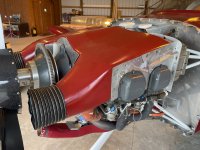
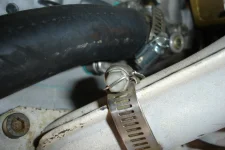
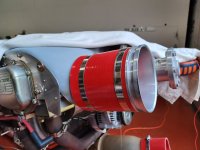
I decowled the plane and it was obvious as day - I have the Sam James cowl and Sam James Plenum, which uses a neoprene sleeve between the air inlet rings and the plenum body to absorb the relative movement between the two during startup/shutdown and other engine vibration. I had lost the band clamp holding the neoprene sleeve to the left air inlet and the sleeve had collapsed on itself into the air inlet of the plenum, cutting off half my cooling airflow. My oil cooler takes air from the back of the left side of the plenum, so of course it was getting hot. The only cooling air available to the left cylinders was what could come across the top of the engine from the right hand side. The band clamp fell down through the bottom of the cowl and was gone. I called a local mechanic and we found a replacement band clamp, fitted it up, cowled up, and continued the trip home with perfect cooling.
So now the question - has this happened to others? Is there a better design method for attaching that neoprene sleeve to the air inlet ring and the plenum? A stiffer sleeve material that will mostly hold it's own in that predicament? Some type of adhesive that others have used instead of the band clamp? Inquiring minds want to know...
This morning I launched out of Longview TX KGGG for home 73XA VFR with flight following at 8500, due to higher headwinds aloft. Preflight, taxi and takeoff were normal, as was the climb through about 4000. Shortly thereafter I noticed my CHT's, or more exactly THREE of my four CHT's, were rising rapidly. I caught this as they were climbing through 400F, and assumed I was in detonation in those cylinders. I turned my mixture stupid fat rich to about 10.0 to stop it - and it slowed it down, but they did not drop as expected. I slowed my climb rate to 500/min to gain airspeed for cooling, and the CHT's were still climbing as I was coming up through about 7000'. With the mixture stupid rich I was able to stabilize temps at 423, 428, 318, and 405. Yep, those numbers are right - #3 was just happy. I know those temps are not what some would consider excessively high, but they are about 50 degrees high for me in normal climb, and more like 80-100 degrees high for running that rich. But now my oil temp was climbing through 230. Clearly I had some kind of issue going on. I have piston oil squirters, so high CHT's mean high oil temp, but I should have been able to dump the heat with 38F ambient air in a 110 KIAS climb. I changed tanks in case it was some kind of fuel contamination and kept troubleshooting, it wasn't the fuel.
As I leveled off at 8500 and built airspeed, I continued troubleshooting, swinging the mixture to deep LOP at about 17.0, and could keep the CHT's stable there as well. My cruise airspeed was down about 12-15 knots from usual, that makes sense for lower power hard-LOP, and any attempt to approach "normal" mixture numbers resulting in rapid increases of CHT's (still 3 out of 4 running hot) and oil temp was still climbing to the high 230's. All this time I was on a direct course from KGGG to the Cedar Creek VOR CQY, which takes me right over the top of Tyler, and it was in my mind that Tyler would be an excellent divert - but I was still climbing and making power (and lots of heat) while troubleshooting.
I run the SDS system, and was thinking it might be a timing issue, still thinking detonation was my problem. I changed to the backup computer board which runs about 13 AFR mixture, CHT's took off upward again, back to the primary board. Checked out the mags one at a time, saw the expected EGT rise, no change on CHT's. I pulled my rpm back to about 1900 and cut off my SDS power entirely, with the engine dying as expected, then powered it back up again, the engine came back, and I returned the rpm to 2500, a brief dip in CHT's from the lack of power but they were still elevated and now my oil is at 240.
By this time I had gone through Longview Approach and was talking to Center, I called them up and told them I was having an overtemp issue on my engine and wanted to divert to Tyler to check it out. I was only a couple miles west of Tyler at that point, at 8500', and had gobs of altitude to make the field if the engine quit. I didn't declare an emergency but in hindsight probably should have - always better to have all options at your disposal. Center sent me back to Longview Approach and by the time I called them they were aware of my issue and offered me any runway I wanted. I told them I had partial power and plenty altitude and would take a right downwind into 22 with the normal traffic. As I pulled power back to about 8" manifold pressure and starting dropping, of course the CHTs were coming down - but I don't trust the engine any more at this point and I'm committed to the divert. I kept it at or near idle all the way down with just short blips of power to confirm it's still running, set up for high drag steep no-power approach to an uneventful landing and taxied off to the FBO. Rescue rolled right behind me and followed me to parking, took down my info and departed back to their still-warm cups of coffee. Major kudo's to those guys for being there, always good to have them and not need them.
So the issue?
I decowled the plane and it was obvious as day - I have the Sam James cowl and Sam James Plenum, which uses a neoprene sleeve between the air inlet rings and the plenum body to absorb the relative movement between the two during startup/shutdown and other engine vibration. I had lost the band clamp holding the neoprene sleeve to the left air inlet and the sleeve had collapsed on itself into the air inlet of the plenum, cutting off half my cooling airflow. My oil cooler takes air from the back of the left side of the plenum, so of course it was getting hot. The only cooling air available to the left cylinders was what could come across the top of the engine from the right hand side. The band clamp fell down through the bottom of the cowl and was gone. I called a local mechanic and we found a replacement band clamp, fitted it up, cowled up, and continued the trip home with perfect cooling.
So now the question - has this happened to others? Is there a better design method for attaching that neoprene sleeve to the air inlet ring and the plenum? A stiffer sleeve material that will mostly hold it's own in that predicament? Some type of adhesive that others have used instead of the band clamp? Inquiring minds want to know...
Last edited: