Van's Air Force

The definitive Van's Aircraft support community! Buying, building or flying an RV? Join our exclusive family of mentors and enthusiasts!

Major or Minor Change?

DanH

Legacy Member
Benefactor
Advertiser
Mentor
I'm wrapping up some changes to an RV-8...

Remove a carb, install an AFP FM-150 and the appropriate pumps
Install a Raven inverted oil system
Install a flop tube in the left tank per Vans drawings
Install second seat belt anchor points, both seats
Install rear seat rudder and brake pedals, w/ links
Do a fresh weight and balance.

FWIW, I expect the aircraft to come in slightly heavier, but not significantly different in terms of CG location.

The Operating Limitations contain the usual wording, which (to paraphrase) requires a determination of major or minor change as defined in 14 CFR 21.93, and if "major", informing the geographically responsible FSDO with a proposed test area. When approved, the aircraft is logged back into Phase 1 for five hours, or more if directed.

What say ye...major or minor?
 
I'm wrapping up some changes to an RV-8...

Remove a carb, install an AFP FM-150 and the appropriate pumps
Install a Raven inverted oil system
Install a flop tube in the left tank per Vans drawings
Install second seat belt anchor points, both seats
Install rear seat rudder and brake pedals, w/ links
Do a fresh weight and balance.

FWIW, I expect the aircraft to come in slightly heavier, but not significantly different in terms of CG location.

The Operating Limitations contain the usual wording, which (to paraphrase) requires a determination of major or minor change as defined in 14 CFR 21.93, and if "major", informing the geographically responsible FSDO with a proposed test area. When approved, the aircraft is logged back into Phase 1 for five hours, or more if directed.

What say ye...major or minor?
A “minor change” is one that has no appreciable effect on the weight, balance, structural strength, reliability, operational characteristics, or other characteristics affecting the airworthiness of the product.

I go for a minor change.

Good luck
 
Seems major (heck, almost impossible for ME) but in the spirit of the reg I would say changing from Carb to FI has an effect on reliability. It's a positive effect, but testing makes sense.
 
Seems major (heck, almost impossible for ME) but in the spirit of the reg I would say changing from Carb to FI has an effect on reliability. It's a positive effect, but testing makes sense.
THIS ^, Also adding the flop tube could easily affect reliability.
 
Seems major (heck, almost impossible for ME) but in the spirit of the reg I would say changing from Carb to FI has an effect on reliability. It's a positive effect, but testing makes sense.
THIS ^, Also adding the flop tube could easily affect reliability.
If the flop tube or fuel injection had no certification or service history I'd agree that in the aggregate, this would be a major change with respect to reliability. But those are known, proven systems or parts of the basic design with a long service history so I think you could make the case that it's "minor".

ds
 
I vote "Minor" with caveats. I think the key to this is in the word "appreciable" in the FAR; Here's my thinking change-by-change:

1. Carb to FI -- Still controlled by a Throttle and Mixture knob/lever, starting technique changes, but those techniques are widely varied previously. (Minor)
2. Inverted Oil -- Engine still receives lubrication in normal (+1G) flight regimes. No pilot intervention required to enable/disable it. (Minor)
3. Flop Tube -- Engine still receives fuel in normal (+1G) flight regimes. No pilot intervention required to enable/disable it - aside from selecting the correct tank, which is appropriately placarded. (Minor)
4. Second Seat Belt -- Didn't change the operation of the primary seatbelt. (Minor)
5. Rear Rudder/Brakes -- This one might trigger the appreciable test as the operation of the existing rudder/brake could possibly change if the rear seat is occupied and rear seat panic sets in. (Major)
 
Concern for reliability is not the same as "appreciable affect" on reliability. The operative word being "appreciable", meaning perceptibly measurable or significant. If you cannot apply a metric to the appreciable affect, then it is automatically not measurable. Even if measured - you've already said they are not significant changes, and I believe that is your answer.

As was pointed out previously, none of the items performed individually rise to the level of a major change by the letter of the regulation. I would simply note the changes with a log entry.

Now, I'm guessing the road you're going down is that these are changes to the aircraft - what is their defined impact? I have no doubt you will monitoring for reliability and affect on the aircraft performance, which should absolutely be done. But then I would do the same thing if I just completed any maintenance, including changing oil brands or waxing the airframe.

I agree with your changes being minor. I'm curious on where you land on this Dan.
 
I'm wrapping up some changes to an RV-8...

Remove a carb, install an AFP FM-150 and the appropriate pumps
Install a Raven inverted oil system
Install a flop tube in the left tank per Vans drawings
Install second seat belt anchor points, both seats
Install rear seat rudder and brake pedals, w/ links
Do a fresh weight and balance.

FWIW, I expect the aircraft to come in slightly heavier, but not significantly different in terms of CG location.

The Operating Limitations contain the usual wording, which (to paraphrase) requires a determination of major or minor change as defined in 14 CFR 21.93, and if "major", informing the geographically responsible FSDO with a proposed test area. When approved, the aircraft is logged back into Phase 1 for five hours, or more if directed.

What say ye...major or minor?
I’m curious… how did you do the second seat belt anchor points? Got pics? I was going to do that on my RV-8, but then I just decided it was too much trouble. So I got an Extra instead!😊

Sounds like someone is interested in IAC competition aerobatics!

Jerry
 
If the flop tube or fuel injection had no certification or service history I'd agree that in the aggregate, this would be a major change with respect to reliability. But those are known, proven systems or parts of the basic design with a long service history so I think you could make the case that it's "minor".

ds
The same argument could be used for an airplane that had a brand new certificated engine at the time of initial certification, but it only reduces the required phase one test time by 15 hrs if it was paired up with a combination certified propeller.
The actual installation and the person doing it is part of the reliability equation.

So my opinion is that in this case, it is a major change.
Having said that, the important consideration is what the authorities in your local area think. I know at times we feel there is a risk in asking and would prefer to just ask for forgiveness later, but someone from the FAA is the opinion/position that actually counts.

Part of the reason I say you should ask is our local FSDO office has gone on record saying it is only a major change if the type of propeller, as in fixed pitch to constant speed, or an entirely different type of engine is what constitutes a major change.
They consider most others to be a minor change.
I don’t feel that this matches up with the definition as defined in a number of different places in the FAR’s, so I prefer to recommend that people be conservative to avoid any future enforcement issues.
By the way, it is very important that people are clear on the exact details of the operating limitation for THEIR aircraft. Some allow the operator to self place the Aircraft back into phase one for five hours, some older ones and newer ones require communication with the local FSDO to define what the current phase one flight test area is.
The newest limitation is actually beneficial to an owner that purchased an airplane from another party, because they are not tied to using the phase one flight test area that was defined in the originally issued airworthiness certificate. They are able to simply contact their local FSDO and get a written confirmation of approval for their proposed local phase 1 flight test area. This can usually be done via email.
 
Minor change. Jumping from airplane to airplane, a generic pilot would need zero training to operate either configuration safely.
 
A comment more specifically addressing the original question, adding the additional seatbelt and / or rear seat rudder pedals I would consider a minor change.
Everything else is a major change because it could affect the operational reliability of the aircraft.
That is largely the purpose of the original phase one flight test period.
Saying that all of the new equipment provides the same function as the removed equipment, and therefore makes it a minor change, would be the same as building new wings with an entirely different air foil and saying that the process for producing lift is the same as the original wings, so it is therefore a minor change.
I think we could all agree that that would be a major change.
The test period is also not to prove that any typical pilot could fly the airplane as modified.
 
Everything else is a major change because it could affect the operational reliability of the aircraft.

Assuming all the other changes are in accordance with standard aircraft and design standards, then that ship has sailed in my mind. The reliability value is quantified with plenty of data. Printing a crank drive gear out of some new, space age nylon wonder material…., that’s a “ reliability” issue that deserves promotion to the “major” category. Carbs and FI are both installed on airplanes with regularity. Same with flop tubes, seat belts, etc. all normal stuff that requires no difference in pilot action.
 
I’m curious… how did you do the second seat belt anchor points? Got pics? I was going to do that on my RV-8, but then I just decided it was too much trouble. So I got an Extra instead!😊

Sounds like someone is interested in IAC competition aerobatics!

Jerry
I’m interested to see what DH did too. Here is the most famous implementation
 
2015 my DAR, who has since retired, and was at the time retired from FSDO, spent a LOT of time discussing this. Prop change, fixed pitch to fixed pitch, minor change. Engine Change Lyc 0 235 to IO360 minor change. Piston engine to turboprop major change. etc etc
I believe this was around 2010 so may have been before the current rules. RV4 pilot a long ways from home, landed at North Vegas and taxied into something destroying the wood fixed pitch prop. I got involved because I offered to loan the guy a wood fixed pitch prop designed for RV4. FSDO would not let the airplane leave except with an identical Sensenich wood prop to the damaged one. My recollection is that the airplane sat there for three months while Sensenich built a new prop.
Unfortunately Vegas FSDO is one of several that I have had negative experiences with. So if there are 3000 FSDO inspectors in the FAA there are 3000 different rules for any given item.
Not quite that bad but close. I had an issue with the FAA where the FSDO Inspector volunteered to issue to me a temporary certificate. I very politely told him I thought it was not a good idea and we should let the issue run its course. A few days later I had a new certificate from region along with a letter of apology for the mess they had created.
One of my favorites: I was parking next to the FSDO following a freight run 5 days a week. FSDO Inspector showed up and very politely asked to inspect the airplane. Pilot side shoulder strap looked like it had been chewed half way thru by a rat. Inspector saw that and asked "what do you think I should do"? I said write it up, which he did. I called my boss in another state and he probably spent several hours arranging repairs. I think I laughed for the rest of the week.
 
I’m interested to see what DH did too. Here is the most famous implementation
Yup, very familiar with my mentor’s installation. That’s what I was going to do at the time.
 
Assuming all the other changes are in accordance with standard aircraft and design standards, then that ship has sailed in my mind. The reliability value is quantified with plenty of data. Printing a crank drive gear out of some new, space age nylon wonder material…., that’s a “ reliability” issue that deserves promotion to the “major” category. Carbs and FI are both installed on airplanes with regularity. Same with flop tubes, seat belts, etc. all normal stuff that requires no difference in pilot action.
The FAR’s have a requirement for a test flight on certificate Aircraft after major maintenance is performed so this is nothing unusual or specific to experimental amateur built, other than it has a specified flight test area, and a specified duration of time, with that primarily being a CYA for the FAA because the aircraft has the word experimental printed on it.
The same is required on certificate airplanes that have modifications installed via STC.
 
It’s all good until you have to stand in-front of the FAA and justify your “minor “ decision. Then, what we think here doesn’t matter. It’s what they think.
Here’s more of a question than an answer, but am I assuming, the odds of having to have that conversation would go with the aircraft for life. If there ever was a problem, no matter how long down the line, and that problem was associated with the change, would they then state it wasn’t taken back to Phase I ? Is there a “statute of limitation” per se?
I’m not sure I would want that argument.

When I saw Dan H had a question, I knew it wouldn’t be a black and white answer.
Dan - you could always call the FISDO and ask, if you dare…..
 
I'm curious on where you land on this Dan.

I am personally inclined toward "minor". The FI system, oil system, and flop tube are all proven components installed by the book. The seat belt and rudder pedal additions don't affect how the airplane performs.

However, it's not my airplane. Eventually it will be based in the geographic area of another FSDO (Vegas to be precise), and the owner has professional pilot credentials to protect. So...

Having said that, the important consideration is what the authorities in your local area think. I know at times we feel there is a risk in asking and would prefer to just ask for forgiveness later, but someone from the FAA is the opinion/position that actually counts.

...I did elect to ask for a ruling from the Birmingham FSDO. We may not be the only ones who think the practical application of 14 CFR 21.93 isn't real clear, as some time has passed. That's ok; no hurry here, and a written ruling keeps everybody's butt out of trouble, including the inspector's. I will be back with a pirep.

No great pain with going back into Phase 1 for five hours, but that involves the FSDO anyway. So why not ask?

Part of the reason I say you should ask is our local FSDO office has gone on record saying it is only a major change if the type of propeller, as in fixed pitch to constant speed, or an entirely different type of engine is what constitutes a major change.

I once designed and built an entire new propeller speed reduction unit, and contacted the BHM FSDO in writing for permission to fly it, per the Op Lims issued at the time. The response was (in short) "You have an EAB. Do whatever you like. Don't contact us again." Needless to say I carefully preserved the letter ;)

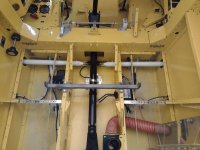
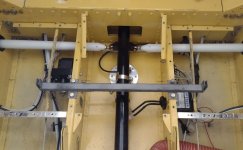
I’m curious… how did you do the second seat belt anchor points? Got pics?

Front patterned on Ron's...

Front Seat Belt Mount.jpg

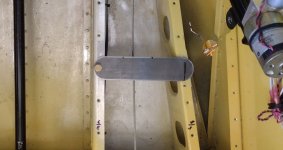
...but having four seat ribs in the back offered an opportunity to eliminate the crossbar. That's a short length of 0.125" thick 4130 strap in the photo. I've installed a nutplate under the flange on the F-814B-L-1 and I'm about to match drill the outboard end to the F-813-L-1.

Rear Seat Belt Attach Fab.jpg

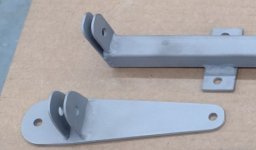
Later the strap was sawn to a suitable profile, and two ears were added.

Caveat: no significant structural analysis. It's strictly TLAR, so copy at your own risk.

Belt Mounts.jpg
 
Last edited:
The actual installation and the person doing it is part of the reliability equation.
So my opinion is that in this case, it is a major change.
Part of the reason I say you should ask is our local FSDO office has gone on record saying it is only a major change if the type of propeller, as in fixed pitch to constant speed, or an entirely different type of engine is what constitutes a major change.
They consider most others to be a minor change.

I don’t feel that this matches up with the definition as defined in a number of different places in the FAR’s, so I prefer to recommend that people be conservative to avoid any future enforcement issues.
By the way, it is very important that people are clear on the exact details of the operating limitation for THEIR aircraft. Some allow the operator to self place the Aircraft back into phase one for five hours, some older ones and newer ones require communication with the local FSDO to define what the current phase one flight test area is.
The newest limitation is actually beneficial to an owner that purchased an airplane from another party, because they are not tied to using the phase one flight test area that was defined in the originally issued airworthiness certificate. They are able to simply contact their local FSDO and get a written confirmation of approval for their proposed local phase 1 flight test area. This can usually be done via email.
The "bolded" portion above is a misinterpretation that is shared by many FSDO inspectors and some DARs. The reference to the type of prop change and "type" of engine only refers to needing a new 8130-6. While these changes do constitute a major change, other changes can also!
 
Dan,

Looking at Appendix A to Part 43—"Major Alterations, Major Repairs, and Preventive Maintenance", this is shown in (a) (1) (xii):

(a) Major alterations

(1) Airframe major alterations. Alterations of the following parts and alterations of the following types, when not listed in the aircraft specifications issued by the FAA, are airframe major alterations:

(i) Wings.
(ii) Tail surfaces.
(iii) Fuselage.
(iv) Engine mounts.
(v) Control system.
(vi) Landing gear.
(vii) Hull or floats.
(viii) Elements of an airframe including spars, ribs, fittings, shock absorbers, bracing, cowling, fairings, and balance weights.
(ix) Hydraulic and electrical actuating system of components.
(x) Rotor blades.
(xi) Changes to the empty weight or empty balance which result in an increase in the maximum certificated weight or center of gravity limits of the aircraft.
(xii) Changes to the basic design of the fuel, oil, cooling, heating, cabin pressurization, electrical, hydraulic, de-icing, or exhaust systems.
(xiii) Changes to the wing or to fixed or movable control surfaces which affect flutter and vibration characteristics.

Here's the link: https://www.ecfr.gov/current/title-14/chapter-I/subchapter-C/part-43/appendix-Appendix A to Part 43

I reckon the question would be, does changing from a carb to FI, adding a flop tube, or installing an inverted oil system meet the definition/interpretation of a "change to the basic design" of that system. Seems to nudge this towards, or into, the major alteration realm. For your consideration.

I could not find any paragraphs or sub-paragraphs in that section that would trigger major for the other items on your list.

Cheers,
Bob
 
Last edited:
The EAB regulations date to late 1952. For several decades no one cared about changes. There are lots of examples of EAB aircraft that show for example Lyc 290 on registration and have actually had 360's for years. The most glaring example is props. I probably had six different props on my first airplane, none of the changes documented. No one cared.
 
Minor change? Every one of those changes would be a major alteration and require a 337 form on a certified aircraft.
 
The EAB regulations date to late 1952. For several decades no one cared about changes. There are lots of examples of EAB aircraft that show for example Lyc 290 on registration and have actually had 360's for years. The most glaring example is props. I probably had six different props on my first airplane, none of the changes documented. No one cared.
irrelavent. What I'm saying is that for decades the FAA didn't know what prop or other item was original and they didn't care
 
I’m curious… how did you do the second seat belt anchor points? Got pics? I was going to do that on my RV-8, but then I just decided it was too much trouble. So I got an Extra instead!😊

Sounds like someone is interested in IAC competition aerobatics!

Jerry
Yeah! Interested too, until the Extra gets here :).

Surely I'm missing something. Every fiber of my mechanical engineering education shivers at the load path of those seatbelt anchors into the flange at a single point, and not the web.
 
Last edited:
By the way, it is very important that people are clear on the exact details of the operating limitation for THEIR aircraft. Some allow the operator to self place the Aircraft back into phase one for five hours, some older ones and newer ones require communication with the local FSDO to define what the current phase one flight test area is.
Some new ones don't even mention having to place the aircraft back into Phase 1 for any reason whatsoever so they don't even state any area for a Phase 1 operation. It's a changing world out there !
 
Some new ones don't even mention having to place the aircraft back into Phase 1 for any reason whatsoever so they don't even state any area for a Phase 1 operation. It's a changing world out there !
Over the years the exact wording of this limitation has changed a number of times (which is why many of us always say "read the operating limitations for your aircraft") but for quite a few years now it has been -

After incorporating a major change as described in § 21.93, the aircraft owner is required to reestablish compliance with § 91.319(b) and notify the geographically responsible FSDO of the location of the proposed test area. The aircraft owner must obtain concurrence from the FSDO as to the suitability of the proposed test area. If the major change includes installing a different type of engine (reciprocating to turbine) or a change of a fixed pitch from or to a controllable propeller, the aircraft owner must fill out a revised FAA Form 8130-6 to update the aircraft’s file in the FAA Aircraft Registration Branch, AFB-710. All operations must be conducted under day visual flight rules (VFR) conditions over a sparsely populated area in compliance with § 91.305. The aircraft must remain in flight test for a minimum of 5 hours. The FSDO may require additional time (more than 5 hours) depending on the extent of the modification. Persons nonessential to the flight must not be carried. The aircraft owner must make an aircraft
maintenance record entry describing the change before the test flight. Following satisfactory completion of the required number of flight hours in the flight test area, the pilot must certify in the records that the aircraft has been shown to comply with § 91.319(b). Compliance with § 91.319(b) must be recorded in the maintenance records with the following, or a similarly worded, statement: “I certify that the prescribed flight test hours have been completed and the aircraft is controllable throughout its normal range of speeds and throughout all maneuvers to be executed, has no hazardous characteristics or design features, and is safe for operation." (23)


With Order 8130.2K just taking effect a few days ago and now in use, any new certification will have a limitation that will read -

The responsible Flight Standards Office where the aircraft is based must be notified, and its response received in writing,
before flying this aircraft after incorporation of a major change as defined by § 21.93 that was not presented to the
FAA during the application process for the current airworthiness certificate. This notice gives the FAA the
opportunity to reevaluate the aircraft operating limitations in relation to the major change to determine sufficiency or
amend operating limitations if necessary. Compliance with § 91.319(b) by re-entry of Phase I is required after any major
change. Notwithstanding any other operating limitation, prior to showing compliance with § 91.319(b) after a major
change, all operations must be conducted under day visual flight rules (VFR) conditions and over an area described by
§ 91.305.
If the major change includes installing a different type of engine (reciprocating to turbine) or a change of a fixed pitch
from or to a controllable propeller, the aircraft owner must submit a revised FAA Form 8130-6 to update the aircraft’s
file in the FAA Aircraft Registration Branch, AFB-710.
Compliance with § 91.319(b) must be recorded in the
maintenance records with the following, or a similarly worded, statement: “I certify that the prescribed flight test
hours have been completed and the aircraft is controllable throughout its normal range of speeds and throughout all
maneuvers to be executed, has no hazardous characteristics or design features, and is safe for operation.
Note: Major changes to aircraft certificated under crew training or market survey will require the issuance of an R&D
certificate. (22)


I think this shows that at least some of the FAA interprets a major change on an E-AB as being more than a change in engine or propeller type.
 
Seems major (heck, almost impossible for ME) but in the spirit of the reg I would say changing from Carb to FI has an effect on reliability. It's a positive effect, but testing makes sense.
I'm in this pile - it's an improvement, but it pushes you into the "major" category.
 
I couldn’t find a non-draft version, perhaps it never was finalized. However this draft A/C had very good advice. A very good method of determination using the System Safety Approach. Figure 4 had a 1-5 severity. 1&2 being minor 3 being maybe and 4&5 being major.

See attached PDF
 

Attachments

I changed props on an RV4 from a fixed pitch metal Sensenich to a fixed pitch ground adjustable carbon fiber Sensenich prop. The weight difference was over 20 pounds. I contacted my local Cincinnati FSDO, and asked my inspector if a new phase one was required. His final answer was - he didn’t know, but to keep my insurance company happy, and since I was going to need to do some testing to come up with a pitch setting I was looking for anyway, why not just call it phase 1 and not worry about it. He issued me a test area and time (5 hours) and emailed me the authorization right then. The question wasn’t the prop or pitch, it was the weight at one end of the envelope and how it would affect performance and handling. Maybe 20+ pounds wasn’t major, but I wonder what my insurance company would have said if there was a problem and no testing had been done.
 
Wouldn't adding the capability of sustained inverted flight be a change to the "operational characteristics" of the plane? I.e. a major change.
 
I'm wrapping up some changes to an RV-8...

Remove a carb, install an AFP FM-150 and the appropriate pumps
Install a Raven inverted oil system
Install a flop tube in the left tank per Vans drawings
Install second seat belt anchor points, both seats
Install rear seat rudder and brake pedals, w/ links
Do a fresh weight and balance.

FWIW, I expect the aircraft to come in slightly heavier, but not significantly different in terms of CG location.

The Operating Limitations contain the usual wording, which (to paraphrase) requires a determination of major or minor change as defined in 14 CFR 21.93, and if "major", informing the geographically responsible FSDO with a proposed test area. When approved, the aircraft is logged back into Phase 1 for five hours, or more if directed.

What say ye...major or minor?
These major vs minor discussions always seem to invite debate, which is good I guess. I think the regs are somewhat vague, incorporating a "grey area".. experimental class provides a little more wiggle room. Let's say Safety First 😁
 
Vote for BOTH Minor and Major.

The Engine Oil, significant system. Flight controls, significant system. Failure of either...
Do you put it in Phase 1 with or without FAA advice or consent?

We all agree you should do flight test sans passenger with a safe landing area near (airport).
You make logbook entry of work, verified proper operation. Now do you call these post Mod flights Phase 1?
Call you FISDO. Tell what you did. They may say good to go. What can it hurt. Cover yourself.
Phase 1 does not have to be a full 40 hours. I have heard others say the FAA had "no objection".
The FAA is not responsible for airworthiness, the manufacture is, you.
 
Dan,

Looking at Appendix A to Part 43—"Major Alterations, Major Repairs, and Preventive Maintenance", this is shown in (a) (1) (xii):

(a) Major alterations

(1) Airframe major alterations. Alterations of the following parts and alterations of the following types, when not listed in the aircraft specifications issued by the FAA, are airframe major alterations:

(i) Wings.
(ii) Tail surfaces.
(iii) Fuselage.
(iv) Engine mounts.
(v) Control system.
(vi) Landing gear.
(vii) Hull or floats.
(viii) Elements of an airframe including spars, ribs, fittings, shock absorbers, bracing, cowling, fairings, and balance weights.
(ix) Hydraulic and electrical actuating system of components.
(x) Rotor blades.
(xi) Changes to the empty weight or empty balance which result in an increase in the maximum certificated weight or center of gravity limits of the aircraft.
(xii) Changes to the basic design of the fuel, oil, cooling, heating, cabin pressurization, electrical, hydraulic, de-icing, or exhaust systems.
(xiii) Changes to the wing or to fixed or movable control surfaces which affect flutter and vibration characteristics.

Here's the link: https://www.ecfr.gov/current/title-14/chapter-I/subchapter-C/part-43/appendix-Appendix A to Part 43

I reckon the question would be, does changing from a carb to FI, adding a flop tube, or installing an inverted oil system meet the definition/interpretation of a "change to the basic design" of that system. Seems to nudge this towards, or into, the major alteration realm. For your consideration.

I could not find any paragraphs or sub-paragraphs in that section that would trigger major for the other items on your list.

Cheers,
Bob
I agree! I spent more than a little time reading my the conditions and limitations section of my special airworthiness certificate, as I am doing the full IFR upgrade to a day only vfr -7. In my case, sections 23 & 24 spell out installed, operational, maintained, and signed off in the aircraft records IAW the applicable part 91 requirement.

Back to the OP’s question. If it is not a major alteration, then no, Minor alterations do not require notification to your local FSDO.

I'm wrapping up some changes to an RV-8...

Remove a carb, install an AFP FM-150 and the appropriate pumps
Install a Raven inverted oil system
Install a flop tube in the left tank per Vans drawings
Install second seat belt anchor points, both seats
Install rear seat rudder and brake pedals, w/ links
Do a fresh weight and balance.

FWIW, I expect the aircraft to come in slightly heavier, but not significantly different in terms of CG location.

The Operating Limitations contain the usual wording, which (to paraphrase) requires a determination of major or minor change as defined in 14 CFR 21.93, and if "major", informing the geographically responsible FSDO with a proposed test area. When approved, the aircraft is logged back into Phase 1 for five hours, or more if directed.

What say ye...major or minor?
Don’t overthink it. Read through the list of major alterations. If it isn’t major, it will always be minor.
 

Appendix A to Part 43—Major Alterations, Major Repairs, and Preventive Maintenance​


(a) Major alterations

(1) Airframe major alterations. Alterations of the following parts and alterations of the following types, when not listed in the aircraft specifications issued by the FAA, are airframe major alterations:

(i) Wings.
(ii) Tail surfaces.
(iii) Fuselage.
(iv) Engine mounts.
(v) Control system. (rudder pedals)
(vi) Landing gear.
(vii) Hull or floats.
(viii) Elements of an airframe including spars, ribs, fittings, shock absorbers, bracing, cowling, fairings, and balance weights.
(ix) Hydraulic and electrical actuating system of components.
(x) Rotor blades.
(xi) Changes to the empty weight or empty balance which result in an increase in the maximum certificated weight or center of gravity limits of the aircraft.
(xii) Changes to the basic design of the fuel, oil, cooling, heating, cabin pressurization, electrical, hydraulic, de-icing, or exhaust systems.
(Raven oil system)

Major. Call FSDO (They may say no objection, waive it off. Get it cleared from mother ship is my advice. Can't hurt? Although some say what they don't know.... I'd rather error on conservative side. This could but unlikely turn into a hassle. But think of it, an engine oil leak or jammed rudder could be a safety issue. Major. )
 
Last edited:
Vote for BOTH Minor and Major.

The Engine Oil, significant system. Flight controls, significant system. Failure of either...
Do you put it in Phase 1 with or without FAA advice or consent?

We all agree you should do flight test sans passenger with a safe landing area near (airport).
You make logbook entry of work, verified proper operation. Now do you call these post Mod flights Phase 1?
Call you FISDO. Tell what you did. They may say good to go. What can it hurt. Cover yourself.
Phase 1 does not have to be a full 40 hours. I have heard others say the FAA had "no objection".
The FAA is not responsible for airworthiness, the manufacture is, you.
I agree with this. I have twice put airplanes back into phase 1 with prop changes. Both times I called the ATL FSDO with a plan. The plan included number of hours and to test area that I thought were reasonable. Both times they okayed it. I might have had to send an email but either way it was no big deal since I already had a plan.
 

Appendix A to Part 43—Major Alterations, Major Repairs, and Preventive Maintenance​


(a) Major alterations

(1) Airframe major alterations. Alterations of the following parts and alterations of the following types, when not listed in the aircraft specifications issued by the FAA, are airframe major alterations:

(i) Wings.
(ii) Tail surfaces.
(iii) Fuselage.
(iv) Engine mounts.
(v) Control system. (rudder pedals)
(vi) Landing gear.
(vii) Hull or floats.
(viii) Elements of an airframe including spars, ribs, fittings, shock absorbers, bracing, cowling, fairings, and balance weights.
(ix) Hydraulic and electrical actuating system of components.
(x) Rotor blades.
(xi) Changes to the empty weight or empty balance which result in an increase in the maximum certificated weight or center of gravity limits of the aircraft.
(xii) Changes to the basic design of the fuel, oil, cooling, heating, cabin pressurization, electrical, hydraulic, de-icing, or exhaust systems.
(Raven oil system)

Major. Call FSDO (They may say no objection, waive it off. Get it cleared from mother ship is my advice. Can't hurt? Although some say what they don't know.... I'd rather error on conservative side. This could but unlikely turn into a hassle. But think of it, an engine oil leak or jammed rudder could be a safety issue. Major. )
Reading from the top.....

FAR 43.1 - Applicability​

(a) Except as provided in paragraphs (b) and (d) of this section, this part prescribes rules governing the maintenance, preventive maintenance, rebuilding, and alteration of any—

(1) Aircraft having a U.S. airworthiness certificate;

(2) Foreign-registered civil aircraft used in common carriage or carriage of mail under the provisions of Part 121 or 135 of this chapter; and

(3) Airframe, aircraft engines, propellers, appliances, and component parts of such aircraft.

(b) This part does not apply to any aircraft for which the FAA has issued an experimental certificate, unless the FAA has previously issued a different kind of airworthiness certificate for that aircraft.

....And that is why we are here....
 
Easy boys. The question was mostly rhetorical, given I had already contacted the FSDO.

It's now 3-1/2 weeks since the initial call, and more than two since filing the written question with an inspector. My guess is the inspector was not willing to answer the question without asking upstairs, which is all the better. My interest is to hear the official reasoning, regardless of the answer.

If it takes too long, I'll punt...declare "major" and file for a test area per the OpLim. It was going to be test flown anyway, although it isn't likely to require five hours.

Appendix A to Part 43—Major Alterations, Major Repairs, and Preventive Maintenance

Good guidance, but recall the "Do whatever you want" letter I mentioned in a previous post? In that case my basis for asking was a reference to Appendix A Part 43 in the OpLim. The inspector based his response on "Part 43 doesn't apply to EAB", i.e. the list doesn't apply, even with the specific note in the OpLim.*

* (good catch Warren)
 
Reading from the top.....

....And that is why we are here....
Not entirely…

At least one portion of FAR 43, appendix D, is applicable because reference to it is made in the operating limitation describing the requirement for completion of a condition inspection.
I admit there is nothing in writing to make it regulatory, but this makes it entirely reasonable that a different appendix would be used to determine what constitutes a major or minor modification in this context, since that is the official definition as used by the FAA.
 
Easy boys. The question was mostly rhetorical, given I had already contacted the FSDO.

It's now 3-1/2 weeks since the initial call, and more than two since filing the written question with an inspector. My guess is the inspector was not willing to answer the question without asking upstairs, which is all the better. My interest is to hear the official reasoning, regardless of the answer.

If it takes too long, I'll punt...declare "major" and file for a test area per the OpLim. It was going to be test flown anyway, although it isn't likely to require five hours.


Good guidance, but recall the "Do whatever you want" letter I mentioned in a previous post? In that case my basis for asking was a reference to Appendix A Part 43 in the OpLim. The inspector based his response on "Part 43 doesn't apply to EAB", i.e. the list doesn't apply, even with the specific note in the OpLim.*

* (good catch Warren)
Good point. I'd bring that up with your local FSDO and get their OK. FSDO's are like snowflakes, they are different. I don't think there is a EAB vs Part 23 difference, major is major. That is my opinion. Anyway nuf said. Dan is the manufacture and it's up to him.
 
....Surely I'm missing something. Every fiber of my mechanical engineering education shivers at the load path of those seatbelt anchors into the flange at a single point, and not the web.

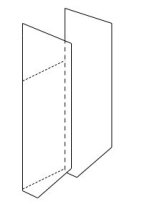
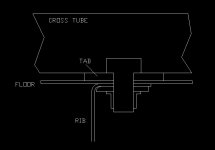
Solidly agree with Steve on this. But the relatively low load might in fact be okay. Still, if it were me, I'd connect to the webs somehow. One way would be with a simple U-shaped bracket like this poor sketch:

Bracket.jpg

Its web would bolt to the web existing, and its flanges to the sides of that square tube.

Dave
 
Not entirely…

At least one portion of FAR 43, appendix D, is applicable because reference to it is made in the operating limitation describing the requirement for completion of a condition inspection.
I admit there is nothing in writing to make it regulatory, but this makes it entirely reasonable that a different appendix would be used to determine what constitutes a major or minor modification in this context, since that is the official definition as used by the FAA.
I can see where it can get confusing.....

FAR 43.1 - Applicability​

(a) Except as provided in paragraphs (b) and (d) of this section, this part prescribes rules governing the maintenance, preventive maintenance, rebuilding, and alteration of any—
 
I can see where it can get confusing.....

FAR 43.1 - Applicability​

(a) Except as provided in paragraphs (b) and (d) of this section, this part prescribes rules governing the maintenance, preventive maintenance, rebuilding, and alteration of any—
I am not confused by that at all....
I am usually the one pointing people to that, but as I already mentioned, it is not 100% true, because the operating limitation for condition inspections on E-AB aircraft specifically points back to FAR43 appendix D as applying to our aircraft.
Because of that I think Appendix A is a valid resource for understanding what the FAA's definition of a major vs Minor change would be.
 
Surely I'm missing something. Every fiber of my mechanical engineering education shivers at the load path of those seatbelt anchors into the flange at a single point, and not the web.

Short detour here...

My fibers also quivered. There were conversations.

The crossbar arrangement for the front belt has been flying a while with several members of the RV acro community. The airframe inverted limit is -3. As one correspondent pointed out, his meter never exceeded -2.5 over thousands of hours.

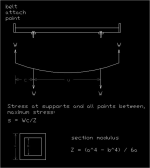
The loads are relatively low, as are cycles. Assume a 225 lb pilot x 3G = 675, or 338 per anchor max, if no load sharing with the other lap belt. Realistic might be 180 lbs x 2G = 360, or 180 per anchor, less load sharing. The typical G will be closer -1.5. Lifetime cycles would be a few thousand even for the most dedicated acro fan, not 10^7.

As for the crossbar itself, the 225 pilot at 3G at results in a max bending stress of 38.3K psi, about half the compressive yield for normalized 4130. I made no attempt to determine stress in the attach tabs, but they are 0.125" 4130, i.e. likely excessive.

1734101015632.png

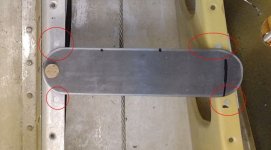
Direct to Scott's concern, a detail; to reduce point load, the nutplates under the floor flanges are mounted on 0.060 2024-T3 reinforcement strips, one edge rounded to nest, with the strips subsequently riveted separately to the flanges. The only clue in the photos is the rivet heads. Below is a rear mount during fabrication; you can see the edge of a strip on the right.

As I mentioned previously, it's a TLAR design, but with some consideration.

Reinforcement Strips.jpg

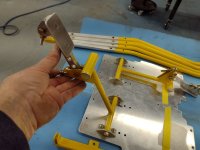
Rear pedal assembly. The pushrod system is conceptually similar to the late Bruce Bohannon's RV-8 transition trainer. More later, new thread.

Rear Pedal.jpg
 
Last edited:
Short detour here...

My fibers also quivered. There were conversations.

The crossbar arrangement for the front belt has been flying a while with several members of the RV acro community. The airframe inverted limit is -3. As one correspondent pointed out, his meter never exceeded -2.5 over thousands of hours.

The loads are relatively low, as are cycles. Assume a 225 lb pilot x 3G = 675, or 338 per anchor max, if no load sharing with the other lap belt. Realistic might be 180 lbs x 2G = 360, or 180 per anchor, less load sharing. The typical G will be closer -1.5. Lifetime cycles would be a few thousand even for the most dedicated acro fan, not 10^7.

As for the crossbar itself, the 225 pilot at 3G at results in a max bending stress of 38.3K psi, about half the compressive yield for normalized 4130. I made no attempt to determine stress in the attach tabs, but they are 0.125" 4130, i.e. likely excessive.

View attachment 76225

Direct to Scott's concern, a detail; to reduce point load, the nutplates under the floor flanges are mounted on 0.060 2024-T3 reinforcement strips, one edge rounded to nest, with the strips subsequently riveted separately to the flanges. The only clue in the photos is the rivet heads. Below is a rear mount during fabrication; you can see the edge of a strip on the right.

As I mentioned previously, it's a TLAR design, but with some consideration.

View attachment 76223

Rear pedal assembly. The pushrod system is conceptually similar to the late Bruce Bohannon's RV-8 transition trainer. More later, new thread.

View attachment 76226
As a former recovering aircraft stress engineer it looks fine. Your seat belt anchor (assume for shoulder harness) will be the least of your worries. I would quibble with the load case. This is for inverted flight. What about crash? A little more complicated. But for your load case you ended up at the approx. correct load. Your margin of safety is good. Aircraft we multiply actual calculated max load by 1.5 to get ultimate load. Then stress calculation divided into allowable to get margin of safety. It seems you have that easily for the 3G load case. The single bolt attach of your "beam" is OK. It is a simply supported beam. The steel and the two bolts are not the weak points.

The attach structure with short doubler (a glorified washer) is weak point. A shear web/angle over a greater length / area would get closer to developing the strength of your of your simply supported tube. Those aluminum flanges are going to bend. Consider extending your structural reinforcement down into web and over longer length. If you can find an extruded aluminum angle, flange wide enough to pick up web, fantastic. It will be "more better". For gins and giggles make a simulated structure out of scrap aluminum, bolt on your modification. Then secure this mock up, pull on it with load cell and come-along. You will see what is up. How much will it deflect? Permanent deformation? Failure? CAD model and FEM would give the actual deflections and stress. Are you going to fall out? Unlikely, and you also are likely never going near 3G negative. The reason it something works so far may just mean it never was loaded near limit load, yet.

Your pedals are awesome.
 
Last edited:
I agonized over this too. Remember this belt is in addition to the existing belt. With my seat geometry the existing belt takes about a third of the vertical load.

But I did use a section of angle to reinforce the web.

To me the additional belt in an RV is more for pilot comfort and maintaining a sight picture at -1G. The second belt isn’t required until you are in the advanced category of aerobatic competition. It’s amazing how nice it feels even in turbulence. Your never hit your shoulder belts.
 
Last edited:
The attach structure with short doubler (a glorified washer) is weak point.

Thanks Jack. Yes, I agree, the attachments on the rib flanges are probably the weakest point in the assembly. With the obvious caveat that I'm not formally trained, I looked at it this way....

There are two bolts per side attaching the bar mount to the floor rib flange. I assume the typical tension load on each rib is 180 lbs, per the previous post, with a rare max as high as 388. The flange is sandwiched between the thick 4130 tabs, the floor panel, and the doubler strips with the nutplates. Although imperfect, the clamped assembly minimizes outright flange bending.

So, in a simplified view, I assume the load is applied to a two inch length of rib, with maximum stress along the bend radius between web and flange. IIRC, the material is 0.035, and assumed to be 2024T3, so Fty is something in excess of 40,000, with Fsu about the same. Area is 0.070, so typical stress is 180 x 0.070 = 12600, and max stress is 388 x 0.070 = 27160.

I know there are subtle details I'm not considering in the above. For sure, if there were a lot of cycles applied to the application, I wouldn't be confident about its life. Here cycles are minimal... and this belt is always backed up with a second belt on the stock belt mounts.

ScreenHunter_2561 Dec. 16 11.25.jpg

Belt Mount Front.jpg
 
Last edited:
And drum roll please...

Official word is "minor".

Caveat...old hands know this sort of grey area is a judgement call by the inspector(s). A different FSDO staff may view things differently. Right here among our own group there wasn't a clear consensus. We should not expect different from the other humans just because they carry a government ID.
 
I know there are subtle details I'm not considering in the above. For sure, if there were a lot of cycles applied to the application, I wouldn't be confident about its life. Here cycles are minimal... and this belt is always backed up with a second belt on the stock belt mounts.
What would concern me is that this mount isn't backed up with the stock belt... This belt is the backup for the stock belt, as far as I understand the purpose of the second belt for aerobatic work. You never want to use this belt at all, but if something happens and the main belt fails, you darn sure don't want this one to fail as well so you should assume it will be taking the same load as the stock belt at the worst case that caused it to fail.

Personally, I would want the mount to be attached to the shear web of the floor rib, and load all of the mounting fasteners in shear. Mounting to the rib flange like that seems like someone has come up with this as a way to say they've technically met the requirement for a second belt, but without actually considering the effectiveness of the solution.
 
Back
Top