Van's Air Force

The definitive Van's Aircraft support community! Buying, building or flying an RV? Join our exclusive family of mentors and enthusiasts!

Changes to Z14 Wire schematic using MZ-30 Generator

danlh

Well Known Member
Sponsor
I am considering using the MZ-30 Generator on my Aux bus and I'm trying to figure out what I need to change in the Z-14 wiring diagram to make it function.
Differences:
MX-30 comes with it's own external regulator- Minimum installation calls for an enable switch. Can I work this wiring into the Aux Master Switch so I have 1 switch instead of 2?
Would the same S700-2-10 switch be used? Or should I keep it separate to have a means of isolating it? How would the Aux Master Switch be wired?
I am a novice at this! Just started working on wiring plan. Be kind!
Thanks,
Dan
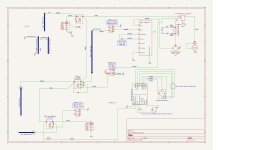
MyRV10.Z-14.jpg
 
My initial feedback:
  • You have 2AWG from the starter contactor to the starter, but 4AWG from the main battery contactor to the starter contactor, 4AWG from the main battery to the main contactor, and 4AWG from the main battery to ground. Unless all of those runs are a lot shorter than the 2AWG run, I think you should have 2AWG all the way from the main battery to the starter. In fact, I plan to do the opposite -- 2AWG from battery -> contactor -> starter contactor, then 4AWG to the starter (since it is a much shorter run).
  • Same thing with the X-Feed Contactor -- one battery connects with 2AWG and the other with 4AWG. Unless the run lengths are significantly different I think you want 2AWG all around (which would also include the aux battery to aux contactor)
  • You have an ANL30 on the 60A B&C LX60; you want an ANL60
  • 18AWG seems excessive for the field wire from the bus to the switch and the switch to the LR3D-14 -- at only 5A that's good for 15+ft. It won't hurt anything to have it oversized, though.
  • Yes, your Aux Master Switch is DPDT which means, like your Main Master Switch, can be used to turn the MZ-30 on/off along with the contactor.
  • You have a lot of busses -- Main Battery Bus (always on), Aux Battery Bus (always on), Auxiliary Bus (only on when Aux battery is on), Main Power Bus (only on when Main battery is on). Nothing wrong with that if you have plans for all of those. Are you going to connect a lot of your avionics to both the Main Power Bus and the Auxiliary Bus?
Other than that it all looks pretty good to me. Make sure you get those diodes done correctly on the X-Feed Contactor. Personally, I'm using Gigavac contactors that have internal diodes (which eliminates the need for a diode on each contactor), and then for my X-Feed contactor I'm using the "Essential Bus Diode" from B&C -- that's the only diode I have in my system that isn't internal to other components.
 
Just got an answer from Monkworkz Bill, who's as always providing a top notch service, to some questions I had. Though you have a different configuration than mine, the following will mostly apply to your install too:

"No problem in leaving the generator enabled all the time, for most people I think that is the best way to run it. The pilot accessible switch is recommended for testing and in the event and an electrical fire."
 
I am considering using the MZ-30 Generator on my Aux bus and I'm trying to figure out what I need to change in the Z-14 wiring diagram to make it function.
Differences:
MX-30 comes with it's own external regulator- Minimum installation calls for an enable switch. Can I work this wiring into the Aux Master Switch so I have 1 switch instead of 2?
Would the same S700-2-10 switch be used? Or should I keep it separate to have a means of isolating it? How would the Aux Master Switch be wired?
I am a novice at this! Just started working on wiring plan. Be kind!
Thanks,
Dan

View attachment 76103

My initial feedback:
  • You have 2AWG from the starter contactor to the starter, but 4AWG from the main battery contactor to the starter contactor, 4AWG from the main battery to the main contactor, and 4AWG from the main battery to ground. Unless all of those runs are a lot shorter than the 2AWG run, I think you should have 2AWG all the way from the main battery to the starter. In fact, I plan to do the opposite -- 2AWG from battery -> contactor -> starter contactor, then 4AWG to the starter (since it is a much shorter run).
  • Same thing with the X-Feed Contactor -- one battery connects with 2AWG and the other with 4AWG. Unless the run lengths are significantly different I think you want 2AWG all around (which would also include the aux battery to aux contactor)
  • You have an ANL30 on the 60A B&C LX60; you want an ANL60
  • 18AWG seems excessive for the field wire from the bus to the switch and the switch to the LR3D-14 -- at only 5A that's good for 15+ft. It won't hurt anything to have it oversized, though.
  • Yes, your Aux Master Switch is DPDT which means, like your Main Master Switch, can be used to turn the MZ-30 on/off along with the contactor.
  • You have a lot of busses -- Main Battery Bus (always on), Aux Battery Bus (always on), Auxiliary Bus (only on when Aux battery is on), Main Power Bus (only on when Main battery is on). Nothing wrong with that if you have plans for all of those. Are you going to connect a lot of your avionics to both the Main Power Bus and the Auxiliary Bus?
Other than that it all looks pretty good to me. Make sure you get those diodes done correctly on the X-Feed Contactor. Personally, I'm using Gigavac contactors that have internal diodes (which eliminates the need for a diode on each contactor), and then for my X-Feed contactor I'm using the "Essential Bus Diode" from B&C -- that's the only diode I have in my system that isn't internal to other components.
Hi Kirk,

* The mix of AWG2&4 was copied directly from Nuckoll’s Z-14. I suspect the reason for his choices were 1 battery up front and 1 in the rear. I will have both batteries in the rear, so I will change the plan to all AWG2 and probably AWG4 to the starter as you suggested.
* Again his plan called for ANL30 off main alt, but he is also showing a 40amp alt. I will change tha to ANL60.
* AWG18 on Field wire? I don’t know where that came from! Knuckoll shows AWG20.
* I’ll connect the enable wires from the MZ-30 to #4 & #5 pins on Aux Master Switch.
* My hot battery busses will be used mainly for electronic ignition. Not sure what else yet. Avionics will be spit up amongst main and aux busses.
* I don’t believe the diode on the B&C contactors are internal but they do come pre-wired according to their website. But I’m not set on any particular suppliers at this point. Thank you for the recommendations. The EB diode, is that to prevent back feed to the main bus?
Thank you for your suggestions.
Dan
 
Last edited:
I am considering using the MZ-30 Generator on my Aux bus and I'm trying to figure out what I need to change in the Z-14 wiring diagram to make it function.
Differences:
MX-30 comes with it's own external regulator- Minimum installation calls for an enable switch. Can I work this wiring into the Aux Master Switch so I have 1 switch instead of 2?
Would the same S700-2-10 switch be used? Or should I keep it separate to have a means of isolating it? How would the Aux Master Switch be wired?
I am a novice at this! Just started working on wiring plan. Be kind!
Thanks,
Dan

View attachment 76103
Dan, a double pole switch should do the trick if i'm reading your question right.
 
Just got an answer from Monkworkz Bill, who's as always providing a top notch service, to some questions I had. Though you have a different configuration than mine, the following will mostly apply to your install too:

"No problem in leaving the generator enabled all the time, for most people I think that is the best way to run it. The pilot accessible switch is recommended for testing and in the event and an electrical fire."
Thanks Dan. My system will be a dual bus system so the generator will be on full time. I was just trying to figure out whether it needs its own enable switch or tie it into the aux master switch. I’m leaning towards tying it into the aux master switch.
Thanks for responding.
Dan
 
* The mix of AWG2&4 was copied directly from Nuckoll’s Z-14. I suspect the reason for his choices were 1 battery up front and 1 in the rear. I will have both batteries in the rear, so I will change the plan to all AWG2 and probably AWG4 to the starter as you suggested.
Agreed. Now I'm not sure why he had 2AWG for the starter -- I do think that 4AWG is more common but it doesn't hurt to confirm that.

In my case, even though the run is super short, I plan to use 2AWG for the crossfeed connections -- my understanding is if you connect a very low EarthX battery to a fully charged EarthX battery it can produce some very high amounts of current. I figure the cost and weight is minimal to go ahead and make that 2AWG even though it will be <2ft in length. I also plan to use braided bonding straps for connecting my batteries, starter, and avionics ground panels to the chassis.

* My hot battery busses will be used mainly for electronic ignition. Not sure what else yet. Avionics will be spit up amongst main and aux busses.

Keep in mind that some avionics have dual power inputs with internal diode isolation which allows you to connect them to two busses and they will run off of either bus.

* I don’t believe the diode on the B&C contactors are internal but they do come pre-wired according to their website. But I’m not set on any particular suppliers at this point. But thank you for the recommendation. The EB diode, is that to prevent back feed to the main bus?

The B&C Essential Bus Diode, based on its name, is intended to power an essential bus from two independent power sources. But I won't be using it for that purpose because I don't have an essential bus. But what I do have (like you) is a crossfeed contactor, and I'd like to be able to power that from either battery in case one battery is low on charge. So I'll be using the Essential Bus Diode to allow either battery to energize my crossfeed contactor. I asked B&C and have since confirmed that the two power inputs can be connected to different power sources and power will not flow between the inputs. Power does flow from one or both inputs to the output. The small installation manual is here.
 
What I know:
- I install the Monkworkz in the standby mode. The output is wired to the same place as the primary alternator. The Monkworkz is always on and automatically picks up the load if buss voltage declines (e.g. the primary alternator fails).
- I do add a normally closed switch for the Monkworkz enable control line. I found, during testing, that while the Monkworkz easily picks up the load when I turn off the primary alternator, sometimes it says on after I turn the primary alternator back on. Cycling the enable switch after turning the primary alternator back on places the MonkWorkz back into standby mode.
- While running the MonkWorkz in parallel with the primary alternator does no harm it would mask a failure of the primary alternator, thus the reason to move it back to standby mode (so the need for a switch).

I run a dual battery, dual alternator power distribution. The MonkWorkz is not required to meet my IFR power design objectives, so its primary function is the "get me home" tool if the primary alternator should fail on a long cross country run.

Carl
 
Agreed. Now I'm not sure why he had 2AWG for the starter -- I do think that 4AWG is more common but it doesn't hurt to confirm that.

In my case, even though the run is super short, I plan to use 2AWG for the crossfeed connections -- my understanding is if you connect a very low EarthX battery to a fully charged EarthX battery it can produce some very high amounts of current. I figure the cost and weight is minimal to go ahead and make that 2AWG even though it will be <2ft in length. I also plan to use braided bonding straps for connecting my batteries, starter, and avionics ground panels to the chassis.


Keep in mind that some avionics have dual power inputs with internal diode isolation which allows you to connect them to two busses and they will run off of either bus.


The B&C Essential Bus Diode, based on its name, is intended to power an essential bus from two independent power sources. But I won't be using it for that purpose because I don't have an essential bus. But what I do have (like you) is a crossfeed contactor, and I'd like to be able to power that from either battery in case one battery is low on charge. So I'll be using the Essential Bus Diode to allow either battery to energize my crossfeed contactor. I asked B&C and have since confirmed that the two power inputs can be connected to different power sources and power will not flow between the inputs. Power does flow from one or both inputs to the output. The small installation manual is here.
 
I do plan to take advantage of the dual power inputs where available.
Is there an advantage to using braided bonding straps instead of AWG2 cable for grounding those items?
I like your idea of using the Essential Bus Diode but I'm not clear on how it should be wired into the system. Your link to the manual didn't work but I did go on their website and was able to download from there. It was a very simple schematic of the diode connecting the main bus to the essential bus and nothing else.
 
In my case, even though the run is super short, I plan to use 2AWG for the crossfeed connections -- my understanding is if you connect a very low EarthX battery to a fully charged EarthX battery it can produce some very high amounts of current.
Nuckolls wrote in an article about inter-tying batteries that putting two batteries directly in parallel does not mean that there will be current flowing to balance the charge state of the two batteries. A battery only accepts a charge above a certain threshold voltage -- something like 13.3V. So if you wire a battery with 12.2V to a battery with 12.8V, no significant current will flow between them. His discussion was based on lead-acid batteries though -- I'm not sure that applies to Lithium batteries??? But I thought it was an interesting and counter-intuitive point.
 
What I know:
- I install the Monkworkz in the standby mode. The output is wired to the same place as the primary alternator. The Monkworkz is always on and automatically picks up the load if buss voltage declines (e.g. the primary alternator fails).
- I do add a normally closed switch for the Monkworkz enable control line. I found, during testing, that while the Monkworkz easily picks up the load when I turn off the primary alternator, sometimes it says on after I turn the primary alternator back on. Cycling the enable switch after turning the primary alternator back on places the MonkWorkz back into standby mode.
- While running the MonkWorkz in parallel with the primary alternator does no harm it would mask a failure of the primary alternator, thus the reason to move it back to standby mode (so the need for a switch).

I run a dual battery, dual alternator power distribution. The MonkWorkz is not required to meet my IFR power design objectives, so its primary function is the "get me home" tool if the primary alternator should fail on a long cross country run.

Carl
Hi Carl,

Why did you not go with separate bus distributions for the dual power sources? Was this to simplify cockpit management?

Dan
 
I do plan to take advantage of the dual power inputs where available.
Is there an advantage to using braided bonding straps instead of AWG2 cable for grounding those items?
I like your idea of using the Essential Bus Diode but I'm not clear on how it should be wired into the system. Your link to the manual didn't work but I did go on their website and was able to download from there. It was a very simple schematic of the diode connecting the main bus to the essential bus and nothing else.

I think the braided bonding strap is really just more flexible, that's the primary benefit.

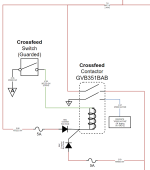
Here is my crossfeed contactor using the B&C Essential Bus Diode -- the unit they sell has two diodes internally, so you connect one input to each battery (through a fuse) and the output to the contactor. My contactor has a separate low-current switch internally and that's optional -- you can ignore the blue "XFEED ACTIVE" wire.

1733951124721.png
 
Nuckolls wrote in an article about inter-tying batteries that putting two batteries directly in parallel does not mean that there will be current flowing to balance the charge state of the two batteries. A battery only accepts a charge above a certain threshold voltage -- something like 13.3V. So if you wire a battery with 12.2V to a battery with 12.8V, no significant current will flow between them. His discussion was based on lead-acid batteries though -- I'm not sure that applies to Lithium batteries??? But I thought it was an interesting and counter-intuitive point.
That's interesting! Once I have my batteries I plan to do some limited testing, but it would be nice if I don't have to worry about huge currents.

Given the very short distances I'll still stick with 2AWG anyways; the weight and cost penalty is negligible with ~1ft wires.
 
I am considering using the MZ-30 Generator on my Aux bus and I'm trying to figure out what I need to change in the Z-14 wiring diagram to make it function.
Differences:
MX-30 comes with it's own external regulator- Minimum installation calls for an enable switch. Can I work this wiring into the Aux Master Switch so I have 1 switch instead of 2?
Would the same S700-2-10 switch be used? Or should I keep it separate to have a means of isolating it? How would the Aux Master Switch be wired?
I am a novice at this! Just started working on wiring plan. Be kind!
Thanks,
Dan

View attachment 76103

My initial feedback:
  • You have 2AWG from the starter contactor to the starter, but 4AWG from the main battery contactor to the starter contactor, 4AWG from the main battery to the main contactor, and 4AWG from the main battery to ground. Unless all of those runs are a lot shorter than the 2AWG run, I think you should have 2AWG all the way from the main battery to the starter. In fact, I plan to do the opposite -- 2AWG from battery -> contactor -> starter contactor, then 4AWG to the starter (since it is a much shorter run).
  • Same thing with the X-Feed Contactor -- one battery connects with 2AWG and the other with 4AWG. Unless the run lengths are significantly different I think you want 2AWG all around (which would also include the aux battery to aux contactor)
  • You have an ANL30 on the 60A B&C LX60; you want an ANL60
  • 18AWG seems excessive for the field wire from the bus to the switch and the switch to the LR3D-14 -- at only 5A that's good for 15+ft. It won't hurt anything to have it oversized, though.
  • Yes, your Aux Master Switch is DPDT which means, like your Main Master Switch, can be used to turn the MZ-30 on/off along with the contactor.
  • You have a lot of busses -- Main Battery Bus (always on), Aux Battery Bus (always on), Auxiliary Bus (only on when Aux battery is on), Main Power Bus (only on when Main battery is on). Nothing wrong with that if you have plans for all of those. Are you going to connect a lot of your avionics to both the Main Power Bus and the Auxiliary Bus?
Other than that it all looks pretty good to me. Make sure you get those diodes done correctly on the X-Feed Contactor. Personally, I'm using Gigavac contactors that have internal diodes (which eliminates the need for a diode on each contactor), and then for my X-Feed contactor I'm using the "Essential Bus Diode" from B&C -- that's the only diode I have in my system that isn't internal to other components.
* The mix of AWG2&4 was copied directly from Nuckoll’s Z-14. I suspect the reason for his choices were 1 battery up front and 1 in the rear. I will have both batteries in the rear, so I will change the plan to all AWG2 and probably AWG4 to the starter as you suggested.
* Again his plan called for ANL30 off main alt, but he is also showing a 40amp alt. I will change tha to ANL60.
* AWG18 on Field wire? I don’t know where that came from! Knuckoll shows AWG20.
* I’ll connect the enable wires from the MZ-30 to #4 & #5 pins on Aux Master Switch.
* My hot battery busses will be used mainly for electronic ignition. Not sure what else yet. Avionics will be spit up amongst main and aux busses.
* I don’t believe the diode on the B&C contactors are internal but they do come pre-wired according
That's interesting! Once I have my batteries I plan to do some limited testing, but it would be nice if I don't have to worry about huge currents.

Given the very short distances I'll still stick with 2AWG anyways; the weight and cost penalty is negligible with ~1ft wires.
The indications of your diagram would suggest 3 connections to your essential bus diode. I’m assuming the plus terminal goes to the x-feed contactor and 2 of the other terminals attach to the main and aux busses.
 
Hi Carl,

Why did you not go with separate bus distributions for the dual power sources? Was this to simplify cockpit management?

Dan
I have not found a better, more redundant design than two batteries feeding separate busses. Simple, and the design provides for multiple back up modes.

Think of this as two avionics busses.

Carl
 
I have not found a better, more redundant design than two batteries feeding separate busses. Simple, and the design provides for multiple back up modes.

Think of this as two avionics busses.

Carl

I went this way as well on my RV-10 design. Each battery, alternator, and bus separate. No diodes other than my (completely optional) cross-feed contactor setup. Fully operational for day VFR operations with either bus completely dead. It just felt simplest to me. Now, unlike Carl, I'm not flying that design yet.
 
Back
Top