Van's Air Force

The definitive Van's Aircraft support community! Buying, building or flying an RV? Join our exclusive family of mentors and enthusiasts!

Using a gasket to seal the fuel sender panel on a fuel tank instead of proseal?

nickw9815

Well Known Member
Our RV6 tank has a leak coming from the panel where the fuel sender is attached. We pulled the tank, and removed the panel and are now going to reseal it. Our mechanic advised us to not fix it with proseal, and instead to use a custom gasket to seal the panel to the tank, and to use stat-o-seal screws to seal each fastener. Has anyone had experience with this?

I was thinking something like this: https://realgaskets.com/product/fuel-tank-ring-gasket-for-rv-series/
 
Last edited:
Our RV6 tank has a leak coming from the panel where the fuel sender is attached. We pulled the tank, and removed the panel and are now going to reseal it. Our mechanic advised us to not fix it with proseal, and instead to use a custom gasket to seal the panel to the tank, and to use stat-o-seal screws to seal each fastener. Has anyone had experience with this?

I was thinking something like this: https://realgaskets.com/product/fuel-tank-ring-gasket-for-rv-series/
Since it is an RV-6 the screw holes in the cover plate were probably marked out and drilled by the builder, so they may not align perfectly with a custom gasket. The older kits did not have pre-punched parts like the newer models and therefore each one will be different, since they were "hand made".
 
I'm repairing one this week for an RV-6 with similar issue and have done quite a bit of tank sealing. I always install the access panels/senders with sealant. If you have to go back into them for sender replacement or access, it's a little more work, but if you have to go back and fix just a leak its unnecessary extra work. The sealant screws/washers do nothing for "puckering/distortion" between attach screws common to thin metal plates when torqued and gasket distorts/squeezes out. It would be different if you were dealing with .250" thick components.
 
A lot of people have tried gaskets over the course of the past 30+ years of RV-6(A) completions but very few if any have had success with the gaskets not leaking.
 
Adding additional info to those that have said a gasket will leak…
The best definition of that is that use of a gasket pretty much guarantees that it will leak at some point in time.
Often times it works fine initially but then requires a leak repair in the future.
If done properly using the tank sealant, it can be leak free for the life of the airplane.
 
To paraphrase Indiana Jones, "Gaskets and sealing......why does it always have to be gaskets and sealing?"

Maybe I'm the only one who used both a cork gasket AND proseal to seal both the sender to the access plate, and the access plate to the tank. So far (1400 hrs, 11 years) no leaks. Yes, I know, that and $5 gets me a small fancy coffee at Starbucks :rolleyes:.

So, why both? Given that I don't trust a standard flat gasket installed between two thin sheet metal surfaces to never leak, even when properly torqued (as in NOT OVER TORQUED), I decided to try a gasket+proseal combination. As previously mentioned, it has not leaked. As a second benefit, the cork gasket is sacrificial and provides a thicker "insert razor blade here" zone if the fuel sender or tank cover ever needs to be removed. I did have a chance to test removing this combination prior to first flight, when I needed to remove the cover plate and install the fuel pickup anti-rotation bracket. Was it easier to remove? Maybe....never compared it to a proseal only installation.

As a strange coincidence, I will have to remove both tank senders in the near future. (Fuel leak through the sender itself. Plus, both fuel gauge readings have recently been erratic...wandering up and down when they used to be steady.) So, maybe I'll go with proseal only on these. :unsure:
 
I use a cork gasket with Permatex Hi-Tack or Permatex Aviation Form-A-Gasket gasket sealant. Never had a leak. I use socket-head cap screws to attach the panel so they can be removed in the small space between the wing and fuselage. I've had to change a sender twice (only one had failed, the other was suspect but OK), and I was SO glad I did not have to carve the panel away from a Proseal bond. The old permatex cleans up with a little bit of acetone, and then installed a new gasket.

We have had one leaky installation with the Permatex gasket sealant, but it was using a rubber gasket. The rubber slowly creeped out of the joint. Replacing the rubber gasket with a heavy paper gasket solved the problem.
 
Our RV6 tank has a leak coming from the panel where the fuel sender is attached. We pulled the tank, and removed the panel and are now going to reseal it. Our mechanic advised us to not fix it with proseal, and instead to use a custom gasket to seal the panel to the tank, and to use stat-o-seal screws to seal each fastener. Has anyone had experience with this?

I was thinking something like this: https://realgaskets.com/product/fuel-tank-ring-gasket-for-rv-series/
Pro Seal is great.. I sometimes use:

Permatex #85420 if a flexible seal is required​

 
Our RV6 tank has a leak coming from the panel where the fuel sender is attached. We pulled the tank, and removed the panel and are now going to reseal it. Our mechanic advised us to not fix it with proseal, and instead to use a custom gasket to seal the panel to the tank, and to use stat-o-seal screws to seal each fastener. Has anyone had experience with this?

I was thinking something like this: https://realgaskets.com/product/fuel-tank-ring-gasket-for-rv-series/
Nick9815,
Strongly suggest you use screws that also have gaskets on them in addition to the gasket.
I bought mine from McMaster-Carr.
Daddyman
 
Adding additional info to those that have said a gasket will leak…
The best definition of that is that use of a gasket pretty much guarantees that it will leak at some point in time.
Often times it works fine initially but then requires a leak repair in the future.
If done properly using the tank sealant, it can be leak free for the life of the airplane.
Scott-
The weak link seems to be the fuel sender wearing out. How easy is it to remove an access plate prosealed directly to the rib?
 
Last edited:
I use a cork gasket with Permatex Hi-Tack or Permatex Aviation Form-A-Gasket gasket sealant. Never had a leak. I use socket-head cap screws to attach the panel so they can be removed in the small space between the wing and fuselage. I've had to change a sender twice (only one had failed, the other was suspect but OK), and I was SO glad I did not have to carve the panel away from a Proseal bond. The old permatex cleans up with a little bit of acetone, and then installed a new gasket.

We have had one leaky installation with the Permatex gasket sealant, but it was using a rubber gasket. The rubber slowly creeped out of the joint. Replacing the rubber gasket with a heavy paper gasket solved the problem.
Steve
Socket head screws are indeed are the way to go!
 
Maybe I'm the only one who used both a cork gasket AND proseal to seal both the sender to the access plate, and the access plate to the tank. So far (1400 hrs, 11 years) no leaks. Yes, I know, that and $5 gets me a small fancy coffee at Starbucks :rolleyes:.
Nah, me too; back in 2005 I followed the instructions, slathered some proseal on to the cork gasket and closed it up. At the time I didn’t know any different and it’s what the build manual called out. But, I’ve been lucky; 18 years and 2250 hours, no leaks yet!
 
Scott-
The weak link seems to be the fuel sender wearing out. How easy is it to remove an access plate prosealed directly to the rib?
In 30 years of working on RV’s, I don’t remember ever needing to replace a sender unit.
If one does need to be replaced you don’t have to remove the cover plate to do it.

I admit that removing a cover or sender is easier if it was installed with a gasket, but if only sealed with tank sealant they can still be removed. I have done it a few times…. Just did one a couple weeks ago.
 
sw
In 30 years of working on RV’s, I don’t remember ever needing to replace a sender unit.
If one does need to be replaced you don’t have to remove the cover plate to do it.

I admit that removing a cover or sender is easier if it was installed with a gasket, but if only sealed with tank sealant they can still be removed. I have done it a few times…. Just did one a couple weeks ago.
Scott-
ok, that’s persuasive. The high percentage play is a no gasket, proseal only install on both access plate and sender.
 
I just rebuilt my left tank after a few leaking rivets on the sender cover that held the bracket for the pick up tube. Original builder used cork gasket and proseal. While it never leaked from the gasket, it was a serious pain to remove as the cork broke apart on disassembly. I think the only reason the sender cover didn’t leak was because the proseal worked it’s way into the cork gasket and fill the gaps to create a good seal. I used sealant only when closing it back up. Dry as a bone, sealant only get my recommendation.
 
I admit that removing a cover or sender is easier if it was installed with a gasket, but if only sealed with tank sealant they can still be removed. I have done it a few times…. Just did one a couple weeks ago.
Great! That’s one less part (the gasket) to mess with when I have to replace the leaky sender.

For the record, I have no idea why this sender is leaking around the brass electrical connection. It started about 4 years ago when I discovered it during a condition inspection. Started leaking just enough to leave a dry blue stain. Kept monitoring it every year. Recently discovered the stain larger than previous ones, and wet from the leak. OK, time to change it….I do not like fuel leaks, no matter how small.
 
Recently I had to repair a fuel leak around my drain valve on the left fuel tank. Watched the Van’s video several times and talked to Vans Tech support twice before starting the project. I had to remove the tank from the wing to gain access and insure there wasn’t any other leak in the tank. I also decided that since I had the tank off I would go ahead and replace the fuel sending unit (mistake - if it’s working properly don’t mess with it). Long story short, I did just about everything wrong that could be done wrong including sealing the new float unit to the inside of the wing with excess proseal!

I eventually removed the tank four times from the wing correcting my numerous mistakes but did learn a few things. Removing the fuel sensor and access panel is relatively easy once you heat up the area with a heat gun (of course you need to insure ALL fuel is removed from the tank and your working in a well ventilated environment). MEK substitute and a nylon pad will quickly clean up the most harden proseal covered area. A brass brush from Harbor Freight is useful for hard to get areas. AND - I HATE, HATE “Z” brackets!

PS - don’t over pressurize the tank doing your leak check. Leave the balloon on overnight to confirm the tank doesn’t leak.

PPS - buy the quart size proseal from Vans. It’ll keep several years if kept refrigerated. You never know when you might want to proseal your neighbor’s aircraft to the ground 😁.
 
As far as I can tell, I have no leaks. However, I've always had in the back of my mind that if I had to clear away Proseal, that it would be easily done with something called Polygone 310-AG from ACS. Can anyone report any practical experience with this compound?
 
Our RV6 tank has a leak coming from the panel where the fuel sender is attached. We pulled the tank, and removed the panel and are now going to reseal it. Our mechanic advised us to not fix it with proseal, and instead to use a custom gasket to seal the panel to the tank, and to use stat-o-seal screws to seal each fastener. Has anyone had experience with this?

I was thinking something like this: https://realgaskets.com/product/fuel-tank-ring-gasket-for-rv-series/
If the sheet metal is thin you must use pro seal
 
As far as I can tell, I have no leaks. However, I've always had in the back of my mind that if I had to clear away Proseal, that it would be easily done with something called Polygone 310-AG from ACS. Can anyone report any practical experience with this compound?
Been using some PolyGone recently, and it does a great job of liquifying the pro-seal (that it can get to) - really slick!
 
A lot of people have tried gaskets over the course of the past 30+ years of RV-6(A) completions but very few if any have had success with the gaskets not leaking.
I use a paper or cork gasket coated generously with Permatex Hi-Tack gasket adhesive. I have never had one leak. AND, it is pretty easy to pry the cover plate off in the future when you need to.

The one gasket solution I have tried that did not work was a butyl rubber gasket with the Permatex Hi-Tack. The rubber gasket slowly creeped out from under the cover plate and leaked. Replaced it with a paper gasket and good to go.
 
More details please. Never had one leak over what time frame? Decades?
I made gaskets for my senders on both planes. The standard rubberized paper gaskets (fel pro IIRC) you buy in a roll. Coated gasket with anaerobic sealant and also put that sealant on the screw heads and 1/4" down from the screw head. The 6 was done 11 years ago and still leak free. Screw heads must be sealed, as the threads are a leak path not covered by the gasket. Thicker sealants on the gasket MAY squeeze into that area and seal the path, but safer to seal the heads.

DO NOTTTT use the thick rubber gasket that comes with the senders! Over time, it will shrink and crack, introducing leak paths even with sealant.
 
Last edited:
You can get access hatch tank sealant. It's a dirty pink color, mixed, but otherwise behaves like the Pro-Seal you know and love. It ain't cheap. Skygeek sells it. It's intended for removable panels.

Dave
 
You can get access hatch tank sealant. It's a dirty pink color, mixed, but otherwise behaves like the Pro-Seal you know and love. It ain't cheap. Skygeek sells it. It's intended for removable panels.

Dave
Do you have a part number for your favorite of those available?
 
I'm repairing one this week for an RV-6 with similar issue and have done quite a bit of tank sealing. I always install the access panels/senders with sealant. If you have to go back into them for sender replacement or access, it's a little more work, but if you have to go back and fix just a leak its unnecessary extra work. The sealant screws/washers do nothing for "puckering/distortion" between attach screws common to thin metal plates when torqued and gasket distorts/squeezes out. It would be different if you were dealing with .250" thick components.
Fixnflyguy,
Any suggestions on getting a pro-sealed sender out? My right sender is a bit sticky and I think I'll order a new one to swap eventually. I tried a little heat with a heat gun and using a spackling tool to try and pry against the inboard rib. Pro-seal is tough stuff. Thoughts?
 
Our RV6 tank has a leak coming from the panel where the fuel sender is attached. We pulled the tank, and removed the panel and are now going to reseal it. Our mechanic advised us to not fix it with proseal, and instead to use a custom gasket to seal the panel to the tank, and to use stat-o-seal screws to seal each fastener. Has anyone had experience with this?

I was thinking something like this: https://realgaskets.com/product/fuel-tank-ring-gasket-for-rv-series/
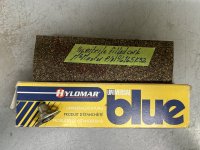
I have made and have been using the materials shown in the attached pics since 1989 and no leaks ...

1/16" Nitrile (buna-N) filled cork material - McMaster-Carr P/N 96165K32
Hylomar Universal Blue non-hardening sealant, used by Boeing & Rolls-Royce in their engine divisions
Sealed anchor nuts - O-ring seal + ProSeal PS870 A-2 over

HFS
 

Attachments

  • Nitrile Filled Cork Gasket Material .jpg
    Nitrile Filled Cork Gasket Material .jpg
    2.9 MB · Views: 47
Last edited:
A lot of people have tried gaskets over the course of the past 30+ years of RV-6(A) completions but very few if any have had success with the gaskets not leaking.
Installed correctly, the fuel sender should be an accessible/serviceable part. I used cork and gasket sealer an no leaks in 25 years of service.

41TKltcXnDL._SY445_SX342_QL70_FMwebp_.webp
 
I ended up pulling the tank with the clunk tank. That tank had a thick rubber gasket that was leaking. The other tank had a thin cork gasket. Does anyone have a clue where to buy a pair of the thin cork gaskets?
 
More details please. Never had one leak over what time frame? Decades?
spanning multiple airplanes (and cars) spanning decades. My RV-8 has 800 hrs over 15.5 yrs. no leaks. I use the same approach on sump gasket, fuel pump gasket, etc. no leaks there either although i do think the tank close-out plate is the most challenging test.

also note that the Permatex "Aviation Form-A-Gasket" that is pictured above posted by 71459 is a very similar product to the "High Tack" product I mentioned, and I use them interchangeably.
 
I have blissfully used the standard Vans method on my 6. And 14. I am building a 10 and now sit here wondering why the use of K1000-8 nutplates does NOT introduce a leak path at the sender??

I was thinking of using a nut ring or sealed anchor nuts. Am I avoiding a potential issue or creating one?

Thanks
 
I have blissfully used the standard Vans method on my 6. And 14. I am building a 10 and now sit here wondering why the use of K1000-8 nutplates does NOT introduce a leak path at the sender??

I was thinking of using a nut ring or sealed anchor nuts. Am I avoiding a potential issue or creating one?

Thanks
I found what I expected inside my tanks: dome nuts/nutplates Rated 0-50 psi

NA2172 Dome Nut / NAS1474​

25 years A&P
 
I use a cork gasket with Permatex Hi-Tack or Permatex Aviation Form-A-Gasket gasket sealant. Never had a leak. I use socket-head cap screws to attach the panel so they can be removed in the small space between the wing and fuselage. I've had to change a sender twice (only one had failed, the other was suspect but OK), and I was SO glad I did not have to carve the panel away from a Proseal bond. The old permatex cleans up with a little bit of acetone, and then installed a new gasket.

We have had one leaky installation with the Permatex gasket sealant, but it was using a rubber gasket. The rubber slowly creeped out of the joint. Replacing the rubber gasket with a heavy paper gasket solved the problem.
I have built two RVs using this technique and never had a leak either!!!
 
sw

Scott-
ok, that’s persuasive. The high percentage play is a no gasket, proseal only install on both access plate and sender.

In 30 years of working on RV’s, I don’t remember ever needing to replace a sender unit.
If one does need to be replaced you don’t have to remove the cover plate to do it.

I admit that removing a cover or sender is easier if it was installed with a gasket, but if only sealed with tank sealant they can still be removed. I have done it a few times…. Just did one a couple weeks ago.

Hi rvbuilder2002, My name is Les Clark in Santa Ynez CA KIZA. thanks for sharing your knowledge of RVs. I have helped build and flown fiberglass planes for about 30 rears and recently bought a RV-6A. I enjoy it thoroughly. I recently had a leak on my fuel drain flange and need to get a better look from the inside of the tank so I need to pull the access panel from the left tank. The plane has a beautiful paint job and I hate to pull the tank off. My question, if you know, can I pull the access panel off through the 5 inches of workspace I have to work with between the wing and the fuselage and do I have to remove the float sensor first or can I get the access panel with the sensor attached through the little space I have to work with. Thank you in advance for any information you can share.
 
Hi rvbuilder2002, My name is Les Clark in Santa Ynez CA KIZA. thanks for sharing your knowledge of RVs. I have helped build and flown fiberglass planes for about 30 rears and recently bought a RV-6A. I enjoy it thoroughly. I recently had a leak on my fuel drain flange and need to get a better look from the inside of the tank so I need to pull the access panel from the left tank. The plane has a beautiful paint job and I hate to pull the tank off. My question, if you know, can I pull the access panel off through the 5 inches of workspace I have to work with between the wing and the fuselage and do I have to remove the float sensor first or can I get the access panel with the sensor attached through the little space I have to work with. Thank you in advance for any information you can share.
It takes a little bit of manipulating to maneuver it the right way so that it works, but I have done it.
The biggest issue isn’t the space available, it is the hard aluminum fuel line that gets in the way.
I can’t remember specifics now of whether I had to disconnect the line at the fuel valve and move it in board slightly or whether I was able to maneuver the cover plate and sender in order to avoid interference with the line.
You will have to just try it and see
 
Our RV6 tank has a leak coming from the panel where the fuel sender is attached. We pulled the tank, and removed the panel and are now going to reseal it. Our mechanic advised us to not fix it with proseal, and instead to use a custom gasket to seal the panel to the tank, and to use stat-o-seal screws to seal each fastener. Has anyone had experience with this?

I was thinking something like this: https://realgaskets.com/product/fuel-tank-ring-gasket-for-rv-series/
Tried this in the past, several types of gasket material, I'll second the motion that "gaskets always leak"....eventually. If its something temporary while you need access in there it's probably fine.
 
As far as I can tell, I have no leaks. However, I've always had in the back of my mind that if I had to clear away Proseal, that it would be easily done with something called Polygone 310-AG from ACS. Can anyone report any practical experience with this compound?
I also had good experience with Polygone.
 
To paraphrase Indiana Jones, "Gaskets and sealing......why does it always have to be gaskets and sealing?"

Maybe I'm the only one who used both a cork gasket AND proseal to seal both the sender to the access plate, and the access plate to the tank. So far (1400 hrs, 11 years) no leaks. Yes, I know, that and $5 gets me a small fancy coffee at Starbucks :rolleyes:.

So, why both? Given that I don't trust a standard flat gasket installed between two thin sheet metal surfaces to never leak, even when properly torqued (as in NOT OVER TORQUED), I decided to try a gasket+proseal combination. As previously mentioned, it has not leaked. As a second benefit, the cork gasket is sacrificial and provides a thicker "insert razor blade here" zone if the fuel sender or tank cover ever needs to be removed. I did have a chance to test removing this combination prior to first flight, when I needed to remove the cover plate and install the fuel pickup anti-rotation bracket. Was it easier to remove? Maybe....never compared it to a proseal only installation.

As a strange coincidence, I will have to remove both tank senders in the near future. (Fuel leak through the sender itself. Plus, both fuel gauge readings have recently been erratic...wandering up and down when they used to be steady.) So, maybe I'll go with proseal only on these. :unsure:

I have personally delt with 20-30 year old proseal in this area and some were impossible to separate from the thin tank skin without damage to the tank. I vote for a homemade cork gasket and proseal. This makes it much easier to remove or replace a tank sending unit.
 
I have personally delt with 20-30 year old proseal in this area and some were impossible to separate from the thin tank skin without damage to the tank. I vote for a homemade cork gasket and proseal. This makes it much easier to remove or replace a tank sending unit.
Forgot to follow up on this one.

I did finally replace the leaking sender, and I opted not to use the cork gasket/proseal as I did originally.

The old sender came off after some work. I ended up using a piece of 4130 steel (~ 3/8” wide x .032” thick) with a chisel point ground on the end to cut through the cork. Proseal remover cleaned up the old stuff on the outside of the tank cover plate.

Reinstall: prosealed the new sender directly to the tank cover plate. Leaking sender problem solved.

As for future replacement of this particular sender, I am fairly confident the same removal technique used to get the old sender out would work on the new “no gasket” installation. It might require local heating to soften the proseal in addition to the steel cutting tool, but I am sure I could remove it.
 
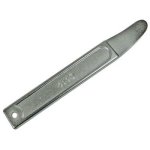
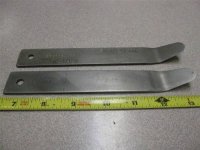
Anyone needing to remove sender plates, access plates or separate bonded parts MUST have one of these. I've posted before, and they are out there for sale. It's the go-to-tool it the big jet world, and in my RV/GA toolbox. They were developed to open up bonded layers and have a very "harmless" but effective profile and can be hammered (more tapped) under a surface. having 2 is better than one, but I also use plastic scrappers to hold up the areas where I start separating with the skin wedge.
 

Attachments

  • Skin Wedge.jpg
    Skin Wedge.jpg
    13.7 KB · Views: 30
  • ST991A skin wedge.jpg
    ST991A skin wedge.jpg
    33.1 KB · Views: 30
Anyone needing to remove sender plates, access plates or separate bonded parts MUST have one of these. I've posted before, and they are out there for sale. It's the go-to-tool it the big jet world, and in my RV/GA toolbox. They were developed to open up bonded layers and have a very "harmless" but effective profile and can be hammered (more tapped) under a surface. having 2 is better than one, but I also use plastic scrappers to hold up the areas where I start separating with the skin wedge.
“God’s Fingernail” - love mine, and they are cheap online…..
 
Back
Top