Van's Air Force

The definitive Van's Aircraft support community! Buying, building or flying an RV? Join our exclusive family of mentors and enthusiasts!

P-Mag Switchology How Did You Do It? What You Think of My 3 Ideas?

jackking123

Well Known Member
Patron
So all P-Mag drivers know there is power, P-lead. Assume x2 P-Mags, to test you ground one P-Mag P-Lead and on opposite P-Mag you turn the power off to test self-power function.
Question is how to do. What did you do? Would you do it different next time.

#1) Two power (toggle) switches and one Standard "Mag Switch, Off, L, R, Both, Start). Advantages or PRO is fairly standard like any airplane and provides some key security. The CON is that big Mag switch. To test you do the standard MAG check as any plane with the added steps of cycling off and back on power to the opposite Mag via Toggle switches.

#2) Two DPDT (toggle switches) On-On-(On) that allows you to turn P-Mag OFF (grounded P-lead), Turn P-Mag ON (Power and P-Lead Open), and TEST (P-lead Open, Power off in momentary position). To start PUSH Button. To do run up simply turn one switch power to off (down) and the opposite to TEST (momentary). Back P-mag that was off back ON, and repeat for opposite side. PRO two DPDT 3 Position switches gets the job done. CON: Not "Cessna" standard", expensive Mil Spec Locking Toggles, and no key and security, although security can be done with external means (keyed or hidden kill switch in series, Prop or throttle locks).

#3) Two SPST (toggle switches, On-OFF for P-Lead only. Toggle will be mounted upside down, meaning, DOWN is Closed and UP is Open. The power will be by CB's, that can either be pulled or a CB with toggle switch built in. So you will have 4 separate switches, 2 for power and 2 for P-lead. Start will be Push Button. Fairly elegant solution. CON not standard where a Cessna driver would understand without training, and no key security like #2. Possible Pilot induced errors. The PRO's are no expensive MAG switch and Special Mil-Spec Lock Out Toggles.

Pictures appreciated. Thank You
 
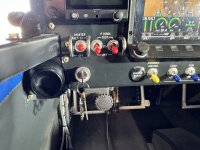
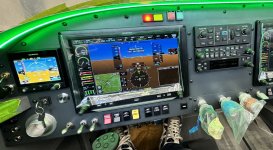
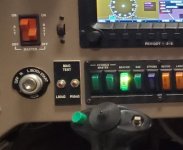
Option #2 with a single switch per mag is what I chose. Love the configuration, easy to test and reduces the clutter on the panel. I use the Start Enable switch to kill the ground to the start solenoid, thus a safety on both sides of the start switch.
 

Attachments

  • IMG_1453.jpeg
    IMG_1453.jpeg
    1.5 MB · Views: 164
Two locking toggle switches and two pull breakers. Simple. I hate keyed ignition switches after experiencing one failing on a spam can.

I like these locking toggle switches (now used on four RVs or power, ignitions and such). They come in various contact configurations.

I suggest key security is a good idea, but perhaps not the best approach. I worry about some kid getting in the plane and hitting the start button at a fly in. The engine will not start but the swinging prop might hit someone. Fort this I add a switch in a non-obvious location that opens the power path to the starter solenoid. If you really want a key then add a keyed “starter permissive” switch.

Side note - not configuring like a Cessna is, in my opinion, an advantage. No one should be flying your plane unless they read and understand your POH.

Carl
 
I did the same thing as Msstahl. Two ON-ON-(ON) switches one for each PMag, and a keys single pole switch for starter enable. That way no accidental engine starts. Can do all other operations normally. (I have since labeled the switch) I have a more detailed write up on my website.IMG_7177.jpeg
 
Two locking toggle switches and two pull breakers. Simple. I hate keyed ignition switches after experiencing one failing on a spam can.

I like these locking toggle switches (now used on four RVs or power, ignitions and such). They come in various contact configurations.

I suggest key security is a good idea, but perhaps not the best approach. I worry about some kid getting in the plane and hitting the start button at a fly in. The engine will not start but the swinging prop might hit someone. Fort this I add a switch in a non-obvious location that opens the power path to the starter solenoid. If you really want a key then add a keyed “starter permissive” switch.

Side note - not configuring like a Cessna is, in my opinion, an advantage. No one should be flying your plane unless they read and understand your POH.

Carl
I actually agree with Carl on this, but I would never use a switch as important as that with solder tabs, you can get the Honeywell TL series for about the same price. Use a pull the breaker for the starter if you are worried.
 
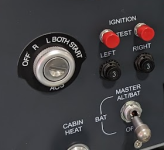
Option 2.
Two of these switches.
I did wire them direct to the Master Contactor through two breakers in the panel so they can be disconnected.
Also used this start switch.
Finally, I ran cables inside from the mags for maintenance. Terminated to female 9-pin D-sub. Male D-subs have the pin 2-3 jumper.
 
Last edited:
I hate keyed ignition switches after experiencing one failing on a spam can.
What was the failure mode? Did it fail "on" or "fail off"?

I'm currently contemplating a similar decision weighing "simplicity if the situation hits the fan" vs using different switch logic paths which may offer additional redundancy at the expense of simplicity/instinctiveness of use...

In my world, I have only seen a keyed ignition failure once and it was on a daily driver 1985 1/2 Ton pickup and the failure mode is that one day it wouldn't rotate away from "off" (this was when it was about 20 years old IIRC). Most of my flying has been in airplanes without keys, however. If key switches are a common failure though(especially if it randomly just opens the circuit), I'd love to know!
 
I’m doing your option 2 with two of the pmag switches from stein. It simple and will work really well.
 
I thought of a key switch to kill the starter as N890GF. If anything it is a deterrent to see the key switch and is a second layer to preventing accidental pushing of start button.

Carl Froehlich suggestion of switch with solder lugs does no bother me in the least. Solder and heat shrink can be very good, but a solder joint is an art and a science. You have to be careful how you strain relive the wire as solder can make a "hard-point", wire act like a solid wire, not multi strand which has better fatigue life. Crimped multi strand wire is easy, and if it meets the pull test, screw, lock washer terminal, good to go. Yeah latter is my preference, but that is a nice switch. I think they are made in Japan. In my case I am committed to all Mil-Spec MS and 2TL1 types. (Side note: having panel laser cut so the anti rotation tab will be in mount hole, so lock anti rotation washer and second hole not needed.)

#2 it is! Winner winner chicken diner. Push start and the starter defeat switch (panel mounted keyed or hidden switch may be). I have room in panel. Thanks for the great suggestions, appreciate the help. You can ponder these details too long. At some point you just have to decide and go... good to see I am not too crazy. Ha ha.

 
Last edited:
So all P-Mag drivers know there is power, P-lead. Assume x2 P-Mags, to test you ground one P-Mag P-Lead and on opposite P-Mag you turn the power off to test self-power function.
Question is how to do. What did you do? Would you do it different next time.

#1) Two power (toggle) switches and one Standard "Mag Switch, Off, L, R, Both, Start). Advantages or PRO is fairly standard like any airplane and provides some key security. The CON is that big Mag switch. To test you do the standard MAG check as any plane with the added steps of cycling off and back on power to the opposite Mag via Toggle switches.

#2) Two DPDT (toggle switches) On-On-(On) that allows you to turn P-Mag OFF (grounded P-lead), Turn P-Mag ON (Power and P-Lead Open), and TEST (P-lead Open, Power off in momentary position). To start PUSH Button. To do run up simply turn one switch power to off (down) and the opposite to TEST (momentary). Back P-mag that was off back ON, and repeat for opposite side. PRO two DPDT 3 Position switches gets the job done. CON: Not "Cessna" standard", expensive Mil Spec Locking Toggles, and no key and security, although security can be done with external means (keyed or hidden kill switch in series, Prop or throttle locks).

#3) Two SPST (toggle switches, On-OFF for P-Lead only. Toggle will be mounted upside down, meaning, DOWN is Closed and UP is Open. The power will be by CB's, that can either be pulled or a CB with toggle switch built in. So you will have 4 separate switches, 2 for power and 2 for P-lead. Start will be Push Button. Fairly elegant solution. CON not standard where a Cessna driver would understand without training, and no key security like #2. Possible Pilot induced errors. The PRO's are no expensive MAG switch and Special Mil-Spec Lock Out Toggles.

Pictures appreciated. Thank You
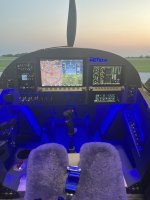
#1 for us

1733055846013.png
 
The biggest problem with keyswitches IMO is that there's always a keychain of some kind hanginf off them, and over time the swinging keychain will scratch the panel around it. Even more so if you're inclined to find yourself upside-down from time to time...
 
I ended up with a pair conventional toggle switches, each inline with pullable breakers. This is a simple and reliable method and it has the benefit of allowing the EMags to be configured to support hand propping, if ever required.

It also happens to be one of the factory recommended methods.

The issue with hand propping is that the Emags normally introduce a 3-revolution delay to purge the intake system before enabling the sparks. By turning on the P-Leads before applying power, this ignition delay is defeated.

Brad Dement at Emagair was helpful in describing the various switching options. In the end, the KISS method prevailed (Keep it Simple, Stupid). Despite my natural inclination to overthink the problem, I followed the factory recommendation.
 
I installed the standard ACS ignition switch and control power to the Pmags via VPX interface in the EFIS. The test is only done on the ground so I didn't see a need for a physical switch.
 
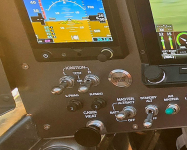
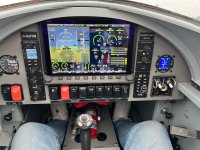
Look at the bottom right of my panel. My P-Mag ground toggle switches with switch/CB's under each toggle. During run up, I simply pull both CB's ( because above 800-900 RPM the P-Mag should be self powered ) and do a simple mag check as normal, then reinsert the CB's. Another option is to pull the LH CB then ground the RH mag, back to normal, then same for the other side.
 

Attachments

  • IMG_8317.jpeg
    IMG_8317.jpeg
    2.4 MB · Views: 119
FWIW; 954hrs, and counting, with no issues whatever. The circuit breaker(s) are with all other breakers on a separate panel.

EMag Switches.jpg EMag Breakers.JPG
 
I simply turn off the power ON/OFF to the P-mags via the Skyview EFIS using the VP-X screen where they are on two separate circuits. No extra switches. Keeps the panel very clean.
 
I simply turn off the power ON/OFF to the P-mags via the Skyview EFIS using the VP-X screen where they are on two separate circuits. No extra switches. Keeps the panel very clean.
Sure makes a simple mag chk cumbersome and unintuitive.
 
I dislike keyed mag switches and locked toggle switches and also don't really care what Cessna did 50 years ago. My preference is not to use c/bs to switch supplies that I am planning to switch, even occasionally. I've also been running Pmags for 20 years and test the generator function only occasionally.
My solution is 2 x regular toggle switches for "mag" switches with P-mag power is via switchable c/bs.
Yes, 4 switches that could be handled with 2 but there are 2 distinct functions involved so use separate switches. "Mag" switches are used several times each flight, power switch is used only once every several flights.
 
I dislike keyed mag switches and locked toggle switches and also don't really care what Cessna did 50 years ago. My preference is not to use c/bs to switch supplies that I am planning to switch, even occasionally. I've also been running Pmags for 20 years and test the generator function only occasionally.
My solution is 2 x regular toggle switches for "mag" switches with P-mag power is via switchable c/bs.
Yes, 4 switches that could be handled with 2 but there are 2 distinct functions involved so use separate switches. "Mag" switches are used several times each flight, power switch is used only once every several flights.
If you're relying on Tyco switch/breakers for power that's a bad idea, they fail regularly.
 
If you're relying on Tyco switch/breakers for power that's a bad idea, they fail regularly.

I'm trying to research if that's in fact the case for current production units or if there was maybe a bad batch 10+ years ago? There was the FAA bulletin CE-13-22 from March 13, 2013 with guidance including a replacement interval on these.

If there is more info regarding this I would appreciate being steered in that direction! Thanks
 
If you're relying on Tyco switch/breakers for power that's a bad idea, they fail regularly.
For my application - only occasional use as a switch - and the FAA recommendation to change out after 2000 flight hours, assuming use as a switch once per flight hour, I am comfortable these products give acceptable reliability.
 
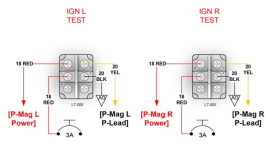
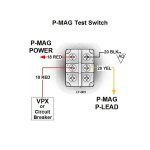
Here's how SteinAir wired for dual P-mags on my recent RV-14A panel

View attachment 75410View attachment 75411
Trying to wrap my head around leaving the two lower contacts empty. Shouldn't the bottom screws have P-Lead on one side and ground on the other side? Stein photo shows the switch as "ON-ON-ON Momentary" but this photo would imply the P-Lead is ungrounded when away from the cockpit. Concerning to me as I move the prop on a very Heat Soaking engine to attach the Tug. Feel free to correct me, Ed
 
Trying to wrap my head around leaving the two lower contacts empty. Shouldn't the bottom screws have P-Lead on one side and ground on the other side? Stein photo shows the switch as "ON-ON-ON Momentary" but this photo would imply the P-Lead is ungrounded when away from the cockpit. Concerning to me as I move the prop on a very Heat Soaking engine to attach the Tug. Feel free to correct me, Ed
This may look like "Bumping Up" but I am only hoping Stein will answer about their wiring diagram. (it seems the Stein wiring diagram did not follow the OP posts thru the replies up to here.) Could OP repost it?
 
I installed the standard ACS ignition switch and control power to the Pmags via VPX interface in the EFIS. The test is only done on the ground so I didn't see a need for a physical switch.
Very similar for me.
Standard ignition switch.
Toggle switch to supply power for startup (dedicated line from battery with fuse and green LED.)

It's a very simple approach. I started this way over 2000 hours ago with a Jeff Rose EI + Mag. Over time, I migrated to 2x P-MAG and stayed that way.

Rare Test: On the ground with >1000 RPM, switch power OFF. Slowly reduce RPM until engine cutoff. Note RPM. Restart and go fly.
 
Trying to wrap my head around leaving the two lower contacts empty. Shouldn't the bottom screws have P-Lead on one side and ground on the other side? Stein photo shows the switch as "ON-ON-ON Momentary" but this photo would imply the P-Lead is ungrounded when away from the cockpit. Concerning to me as I move the prop on a very Heat Soaking engine to attach the Tug. Feel free to correct me, Ed
Would seem you're thinking the ignition system could create an unwanted spark by hand turning the prop.

Not a PMag guy but electronic ignition of any type would need to be energized/on as a bare minimum. Then there is the inherent safety of the design.

If I'm misunderstanding, please clarify your conceived scenario.
 
I ended up with a pair conventional toggle switches, each inline with pullable breakers. This is a simple and reliable method and it has the benefit of allowing the EMags to be configured to support hand propping, if ever required.

It also happens to be one of the factory recommended methods.

The issue with hand propping is that the Emags normally introduce a 3-revolution delay to purge the intake system before enabling the sparks. By turning on the P-Leads before applying power, this ignition delay is defeated.

Brad Dement at Emagair was helpful in describing the various switching options. In the end, the KISS method prevailed (Keep it Simple, Stupid). Despite my natural inclination to overthink the problem, I followed the factory recommendation.
I have the same setup.
 
Trying to wrap my head around leaving the two lower contacts empty. Shouldn't the bottom screws have P-Lead on one side and ground on the other side? Stein photo shows the switch as "ON-ON-ON Momentary" but this photo would imply the P-Lead is ungrounded when away from the cockpit. Concerning to me as I move the prop on a very Heat Soaking engine to attach the Tug. Feel free to correct me, Ed
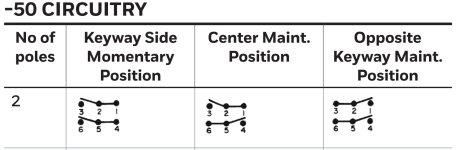
For the Honeywell TL series switches with the -50 circuitry, when the switch is in the opposite keyway maintained position "down", pins 3&2 and 5&6 are connected, which in this case would be grounding the mag, and applying power to the Emag. In the center maintained position, pins 1&2 and 5&6 are connected, ungrounding the mag but leaving the power connected. With the keyway side momentary position "up", pins 1&2 and 4&5 are connected, leaving the p-lead ungrounded and also disconnecting the ship's power to the mag. Attached pic is from the TL series datasheet.

1733848387549.png
 
Exactly. The switch is actually installed upside down. Notice the pin numbers.
It does mean in "OFF" position, the P-mags have power until the source is turned off. That's how they go into program mode. Turn on ship power with the P-lead shorted to ground. They switch to run mode as soon as any rotation is detected in run position.

If you contemplate programming or maintenance, I suggest extending the program pins from the P-mag harnesses. Pins 2,3 & ground. It's not easy to loosen those tiny screws to pull the plug. You can add a female D-sub to each harness then a male with pins 2&3 jumpered for the "A" curve. To connect a computer just plug in to the female. Remember to replace the male or program the "B" curve to the same parameters.
LT-005-DPDT-3-POSITION-LOCKING-P-MAG-SW-3.jpg
 
For the Honeywell TL series switches with the -50 circuitry, when the switch is in the opposite keyway maintained position "down", pins 3&2 and 5&6 are connected, which in this case would be grounding the mag, and applying power to the Emag. In the center maintained position, pins 1&2 and 5&6 are connected, ungrounding the mag but leaving the power connected. With the keyway side momentary position "up", pins 1&2 and 4&5 are connected, leaving the p-lead ungrounded and also disconnecting the ship's power to the mag. Attached pic is from the TL series datasheet.

View attachment 76091
Thanks for this example! So as I see it now the terminals 1 & 4 are being utilized and I may have been confusing terminal locations with toggle positions when looking at BWAGNER post # 6 above (Stein drawing 1&4 not in use).

This is an excellent example for SINGLE PMAG testing as when the toggle is lifted to the momentary position at idle the engine should quit, BUT when lifted to momentary position above 1200RPM it should keep running normal and uninterrupted.
In order to test with TWO PMAGS each one will have to be turned OFF to down position in order to test the other one.
Otherwise, you would not be aware of which PMAG is running the engine. So: One toggle down and other toggle held UP, engine still running above 1200RPM , that PMAG check is good, now reverse check for the other PMAG. I think I got this!

Side Bar: You know I feel "OLD SCHOOL" when I was told to always use a shutdown procedure: Hold Brakes, Pull to Idle Cut Off, wait till engine quits and TURN OFF the key and REMOVE the KEY and place it on top of panel in the windshield for ALL to SEE!
 
I put a switch across
… If you contemplate programming or maintenance, I suggest extending the program pins from the P-mag harnesses. Pins 2,3 & ground. It's not easy to loosen those tiny screws to pull the plug. You can add a female D-sub to each harness then a male with pins 2&3 jumpered for the "A" curve. To connect a computer just plug in to the female. Remember to replace the male or program the "B" curve to the same parameters.
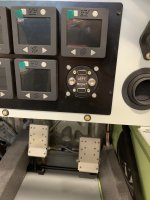
I have both a timing A/B switch and DSub connectors for connecting a computer. Switch 'Down’ is curve A (normal) and 'Up' is curve B or external control. I also have tach pulses on BNC connectors so I can use a portable oscilloscope to measure timing alignment. Sorry, pics are not from an RV.
 

Attachments

  • IMG_0184.png
    IMG_0184.png
    363 KB · Views: 63
  • IMG_4477.jpeg
    IMG_4477.jpeg
    1.4 MB · Views: 62
  • IMG_4447.jpeg
    IMG_4447.jpeg
    1.9 MB · Views: 62
I put a switch across

I have both a timing A/B switch and DSub connectors for connecting a computer. Switch 'Down’ is curve A (normal) and 'Up' is curve B or external control. I also have tach pulses on BNC connectors so I can use a portable oscilloscope to measure timing alignment. Sorry, pics are not from an RV.

Vern:
Switch from "A" to "B" timing. How much do you use that?
Extended Sub-D9's into the cockpit. To measure timing alignment. Did you need that and why?
What do you think of EI Commander, seems it does similar things as what you are trying to do. Correct?
What are those little displays in your panel? Inquiring Minds need to know. Ha ha.
 
Vern:
Switch from "A" to "B" timing. How much do you use that?
Extended Sub-D9's into the cockpit. To measure timing alignment. Did you need that and why?
What do you think of EI Commander, seems it does similar things as what you are trying to do. Correct?
What are those little displays in your panel? Inquiring Minds need to know. Ha ha.
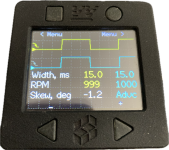
Still breaking the engine, so only using A timing. As for timing alignment using an oscilloscope, this is for development purposes. Eventually, I will build an in-flight ignition analyzer using the huVVer-AVI displays, which are the instruments that you see. These were developed as open-source flight instruments by huVVer.tech
 
Still breaking the engine, so only using A timing. As for timing alignment using an oscilloscope, this is for development purposes. Eventually, I will build an in-flight ignition analyzer using the huVVer-AVI displays, which are the instruments that you see. These were developed as open-source flight instruments by huVVer.tech

Still early, but here is a preview of the ignition analyzer in development….. 1744470701284.png
 
Option 1: it is simple and gives me the ability to turn the power to the PMAG off at any time. The most often use to turn the power off is if I am working on the engine that I want to ensure it has no ability to start AND if I am using trickle charger with the Master ON. I have a LED light above my toggle switch that comes ON if they are OFF.
 
Back
Top