Van's Air Force

The definitive Van's Aircraft support community! Buying, building or flying an RV? Join our exclusive family of mentors and enthusiasts!

Alternator field wire

FireMedic_2009

Well Known Member
Patron
The alternator is a denso mini alternator (with internal regulator) with 2 wire in the plug so I guess it’s what they call a 1-wire alternator and would refer to that wire as the field wire. I installed a contactor to disconnect the B-lead in case of an over voltage and am using a B&C OV module to automatically trip the 5A breaker switch that controls the contactor. From what I’ve heard, although rare, the alternator or voltage regulator can possibly fail a certain way where the alternator won’t shut down causing voltage runaway.

I believe I would connect the field wire to the contactor control terminal the 5A breaker switch is connected. Would that be correct? Just want to double check, it’s been awhile.

Thanks
 
Bob Nuckolls has Z-24-Interim (shows a Field terminal and labeled Interim) and Z-24A (shows an Ignition terminal and labeled Preliminary) at http://www.aeroelectric.com/PPS/Adobe_Architecture_Pdfs/ both dated 2009-03-07. You could ask him on the Aeroelectric List at Matronics.com http://forums.matronics.com/viewforum.php?f=3

AFAIK most internally-regulated automotive alternators have an ignition/enable terminal not to be confused with a field terminal, powering the ignition/enable terminal turns the alternator on, de-powering the ignition/enable terminal does not turn the alternator off.

You have a B Lead OV contactor so the issue is nil. Inelegant but it works.

A schematic of what you have would be helpful.
 
Last edited:
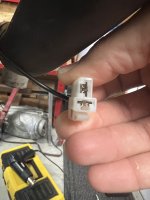
The plug on the back of the alternator is the T style plug. If removing power to the wire doesn’t shut down the B-lead then how else would you disconnect it from the bus without a contactor?
Thanks
 

Attachments

  • IMG_8664.jpeg
    IMG_8664.jpeg
    1 MB · Views: 29
Hi you can't, the alternator field is supplied from a diode trio internal to the alternator. The field wire just initially energises the field then the supply comes from the trio. So you either have to use a contactor or convert the alternator to external regulated with over voltage protection.
Good luck
K
 
Hi you can't, the alternator field is supplied from a diode trio internal to the alternator. The field wire just initially energises the field then the supply comes from the trio. So you either have to use a contactor or convert the alternator to external regulated with over voltage protection.
Good luck
K
To make sure I understand, you are saying the only way to disconnect THIS alternator from the bus is to use contactor to physically disconnect it, correct? I believe the 2nd or 3rd post stated using a contactor wasn’t elegant, so it is why I asked, “how else would you disconnect it from the bus other than by using a contactor.” Other than removing the internal voltage regulator and installing an external regulator and still having to use an over voltage protection module.

So a characteristic of an internal regulator is once the alternator is turned On it is unable to shut it down and an external regulator is able to shut it down if you choose to, is the correct?

Thanks
 
To make sure I understand, you are saying the only way to disconnect THIS alternator from the bus is to use contactor to physically disconnect it, correct? I believe the 2nd or 3rd post stated using a contactor wasn’t elegant, so it is why I asked, “how else would you disconnect it from the bus other than by using a contactor.” Other than removing the internal voltage regulator and installing an external regulator and still having to use an over voltage protection module.

So a characteristic of an internal regulator is once the alternator is turned On it is unable to shut it down and an external regulator is able to shut it down if you choose to, is the correct?

Thanks

I did refer to, in post #2, adding a contactor between an alternator B terminal and the main bus as inelegant. This is my engineering opinion because an additional component, the continuous-duty contactor, is added, this opinion can be fairly ignored.

Note in the case of an alternator with a field power wire, whether internally or externally regulated, the alternator B lead is not disconnected from the main bus, rather the alternator is shut down by depowering the field terminal.

I have a document on Google Drive re Allan Nimmo’s inflight OV event that may be informative.

https://docs.google.com/document/d/1Kran0Ay6_lCk8ji-esrwUHcLtm5VYXGT0DZrWh6eeGI/edit
.
 
Last edited:
I did refer to, in post #2, adding a contactor between an alternator B terminal and the main bus as inelegant. This is my engineering opinion because an additional component, the continuous-duty contactor, is added, this opinion can be fairly ignored.

Note in the case of an alternator with a field power wire, whether internally or externally regulated, the alternator B lead is not disconnected from the main bus, rather the alternator is shut down by depowering the field terminal.

I have a document on Google Drive re Allan Nimmo’s inflight OV event that may be informative.

https://docs.google.com/document/d/1Kran0Ay6_lCk8ji-esrwUHcLtm5VYXGT0DZrWh6eeGI/edit
.
John thanks for the article. Very interesting and informative. Never really knew the difference between automotive alternators. So if you use an automotive alternator you should use and contactor in order to disconnect it from the bus or remove the internal voltage regulator and add an external regulator so you can stop the output of the alternator. I’m not sure if the only difference between an automotive and a B&C alternator is the voltage regulator or if there is also a mechanical difference between the alternator (separate from the regulator). I understand how the voltage is generated and rectified in dc current by the diodes but don’t know it regulates the voltage and how it stops the output
 
The alternator is a denso mini alternator (with internal regulator) with 2 wire in the plug so I guess it’s what they call a 1-wire alternator and would refer to that wire as the field wire.

Thanks


No you do not have a 1 wire alternator, those only have one wire, the charging wire that goes to your bus, no field wire. You have a 3wire alternator with internal regulator.

Been using an intetnally reg Denso with that same style connector for 9 years now, works great. No external regulator or anything else, just the alternator hot terminal connected to the ammeter than bus, and the field power is connected to that T connector with an on off toggle, when the field toggle switch is OFF the Alternator is not charging. When I flip the toggle ON the alternator starts charging, if I need to stop the alternator from charging just flip the field toggle switch back off and alternator is offline. Simple works great no problems over the past 9 years.. about 300 hours

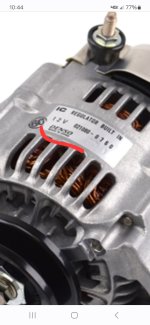
here is the one i have https://www.ase-supply.com/product_p/nd-021080-0760.htm
 

Attachments

  • Screenshot_20230215-085158_Opera.jpg
    Screenshot_20230215-085158_Opera.jpg
    194.5 KB · Views: 38
Last edited:
The plug on the back of the alternator is the T style plug. If removing power to the wire doesn’t shut down the B-lead then how else would you disconnect it from the bus without a contactor?
Thanks

Removing power from this connector does stop the B output, just connect the wire to your battery with a toggle switch to turn the power on off, and put a 5amp fuse or breaker in line between the alternator and toggle switch
 
The problem with depending on a manual OV disconnect such as a toggle switch or split master is having avionics damage long before the pilot notices the over-voltage. The B&C OV module trips the field breaker in milli-seconds after an OV event before the bus really has a chance to damage anything. I consider a manual switch to be just a way to turn off the alternator instead of valid OV protection.
 
The problem with depending on a manual OV disconnect such as a toggle switch or split master is having avionics damage long before the pilot notices the over-voltage. The B&C OV module trips the field breaker in milli-seconds after an OV event before the bus really has a chance to damage anything. I consider a manual switch to be just a way to turn off the alternator instead of valid OV protection.
I suppose a good reason to buy a real Denso than and not a chinese knockoff. I dont think a real Denso has ever had an overvoltage problem... at least mine or any of my friends have not had any issues, always dead on 14.2 volts. A little less if the battery is down some but after a few minutes its right at 14.2 again and stays there
 
I suppose a good reason to buy a real Denso than and not a chinese knockoff. I dont think a real Denso has ever had an overvoltage problem... at least mine or any of my friends have not had any issues, always dead on 14.2 volts. A little less if the battery is down some but after a few minutes its right at 14.2 again and stays there
I've never had an OV event either even though my RV-6 has flown with the legacy 35a "Vans" (14184 automotive) alternator for 25 years. I did have one develop noisy bearings which I caught during a condition inspection but the alternator and Ford regulator has maintained correct voltage just fine.
 
Your Nippon Denso if I understand is STOCK and has one B-Lead out, to battery and a plug with two wires. You put a contactor over voltage relay on B-lead.

The two wires is SENSE or SLEEP wire and warning light.

WARNING never cycle the SENSE wire (off or on or off/on) manually while alternator is running normally.

The Wake/Sleep/Sense wire is NOT a FIELD WIRE. It works different than a field wire. The micro processor inside the IR controls the field. Period. Sense wire tells the IR (internal regulator) to go to sleep after you shut the CAR down or wake up, as well as provide a bus voltage reference. It does not directly control the field. If it did you would put your OV protection on that.

The way I have my "single wire" (one B-lead, two small wires for Sense and Warning) wired is a DPDT Toggle, that turns on the Master Contactor (Relay) and provides Bus power to the alternators SENSE wire. As with all wires with power there is CB protection. The current in operation is tiny unlike a true field wire. You can put the SENSE wire on bus directly, since we turn our main BUS OFF after shut down. Add a pullable CB if you like.

Think of a car, all the stay alive currents stay connected to a HOT BUS after you shut down. As cars added more things, the batteries drained in a week or two parked. To avoid this, circuits go into sleep mode, turn their self off. That is what the alternator is doing,one of the functions of the SENSE or sleep wire. When you turn the car ignition on (power is connected to bus) the alternator wakes up and is ready to work.

Remember with external regulator the field current wire up to 2 amps on it. With an IR alternator that power is coming directly from the B-lead, and the IR is controlling the field. The IR only needs to know bus voltage at or after the battery, and that is the other function of that SENSE wire.

NEVER disconnect that SENSE wire to the alternator while it is running and making power. Worse is turn sense off then turn it back on. That can/will kill the IR, it may cause an actual OV.

These regulators are very reliable despite Bob Nuckolls strong opinions. Up to you no argument. Not getting into the debate. The IR in these regulators have microprocessors and do a great job protecting from OV, which is rare. If they happen they are builder pilot induced. Treating an IR alternator like one with an external VR is the issue. The OV fear was born out of EXTERNAL VR's and old technology in the day. They did have OV's. Not true of modern IR alternators or modern external regulators.

My OV protection is what is in the alternators IR. OV protection built into the IR. If it detects OV it will shut the field down. Period. I can pull a main CB that disconnects the alternator/battery from bus, but it is manual. That is for electrical fire. Most avionics are happy up to 30V. I don't think my small alternator can make 30V with a load at low engine RPM.

Sounds like you put OV protection on the B-lead. That is OK. I did not see the need. NEVER test it works inflight or with engine running. The IR and the B-lead need to be connected to the battery. Abruptly disconnecting and reconnecting while alternator is turning may cause a surge. They were not made to work that way.

The SECOND WIRE is a warning light. I recall it goes to ground if there is a FAULT to activate a warning light. It does more than indicate Hi or Lo volts, which it does do. It also indicates internal faults. It is kind of sophisticated if you have genuine ND IR not something with sawdust inside. Note all "new" ND's that are cheap are "clones". Not all clones are same quality. ND's patents are expired so everyone copies them. You can still find new OEM ND alternators, but they cost more. Aftermarket replacement IR's are all over. Some are garbage and some are good. The NICE THING about having an off the shelf car alternator is you can replace it on a trip. Have some special wiz-bang custom deal good luck. I sourced a new ND years ago for a Kabota tractor. It is tiny, rated at 35 amps (but can make 40 amps).

Most OV stories from tribal knowledge involving IR alternator were hearsay rumor or Pilot induced with IR alternators. If they do fail and they can, they just stop putting out power. The chance of an OV happening is nil if you use good practices, install and operate it as it was designed. With that said do as you like.

Last by all means put heat shields from hot exhaust to keep heat off the back of the alternator, and cooling air blast. This is what the IR needs to not COOK. This is where the external regulator has a claim to fame or advantage, you can located in a less hot or shaky place. With that said the IR is so stout, potted, heat sink, has proven reliable, it is a non issue.
 
Last edited:
Ok so post #9 says I have a 3-wire which I think means I have a field wire. Post #14 says I don’t have a field wire, it’s a sense wire (which I assume is the red wire) and the warning light (which I assume is the black wire).

So I connect the red wire to the master contactor to wake up the alternator. If I don’t put a warning light, do I leave the black wire disconnected?

How do you know if the alternator is an actual Denso and not a high priced clone posing as an actual Denso alternator? Will an actual Denso have on the IR Denso written on the IR?
 
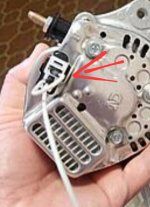
says Denso on the tag, the wires coming out of the back get jumped together as they exit the alternator, and ran out to the toggle switch to toggle battery power on, thats your field. I always srart with battery and field off and toggle both on after engine start, doing it that way for 9 years and the Denso still going strong.
see second pic, the top wire is jumped to the bottom wire and the bottom wire runs out to your toggle.

installed via field approval on a 1949
Piper which has the starter hot to the battety so always start with battery off

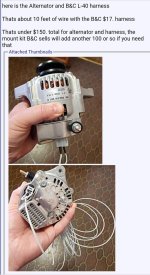
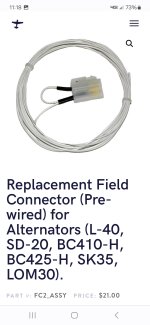
you can buy the prewired field connector jumped together from BandC for $21. its the L40 alternator harness https://bandc.com/product/replaceme...-alternators-l-40-bc410-h-bc425-h-sk35-lom30/

L40 alternator https://bandc.com/product/alternator-40-amps-homebuilt-2/#bracket-configuration

I just used the L40 harness on the Denso alternator, this is the same alternator as the L40 but only $139. https://www.ase-supply.com/product_p/nd-021080-0760.htm
 

Attachments

  • Screenshot_20241127_104443_Chrome.jpg
    Screenshot_20241127_104443_Chrome.jpg
    178 KB · Views: 53
  • Screenshot_20241127_110422_Chrome.jpg
    Screenshot_20241127_110422_Chrome.jpg
    139.8 KB · Views: 52
  • Screenshot_20241127_111835_Chrome.jpg
    Screenshot_20241127_111835_Chrome.jpg
    179.1 KB · Views: 50
Last edited:
I just went through this on a friend’s RV6. The jumper wire was missing, and when I checked the security of that connector the other wire (field wire) fell out. I spliced onto that one field wire, which runs through the firewall to the external regulator (BnC L40), using two wires for the two spade connectors on the T connector. According to the BnC install manual, those two positions are electrically the same, because the male ends of the connector are soldered together inside the alternator. BNC recommends using both positions to stabilize the connector - a weak point on this setup.
 
Your Nippon Denso if I understand is STOCK and has one B-Lead out, to battery and a plug with two wires. You put a contactor over voltage relay on B-lead.

The two wires is SENSE or SLEEP wire and warning light.

WARNING never cycle the SENSE wire (off or on or off/on) manually while alternator is running normally.

The Wake/Sleep/Sense wire is NOT a FIELD WIRE. It works different than a field wire. The micro processor inside the IR controls the field. Period. Sense wire tells the IR (internal regulator) to go to sleep after you shut the CAR down or wake up, as well as provide a bus voltage reference. It does not directly control the field. If it did you would put your OV protection on that.

The way I have my "single wire" (one B-lead, two small wires for Sense and Warning) wired is a DPDT Toggle, that turns on the Master Contactor (Relay) and provides Bus power to the alternators SENSE wire. As with all wires with power there is CB protection. The current in operation is tiny unlike a true field wire. You can put the SENSE wire on bus directly, since we turn our main BUS OFF after shut down. Add a pullable CB if you like.

Think of a car, all the stay alive currents stay connected to a HOT BUS after you shut down. As cars added more things, the batteries drained in a week or two parked. To avoid this, circuits go into sleep mode, turn their self off. That is what the alternator is doing,one of the functions of the SENSE or sleep wire. When you turn the car ignition on (power is connected to bus) the alternator wakes up and is ready to work.

Remember with external regulator the field current wire up to 2 amps on it. With an IR alternator that power is coming directly from the B-lead, and the IR is controlling the field. The IR only needs to know bus voltage at or after the battery, and that is the other function of that SENSE wire.

NEVER disconnect that SENSE wire to the alternator while it is running and making power. Worse is turn sense off then turn it back on. That can/will kill the IR, it may cause an actual OV.

These regulators are very reliable despite Bob Nuckolls strong opinions. Up to you no argument. Not getting into the debate. The IR in these regulators have microprocessors and do a great job protecting from OV, which is rare. If they happen they are builder pilot induced. Treating an IR alternator like one with an external VR is the issue. The OV fear was born out of EXTERNAL VR's and old technology in the day. They did have OV's. Not true of modern IR alternators or modern external regulators.

My OV protection is what is in the alternators IR. OV protection built into the IR. If it detects OV it will shut the field down. Period. I can pull a main CB that disconnects the alternator/battery from bus, but it is manual. That is for electrical fire. Most avionics are happy up to 30V. I don't think my small alternator can make 30V with a load at low engine RPM.

Sounds like you put OV protection on the B-lead. That is OK. I did not see the need. NEVER test it works inflight or with engine running. The IR and the B-lead need to be connected to the battery. Abruptly disconnecting and reconnecting while alternator is turning may cause a surge. They were not made to work that way.

The SECOND WIRE is a warning light. I recall it goes to ground if there is a FAULT to activate a warning light. It does more than indicate Hi or Lo volts, which it does do. It also indicates internal faults. It is kind of sophisticated if you have genuine ND IR not something with sawdust inside. Note all "new" ND's that are cheap are "clones". Not all clones are same quality. ND's patents are expired so everyone copies them. You can still find new OEM ND alternators, but they cost more. Aftermarket replacement IR's are all over. Some are garbage and some are good. The NICE THING about having an off the shelf car alternator is you can replace it on a trip. Have some special wiz-bang custom deal good luck. I sourced a new ND years ago for a Kabota tractor. It is tiny, rated at 35 amps (but can make 40 amps).

Most OV stories from tribal knowledge involving IR alternator were hearsay rumor or Pilot induced with IR alternators. If they do fail and they can, they just stop putting out power. The chance of an OV happening is nil if you use good practices, install and operate it as it was designed. With that said do as you like.

Last by all means put heat shields from hot exhaust to keep heat off the back of the alternator, and cooling air blast. This is what the IR needs to not COOK. This is where the external regulator has a claim to fame or advantage, you can located in a less hot or shaky place. With that said the IR is so stout, potted, heat sink, has proven reliable, it is a non issue.
The only flaw in your logic is, as in most cases of alt failures, it is the internal regulator that fails, then all bets are off.
 
Last edited:
I just went through this on a friend’s RV6. The jumper wire was missing, and when I checked the security of that connector the other wire (field wire) fell out. I spliced onto that one field wire, which runs through the firewall to the external regulator (BnC L40), using two wires for the two spade connectors on the T connector. According to the BnC install manual, those two positions are electrically the same, because the male ends of the connector are soldered together inside the alternator. BNC recommends using both positions to stabilize the connector - a weak point on this setup.

Sorry to be nit picky but for the sake of those who might be new to all of this, the company is B&C (Specialty Products), not BnC.
 
ases of alt failures, is the internal regulator fails, then all bets are off.
I don't wish to get into an argument, but what? Contrarian arguments drives these discussion, fear. What failure? Point to some spacific cases, why and how. I get pilots want control. They want to be able to shut the alternator down manually. I get it. I have been flying for 39 yrs and never wanted or needed to manually shut the alternator down. Now if the belt comes off, sure turn the field off to save some power. Thus the Cessna split Master/Alt. Check list says alternator stops working turn alternator off. That is a fine case. The IR alternator will do it for you via the magic of electronic processor control. IR alternators sense if alternator is turning, current in field. If the alternator is not turning the field current is reduced to milliamps or goes to sleep. Yeah verily. I understand a lack of trust of micro processors and desire for manual control. However our life today is trusting electronics. When the AI robots take over we are screwed. Ha ha.

I will agree to disagree. How do you know failure mode means "all bets are off"? This is were fear kicks in. Typically an IR alternator fails in a benign way, just from my experience. I realize this is anecdotal. I rarely see them fail in cars or EAB planes, other than they go to ZERO volts not infinity volts. Sometime the rectifier blows and you get nothing. I have a lot experience with these ND IR alternators, I know is not a logical argument, but I trust them, with the caveat get a good IR alternator not a cheap aftermarket clone. Although aftermarket has good manufactures and "cheap" may just be economy of scale.

Biggest CON of IR alternators may be assuring the quality of components. There is a mass aftermarket market of ND parts (now that ND's patent has expired). I got on a USA wholesale importers website that caters to alternator parts sellers and rebuilders. There are a lot of brands making aftermarket ND parts. I am sure that is where Plane power and B&C get some parts. They are not rebuilding junkyard alternators and they are not casting their own housing or making bearings.

Aircraft still use external regulators due to regulations. You may recall when ND alternators with external regulators were being installed via field approvals; the FAA went nuts. Replacing a 1950's generator with mechanical voltage regulator with a compact ND alternator and solid state VR is a win win. FAA was appeased at some point. IR alternators would be too much to certify. External VR alternators for standard category airplanes is status quo.

Keep the IR as cool as you can and balance your prop so the engine is not shaking like a wet dog. Obvious advantage of external VR as it can be firewall mounted, a little cooler and less vibrations. Some IR alternator aftermarket brands are OK. However genuine ND is best IMHO.

In my opinion the IC circuits in these IR alternators are robust, sophisticated and have OV protection with benign failure modes. As I said, repeating you can induce failures (from one story I heard) by cycling the sense wire OFF than back ON while alternator is under load. Don't do that. The IR is automatic and thou shall not mess with it; works without pilot input. Wire your master and sense wire to come on and off together and never turn them off with engine spinning (like a car).

There is no right or wrong. Tribal myth is strong, and builders have opinions based on rhetoric promoted for years. Most of the topic is opinion based (including mine). Facts are few (but try to bring some facts) and fear is a motivator, due to lack of understanding of how IR alternators work. I say up to you. Those who passionately promote external voltage regulators and "crow bar" OV protection, up to you. Nothing wrong with that and there are advantages. Airplanes still use External regulators due to inertia and certification.

External VR needs more wires, more connections, but it does give the pilot total more direct control. Hey flyby wire planes the pilot only votes on what they want the plane to do, the computers fly the plane. True you have no direct control over the field with an IR alternator. It is all in the IC. I looked up the IC chip part number, and the chip is solid technology. Pilots want control. "I don't need no stinking IC." I understand. Most older GA planes flying today have no OV protection per se, and use 1950's and 1960's car technology. Little ND's are rocking 1980's IC chip technology. So there. Ha ha. The external regulator is a throw back to frankly to 60' and earlier. That is what planes use to use, and due to inertia and certification still use external VR's, now solid state of course. So you are still trusting electronics one way or another. Can your OV protection circuit have a bad day and shut down a good alternator or not shut down a misbehaving one? Yes.

Can that IR alternator's electronic VR circuit and components fail so field power becomes unregulated or go OV? From my research/experience, have a hard time finding examples: Here are two stories. Case one pilot cycled the sense wire from ON to OFF and than back to ON while flying. That is a big no no (as I said above). This is not a fault of the IR alternators IC, just that surges apparently can fry the power transistor or something. I assume it fails open and does not clamp down? Case two another pilot tested his optional added on B-lead OV contactor, tripped it manually "to see if it worked". It did work and blew the alternator's IR. BTW, this is hearsay, so take it with grain of salt. It is hard to verify. I'm sure someone has an uncle, who has a friend, who knew a guy, who knew a guy when XYZ happened...

Not a fan of B-Lead OV guillotine on an IR Alternators. It's abrupt and heavy. You can put a big CB on your instrument panel and pull it. If you are that worried about OV with an IR alternator then IMHO get an externally regulated VR with all the pilot controlled crow bar disconnect contactors you can find. Spend as much as you like. A simple IR alternator is less money and easier to install. If you need to PhD in switch throwing and 100 miles or wires, with 3-lbs of contactors, dual alternators, dual batteries to get your single engine planes electrical going it's probably too complicated. If it makes you happy and feel you need it, that is cool.

BTW old avionics, back in the day, had ships power go right into the main circuit board, to voltage sensitive semi-conductors with low voltage limits, so they could not handle over rated voltage which was like 16 volts. New avionics (check with manufacture) have internal voltage regulated supply and can handle wide range of bus voltages so they work in a 12 or 24 volt aircraft, typically 30 volts I recall is common.
 
One of the largest distributors of IR aircraft alternators is Plane Power, and they have a dismal record of reliability. Quite a few polls and threads on VAF discussing the problems with PP and auto installs. IR alternators, one wire alt’s, have a big ease of installation advantage, but there is little doubt the failure rates of PP and other automotive alternator installations is unacceptably high for whatever reason. People like ‘easy’ and cheap which is why most folks install auto 1 wire units, because the data speaks for itself on reliability.
 
Last edited:
One of the largest distributors of IR aircraft alternators is Plane Power, and they have a dismal record of reliability. Quite a few polls and threads on VAF discussing the problems with PP and auto installs. IR alternators, one wire alt’s, have a big ease of installation advantage, but there is little doubt the failure rates of PP and other automotive alternator installations is unacceptably high for whatever reason. People like ‘easy’ and cheap which is why most folks install auto 1 wire units, because the data speaks for itself on reliability.
Yep I heard that. Hartzell bought PP I recall. BUT PP issues does NOT = IR are bad.. PP issues are their own. They use external voltage regulator don't they? Or do they have internal regulators or both? Yes Both... From my 2 min research (Plane Power reviews on Aircraft Spruce), PP did not have over voltage *OV* on their internally regulator models. Regardless of model there were complaints of them. They stopped working, for things like stator or bearing failed after 18mo or 3 years. Yeah that is not great. May be they fixed that issue. I recall they have OV crow bar protection built in. I did notice in my 2 min research I see PP takes cores at $200. They also have expanded their STC and aircraft spacific alternator types, like case mounted gear driven Continental alternators, not just belt drive. Experimental market is just part of their current business. Looking at the "stars" there was some 5/5 and a few 4/5 on the certified side, and in the case of experimental 3/5. I would be mad too if my $1500 alternator kit stopped making juice after 18 months.

Not sure what the definition of dismal record is, a few post on VAF. B&C has had some issues as well. Not bashing either company. A few complaints is not a reason for me to jump to conclusions. To my point supply chain issues and QC comment above. Not going to argue PP's reputation. I'm not here to defend or bash any product. I am talking about SENSE wires on automotive alternators, and the topic of OV with internal regulators, frankly over hyped. Modern good ND Internal VR are not inherently prone to failure or OV. That is my story and sticking to it. Ha ha. PP is not know for OV with internal regulator is my takeaway as well, but they claim to have some crow bar built-in. The failures on Spruce Aircraft reviews bothers me. I suppose they have warranty. So do rebuilds from Auto Parts store, some "life time" warranty with towing expense and up to $250 in other expenses. Ha ha. So there is that. Typical warranty is 3 yrs. Most "experts" say alternators should last 10 yars. Assuming an alternator on a Lycoming in your RV has a harsher environment, 5 yrs? If you have a cheap auto parts store alternator you can afford to swap it out every 3 years.

I would not buy PP or B&C due to cost, not due to good/bad/indifferent reputation. As expensive as building a plane is, what is another $1000-$1500 I guess. But don't expect $$$$ to equal better reliability necessarily. The other reason I would not go with PP units for me personally, they are medium frame ND models, 60 Amps. I have a small frame ND that is 35/40 amps. That is all I need, thanks to LED's. B&C has always made a small frame 40 amp model, a nice product, wired for external regulator. All good stuff. PP vs B&C is not the topic I was discussing. Bottom line you can't point to PP and say see IR alternators are bad. Besides my exhaustive 2 min research, I don't know all PP past issues were , but IR (internal regulator) was not the main problem, as far as I know, definitely not OV. I use off the shelf and DYI IR alternators, so no dog in fight.

We have to look at builders, how they install, operate and condition of their engine (prop vibration**). You can't get around the fact the alternator and rectifier, regardless of brand or where the voltage regulator is BOLTED to the hot shaking engine.


--------------------------------

All these companies are buying some or may be most components off the shelf. I know B&C is not winding their own rotor or stator, casting their own housing, making bearings. They buy them. B&C wires up their own VR and they are very simple, through hole board mounted with a handful off components, no IC.. I know B&C promoted at one time they take the stock rotor and balance it. Nice. I am sure the vibrating** engine their alternator is bolted to, regardless rotor balance, is putting in more vibrations** on the alternator rotor, than the stock rotor is making by rotating, with or without special balancing. I could be wrong, and it may be value added. You can't get around the fact the alternator is bolted to engine. It is driven by belt that helps a little. Besides the IR, the rectifier is always onboard the alternator, regardless of where your voltage regulator is mounted.

Most or all know this, but for those who may not or for a review, a "rectifier" is inside the alternator housing, typically on the stator assembly; it is a separate component from the external voltage regulator (VR) or internal VR. It takes AC and turns it into DC. Regardless the rectifier has diodes and gets hot and shook with alternator regardless of what kind of VR you have, internal or external. These "semi conductors" are rugged and can take a beating in vibration and high temperatures. The rectifier however is a common failure point. Builders should minimize vibration** keep them cool from external heat as much as possible.

The VR and rectifier are not the only things that can fail. You have brushes, bearings, windings, stator, rotor. I had a belt fail once, yes belt. It's amazing they are as reliable as they are. I have had several Japanese cars I drove 20 yrs and +200K miles, and their ND alternators worked without fail or over voltage. We have focused on the inside or outside VR debate. We lost track of the fact alternator have many moving parts, other components. They all can fail. Regardless of having the VR inside or out, they are fairly reliable. The voltage regulator even internally mounted is NOT the most stressed item (but try to keep it cool).

Builders who maintain their alternators
, periodically removing them, disassembling them, inspecting brushes and bearings will enjoy higher reliability regardless of make model or VR location. You don't inspect and maintain the alternator, expect it to fail at some point. The alternators on planes are in a harsh environment, but we can help lower heat and vibrations**. We treat them like they are in a car. Go until they fail. More proactive maintenance, inspections, pays dividends.

** Balance your prop. It will save you maintenance, add reliability to everything, make the plane more enjoyable to fly. Not every technician is good at prop balancing. It is a bit of an art, and experience really counts. I had one guy balance my prop and it was no better, may be worse. Same plane, I went to a guy who balanced helicopter blades, as well as propellers of all kinds,, on fixed wing engines from Cubs to King Airs.. Night and day difference. I assisted him and he was thorough. Old school dude, knew his stuff. It was like a new plane. When engines are busting the airbox, baffles, oil cooler mounts it's vibrations.

 
Last edited:
9 years 400 hours on my IR Denso, still going strong, always start with field toggle OFF, after starting batt/alt switch gets turned on at same time (DPDT) switch. Suppose maybe this annual I will pull it off and maybe put new brushes in it.
 
Back
Top