Van's Air Force

The definitive Van's Aircraft support community! Buying, building or flying an RV? Join our exclusive family of mentors and enthusiasts!

912ULS Gearbox Rebuild...

Piper J3

Well Known Member
My friend has 500TT on his RV-12 and is experiencing engine vibration when he throttles back from cruise power setting of 5500 RPM. The engine runs smoothly during climb and at 5500 RPM in level cruise. Ignition check at 4000 is always good. Ignition check in the air is also good. When power is reduced for a decent the vibration starts at ~5200 RPM and vibration continues as engine is slowed further. When powering back up the engine runs smoothly again.

We have contacted Lockwood Aviation and they say the gearbox drive dogs are spalled and cause this problem. AreoShell Sport Plus oil has been used since new. There are virtually no metal shavings on the magnetic gearbox plug.

For comparison… my RV-12 with 950TT on early SN 912ULS does not have this vibration. Gearbox has never been overhauled. I use Mobil 1 Racing 4T 10W-40 full-synthetic oil exclusively.

For those that have had gearbox rebuilt… I’m interested in knowing what symptoms justified rebuilding the gearbox and if condition was solved with the rebuild.

Thanks in advance…
 
I replaced my gearbox at 602 TT. Wear can be excessive on the 912 gearbox during low-RPM idling. I bought the airplane at 580 TT with this problem already present. What happens is the dog gear cams have a radius in the corners that transitions into a full slope. Rotational force that would smack the cams into each other rides this radius and then up the slope into a pushing apart force by way of the opposing sloped edges of the cams climbing each other. This pushes against the Belleville washers which act as springs, and this dampens the effect of shock loads on the cams. When the engine is run in the ballpark of 2500 rpm or higher, the cams are fairly well engaged full time. At lower RPMs, like say 1800 rpm, the engagement of the cams is somewhat intermittent, and so the cams are constantly slamming into the radius to ride into the matched slopes. Over time, even at low TT hours like 500, this can wear out the radius so that it no longer causes a nice transition of force from rotational to outward. Instead, it can start "catching" and then it no longer dampens shock loading on the dog gear as it is designed to do. I would not really expect this to be much of a concern at higher RPMs (> 2500) because the cams normally stay fairly engaged above that, so there is no need for the shock absorption. The impact of the cams being worn into a corner would show up at lower RPM where the shock is occurring and not being dampened. This will show up as rough idling and in my case with a distinct metallic "ching" noise at low RPM.
 
My friend has 500TT on his RV-12 and is experiencing engine vibration when he throttles back from cruise power setting of 5500 RPM. The engine runs smoothly during climb and at 5500 RPM in level cruise. Ignition check at 4000 is always good. Ignition check in the air is also good. When power is reduced for a decent the vibration starts at ~5200 RPM and vibration continues as engine is slowed further. When powering back up the engine runs smoothly again.

We have contacted Lockwood Aviation and they say the gearbox drive dogs are spalled and cause this problem. AreoShell Sport Plus oil has been used since new. There are virtually no metal shavings on the magnetic gearbox plug.

For comparison… my RV-12 with 950TT on early SN 912ULS does not have this vibration. Gearbox has never been overhauled. I use Mobil 1 Racing 4T 10W-40 full-synthetic oil exclusively.

For those that have had gearbox rebuilt… I’m interested in knowing what symptoms justified rebuilding the gearbox and if condition was solved with the rebuild.

Thanks in advance…
This is the classic symptom of drive dog wear, and is why Lockwood recommended that the gear box be looked at.

There are numerous things that can have an impact on what total operating hrs this might occur, with the oil being used only a small part of the equation (if a factor at all).

Pilot operating technique is a big one, along with maintenance details (level of prop balance, and carb synch) and what fuel is used predominately, are a few that come to mind.
 
I’ll echo what others have said, limit idle time below 2000 rpm, carb balance at 3000 rpm but also at idle, dynamic prop balance. My gearbox was shimmed at 1200 hrs but didn’t need it, dogs had minimal wear.
 
I have a bit of gearbox rattle at 565 hours, it started about 100 hours ago. You can hear it during warm up. When taxing if you hold the stick back its more pronounced then with stick forward. After landing with engine hotter there was no noise however now I'm hearing it after landing. No metal on chip detector or in oil filter. I bought the aircraft when it had 185 hrs on it, use only the Aero Shell Rotax oil with changes at 50 hours or less. I use mogas and rarely use avgas. I'm wondering if there was ever a documented gearbox failure, and what the conclusion was. I'll probably pull it off at 600 hours and send to Lockwood.
 
I have a bit of gearbox rattle at 565 hours, it started about 100 hours ago. You can hear it during warm up. When taxing if you hold the stick back its more pronounced then with stick forward. After landing with engine hotter there was no noise however now I'm hearing it after landing. No metal on chip detector or in oil filter. I bought the aircraft when it had 185 hrs on it, use only the Aero Shell Rotax oil with changes at 50 hours or less. I use mogas and rarely use avgas. I'm wondering if there was ever a documented gearbox failure, and what the conclusion was. I'll probably pull it off at 600 hours and send to Lockwood.
What RPM do you warm up at? Low RPM warmup is a terrible time for the dog gear cams and what you are describing sounds exactly like your dog gear cams are worn into a corner.
 
What RPM do you warm up at? Low RPM warmup is a terrible time for the dog gear cams and what you are describing sounds exactly like your dog gear cams are worn into a corner.
Eriselle… I think your description of gearbox design intent in post #2 above is exactly correct. Thank you for excellent and easily understood synopsis.

My friend’s RV-12 w/ 500TT has always been run at fast idle to prevent death rattle. Engine always synched, balanced prop, and treated with loving care and now this weird vibration only on power reduction. I am of the opinion that this particular problem is not related to drive dogs because dogs are forced tightly together under load of fast running prop.

I seem to remember some discussion years ago about Rotax having heat treatment problems (soft wear surface). I have sent message to Rotax with engine SN and description of problem. I will report back when I hear from them. Piper J3
 
What RPM do you warm up at? Low RPM warmup is a terrible time for the dog gear cams and what you are describing sounds exactly like your dog gear cams are worn into a corner.
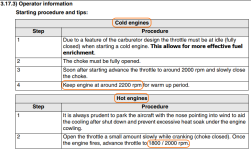
Finding the right way to idle is a bit of a treasure hunt in the Rotax world. The RV-12 POH has some guidance but it isn't very specific. It says at start "Throttle/Choke - 2000 RPM", "Taxi RPM – 1800–2500 RPM until oil temp reaches 120° F". The Rotax Operators Manual says even less. However if you are lucky enough to find Rotax Service Letter SL-912-016R2, on Page 16 it says...

1730476974012.png
Based on this I warm up at 2200 RPM. When warm I idle at 1800 RPM (1800 seems smoother than 2000 for me).
 
Finding the right way to idle is a bit of a treasure hunt in the Rotax world. The RV-12 POH has some guidance but it isn't very specific. It says at start "Throttle/Choke - 2000 RPM", "Taxi RPM – 1800–2500 RPM until oil temp reaches 120° F". The Rotax Operators Manual says even less. However if you are lucky enough to find Rotax Service Letter SL-912-016R2, on Page 16 it says...

View attachment 73409
Based on this I warm up at 2200 RPM. When warm I idle at 1800 RPM (1800 seems smoother than 2000 for me).
I would strongly recommend an engine warmer over conducting an ice cold start. If the engine is already hot, there is zero benefit to idling that low in terms of engine longevity. In fact, the the 912 is happiest at max cruise, and anything less than that comes at the cost of increased wear. The only downside to idling a hot 912 a little higher is that you might be producing more thrust than you want to be. Higher than 2000 rpm, you are going to notice the effects of that thrust, whether landing, taxiing, or sitting still. I ride my brakes while taxiing, which comes at a cost of increased brake wear. However brakes are trivial to replace, so I consider that a superior outcome to the alternative of burning my gearbox dog gear cams faster. While doing a landing where I cannot afford to float for a while, that's about the only time I pull back further than 2000. The RV-12 G3X has the high end of the warmup range configured to 2000-2300. If you ask Advanced Powerplant Solutions (formerly Leading Edge Airfoils) who is one of the four major Rotax service centers in the USA, they recommended substantially higher to me in the 2300 to 2800 range (this was verbal over the phone). Lockwood (another of the four major Rotax service centers) verbally recommended 2500 RPM during the carburetor balancing segment of the iRMT classes I took with them. The reason you would want to keep the RPM lower is to not cause uneven heat expansion in the engine, however the 912 is less susceptible to this than a traditional lycoming/continental engine due to the block being aluminum and the cylinder walls being a ceramic. Aluminum transfers heat much better than steel does, so the heat propagation is faster, and thus more even. The thermal expansion is also significantly higher than steel, which is a reason you really don't want to do an ice cold start. The reason you want to keep the RPM higher is to ensure the dog gear cams in the gearbox stay fully engaged. A balance of the concerns is necessary. Nothing wrong with following exactly what the operators manual says to do, but there are tradeoffs no matter what you do, and knowledge is power to let you choose where you want the wear to occur.
 
After engine start my warm up rpm is at first just above 1800 then I adjust it to 2400-2500 until 121*F ...Every October I install my cable controlled oil cooler blocker door to help warm up faster, but in reality it only saves me a minute or two, an oil temp thermostat system would be better but the cowl area is already over crowded so I'm not going to go that route.
 
As Eriselle states… cold start / low rpm are both areas to avoid. I preheat engine when temps fall below 50F. Engine heater remains plugged in and I wake it with cellphone 2-3 hours before flying. I always run engine 2500 – 2800 RPM on initial start of the day… right out of the box… been doing it for 950TT and gearbox hasn’t taken a dump.

Again... for those with gearbox rebuilt… did magnetic plug collect much metal indicating need for maintenance? What was deciding factor to get gearbox rebuilt?

I have owned dozens of motorcycles over the years that had magnetic drain plugs and most of them were ripe with metal filings. A couple of motorcycles even had an oil-slinger to accumulate non-ferrous aluminum.
 
This is an update to my original post that started this thread. I’m still trying to diagnose vibration roughness when throttling down from cruise RPM. See my post #1 above for full description of the problem. I spoke with Roger Lee (Rotax Owner’s Forum for 912/914 Technical Questions) and he thought problem is most likely carb synchronization. Advanced Power Solutions was also consulted and they offered carb synch as more plausible cause Vs. gearbox.

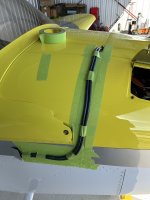
I’m wondering if anyone has ever hooked up a carb synchronizer in-flight to verify differential manifold vacuum L-R? I brought vacuum hoses from the intake manifolds into the airplane cabin via the side vent. Attached photo shows vacuum hose routing before hoses were completely covered with overlay tape.

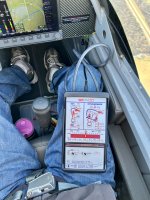
Carbs were synched nicely at idle and off-idle before first test flight. The SynchroMate showed a large (4.5 cmHg) difference at full and mid-throttle flight settings. It took two ground adjustments of the left carb throttle cable housing to get a nearly dead-on synch in flight for mid-throttle and above. See photo of SynchroMate in-flight at 5500 RPM. The vibration roughness when reducing throttle from cruise RPM is significantly reduced and not really noticeable now. EGT’s track nicely in the upper RPM range. So, I think carb synch is the root cause of the vibration / roughness problem. To verify accuracy of SynchroMate, I reverse manifold vacuum lines and reading show same but on opposite side of scale.

The problem now is carb sync at lower engine speeds. With carbs now synched for mid-high RPM, the low speeds show manifold pressure differential at 7 cmHg and engine roughness. So, it seems I can’t make engine run happily at slow and fast speeds with same throttle cable adjustment.

Next step is probably to rebuild the carbs and then synchronize from bare bones up.

Has anyone tried a carb synchronizer in-flight to verify differential manifold vacuum L-R? I’m interested to know if synchronization of both carbs can be attained over full RPM range with a single cable setting…IMG_0590.jpegIMG_0596.jpeg
 
Last edited by a moderator:
Where are your carb bowl vent lines terminated?
If the vent lines are under the bowl bails, most are, then in flight the vents "see" different pressure due to the swirling air inside of the cowl. The pressure at the end of the vent line causes more or less pressure above the fuel in the bowl causing a change in mixture. If you want to prove this out put one tube of your carb balancer under each bail next to the carb bowl tube and go fly. You will see a difference between the sides. Rotax understood this and incorporated an air box that both vent lines plugged into so they both "saw" the same pressure. My solution is;
https://waltsrv12.com/engine/carburetor-vent-line-reposition/
 
Last edited:
Seagull--Very interesting solution! Thanks for sharing.

Why did you elect to seal the end of the Tygon and then put side holes for venting? What would be the adverse effect of just leaving the end open inside the air filter?
 
Seagull--Very interesting solution! Thanks for sharing.

Why did you elect to seal the end of the Tygon and then put side holes for venting? What would be the adverse effect of just leaving the end open inside the air filter?
I was thinking that with only one opening in the hose there may be a venturi effect with the air rushing into the carburetor and that may cause a change in the pressure. I felt the holes in all directions would cancel it out.
 
I was thinking that with only one opening in the hose there may be a venturi effect with the air rushing into the carburetor and that may cause a change in the pressure. I felt the holes in all directions would cancel it out.
👍🏻
 
Back
Top