Van's Air Force

The definitive Van's Aircraft support community! Buying, building or flying an RV? Join our exclusive family of mentors and enthusiasts!

Electrical layout from engine to elec bus

FireMedic_2009

Well Known Member
Patron
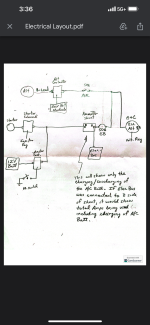
I’m updating the panel to glass and rewiring. Attached is the general layout. 5-6 yrs ago DanH advised to put and ANL fuse on the firewall side before the B-lead enters into the cockpit. I believe he said the reason was in case the B-lead would ever short out going through the FW, it would blow the fuse. I would like someone to confirm that after days of me looking at diagrams, pins, and connections of all the avionics, my brain is tired.

The ammeter shunt and 50A CB are inside the cockpit along with the elec bus.

I believe the 50A CB is located correctly in case it happens to fail the a/c battery will be able to power the elec bus short term. By having the elec bus connected to the A side of the shunt the system will know immediately when the alternator, ANL or CB has failed.
 

Attachments

  • IMG_8617.png
    IMG_8617.png
    2.5 MB · Views: 106
I’m updating the panel to glass and rewiring. Attached is the general layout. 5-6 yrs ago DanH advised to put and ANL fuse on the firewall side before the B-lead enters into the cockpit. I believe he said the reason was in case the B-lead would ever short out going through the FW, it would blow the fuse. I would like someone to confirm that after days of me looking at diagrams, pins, and connections of all the avionics, my brain is tired.

The ammeter shunt and 50A CB are inside the cockpit along with the elec bus.

I believe the 50A CB is located correctly in case it happens to fail the a/c battery will be able to power the elec bus short term. By having the elec bus connected to the A side of the shunt the system will know immediately when the alternator, ANL or CB has failed.
The protection for the B-lead is normally located close to the battery and is intended to protect that lead from overheating (from battery current) in case there is a short in the alternator or the lead. This explanation is based on Bob Nuckolls Aeroelectric Connection.
The diagram attached above shows both a circuit breaker and a fuse on the circuit that is shared by the primary alternator and the backup alternator, whereas I think each should be protected individually.
There are some very good generic circuit diagrams available free at the Aerolectric Connection and I recommend to use one of these (whichever is closest to what you are trying to achieve) as the starting point for your wiring diagram.
 
Alternators do NOT need a contactor unless they are the permanent magnet type.
A relay and overvoltage module may be in series with the alternator field.
Bob Nuckolls latest thinking is to use fusible links instead of ANL fuses. See his Z101B
Look on the left terminal of the starter contactor. 12FLW stands for 12AWG Fuse Link Wire.
NONE of Bob Nuckolls' drawings have a fuse in series with the main power bus.
The alternator "B" lead sure does not need both an ANL fuse and a circuit breaker in series.
Consider using a Hall effect sensor instead of a shunt. Shunt failures cause major electrical problems.
If a Hall effect sensor fails, only the ammeter current indication is affected.FireMedic_2009.png
 
That fusible link is a good idea, but it’s because it is cheaper, easy to install, and maybe more sensitive than the ANL fuse. But what is it that you are protecting? It’s not anything aft of the firewall. It’s that fat wire that goes from the battery to the alternator. The alternator is only capable of so much output, and that ANL or fusible link will probably handle that without blowing. The battery is capable of way much more, so you are protecting that fat wire to the alternator from a short in that section of wire that the battery can destroy. So what is protecting the same gage fat wire that goes through the firewall? In this example - nothing. Still capable of a huge amount of current supplied by the only capable power source to do such damage - the battery. And in this example, we have no protection on this big fat feed wire coming through the firewall, into our cockpit. I know that this is the way numerous certified aircraft are wired, but that doesn’t make it right, or smart. Just because it hasn’t caused problems, doesn’t make the design OK. Why do we protect 20awg wires behind the firewall with fuses or CB’s? Do we expect them to short circuit? I don’t, but I still protect them. Maybe we shouldn’t protect any wires, because we built it right and, well, we shouldn’t get any shorts……. A 15 amp short through an improperly gauged 20 awg wire might cause a problem, but it probably will be short lived and “maybe” not too catastrophic. But put an almost limitless amount of power, via the battery, through a 6awg main bus feed wire, and you will have melted metal and anything that can catch fire, will. I have never understood this design in aircraft electrical systems. In the 6+ aircraft that I have built and wired, I have never had an unprotected wire aft of the firewall.
 
Alternators do NOT need a contactor unless they are the permanent magnet type.
A relay and overvoltage module may be in series with the alternator field.
Hi Mich
A Denzo alternator has an internal voltage regulator and supposedly it can fail where the field wire is unable to shut it down (I believe DanH told me when I asked him about it so he told me to use a contactor to physically disconnect the B-lead using an OV module)
Bob Nuckolls latest thinking is to use fusible links instead of ANL fuses. See his Z101B
I’ll take a look at it. Thanks
The alternator "B" lead sure does not need both an ANL fuse and a circuit breaker in series.
I agree. I’ve always seen a main CB in planes. Where should it be in the electrical diagram or is one not needed?
Consider using a Hall effect sensor instead of a shunt. Shunt failures cause major electrical problems.
If a Hall effect sensor fails, only the ammeter current indication is affected.
What type of electrical problems does it cause?
Thanks
 
A Denzo alternator has an internal voltage regulator and supposedly it can fail where the field wire is unable to shut it down (I believe DanH told me when I asked him about it so he told me to use a contactor to physically disconnect the B-lead using an OV module)
You are right. I was thinking about alternators with an external field wire.
.
The alternator "B" lead should be protected at its end that is closest to the battery, for instance at the downstream side of the battery contactor. Disadvantages of using a circuit breaker are expense, using up valuable panel space, and running heavy wires through the firewall. A fusible link between the battery contactor and the alternator "B" lead will suffice. No circuit breaker needed provided that there is another way to shut off the alternator.
.
Shunts require that the heavy cable be cut and ring terminals be crimped on the ends. Those crimps can fail. Then the ring terminals need to be bolted to the shunt. Those nuts and bolts can come loose. The shunt itself can fail, usually caused by heat from a loose connection. The small terminals on the shunt can come loose. All of the shunt terminals need to be protected against shorting by foreign objects. A shunt requires space to be mounted, usually on the firewall. A hall effect sensor is immune to all of those problems because the heavy cable is never cut. No bare copper is exposed.
 
Back
Top