Van's Air Force

The definitive Van's Aircraft support community! Buying, building or flying an RV? Join our exclusive family of mentors and enthusiasts!

Calling all Nuckoll-heads

PCHunt

Well Known Member
I am rebuilding the "Fat Wire" portion of my purchased RV-6A, moving the battery and contactors to the engine side of the firewall.
Bob Nuckolls fig Z-11 does not show any protection on the 6AWG wire going from the Battery Contactor to supply the Main Power Distribution Bus. In my case, I am using a 12AWG wire, which passes through the firewall. Seems to me this wire needs protection of some sort, such as a fusible link, or an in-line fuse on the engine side of the firewall.:confused:

Looking for suggestions/recommendations, thanks!
 
I think the reasoning is that it is short, and the circuit protection adds a failure point that increases risk beyond the safety advantage of protecting that wire.

I am a little uncomfortable with that myself and my plan was to add more anti-chafe protection and to cover the connections at both ends, since the main threat is a short to ground.
 
I believe Andrew is correct, but hey, why not ask the Nuckoll-head himself on the Aeroelectric List?

erich
 
Industry practice doesn't use circuit protection here, unless you think of the battery contactor as circuit protection. IIRC, the logic is that the really fat wires are short, and if they do arc to ground at the firewall, they will typically burn the hole bigger in short order thus stopping the short. This bothered me too. I used no extra protection on the fat wire from the contactor to the main bus, but DID include a 40 amp MAXI fuse on the fat wire to the always hot battery bus.
 
One data point

The only plane I know that provided protection for the fat wires unfortunately crashed (both pilot and pax survived with relatively minor injuries). The salvage crew did not disconnect the batteries before they attempted to move the plane, and electrical sparks started a fire which destroyed the plane (the tanks were filled just before the flight, and ruptured during the crash).
That tells me that the fuses didn't provide the protection intended, and therefore are of dubious value. If the fuses are big enough to handle the starting current, they will definitely allow the wire to burn holes in thin sheet metal without blowing.
 
A little extra...

Industry practice doesn't use circuit protection here, unless you think of the battery contactor as circuit protection. IIRC, the logic is that the really fat wires are short, and if they do arc to ground at the firewall, they will typically burn the hole bigger in short order thus stopping the short. This bothered me too. I used no extra protection on the fat wire from the contactor to the main bus, but DID include a 40 amp MAXI fuse on the fat wire to the always hot battery bus.

...physical protection would be a good idea for the short section that actually penetrates the firewall.
 
I did ask Bob Nuckolls that exact question....

and he replied as previuosly stated in this thread that due to the short run it was considered unnecessary. He did suggest additional protection on the wire.
 
The wire I am talking about is about 3 feet long, and goes from the master contactor on the engine side of the firewall, through the firewall, and then up to the panel row of CB's, and supplies the main power distribution bus. The wire, and the bus behind the panel, are "hot" whenever the Master Switch is on.

Is 3' considered to be a "short" wire?

And if I did want to put a fuse or a fuselink in the system, what would be your recommendations??

Thanks again!
 
All,
What about putting another ANL-60 in-line with this wire before penetrating the firewall? We do this for the alternator B-lead; why not for this wire?
 
Additional 60 amp current limiter...

Tony,

An additional 60 amp current limiter is a good idea. I originally had this in my design until talking to Bob Nuckolls. My run through the firewall was only 9 inches so I eliminated it. If you check the example electrical drawing on the B&C website it shows two current limiters used exactly as you have described and is probably a good solution for Pete.
 
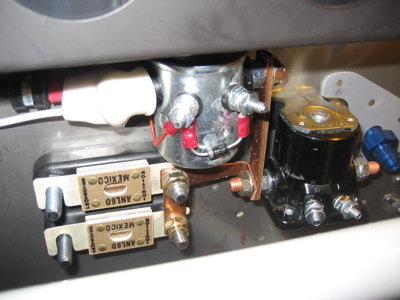
I likewise used an extra current limiter between the main battery contactor and the #6 wire that feeds the main bus. It's mounted right next to the one for the alternator, and is fed by a piece of copper bus bar:

20071027_wiring5.jpg


mcb
 
I second the comments to use an extra ANL, I did. No way I was running that big fat unprotected wire inside my cockpit without some sort of protection!

33272ba.jpg
 
Answers from "himself"

I posted my original question, and then several follow-up questions, on the Matronics AeroElectric forum, and received clear answers from Bob Nuckolls. I found the answers interesting, and educational. I thought it would be worthwhile posting the answers here:

Original Question:
>I am rebuilding the "Fat Wire" portion of my purchased RV-6A, moving
>the battery and contactors to the engine side of the firewall.
>Fig Z-11 does not show any protection on the 6AWG wire going from
>the Battery Contactor to supply the Main Power Distribution Bus. In
>my case, I am using a 12AWG wire, which passes through the firewall.
>Seems to me this wire needs protection of some sort, such as a
>fusible link, or an in-line fuse on the engine side of the firewall.
>
>Looking for suggestions/recommendations, thanks!


A 12AWG wire is probably too small to be
a bus feeder. When wiring with truly "fat"
wires (6AWG or larger) they're not at high
risk for burning due to shorts or overloads.
Take a look at the wiring diagrams for any
single engine TC aircraft and you'll find
that few if any will incorporate fuses or
current limiters in these pathways. This
philosophy is echoed in the FARS . . .


Sec. 23.1357 Circuit protective devices.

(a) Protective devices, such as fuses or circuit breakers, must be
installed in all electrical circuits other than--
(1) Main circuits of starter motors used during starting only; and
(2) Circuits in which no hazard is presented by their omission.
(b) A protective device for a circuit essential to flight safety may not be
used to protect any other circuit.
(c) Each resettable circuit protective device ("trip free" device in which
the tripping mechanism cannot be overridden by the operating control) must be
designed so that--
(1) A manual operation is required to restore service after tripping; and
(2) If an overload or circuit fault exists, the device will open the
circuit regardless of the position of the operating control.
(d) If the ability to reset a circuit breaker or replace a fuse is
essential to safety in flight, that circuit breaker or fuse must be so
located and identified that it can be readily reset or replaced in flight.


In particular, paragraph 12.1357(a)(2) applies here.
Faulted robust wires generally arc to ground and
burn their faults clear. Further, they're easily
installed with attention to mechanical details such
that faults to ground are as probable as loosing
one's propeller due to bolt failure.

The Z-figures are crafted with this philosophy
in mind supported by a confidence in nearly 100
years of field history. I'll suggest that none
of your fat wires should be smaller than 6AWG
and that protection beyond what is illustrated
in the Z-figures is no-value-added weight, cost
and complexity.

Bob . . .

Follow-up Question from another forum member:
>Bob,
>Trying to turn this into a learning/understanding moment, the above
>leaves me a bit puzzled as to exactly when the omission of a
>protective device would be considered to pose no hazard. Say one
>has an AWG-6 feeder connected to the switched side of the master
>relay and the conductor or a terminal faults to
>airframe. Alternator current would be limited by the alternator
>breaker, good; but battery current would only be limited by
>conductor, termination, device and internal battery resistances. At
>first estimate this would seem to be capable of generating a current
>well above the safe capacity of the AWG-6.
>
>This topic is of particular interest to me as we are currently
>working on electrical system modifications for a Bellanca BL-17 and
>found the local FSDO inspectors have conflicting thoughts
>with what you have stated.
>
>Appreciate any additional insight you may be able to provide.


The style of "protection" one might add to
fat wires in an array of battery/bus/cranking
feeders are like the ANL "current limiters"
found in the power distribution systems of
many larger aircraft.

http://aeroelectric.com/Pictures/Fuses/Fuses/ANL-ANN_Current_Limiter.jpg

Fusing characteristics for these puppies are
shown here . . .

http://aeroelectric.com/Mfgr_Data/Fuses_and_Current_Limiters/Bussman/ANL_Specs.pdf

Suppose you decided to put an ANL200 in the
battery feeder for your project. Note in
the fusing plots above the ANL200 will carry
300A without breathing hard.

Now, what kind of fault can you imagine
that ties your feeders down so firmly to
the airframe that you'd expect battery fault
currents of 1000+ amps to flow? You're
going to rub off some insulation and have
some low pressure, flying fault that
arcs a lot and intermittently draws hundreds
of amps . . . but is unlikely to open the
ANL limiter. In fact, you'll find that
the copper is barely damaged compared to
adjacent aluminum that simply burns clear
without even warming up your feed wire.

Have your skeptics research the wiring
diagrams for the host of S.E. aircraft
produced in the hundreds of thousands
for nearly 100 years and they'll note
a not so curious absence of fuses/breakers
in the fat wire feeders . . .

These wires seldom get faulted and when
they do, the event is so benign that
the current protection doesn't operate
before arcing burns the fault clear.

It's a lot of careful design and hard work
to bring two conductors together to be
an efficient conductor of hundreds of amps.
It just doesn't happen accidently.

Bob . . .

More follow-up questions from me:
>First, thank you for your response to my original question. If I am
>following your logic: A fat wire, if shorted to airframe
>ground, will burn away the nearby aluminum ground fault very
>quickly, and thereby eliminate the immediate problem.
>
>If that is so, then the next question would seem to be: Why protect
>the relatively short B-Lead that goes to-from the alternator, as it
>can be easily physically protected in a similar manner to the bus feed wire.

Because the fault risk there is not to the
wire itself but for the potential of diodes
shorting in the alternator. This failure
would probably burn wires in the alternator.
That's probably the least "useful" of the fat-wire
feeder fuses. Probability of diodes shorting
in modern alternators is exceedingly low.
That fuse or breaker can probably be eliminated
with little risk. Cars have never used
this fuse. Early cars burned some wires . . .
later ones added fusible links in the system
to limit the amount of wire that needed to
be replaced after a "burn".


>And a second question: Why use an AWG-6 wire to supply a main bus
>that only has a 20 amp max load?


Because to qualify as a fat-feeder with
little use for protection, the wire needs to
be more robust than the fault site conductors that
would put it at risk. We protect the little
guys because flying faults will often burn
them . . . a distribution fat-wire unworthy of
protection needs to be in the robust class.
I've never seen any rules of thumb but my
sense is that wires in the 10 to 6AWG range
are in a grey area and I'd probably fuse them.
A short 6AWG or larger bus feeder is probably
good to go without specific protection other than
extra attention to support and isolation from
potentially hazardous mechanical damage.

 
Yah, I know….. I have Bobs book and have read through it more than once. I understand what he is saying about not protecting feed wires, but it makes no sense to me. Just because it hasn’t happened (very often) in a TC airplane doesn’t mean it can’t. I’ve never had a wing fall off either. Protecting a potential fat wire is incredibly easy and then you’ll never have to prove anything. He says protecting a feed wire of 6awg or larger is “probably good to go without specific protection”. PROBABLY? Is that good enough? My feed wire is 8awg, so what about that? My max load with everything operating is 13 amps, and I have a 40 amp alternator - more than twice what I need. Another thing……. You mentioned what he says about the current limiter (I’ll have to look that up because I don’t remember reading that), but, as Bob says:

“Now, what kind of fault can you imagine
that ties your feeders down so firmly to
the airframe that you'd expect battery fault
currents of 1000+ amps to flow? You're
going to rub off some insulation and have
some low pressure, flying fault that
arcs a lot and intermittently draws hundreds
of amps . . . but is unlikely to open the
ANL limiter. “

Why in the world would it open the ANL current limiter? That current limiter only protects the wire going from the battery to the alternator - in the opposite direction. The alternator cannot possibly dump hundreds of amps into that alternator feed wire and then into the cockpit. That short run of wire, if shorted, is fed by the battery because it can dump hundreds of amps in a millisecond, and also can do in the rest of the feed wire that now goes into the cockpit, totally unprotected. The current limiter has nothing to do with this section of wire as depicted in the wiring diagram at the top of this post, and on most of the wiring diagrams in the Aeroelectric Connection. Bob’s systems are very robust and typically safe in countless TC aircraft, but they are built by professionals with numerous quality inspections by FAA certified technicians. We are amateur builders. A short in an improperly installed unprotected fat wire inside the cockpit would not be unheard of, and the consequences of a high energy dump through a fat wire like that can, and has, melted metal, and caused fires. Maybe not in one of our airplanes, but it certainly could, maybe even has. Protecting that wire is so simple, easy, and cheap, that I can’t understand why it isn’t done routinely. I have wired numerous buildings, basements, hangars, etc, and I’ve seen a short in a 20 amp feed catch the supporting structure on fire in a fraction of a second (more than once). And it was always caused by improper installation. The AE Conn diagrams and most TC wiring setups have one obvious weak point, and that is it.
Do what you want. You’ll PROBABLY be fine.
 
I experienced a rub through of the insulation on this fat wire. Cause was undetected abrasion against the carburetor heat Bowden cable. The resulting smoke in the cockpit initiated a quick return to departing airport.

A field repair was made to the wire using rubber fuel line and zip ties from a local hardware store. Then the airplane was ferried home and the wire was replaced and routing/securing was improved.

I am the builder and repairman, so at least I know who to blame.

This occured after ~15 years and 430 hours. The learning continues...

Eric
 
I am rebuilding the "Fat Wire" portion of my purchased RV-6A, moving the battery and contactors to the engine side of the firewall.
Bob Nuckolls fig Z-11 does not show any protection on the 6AWG wire going from the Battery Contactor to supply the Main Power Distribution Bus. In my case, I am using a 12AWG wire, which passes through the firewall. Seems to me this wire needs protection of some sort, such as a fusible link, or an in-line fuse on the engine side of the firewall.:confused:

Looking for suggestions/recommendations, thanks!
12 gauge? So all your panel breakers, lights, seat heat, pitot heat, radios, etc. won't exceed 20 amps or so? Like the diagram, I've got 6 gauge there.
Also, how does the alternator hook in? If that is flowing thru the main panel bus, to feed back via this wire to the battery, the alternator will dump a lot more than 20 amps into a discharged battery.
 
12 gauge? So all your panel breakers, lights, seat heat, pitot heat, radios, etc. won't exceed 20 amps or so? Like the diagram, I've got 6 gauge there.
Also, how does the alternator hook in? If that is flowing thru the main panel bus, to feed back via this wire to the battery, the alternator will dump a lot more than 20 amps into a discharged battery.
Thanks, guys. You are responding to a 15-year old thread, that seems to still be contemporary. The plane in question is still flying, albeit in a different country now! Sold it years ago......
 
I think part of the problem is the date on ea. post is barely discernible with the recent update. I myself was reading along like it all was just happening. I know the fix is on the to do list.

A
 
How did this end up here? When I responded to the post with my long diatribe, it was on page 1. I didn’t realize it was from 15 years ago!! Disregard whatever I said……. it’s obviously old news.
 
Back
Top