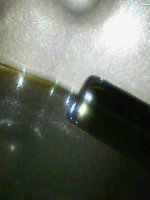
Couple notes...
I went with longerons level because that's where we spend most flying time. It's also the parking position for the A-models, and a common maintenance position for the tailwheel models. This is in fact an RV-8 with the tail on a stand.
I didn't mention minimum quantity and don't intend to do so. Personal preference is to run as much as
practical. My interest is understand the
why of breather oil transport.
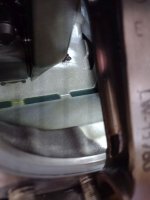
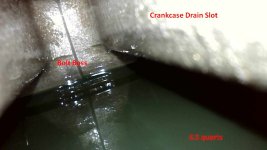
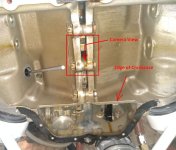
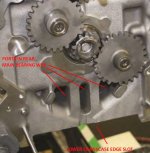
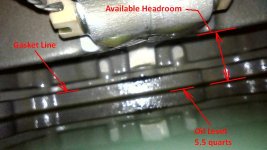
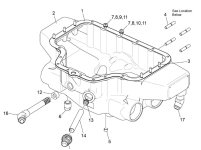
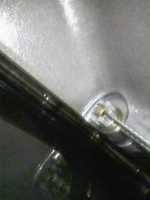
In the first post we see how much the sump will hold before the level extends up into the crankcase. As noted, the stick indicates roughly 7.5 qts, which most folks consider too much. I plan to get similar photos after draining one, then two quarts. Notably I'd like to know how many quarts drops the level below the crankcase sump flange. Here's why. With oil at 7.5, the breather gas path is entirely through just three openings in the rear main bearing web, and that path would carry a lot of aerosol oil from around the whirling crankshaft. With the oil level below the sump flange, the breather gas has an additional path to the accessory case, through the drain slots and under the rear case wall as illustrated below. That path probably contains quite a lot less aerosol oil. Photo below is my 390.
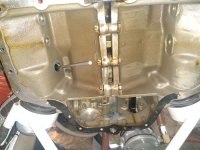
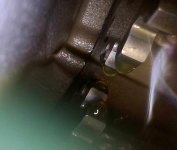
I looked at the governor gear specifically because one of the available transport mechanisms can be described as slinging and splashing. Imagine that gear running partially submerged. It would throw oil 360 degrees, including upward in the accessory case toward the breather outlet, and transport oil to the idler gear above it by contact. For those who don't know, the outlet is at the end of the camshaft.
Note above, those of us with front mounted governors don't have any gears near the oil level.
Stay tuned.