Van's Air Force

The definitive Van's Aircraft support community! Buying, building or flying an RV? Join our exclusive family of mentors and enthusiasts!

Sump Oil Level

DanH

Legacy Member
Benefactor
Advertiser
Mentor
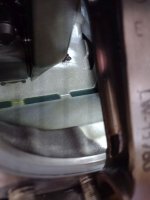
Data point for the record. Photo below is a standard Lycoming o-360 (updraft sump for a carb), looking in past the #4 rod. The slots in the bottom of the case lead down into the sump; they are the oil drains. Here the sump is completely full to the top of the slots. With longerons level, the supplied dipstick indicates approximately 7.5 quarts.

O360 updraft.jpg

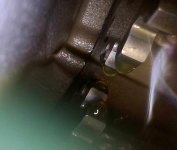
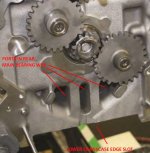
BTW, with longerons level, 7.5 qts is below the rear prop governor drive gear. However, I'm pretty sure this gear is spinning semi-submerged when the tailwheel is down. Borescope through the rear case web into the accessory case:

O360 Governor Gear 7.5 qts.jpg
 
Last edited:
interesting, I take it not many run that high oil level, but interesting data point nonetheless. Im assuming its like a car with oil level, if the level gets high enough that anything that is spinning dips into it, it can cause foaming?
 
I’ve been keeping my oil level at 6 quarts for years. I now believe that 7.5 is better. I live in Texas and it’s hot. I think the engine O-360, is using the oil to help cool the engine. My normal oil temp is 190 plus. Aero Shell 100 year round.
 
Data point for the record. Photo below is a standard Lycoming o-360 (updraft sump for a carb), looking in past the #4 rod. The slots in the bottom of the case lead down into the sump; they are the oil drains. Here the sump is completely full to the top of the slots. With longerons level, the supplied dipstick indicates approximately 7.5 quarts.

View attachment 69734

BTW, with longerons level, 7.5 qts is below the rear prop governor drive gear. However, I'm pretty sure this gear is spinning semi-submerged when the tailwheel is down. Borescope through the rear case web into the accessory case:

View attachment 69751
This is confusing me . I have always assumed that “proper oil level” corresponds to a known amount oil indicated on the stick after the oil galleries and filter have drained back to the sump and the tail is in the resting position on the ground. How else could you check the oil . This oil is available for use during operation, right ?

However, minimum oil quantity specifications by the manufacturer could mean “ less actual amount of oil won’t get sucked in the pump in level flight” or some other subjective criteria like ‘ a full tank of fuel won’t burn more than this much oil ‘

So, does “ minimum” take in to account all the issues Dan describes above or what ?
 
This is confusing me . I have always assumed that “proper oil level” corresponds to a known amount oil indicated on the stick after the oil galleries and filter have drained back to the sump and the tail is in the resting position on the ground. How else could you check the oil . This oil is available for use during operation, right ?

However, minimum oil quantity specifications by the manufacturer could mean “ less actual amount of oil won’t get sucked in the pump in level flight” or some other subjective criteria like ‘ a full tank of fuel won’t burn more than this much oil ‘

So, does “ minimum” take in to account all the issues Dan describes above or what ?
Per Lycoming, the minimum safe quantity in the sump on most O360's is 2 quarts.

I'm not advocating running less than 5-6 quarts because it can cause oil pressure fluctuations and some other stuff, but it illustrates that if you keep it around 6 quarts you have gobs of margin before you get to whatever parameter Lycoming uses to define that minimum.
 
On my 0-360 it has always seemed that if I add 7 quarts it blows out a quart pretty quickly and then gradually reduces from 6 to 5 at which point it seems to stabilize and I get about 16 hours before I have to add another quart. Filling to 7.5 would likely get a lot of oil on the belly.
Figs
 
Couple notes...

I went with longerons level because that's where we spend most flying time. It's also the parking position for the A-models, and a common maintenance position for the tailwheel models. This is in fact an RV-8 with the tail on a stand.

I didn't mention minimum quantity and don't intend to do so. Personal preference is to run as much as practical. My interest is understand the why of breather oil transport.

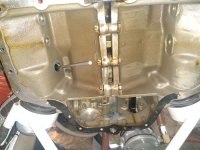
In the first post we see how much the sump will hold before the level extends up into the crankcase. As noted, the stick indicates roughly 7.5 qts, which most folks consider too much. I plan to get similar photos after draining one, then two quarts. Notably I'd like to know how many quarts drops the level below the crankcase sump flange. Here's why. With oil at 7.5, the breather gas path is entirely through just three openings in the rear main bearing web, and that path would carry a lot of aerosol oil from around the whirling crankshaft. With the oil level below the sump flange, the breather gas has an additional path to the accessory case, through the drain slots and under the rear case wall as illustrated below. That path probably contains quite a lot less aerosol oil. Photo below is my 390.
390.jpg

I looked at the governor gear specifically because one of the available transport mechanisms can be described as slinging and splashing. Imagine that gear running partially submerged. It would throw oil 360 degrees, including upward in the accessory case toward the breather outlet, and transport oil to the idler gear above it by contact. For those who don't know, the outlet is at the end of the camshaft.

Note above, those of us with front mounted governors don't have any gears near the oil level.

Stay tuned.

 
Last edited:
Actually I had the sump off the 390 to modify the intake flange, so I could bolt up an FM200 without a restriction. https://vansairforce.net/threads/intake-plenum-mod.226289/

Currently I am doing a fuel injection conversion on a parallel valve, updraft 360. It happened to need two cylinders, so it was a good opportunity to get the sump level data for that model.
 
The rest of the story...

I drained a single quart at a time. The measured total (from post #1) was confirmed at 7.5 quarts.

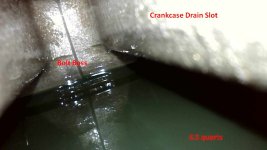
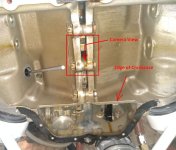
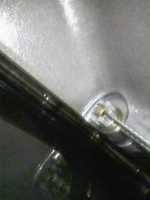
Borescope photo at 6.5 quarts. Camera is inside one of the drain slots in the bottom of the crankcase, looking aft. Oil level is right at the bottom of the split line bolt boss. That means it is also at the level of the aft crankcase edge.

6.5 qts 1 w notes.jpg

Bottom of Crankcase.jpg

At this level, the only path for blow-by gasses is through the three ports in the aft bearing web.

Blow By Passages.jpg

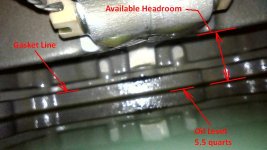
Below, oil level at 5.5 quarts. It's now slightly below the sump gasket line, and well below the aft edge of the crankcase (note, don't be confused by reflection off the surface of the oil). Blow-by gas can now escape through the oil drain slots and under the aft edge, into the accessory case. Port to the breather hose is at the top of the accessory case, at the end of the camshaft.

5.5 qts 1 w notes.jpg

Blow-by gas vented directly from the crankcase is full of aerosol oil droplets, as that space is a storm of spinning crank, moving rods, and oil venting from the bearing spaces. Oil droplets striking the wall surfaces run down and through the slots into the relatively quiet space above the oil in the sump. Blow-by gas taking the path down through the slots enters a relatively quiet area in the sump where is loses much of the oil. It's why oil loss from the breather drops off when the level is reduced to 5.5 quarts or less.

Caveat; the above is an updraft sump for the O-360. Don't assume the horizontal intake sump or C/D/119 sump found on late 390's is the same. I'll try to get similar photo evidence as time goes by.
 
Last edited:
Maybe we could add some kind of a baffle behind the three exit ports on the crankcase to catch the big oil droplets in the blow by when using more then 5.5 quarts of oil in the next overhaul. I prefer to use a little more oil in the sump for safety.
 
New addition...

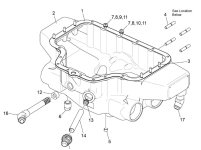
Matt Burch stuck a borescope into his IO-360 M1B to judge oil level. For those who are not familiar, the parallel valve M1B shares a sump casting with the IO-360 and IO-390 angle valve engines. It's part number LW-13864, commonly known as the horizontal intake sump. Oil is held in a wide, flat upper chamber (shown below), while combustion air is routed through a separate lower chamber.

ScreenHunter_2464 Oct. 23 09.13.jpg

These shots taken at 6.5 ~ 6.75 quarts per the dipstick. Level is very near the sump gasket line...

M1B -2 600w.png

...which means the slot passage at the rear of the case, into the accessory case volume, is open.

M1B -1 600w.jpg

Comparison to the updraft sump photos suggests the horizontal sump might hold a little more oil while maintaining a similar clearance volume. Here neither is illustrated with perfect accuracy, but it appears 6 is about the max for the updraft, 6.5 for the horizontal sump, if we want the breather slot open at the rear of the case.
 
If I’m surmising correctly: This is probably why the normal observation with these engines is that filling to 7 quarts results in a quart being blown overboard in the first couple of hours, followed by stable slower consumption for the next 15.

For the first couple of hours, the oil level is high enough that the accessory case gears are slinging it every which way, and it’s aerosolized and heading straight out the breather. After the level has lowered enough to be below the gears, it’s not stirred up anywhere near as much, and will stay relatively stable.

Good intel.

- mark
 
One word of warning (which has been talked about here previously) is running below 5 qts with that horizontal sump. The oil pickup starts to suck air at that point. An easy test (when at the 5qt level) is do a forward slip (in level flight) and monitor oil pressure. Forgot whether it's right or left slip which causes this, but you'll see oil pressure drop off 5-10 psi. Then you know it's time to add oil.
 
Very interesting data points. Seems to agree with the following blurb Lycoming has about wet sump aerobatic engines:

9. DETERMINATION OF NORMAL OIL LEVEL.
a. Starting with engine at normal oil capacity (8 quarts for four cylinder models; 12 quarts for six cylinder models) fly an aerobatic sequence of about 5 or 10 minutes.
b. Land and check oil level. As much as 1 quart of oil loss may be observed.
c. Fly another aerobatic sequence similar to that used in Step a. Land and check oil level again.
d. Continue this procedure until oil losses per flight are abruptly reduced. Typically, this level is between 6 and 7 quarts.
e. This establishes the normal operating level. When oil is added beyond this normal operating level, the excess oil can be expected to be thrown off fairly quickly. However, at the normal operating level, a series of five or six 10 minute severe, unlimited class aerobatic sequences can be flown per quart of oil loss.
 
Very interesting data points. Seems to agree with the following blurb Lycoming has about wet sump aerobatic engines:

9. DETERMINATION OF NORMAL OIL LEVEL.
a. Starting with engine at normal oil capacity (8 quarts for four cylinder models; 12 quarts for six cylinder models) fly an aerobatic sequence of about 5 or 10 minutes.
b. Land and check oil level. As much as 1 quart of oil loss may be observed.
c. Fly another aerobatic sequence similar to that used in Step a. Land and check oil level again.
d. Continue this procedure until oil losses per flight are abruptly reduced. Typically, this level is between 6 and 7 quarts.
e. This establishes the normal operating level. When oil is added beyond this normal operating level, the excess oil can be expected to be thrown off fairly quickly. However, at the normal operating level, a series of five or six 10 minute severe, unlimited class aerobatic sequences can be flown per quart of oil loss.

Yep. Note, with either the updraft or horizontal sump, 8 quarts in a 4-cyl would put the oil surface up in the crankcase, above the sump drain slots, when sitting static with the longerons level (see the first photo in the thread, at 7.5 qts in the updraft sump). As Mel says, when running some of that oil would be elsewhere. The 8 qt max probably puts running oil level right at the drain slots. No one wants it in the main case volume with the rotating crankshaft.

BTW, I realize some readers are thinking "Yeah, yeah, everybody knows it blows it out if the level is too high." This is about mechanics...the why.
 
I am running a IO-360 that came with some morfidite dip stick with two sets of markings, neither correct. I changed oil and filter the put in 5 quarts, started the engine and let if warm up and checked it the next morning. I marked that level with a tubing cutter as the add line. I then added another quart and repeated the procedure as the full line. Running above that results in blowing out oil quickly. I have noticed no loss of oil pressure in any normal attitude running as low as 4 quarts although the oil temperature seems to go up a little.
 
Back
Top