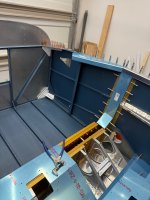
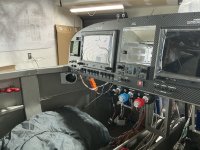
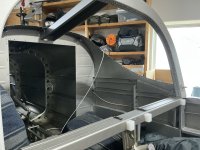
So thanks to OP--Freemasm--and his quote "I suck at painting x 3"! I read that and was like--hey, that's me! I spent weeks researching and trying to decide on interior paint for my RV-14, and went from SW Jetflex WR to SW Polane to Kirker Enduroprime + topcoat, and finally settled on Ceracote C Series. I just finished painting my interior and brake parts and I am genuinely happy with the results. The paint takes 5 days to fully cure, so I cannot comment on durability, etc at this time.
I have sprayed lots of stain, varnish, poly, and paint on my woodworking projects, but never something like Ceracote. I used a $30 touch up HLVP gun from HFT w/ 0.8 mm tip, and it did very well. I re-learned (and re-learned again) that taking a few minutes to mark and set up your spray gun is time well spent, and can also reduce all those errors that make me 'suck at painting'. Get the pressure, flow, and pattern knobs set and don't be afraid to tweek them/change them when needed! (For my HFT sprayer I used 30psi, 3/4 to 1 1/2 turns on the flow knob, and only 1/4 to 1/2 turn open on the pattern knob).
For someone on the fence, I'd definitely recommend it, but with some caveats. I use my one-car garage/shop as my paint booth and just put drop cloths over everything. I'll crack the garage door open and set up a box fan for exhaust, then turn my ceiling mounted heater up to create some airflow through the space. I don't always need to do this when spraying stain or poly, but it was an absolute necessity for the Cerakote! A good respirator and good ventilation is an absolute must before you spray!
I chose Metallic Cobalt color and bought 1 quart for $150 and their plastic strainer for $20. My interior and all parts were pre-primed with self etching primer and/or Vans primer. Cerakote recommends machine shaking or hand shaking for at least 15 minutes. The paint is very thin/low viscosity and mixes quite easily, however, you can see it start to separate again after only 5-10 minutes. I agitated my spray cup (finger over vent hole) and remixed my strained paint at every cup fillup. The HFT spray cup is only 4oz, but this stuff goes on so thin that that was plenty to force me to take a break and not spray too much at one time. One quart was plenty to spray 2-3 coats on the brake parts and 2 coats in the cockpit. I have enough left over to spray the roll bar and floor access panels, but will likely buy another quart just to make sure and to have enought for other parts in the engine compartment, etc.
Initially, I set up all my brake parts hanging from thin wire to try out the spayer and hone my technique before attempting the whole cockpit. I was immediately impressed by both my cheap $30 sprayer and the paint. I set the flow 'low' and had lots of control to put on a see-through base coat, then followed up with another top coat pass while still wet. I had a few sags but mostly because my glasses got fogged and I couldn't see well enough. Taking a break to clean my glasses and lower the pattern knob helped immensely. 24 hours after initial application, I riveted the brake pedals together, gave them a light solvent wipe, then rehung/recoated them the next day. That does not follow Cerakote's recoat recommendations, but I do not anticipate any adhesion/durability issues (but we'll see).
My big panic moment came when trying to spray the interior. I started in the footwell area and tried to just paint the firewall. My flow was set too low (afraid of drips/sags) and pattern set too high for the enclosed area. I rapidly had a thick fog I could not see through (nor breath in)! After setting up/turning on my airflow ventilation, i tried again, but had similar results. I wondered if/how I would be able to paint over a partially cerakote-painted interior if I quit now! I finally spent some time retweeking my sprayer--increased fluid flow with matching pattern--and I was able to paint like I was doing a TV commercial! Smooth even see through strokes over a large panel, take a short break to let the fog clear, then repeat with a second top coat with plenty of visibility to see the full coverage. Another break, then move to the next panel. The entire cockpit took about 60 minutes to spray in this manner. (2 hours total, gloves on to gloves off). My fuse is on a rotisserie, so I did the first coat on my knees with the fuse "sideways", then rotated 180 degrees and waited 24 hrs for the second coat.
So far, everything looks great! My big regret is that I sanded out some of the runs and few paint drips after the first coat (24 hours after application). I used 100 grit paper and a solvent wipe on those areas. While they looked "plenty smooth" to recoat, unfortunately, the sanding marks are still visibile after the final coat. I should have wet-sanded/used 400 or better on those areas. Most will be under carpet/upholstery, so I am not in a hurry to fix them now, but I DO have a plan to touch up some areas after I install the roll bar and paint that and the access panels. Before starting this project I was VERY apprehensive about having to strip, sandblast, sand, and otherwise prep the cockpit for Ceracote application. After using this and understanding how different this sprays/lays down/finishes, I am MUCH less paranoid! I will have to wait and see if there are any durability or adhesion issues, but frankly I will be very surprised if those occur...
Hope this helps someone else get off the fence. Ceracote works great, needs lots of ventilation, and is comparable/less expensive than other paint options out there! Best of all, it looks great!




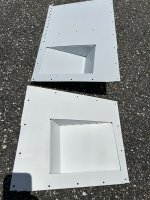


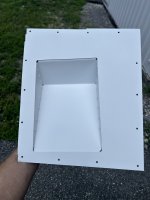


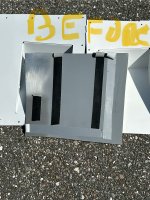
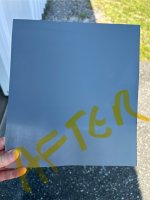


 . As I changed my technique I was able to fix it and it goes on great.