Van's Air Force

The definitive Van's Aircraft support community! Buying, building or flying an RV? Join our exclusive family of mentors and enthusiasts!

...

I measured my friends -14 rudder and all the dimensions seem correct. Did not even think about measuring the thickness though.
I was pretty confident it would fit, based on the fact that the skin and spar part numbers are the same, just with -1 suffixes on the newer parts. Sure enough, both the 7/9 and 14 rudder turned out the exact same shape and size and bolted right up to the same hinge points. Even the fairings from my old rudder fit.

What surprises me is that - as far as I know - Van's is still shipping two different rudder designs (7/9 and 14) that are basically externally identical but differ in their internal construction. For the sake of inventory-streamlining you'd think they'd put the RV-14 rudder on all the aircraft it will fit on, so they can stock fewer unique parts. I can't explain it other than to chalk it up to paperwork inertia being not worth the effort - something I certainly understand from my own career!
 
I was pretty confident it would fit, based on the fact that the skin and spar part numbers are the same, just with -1 suffixes on the newer parts. Sure enough, both the 7/9 and 14 rudder turned out the exact same shape and size and bolted right up to the same hinge points. Even the fairings from my old rudder fit.

What surprises me is that - as far as I know - Van's is still shipping two different rudder designs (7/9 and 14) that are basically externally identical but differ in their internal construction. For the sake of inventory-streamlining you'd think they'd put the RV-14 rudder on all the aircraft it will fit on, so they can stock fewer unique parts. I can't explain it other than to chalk it up to paperwork inertia being not worth the effort - something I certainly understand from my own career!
If Vans makes the changes so they are all the same, the amount of analysis, documentation to the drawings, updating build instructions will be a factor in the price. And then Vans tech support will have to answer different questions about different configurations of the rudder, which happens to be one of the first items a novice RV builder will tackle. And then there will be an endless discussion why the old design is better, etc...
 
Last edited:
I think it's very reasonable to assume that the RV-7 fleet exposure to overspeed events is similar to other RVs.

Me too. And I'll confess to some personal experience. I let a maneuver get away from me, and remember, I'm in the "above average" group that 90% of us claim. Busted VNE quite badly, like >230 indicated. Not sure exactly, because I was busy, and didn't have a memory stick plugged in. What I believe, based on the reports, is a -7 with a zipper rudder might have killed me dead as canned beans.

Does that make it a bad rudder design? Nope, not if VNE is maintained. But personally, I'll take the extra margin.
 
A number of folks here are arguing against gaining extra margin (even when there is essentially no trade-off or sacrifice of anything else) on the basis that it is a pilot problem, not an airframe problem.

The exact same argument is often made about the original 6A/7A/8A/9A nose gear. And also in that case, an improved alternative now exists.

Here is an anecdote that illustrates the benefit of having 'more margin':
I believe this happened in the mid 1980s. A 4-engine transport was crossing the pacific at very high altitude (41,000 ft IIRC) with a full load of passengers. One engine failed. The result (for whatever reason) was that the airplane stalled, rolled and pitched down. The recovery took something like 30,000 ft of altitude, probably exceeded V_d (The equivalent of V_ne for high-mach no. airplanes) and reached a load factor of something like 5.2 g's.

For a Part 25 transport like this, N_lim is 2.5 g's, and the ultimate safety factor is 1.5, so during certification, the airplane has been shown to withstand 3.75 g's. At that load, it is allowed to yield (bend) but must not fail. There is no expectation that the airframe should survive loads greater than 3.75 g's.

This airplane, built by Brand X, did not fail at 5.2 g's. It landed safely at San Francisco International airport. I got to see the airplane. Both wings were bent slightly, one more than the other, but you could visually see the abnormally high dihedral. The wing-body fairing area adjacent to the wing leading edge, where the air conditioning systems are installed, were bent/buckled inward (from the large forward chord force during the pull-out). The horizontal tail was visibly bent downward. Fuselage skin around the horizontal tail attachment was wrinkled. The airplane was later repaired and returned to service!

5.2 g's.

There are a whole lot of people that are really grateful that Brand X built in those kinds of margins into their designs. I would speculate, based on some other incidents, that had that been a Brand Y airplane, it would not have survived the flight.

How much margin is a good amount of margin? It is never infinite. Something is always eventually going to break. Design margins are often based on statistical exposure to exceedences traded off against ability to perform the intended mission. (that's where the 2.5 g, 3.8g, 4.4 g, 5.3g, 6g load factors come from for various categories of aircraft, and where the safety factor of 1.5 comes from). Since airplanes really don't crash very often, these always have been based on very small sample sizes, and always based on incomplete information. Yet we follow what evidence we have, even if not conclusive. Here you have similar population sizes of similar aircraft, with similar pilot demographics, and a seemingly minor difference in construction that correlates to some tragedies for one of the designs and none for the others.

I don't know if it ever makes sense to leave margin on the table if it doesn't cost anything.

The margins you speak of do indeed have a cost....added weight.

Sure you can build an airplane like a tank, then you need more power, which necessitates more fuel, which adds more weight, on and on.

Aircraft design, as we all know, is a delicate balance for the designated mission. If the aircraft is not flown within its design boundaries it may or may not come back from that flight. Nobody that I know of ever takes off thinking "today I'm going to see what happens if I do X".

No matter the airplane, fly it within its design boundaries. If you're unable or unwilling to do that your luck (and that of your passengers) may vary. There is always room for improvement on any aircraft design, but there's a process for that. In the mean time, stay in the envelope.
 
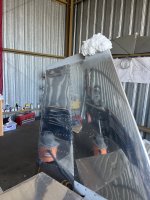
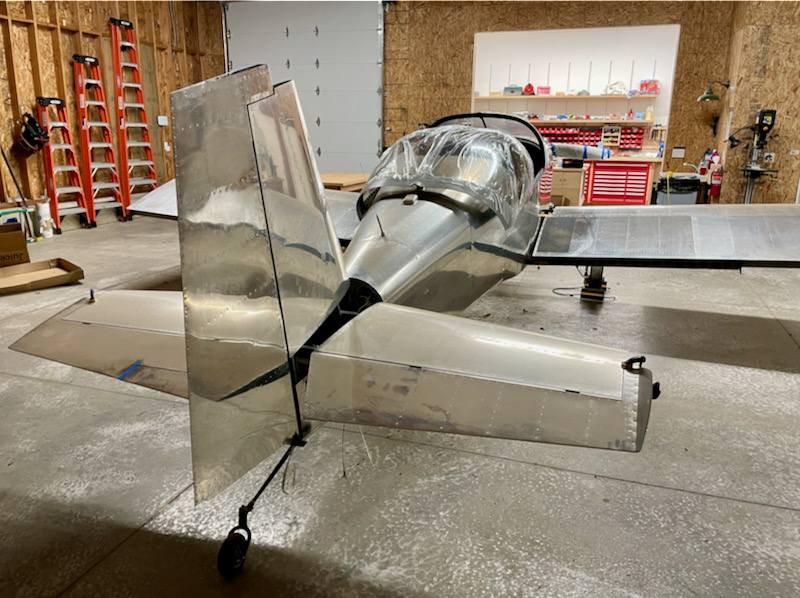
I'm not sure that's correct... I put an RV-14 rudder on my RV-7 and it fits perfectly and flies great.

Edit to add photo:

20220919_rudder21.jpg
Is the VS an unmodified-7?
 
They confirmed the same skin thickness as my -7, but the added stiffness comes from the use of ribs internally, VS stiffeners that are not tied together.
Based on this picture from Matt Burch's excellent website, the stiffener-to-spar and stiffener-to- stiffener connections are clear.

Absolutely no criticism of you intended, Joel...just pointing out that what Van's told you, doesn't appear to be the case.

HTH

Dave
 
The margins you speak of do indeed have a cost....added weight.
Indeed they do. An extra pound (?) or so of added structure in the rudder for some extra flutter margin seems to be a good trade, if that margin can be verified. I could buy that weight gain back (and a lot more) by laying off the Mexican food and Buffalo Trace.

Well, maybe not the Buffalo Trace...

ds
 
What surprises me is that - as far as I know - Van's is still shipping two different rudder designs (7/9 and 14) that are basically externally identical but differ in their internal construction. For the sake of inventory-streamlining you'd think they'd put the RV-14 rudder on all the aircraft it will fit on, so they can stock fewer unique parts. I can't explain it other than to chalk it up to paperwork inertia being not worth the effort - something I certainly understand from my own career!
Couldn't agree with you more, Matt. But if the rudder swap is done correctly, there's also the risk and expense to clear the -7 and -9 flutter envelope to Vd using a rudder with different mass properties. There are others on this thread who can speak far more intelligently about that than I can.

ds
 
Couldn't agree with you more, Matt. But if the rudder swap is done correctly, there's also the risk and expense to clear the -7 and -9 flutter envelope to Vd using a rudder with different mass properties. There are others on this thread who can speak far more intelligently about that than I can.

ds

It maybe just as simple as they have 100s of -7 on the shelves.
 
The margins you speak of do indeed have a cost....added weight.
Well, maybe not the Buffalo Trace...

ds
The modifications Scsmith speaks of have been carefully engineered and I'd expect the weight increase is marginal. ;) For the RV-7 specifically additional margin has been gained by installing a rudder from an 8. I believe this mod reduces weight marginally. The theoretical "cost" would be a marginal reduction in rudder authority. But anecdotal testing has suggested that theory is incorrect. Possibly the reduced area is being compensated by increased stiffness.

Not the Buffalo Trace. Carpet, interior trim, paint, radios, instruments, starter and battery first. :LOL:
 
@ jrs14855: it would be interesting to talk to Dick Keyt, who owned and SARL-raced the Polen Special, about that carbon rudder. Knowing Dick's meticulous approach, I bet he did some keen structural analysis as he did the mod, and may have modified other parts of the structure to balance the load paths. I'll develop that thought a bit more below too.

I
At one point, there was a report available that came out of UT Austin, if I remember correctly. I no longer have it, a consequence of my upgrade to Windows 11. The first report dealt with a rudder flutter analysis. The following is a slide presentation of the second report, which deals mostly with issues going to a wet wing. I would think the first report should still be available, but I haven't found it.

 
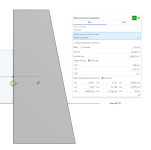
After getting caught up on this thread I thought it would be interesting to take a quick look at a simplified rudder. The following image is of a non counterbalanced rudder, 15" tall, made of solid aluminum 1/8" thick. Opening the image, you will see that it weighs about 1lb, and the center of mass is about 2.25". One figure of merit to look at is the mass times the distance squared from the aircraft cg datum, in this case about 2.25lb-in^2 (also known as the Moment of Inertia, MOI). The higher this number, the greater are the loads that tend to twist the fuselage in maneuvering flight. The rudder internal structure needs to be able sustain these inertial loads as well.

A second figure of merit is the ratio of Lxy/Lyy, which can be pulled from the mass inertia matrix. This term (along with the other off diagonal terms) is directly related to the amount of distortion a flexible structure will undergo. In this case Lxy/Lyy is about .15.

Both figures of merit are reasonably low, and this is a real positive. The RV-4 rudder has done a good job on RVs and Rockets for years within a careful flight envelope.

There is a third figure of merit to consider, and that is the MOI around the hinge line. In this case it is (1)*(2.8^2), or 7.8 lb-in^2. This is not so great--take your feet off the rudder pedals in anything but calm air, and you might be surprised. This rudder is a challenge to scale to higher speeds. In the next post, we will add a counterbalance to get the MOI around the hinge line smaller.


Attachments

  • Screenshot 2024-08-30 065759.png
    Screenshot 2024-08-30 065759.png
    59.5 KB · Views: 46
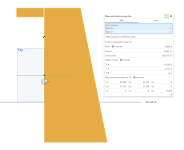
In the attached image, a counterbalance has been added to the top of the rudder to get the rudder 100% mass balanced (NOT what Van recommends). Visually comparing the two images and it is apparent that the center of mass has moved to the hinge line, but also significantly higher on the hinge line.

From the image, the added weight puts the rudder assembly at about 2.9 lbs, but also 7.3" above the aircraft cg.

Calculating the figures of merit, we get (2.9)*(7.3^2)= 155 lb-in^2. This is 155/2.25= 68 times higher than that of the non counterbalanced rudder. It needs to be substantially stronger to handle the MOI in maneuvering flight, and it will have a much greater relative contribution to fuselage twisting in maneuvering flight (yaw/roll).

And since the rudder is attached to the vertical stabilizer, the stabilizer needs to be stiffened accordingly.

The second figure of merit is Lxy/Lyy. For this design this is 1.4, ten times higher than the .14 above and is a direct result of the increased asymmetry of the design because of the added counterweight. Designs that don't have simple geometry tend to have odd and unusual shapes under load deformation and need careful consideration

The third and final figure of merit is the MOI around the hinge line. In this design it is zero. But given the two prior issues, it is easy to see why there has to be a compromise on the degree of mass balance around the hinge.

There are different ways of addressing the balance of the rudder, but this probably is not the best place to discuss them.

On a more practical note, Claudio Ricci has posted here on his rudder flutter incident with his EVO winged Rocket. I believe he was flying with a MK II empennage. After a GVT (Ground Vibration Test) of the empennage with the University of Milan they concluded that (among other things) that the torsional stiffness of the fuselage was a contributing part. Claudio is back flying with a new counter balanced rudder that takes into consideration fuselage torsion.


We continue to see a small number of Rockets that have cracks in the fuselage/empennage attach structure. Everyone needs to be aware of the points Bob and Steve are pointing out in the prior posts.
 

Attachments

  • Screenshot 2024-08-30 071206.png
    Screenshot 2024-08-30 071206.png
    51.3 KB · Views: 43
An extremely knowlegeable pilot who taught me a lot. Unfortunately he had some personal demons. He said you can take any airline in the world and apply the 10/40 rule:
The top 10% are extremely talented
The next 40% are above average
The next 40 % are below average
The bottom 10% are nutjobs and incompetents.
The industry has learned how to deal with the bottom 10% in recent years.
The above does not apply to some third world airlines.
What I have heard about the Polen in recent years should be classified as rumors. I did get a good look at it an Oshkosh many years ago.
I beg to differ with these numbers. While there a few (very few) disappointments, most of the pilots I fly with at my airline impress me. Some impress the heck out of me! And I’m not easily impressed!!!

Jerry
 
The RV7 Accidents:
The NJ accident: We know from previous events observed from another airplane that the accident pilot was trying to learn aileron rolls on his own. Sometimes with coaching from the pilot in the other airplane. The results were roll to inverted, stop the roll, probably a bit of panic and pull into a half loop.
In the UT and Triangle Airport crashes the FAA states that the pilots were attempting split S maneuvers. I believe it is just as likely that one or both were botched roll attempts as described above. Both of the latter were very experienced pilots but with no documented aerobatic experience. Even someone with very limited aerobatic experience should know not to start a split s from high speeds.
Some of the RV7 breakup reports make vague references to "similar accidents" in other model RV's. Setting aside the RV3 accidents which were wing failures, I looked at RV4,6,7 and 8 accidents. The previous mentioned RV4 horizontal tail departure and the RV6 that was not an RV6. The well documented RV8 wing failure was a very different scenario. The RV8 report states that the starting point was near level flight. Something in excess of 9G's not involving aerobatics. The pilot rated passenger had built and flown an RV4 and had done aerobatics with it. So not a case of someone who was not used to lighter control forces.
There were low level show off type aerobatics but all were intact when they hit the ground.
 
It's been 2 years since this thread started. Great discussion & thanks to those who've kept the stats updated.
Are those who've replaced the RV-7 rudder with the RV-8, satisfied with the change, function & performance? Any regrets?
 
Last edited:
It's been 2 years since this thread started. Great discussion & thanks to those who've keep the stats updated.
Are those who've replaced the RV-7 rudder with the RV-8, satisfied with the change, function & performance? Any regrets?
There are several post from people who made the change. All have positive reviews and seem pleased with the change.
 
It's been 2 years since this thread started. Great discussion & thanks to those who've keep the stats updated.
Are those who've replaced the RV-7 rudder with the RV-8, satisfied with the change, function & performance? Any regrets?
Replaced mine a couple of years ago after the storm at Osh damaged so many rudders (mine was not damaged but that gave me the incentive).
Glad I did it, stronger, looks better, handles great.
 
It's been 2 years since this thread started. Great discussion & thanks to those who've keep the stats updated.
Are those who've replaced the RV-7 rudder with the RV-8, satisfied with the change, function & performance? Any regrets?
The -8 rudder is working fine on my -7, 200+ hours so far, first flight March of 2023. We did aerobatic testing, including spins. The spin results were what was expected, it didn’t just snap out on heading, had to hold the input in for a quarter to half turn before recovery. I’ll gladly give up some spin recovery performance for possibly greater flutter margins.
Edit: The spin testing showed that the aircraft was very resistant to spinning, it had to be really forced into a spin.
 
Last edited:
The -8 rudder is working fine on my -7, 200+ hours so far, first flight March of 2023. We did aerobatic testing, including spins. The spin results were what was expected, it didn’t just snap out on heading, had to hold the input in for a quarter to half turn before recovery. I’ll gladly give up some spin recovery performance for possibly greater flutter margins.
Edit: The spin testing showed that the aircraft was very resistant to spinning, it had to be really forced into a spin.
Great pirep! Thanks. I'm considering it for a winter project, if Vans get the rudder off of backorder status.
 
Danny
I wouldn't trust the "backorder" status. You might just try ordering it and see what happens. I've ordered wheel pants, leg fairings etc...all showed BO and all shipped. YMMV.

A
Thanks. I just called them & they have it all in stock. Apparently, she said they call out “back ordered” on all sub kits in the web store, which forces a call in order.
 
The -8 rudder is working fine on my -7, 200+ hours so far, first flight March of 2023. We did aerobatic testing, including spins. The spin results were what was expected, it didn’t just snap out on heading, had to hold the input in for a quarter to half turn before recovery. I’ll gladly give up some spin recovery performance for possibly greater flutter margins.
Edit: The spin testing showed that the aircraft was very resistant to spinning, it had to be really forced into a spin.
Did you happen to do spin testing with 2 people on board/ different weights? Curious how it does with different weights.
 
Back
Top