Van's Air Force

The definitive Van's Aircraft support community! Buying, building or flying an RV? Join our exclusive family of mentors and enthusiasts!

Keyhole Cylinder

DanH

Legacy Member
Benefactor
Advertiser
Mentor
I'm pretty sure our engine guys have seen this one before, but I'd also bet most readers have not.

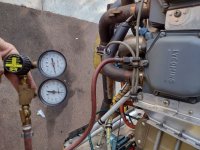
Did a leakdown on a 360 parallel valve, factory Lycoming, about 560 hours since new. Cylinders 1 and 3 were fine, 75/80 and 74/80. Go around the other side and "Uh oh!"
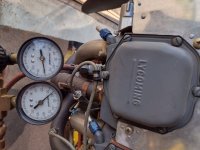
Cyl 2 DPT 600w.jpg
Cyl 4 DPT 600w.jpg

Yep, you're reading it right, 36/80 and 54/80, with lots of air blowing from the breather. Intake and exhaust were quiet. Definitely a ring seal problem here. Off with the jugs. Rings free and springy, grooves clean. Time for some cylinder measurements.

Lycoming says (SSP 1776-5) measure the cylinders for out-of-round at a point 4" from the bottom of the cylinder, in the plane of the valves and perpendicular. The max out-of-round is given as 0.0045".
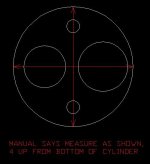
SSP1776 Drawing.jpg

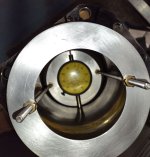
However, a leakdown isn't done with the compression rings in the middle of the piston travel. We do it with the piston at TDC, i.e. rings at the top of the barrel. So, let's suspend a dial indicator just below the top of the ring travel and take diametrical measurements.

Largest diameter found, set the indicator to zero.
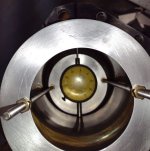
Cyl 2 Measurement B.jpg

Problem found.

Cyl 2 Measurement A.jpg

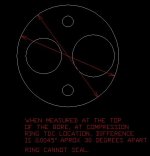
Cyl 2 Drawing.jpg

What we have is a pair of keyholed cylinders. The ring can't seal when the cylinder diameter is at max out-of-round at two points only 30 degrees apart.

Remember, the aluminum head is screwed and shrunk on to the steel barrel. Here the head is squeezing the top of the barrel into a shape that isn't round. The large diameter difference can be measured symmetrically on either side of the exhaust valve. Machining error, distortion of a complex casting, a combination? I don't know the exact reason, but it happens.
 
Last edited:
I have a pretty high end 3 point mic and a dial bore gauge for measuring cylinder bores. Glad to send one or both to you to see if you come up with the same results. I've had experiences where I measured the bore and found weird anomalies like this one and thought it was related to how I was doing the measurements. On my never-ending list of things to do is to set up my CNC mill to do touch probing of cylinders.
 
I have a pretty high end 3 point mic and a dial bore gauge for measuring cylinder bores. Glad to send one or both to you to see if you come up with the same results. I've had experiences where I measured the bore and found weird anomalies like this one and thought it was related to how I was doing the measurements.
Thanks for the offer. I think we're good...and I don't want your tool lost or damaged in shipment.

An indicator in a suspension frame works well for out of round, as it's always held perpendicular to the cylinder axis and at the exact same depth, regardless of clocking.
 
Interesting.

I have seen barrels go out of round inside 500 hours TIS when baffles are not installed correctly however I admit both events resulted in the wear happening from around mid-barrel to the bottom end, not at the top end. However thinking it through there is probably no reason why it couldn't happen at the top end. What are the baffles like? Cowling inlets and ramps? Rapid cooling from long power-off or low power descents?

Mmmmm.
 
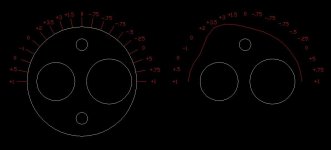
Although the previous measurements told me everything I needed to know to get the repairs underway (in two words, "needs cylinders"), I set aside some time yesterday to see if I could learn more. Decided to measure in 10 degree increments at three different bore depths, 6.375, 6.0, and 5.5, creating a sort of 3D mental map.

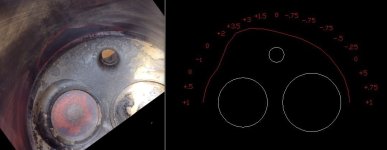
This is cyl #2, the worst in terms of leakdown. Turned out the distortion didn't measure as being symmetrical on each side of the exhaust port. And most of the distortion was at the 6.375" level, in the region of TDC for the top ring. Here's the map. I treated "0" as being in the plane of the spark plugs, so all other measurements are plus or minus in thousandths. Graphic on the right is obviously exaggerated, but proportional. As with the previous less detailed measurements, the sealing problem is obvious:

Map.jpg

Measurements at the 6.0 level showed much less distortion, and at 5.5 the cylinder was mostly just egg-shaped about 0.001". Hmmm....

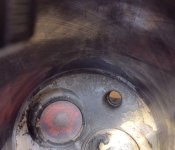
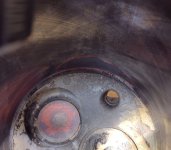
Cut to the chase...took a while to find a lighting combination, but eventually I got a shot of the anomaly. It's basically a concave recess in the last half inch or so of the barrel. I don't know how it formed. That part of the barrel is screwed and shrunk into the head, so a distortion due to machining error is possible. Wear due to shape change with temperature seems unlikely, as the leakdown values were the same hot and cold. Clearly the ring is off the barrel surface (the big leak); as noted previously, there is no way a ring can conform to a cylinder surface with a diametrical difference of 0.045" in 30 degrees.

An interesting aside...the previous owner, an A&P (and good guy) reports he usually had to work the prop to get a decent leakdown value for those cylinders, at every inspection since new. It's not hard to see how that might work if the mechanic uses the "second man holds the prop" method. Here the rings would have sealed if the prop was held with the piston a half inch or so short of TDC.

Concave Recess.jpg
 
Last edited:
Although the previous measurements told me everything I needed to know to get the repairs underway (in two words, "needs cylinders"), I set aside some time yesterday to see if I could learn more. Decided to measure in 10 degree increments at three different bore depths, 6.375, 6.0, and 5.5, creating a sort of 3D mental map.

This is cyl #2, the worst in terms of leakdown. Turned out the distortion didn't measure as being symmetrical on each side of the exhaust port. And most of the distortion was at the 6.375" level, in the region of TDC for the top ring. Here's the map. I treated "0" as being in the plane of the spark plugs, so all other measurements are plus or minus in thousandths. Graphic on the right is obviously exaggerated, but proportional. As with the previous less detailed measurements, the sealing problem is obvious:

View attachment 68642

Measurements at the 6.0 level showed much less distortion, and at 5.5 the cylinder was mostly just egg-shaped about 0.001". Hmmm....

Cut to the chase...took a while to find a lighting combination, but eventually I got a shot of the anomaly. It's basically a concave recess in the last half inch or so of the barrel. I don't know how it formed. That part of the barrel is screwed and shrunk into the head, so a distortion due to machining error is possible. Wear due to shape change with temperature seems unlikely, as the leakdown values were the same hot and cold. Clearly the ring is off the barrel surface (the big leak); as noted previously, there is no way a ring can conform to a cylinder surface with a diametrical difference of 0.045" in 30 degrees.

An interesting aside...the previous owner, an A&P (and good guy) reports he usually had to work the prop to get a decent leakdown value for those cylinders, at every inspection since new. It's not hard to see how that might work if the mechanic uses the "second man holds the prop" method. Here the rings would have sealed if the prop was held with the piston a half inch or so short of TDC.

View attachment 68643
Interesting. I've "worked" the prop back and forth to get a better number. Often times I hear a small click that I assume to be the air pressure pushing the rings out against the cylinder bore. The click is always followed by an increase in compression.
On cold cylinders, BTW.
 
Good find, Dan. Is it the corroded region that is larger in diameter and is it at the top or bottom of the chamber? I wonder if the crank angle parked position left these valves open and was the cause of the corrosion? Have you ever plotted which valves are open to atmo when parked ( am slowly working on that right now).

Very clever, and cost effective bore gauge!!!
 
I'm pretty sure our engine guys have seen this one before, but I'd also bet most readers have not.

Did a leakdown on a 360 parallel valve, factory Lycoming, about 560 hours since new. Cylinders 1 and 3 were fine, 75/80 and 74/80. Go around the other side and "Uh oh!"

View attachment 68564
View attachment 68565

Yep, you're reading it right, 36/80 and 54/80, with lots of air blowing from the breather. Intake and exhaust were quiet. Definitely a ring seal problem here. Off with the jugs. Rings free and springy, grooves clean. Time for some cylinder measurements.

Lycoming says (SSP 1776-5) measure the cylinders for out-of-round at a point 4" from the bottom of the cylinder, in the plane of the valves and perpendicular. The max out-of-round is given as 0.0045".

View attachment 68567

However, a leakdown isn't done with the compression rings in the middle of the piston travel. We do it with the piston at TDC, i.e. rings at the top of the barrel. So, let's suspend a dial indicator just below the top of the ring travel and take diametrical measurements.

Largest diameter found, set the indicator to zero.

View attachment 68568

Problem found.

View attachment 68569

View attachment 68570

What we have is a pair of keyholed cylinders. The ring can't seal when the cylinder diameter is at max out-of-round at two points only 30 degrees apart.

Remember, the aluminum head is screwed and shrunk on to the steel barrel. Here the head is squeezing the top of the barrel into a shape that isn't round. The large diameter difference can be measured symmetrically on either side of the exhaust valve. Machining error, distortion of a complex casting, a combination? I don't know the exact reason, but it happens.
Hi Dan. No criticism...
Just curious... That set up doesn't measure the radius. Only the diameter of the cylinder. So, after 75,000,000 (75 million) up and down strokes of the piston, (500 hours at 2500 rpm's) the cylinder should have some wear on it. Maybe a little on both sides for an average wear of about .002. Easy to be a little off with that dial indicator also. I'm just suggesting that it might not all be off on one side of the barrel. We really need to measure from the center of the bore.
 
Hi Dan. No criticism...
Just curious... That set up doesn't measure the radius. Only the diameter of the cylinder. So, after 75,000,000 (75 million) up and down strokes of the piston, (500 hours at 2500 rpm's) the cylinder should have some wear on it. Maybe a little on both sides for an average wear of about .002. Easy to be a little off with that dial indicator also. I'm just suggesting that it might not all be off on one side of the barrel. We really need to measure from the center of the bore.
Just wondering how you would do that?
 
Also, maybe the #2/4 case half was machined off by .001 perpendicular to the crank shaft... Could make the piston scuff a little more on those spots on both sides. There's only .0005 clearance on the wrist pins.
 
Just curious... That set up doesn't measure the radius. Only the diameter of the cylinder.

Absolutely.

So, after 75,000,000 (75 million) up and down strokes of the piston, (500 hours at 2500 rpm's) the cylinder should have some wear on it. Maybe a little on both sides for an average wear of about .002. Easy to be a little off with that dial indicator also. I'm just suggesting that it might not all be off on one side of the barrel. We really need to measure from the center of the bore.

Yes, and I can detect some very faint ridging between the first and second ring at TDC. Doesn't matter. If 0.0045 or more out of round measured perpendicular, 90 degrees apart, it would be a fail. Here it's out 0.0045 at points only 30 degrees apart, and I can visually identify a wall section not in contact with the rings. I doubt a ring could conform to a difference 30 degrees apart even if the delta was split as 0.00225 on each side. Here the cylinder wall pattern says it's on one side, and probably always was.

I too would prefer radius measurements, but the practical goal is getting the job done. The rest is curiosity.

Now if we could just get Rocket Bob to do that CNC mill setup...

Good find, Dan. Is it the corroded region that is larger in diameter and is it at the top or bottom of the chamber? I wonder if the crank angle parked position left these valves open and was the cause of the corrosion? Have you ever plotted which valves are open to atmo when parked ( am slowly working on that right now).

Mostly in the region of top ring TDC, some at the second ring.

ScreenHunter_2376 Aug. 18 21.51.jpg
 

Attachments

  • ScreenHunter_2375 Aug. 18 21.36.jpg
    ScreenHunter_2375 Aug. 18 21.36.jpg
    116.7 KB · Views: 15
Last edited:
I don't know what lycoming says but I'd think it would be ok to bore out 6 thou. How is this accomplished in a cylinder with the head attached? An automotive boring bar centers itself on the cylinder then spins a cutter down the bore. but the head sticks past the cutter pretty far. Maybe chuck the whole thing in a lathe? Or a mill with a flycutter?
 
Not that easy. Most Lycoming cylinders have a tapered bore. Choke is up at the top near the combustion chamber of the cylinder.
 
Interesting stuff.
From the picture it appears the cross hatch is gone at the enlarged bore area.
would this indicate the cross hatch has worn off and the cause for the problem is wear or was the cross hatch missing from day one since even a hone may have missed the enlarged area?
 
Back
Top