Van's Air Force

The definitive Van's Aircraft support community! Buying, building or flying an RV? Join our exclusive family of mentors and enthusiasts!

¿ ❓sink rate (engine out) for Dynon settings ?

hevansrv7a

Well Known Member
The Dynon (mine is the 1100) there is a place to input a sink rate in order to display a "glide ring". The right number would be with dead engine, of course. But every 12 that I've flown or looked at has some residual power at idle so the right number can only be obtained experimentally with a dead engine. If you have done this, please share your findings. Mine has full wheel fairings so I'd prefer data for that setup.

Please and thank you.
 
I don't remember the numbers, but I did several dead stick landings in my plane. (I have some glider experience, so it wasn't completely new.). The procedure is pretty simple: establish a normal downwind at a field with a long runway. Slow down to about 60 kts with the throttle closed and cut both ignition switches. If needed, nose up until the prop stops windmilling then return to best glide speed or around 60 kts. Return both ignitions to ON so all you have to do is turn the key if you need power again. Fly a normal pattern but aim about 1000' from the threshold to give yourself some safety margin. Land, start, taxi back, take off, repeat until comfortable with the procedure.

If you live in Ohio, I'm happy to do some instruction with you.
 
I don't remember the numbers, but I did several dead stick landings in my plane. (I have some glider experience, so it wasn't completely new.). The procedure is pretty simple: establish a normal downwind at a field with a long runway. Slow down to about 60 kts with the throttle closed and cut both ignition switches. If needed, nose up until the prop stops windmilling then return to best glide speed or around 60 kts. Return both ignitions to ON so all you have to do is turn the key if you need power again. Fly a normal pattern but aim about 1000' from the threshold to give yourself some safety margin. Land, start, taxi back, take off, repeat until comfortable with the procedure.

If you live in Ohio, I'm happy to do some instruction with you.
Thanks for an excellent set of instructions and the kind offer. But it’s not instructions I am seeking. The Dynon wants a sink rate. The glide speed plus glide ratio would give that. It’s a triangle. You can download a spreadsheet from my website that goes into detail on that triangle.
 
Thanks for an excellent set of instructions and the kind offer. But it’s not instructions I am seeking. The Dynon wants a sink rate. The glide speed plus glide ratio would give that. It’s a triangle. You can download a spreadsheet from my website that goes into detail on that triangle.
Heavensrv7a,
I just entered the numbers into my new dynon for my -6A. I inserted the numbers from another -6A POH. It will not be exact, but darn close for my plane in the case of an emergency. From memory it was -800 '/min.
I tested my -4 extensively at different prop configurations and speeds. Came out at -835'/min.

Can you extrapolate it from your POH chart?

Hope that is somewhat helpful.
Daddyman
 
Heavensrv7a,
I just entered the numbers into my new dynon for my -6A. I inserted the numbers from another -6A POH. It will not be exact, but darn close for my plane in the case of an emergency. From memory it was -800 '/min.
I tested my -4 extensively at different prop configurations and speeds. Came out at -835'/min.

Can you extrapolate it from your POH chart?

Hope that is somewhat helpful.
Daddyman
I appreciate the effort but it's not. The glide ratio of the 12 is different than the 6/6a which is different from the 7/7A, etc.
Van's POH gives the best glide speed with engine out as 63 kts. but without a glide ratio such as you would see in a C-150 POH, it can't complete the triangle. I experimented with my spreadsheet using data for the 12 and trying several different gride ratios (same as L/D). The smart thing to do with any airplane where you don't know the right answer is to use my spreadsheet and plug in the most credible low gride ratio (ex: 8 not 11). Since the purpose here is to tell the Dynon a safe glide distance it makes sense to be very conservative, not scientific.

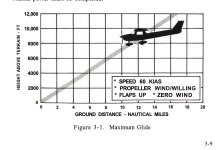
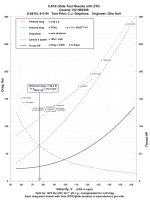
There is a very good CAFE report on the RV6 which gives the glide ratio for it. But even that would not be correct because it's different with an actual prop vs a zero thrust prop. This is a big, big subject. Example: the glide for a C-150 in the POH is about 8.5Screenshot 2024-08-04 at 7.33.53 PM.jpgC152_Propless.jpg but in actual zero thrust testing Jack Norris proved that the ratio (C-152) was closer to 12.

When testing any "normal" RV, an idling prop will come close. But with the 12 even an idle-throttle leaves some power so it messes up the issue.

For finding the glide ratio on a "normal" airplane, you can get within about 1 knot with some test flying at minimum power and some simple math. But, as I noted above, the ratio with a dead prop is not as good as with a zero thrust prop. A dead prop has drag and each one will be significantly different from the other. And of course a FP vs CS prop can make a huge difference depending on the pitch of the CS prop.
 
I use a glide ratio of 9/1and 90 mph in my rv6 for what it is worth. this gives me a glide ring in foreflight.
 
But with the 12 even an idle-throttle leaves some power so it messes up the issue.
I’m assuming by “leaves some power” that you mean thrust?
That has not been my experience. As I glide through the later portion of a landing pattern I pull power all the back against the stop (12ULS). Engine RPMs are around 1800-2000. After touchdown as the bird slows I have to add some throttle to keep RPMs above minimum idle. This tells me that during the glide airflow is driving the prop I.e. the prop is creating drag rather than thrust.
This is why most POH say to slow up and stop a fixed-pitch prop if you can after an engine failure. That way the prop is “stalled” and not taking precious glide energy to spin a dead engine.
Make sense?
 
Last edited:
I’m assuming by “leaves some power” that you mean thrust?
That has not been my experience. As I glide through the later portion of a landing pattern I pull power all the back against the stop (12ULS). Engine RPMs are around 1800-2000. After touchdown as the bird slows I have to add some throttle to keep RPMs above minimum idle. This tells me that during the glide airflow is driving the prop I.e. the prop is creating drag rather than thrust.
This is why most POH say to slow up and stop a fixed-pitch prop if you can after an engine failure. That way the prop is “stalled” and not taking precious glide energy to spin a dead engine.
Make sense?
Dave, that's an interesting response. Yes, by power (engine RPM's) I mean thrust. I can measure RPM's but I can't directly measure thrust. In this discussion, power is the only way to get positive thrust. Negative thrust is, of course, the drag from the prop when the RPMs drop below some point of zero thrust (see Jack Norris' publications for a better explanation and much more detail). In an airplane with no prop (rocket, turbine, whatever) it might be possible to produce thrust without RPMs but you'd still need power.

If anyone wants to know (a lot) more about zero-thrust gliding flight and its importance, per Norris, he or she is welcome to PM me. I had many long discussions with Jack Norris about that and worked out some spreadsheets, too. I'm happy to share but not in this thread.

Just for the sake of perfect clarity and ignoring prop design, prop pitch, when climbing, static or in level flight you can't have RPM without power. Also, you can have RPM without thrust but you can't have thrust without RPM. In descending flight you can have RPMs with thrust or even negative thrust but it's still using power. In that case, the power comes from using up stored kinetic energy (altitude).

I confess that I don't know what my typical RPMs are in a zero-throttle on final glide. I'm paying attention to airspeed at that point o_O

But your idle setup is worthy of a comment. I quickly found that I don't like the residual power/thrust on final and wanted to turn the idle down. More than 1 A&P advised me that the Rotax idle spec is important because if it goes lower there is some back and forth movement in the gearbox which is hard on it and could damage it. For that reason I stayed with the Rotax specification. At that specification there is some noticeable thrust in a zero-throttle, gliding condition. You appear to know about this because you refer to "minimum idle". Your method seems reasonable as long as you always use some additional throttle on the ground.

Yes, your final paragraph certainly does make sense. I've demonstrated - to myself - in several airplanes that a stopped prop (FP) glides better than a windmilling prop. That's fairly well known and most folks agree that if there is time and altitude enough then a quick nose-up maneuver to stop the prop is good to do.

 
Sounds reasonable. For a 6. But I am interested in the 12.
Sounds to me like we experimenters need to do some experimenting. For starters I plan to find a quiet airstrip, fly out to edge of the glide ring and see if I can get back there while staying on published best glide. Rinse and repeat at 4 points of the wind. Also add up and note AC empty weight, fuel, and fat self. Share results.
 
Dave, that's an interesting response. Yes, by power (engine RPM's) I mean thrust. I can measure RPM's but I can't directly measure thrust. In this discussion, power is the only way to get positive thrust. Negative thrust is, of course, the drag from the prop when the RPMs drop below some point of zero thrust (see Jack Norris' publications for a better explanation and much more detail). In an airplane with no prop (rocket, turbine, whatever) it might be possible to produce thrust without RPMs but you'd still need power.

If anyone wants to know (a lot) more about zero-thrust gliding flight and its importance, per Norris, he or she is welcome to PM me. I had many long discussions with Jack Norris about that and worked out some spreadsheets, too. I'm happy to share but not in this thread.

Just for the sake of perfect clarity and ignoring prop design, prop pitch, when climbing, static or in level flight you can't have RPM without power. Also, you can have RPM without thrust but you can't have thrust without RPM. In descending flight you can have RPMs with thrust or even negative thrust but it's still using power. In that case, the power comes from using up stored kinetic energy (altitude).

I confess that I don't know what my typical RPMs are in a zero-throttle on final glide. I'm paying attention to airspeed at that point o_O

But your idle setup is worthy of a comment. I quickly found that I don't like the residual power/thrust on final and wanted to turn the idle down. More than 1 A&P advised me that the Rotax idle spec is important because if it goes lower there is some back and forth movement in the gearbox which is hard on it and could damage it. For that reason I stayed with the Rotax specification. At that specification there is some noticeable thrust in a zero-throttle, gliding condition. You appear to know about this because you refer to "minimum idle". Your method seems reasonable as long as you always use some additional throttle on the ground.

Yes, your final paragraph certainly does make sense. I've demonstrated - to myself - in several airplanes that a stopped prop (FP) glides better than a windmilling prop. That's fairly well known and most folks agree that if there is time and altitude enough then a quick nose-up maneuver to stop the prop is good to do.

Sounds like we’re in broad agreement. Our difference is our idle settings which I hadn’t considered earlier. I reduced my static idle setting because I had a heck of a time getting the bird to come down with the thrust produced by the book setting. Result was an extended landing pattern that made me uncomfortable at our field with mountains nearby. I need to practice more to get it slowed up with that bit of power/thrust remaining.
Thanks for your thoughts and informative response!
 
Sounds like we’re in broad agreement. Our difference is our idle settings which I hadn’t considered earlier. I reduced my static idle setting because I had a heck of a time getting the bird to come down with the thrust produced by the book setting. Result was an extended landing pattern that made me uncomfortable at our field with mountains nearby. I need to practice more to get it slowed up with that bit of power/thrust remaining.
Thanks for your thoughts and informative response!
Dave, as I said, sort of, I did not like the final approach with the Rotax-spec idle. We have the same issue. I did, with practice, find that I could get it slowed down to POH recommended speeds. But the glide angle is flatter that way. That, in turn, requires some adjustment in the patter speeds & altitudes. Perhaps of less importance but still worth considering, the normal on-final glide is flatter than the dead-engine glide. That is the reverse (?) of what I was used to with other airplanes, especially my-7A. It's important if/when the engine quits on final. A prudent pilot, knowing that, will allow for a touch down point farther down the runway just in case. But that's when a short field gets uncomfortably shorter, right?
 
Dave, as I said, sort of, I did not like the final approach with the Rotax-spec idle. We have the same issue. I did, with practice, find that I could get it slowed down to POH recommended speeds. But the glide angle is flatter that way. That, in turn, requires some adjustment in the patter speeds & altitudes. Perhaps of less importance but still worth considering, the normal on-final glide is flatter than the dead-engine glide. That is the reverse (?) of what I was used to with other airplanes, especially my-7A. It's important if/when the engine quits on final. A prudent pilot, knowing that, will allow for a touch down point farther down the runway just in case. But that's when a short field gets uncomfortably shorter, right?
Yup, with a 2400 ft runway and mountains I couldn't come up with a better option than reducing the static idle and getting engine RPMs down to around 1600ish while in the pattern. I tried the on-spec idle long shallow glide down final one time and STILL came over the fence about 60ft high. Yipes. And the idea of "hanging on the prop" to slow down in that situation made me nervous. If the engine stops I've got nothing to "hang on"! Cows here I come!
 
Sounds to me like we experimenters need to do some experimenting. For starters I plan to find a quiet airstrip, fly out to edge of the glide ring and see if I can get back there while staying on published best glide. Rinse and repeat at 4 points of the wind. Also add up and note AC empty weight, fuel, and fat self. Share results.
Keep I mind that "published best glide" is usually no wind, gross weight. Into the wind the range will be less, but the best speed (actual best glide speed) will go up. Best glide speed also varies with gross weight (like the square root) although no-wind range remains the same. But into the wind you'll do better if you're heavy. Lots of complications!!
 
Screenshot 2024-08-10 at 7.49.09 PM.jpgKeep I mind that "published best glide" is usually no wind, gross weight. Into the wind the range will be less, but the best speed (actual best glide speed) will go up. Best glide speed also varies with gross weight (like the square root) although no-wind range remains the same. But into the wind you'll do better if you're heavy. Lots of complications!!
Best glide speed does go up with increased weight. But the glide angle remains the same. Thus if you are at a given height and given distance your point where you hit the ground will be the same. You will hit it sooner and harder with increased weight. Yes, wind is a complicating factor. The actual best glide speed for range will differ with wind but the best aerodynamic best glide will not. Air density also needs to be considered in many cases.

In a no-wind situation, angle of attack is the best way to choose a glide speed but it needs to be pre-determined experimentally.

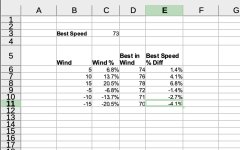
Here is a screenshot of a spreadsheet for determining best speed in a wind. PM me for the actual spreadsheet in xls or ods format.
 
I tested this back in 2021 after I bought my -12 (both the plane and myself had pants on). Prop stopped (had to slow to about 50KIAS to stop it), about 1150 pounds, gliding at 63 KIAS, straight line. I recorded about 525fpm. So in one minute at 63KIAS I covered about 6381 feet and lost 525 feet in that same minute. Just over 12:1. I programmed my descent rate into my gear at 600fpm just to add a bit of margin. I only did this once. I didn't adjust glide speed for weight or anything, I was doing this out of practicality and fudged everything to the safe side in the end.

Also interested if others have data (FROM AN RV-12), to see how it compares. Cheers!
 
About 12:1 is what I got in my old 12 with the prop stopped and 60 knots indicated air speed. That was a descent of 500-600 fpm. As I recall it matched to the glide circle as indicated on the Dynon very closely. Got about 10 minutes of glider time. I have now built another 12 and have recent experience with no problem landing short. Establish 55 knots on final and slow to about 50 and decreasing just before flare. Engine always to idle from down wind at the numbers emulating a dead stick landing. If high slip the heck out of it. The 12 slips great with no increase in airspeed unlike the short wing RVs. If I want I can put it in at 500-600'. Just demonstrated it multiple times recently at Dave's old home airport.
 
I have never completely understood Van's numbers because they don't conform to the normal curves for parasite drag and induced drag. However, I think they probably have this part exactly right because they have done some testing (haven't they?).
--------------------------------------------------------------------------------
15-6 RV-12 Flight Training Supplement
FORCED LANDING (Complete Power Failure)


If the engine cannot be restarted in flight, trim the aircraft to the recommended glide speed. Remain within gliding
distance of the intended point of landing. Maintain a higher and closer pattern than normal making allowance for
wind.

Extending flaps or slipping the aircraft can lose additional altitude. Diving the aircraft in an attempt to lose altitude when flying into a headwind will only increase the required landing distance. Touchdown with minimum airspeed particularly if landing on rough terrain.

• AIRSPEED Max. gliding distance – 63 KIAS
------------------------------------------------------------------------------------------------------------
I think a glide ratio with stopped prop of 12:1 is reasonable but I think I'll use 10:1. I would rather arrive higher than lower! Using 63
kts. and 10:1 would yield 635 f/m. That's a simple triangle solution with 63 as the hypotenuse and 10:1 as the ratio of altitude to ground travel.

Using 12:1 gives a sink of 465 f/m.

If anyone feels lazy about the math, test it this way:
Use smooth air, stable baro conditions.
Stop the prop (I assume NO liability for this).
Glide at 63 kts IAS, flaps up of course.
Observe your sink rate.
I will be glad to tell you what glide ratio was being used.

I want to emphasis again that minimum sink is NOT best glide; slower airspeed, less drag, but shorter glide. Really. So looked at it from the other mathematical direction, slowing the aircraft to minimum sink will SHORTEN the glide. Minimum sink extends time in the air but not distance you can glide.
 
I have never completely understood Van's numbers because they don't conform to the normal curves for parasite drag and induced drag. However, I think they probably have this part exactly right because they have done some testing (haven't they?).
--------------------------------------------------------------------------------
15-6 RV-12 Flight Training Supplement
FORCED LANDING (Complete Power Failure)


If the engine cannot be restarted in flight, trim the aircraft to the recommended glide speed. Remain within gliding
distance of the intended point of landing. Maintain a higher and closer pattern than normal making allowance for
wind.

Extending flaps or slipping the aircraft can lose additional altitude. Diving the aircraft in an attempt to lose altitude when flying into a headwind will only increase the required landing distance. Touchdown with minimum airspeed particularly if landing on rough terrain.

• AIRSPEED Max. gliding distance – 63 KIAS
------------------------------------------------------------------------------------------------------------
I think a glide ratio with stopped prop of 12:1 is reasonable but I think I'll use 10:1. I would rather arrive higher than lower! Using 63
kts. and 10:1 would yield 635 f/m. That's a simple triangle solution with 63 as the hypotenuse and 10:1 as the ratio of altitude to ground travel.

Using 12:1 gives a sink of 465 f/m.

If anyone feels lazy about the math, test it this way:
Use smooth air, stable baro conditions.
Stop the prop (I assume NO liability for this).
Glide at 63 kts IAS, flaps up of course.
Observe your sink rate.
I will be glad to tell you what glide ratio was being used.

I want to emphasis again that minimum sink is NOT best glide; slower airspeed, less drag, but shorter glide. Really. So looked at it from the other mathematical direction, slowing the aircraft to minimum sink will SHORTEN the glide. Minimum sink extends time in the air but not distance you can glide.
I just got the Van's update for the Dynon glide that the UK made them do. The glide ratio they specify is 10.6:1. Since the best glide speed is still shown as 63 kts, the since rate is 599 feet/minute at 1320 pounds.
 
I just got the Van's update for the Dynon glide that the UK made them do. The glide ratio they specify is 10.6:1. Since the best glide speed is still shown as 63 kts, the since rate is 599 feet/minute at 1320 pounds.
Many power pilots don’t know, but all glider pilots should know, that weight does not affect max glide ratio. The speed for max glide and rate of descent at max glide both increase with weight but the max glide ratio is fixed
 
Many power pilots don’t know, but all glider pilots should know, that weight does not affect max glide ratio. The speed for max glide and rate of descent at max glide both increase with weight but the max glide ratio is fixed
Correct. Example: using 10.6 as glide ratio but 1100 pounds, the speed for best glide becomes 58 kts, not 63. And the sink rate becomes 547 ft/min. The glide ratio is the result of the angle of attack. The weight determines the induced drag. The speed determines the parasite drag. They all have to conform to the two curves. This is only true for non-laminar flow, of course. In a real-life airplane with some stuff like steps and antennae the curves are never perfect, but pretty close.

This is, of course, a great reason to fly with AOA. Carrier pilots do, why shouldn't we?
 
I programmed in to my Dynon Touch an optimum glide speed of 63 kts and a descent rate of 600 FPM for the Glide ring settings. The 600 FPM was conservative in that the glide rings were smaller, range wise, than actual, leaving a better margin of safety. My 2012 Legacy RV-12 had wheel pants. I believe at the time my POH was printed, Van's specified an 11:1 glide ratio, or close to it, from what I remember.

I'll let other more experienced RV owners confirm or deny if my numbers were close.
 
I just got the Van's update for the Dynon glide that the UK made them do. The glide ratio they specify is 10.6:1. Since the best glide speed is still shown as 63 kts, the since rate is 599 feet/minute at 1320 pounds.
I was not aware the UK got Van's to do a glide ratio determination for RV-12.
Can you point me at any info about this?
John
 
Comment about the floating and idle speed. Many with Lycoming's find that a low idle setting works well for preventing float. I run an idle of about 500 which is just barley enough to keep it running but not an idle speed I want on the ground. Works great on approach as the forward speed keeps the idle above stalling the motor and on the ground I keep the idle up manually. Never pulling all the way back until engine shut off. YMMV with a Rotax.
 
Back
Top