Van's Air Force

The definitive Van's Aircraft support community! Buying, building or flying an RV? Join our exclusive family of mentors and enthusiasts!

Spark plug getting oil fouled when doing pattern work

vas4vans

Well Known Member
Friend
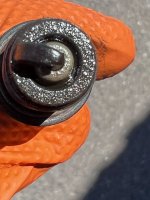
I've had an issue with my engine for about a year. It happened the first time when I was training for my commercial checkride about a year ago - I discovered that one plug (B#2) had got oil-fouled (see photo) after a few sessions of practicing power-off 180's and other types of landings. From then on, it was hard to lean the engine much past peak - it would start running a bit rough. I tried replacing the plug but I found that any improvements in leaning were temporary. Also, during this time, oil consumption went up by a lot - the plane previously used to consume a quart of oil every 8-10 tach hours. Once the issue occurred, I was having to put in a quart every ~5 tach hours.

On the recommendation of an A&P friend, we did an oil control ring solvent flush (https://www.savvyaviation.com/wp-content/uploads/savvy_pdf/savvy-oil-control-ring-solvent-flush.pdf) last September and voila! - that seemed to fix the issue. I was able to run the engine LOP very well. We also checked compressions at that time and all the cylinders were fine so it seems like the pistons are fine. The engine ran fine for quite a few months. Oil consumption seemed marginally higher (1 qt every 7-8 tach hours) but I had no obvious issues with running it LOP. The compressions on all cylinders also checked out fine at the condition inspection in Feb/Mar.

I recently started doing pattern work again from the right seat in preparation for my CFI checkride and the issue has resurfaced after just a couple of flights. I just checked the B#2 plug this weekend and it was oil fouled again (not as bad as last year though).

Any ideas what might be causing this issue and how I can avoid it (outside of not doing any pattern work!).

Thanks,

Vas
 

Attachments

  • IMG_9703.jpeg
    IMG_9703.jpeg
    266.3 KB · Views: 70
When you remove the bottom spark plug on #2 does any amount of oil drip out of the spark plug hole?
 
It might be time to pull that cylinder, look at the rings, piston, cylinder. Have the piston at TDC when you pull the cylinder so any broken pieces of a ring fall on the floor, not into the crankcase.
How many hours on the engine/since overhaul?
 
Since you have done the solvent wash already and now have similar problem again I am agreeing with Bob and think the next step might be pulling the cylinder. If you do try to use a torque plate to keep proper torque on the through studs while the cylinder is off.
 
I've had an issue with my engine for about a year. It happened the first time when I was training for my commercial checkride about a year ago - I discovered that one plug (B#2) had got oil-fouled (see photo) after a few sessions of practicing power-off 180's and other types of landings. From then on, it was hard to lean the engine much past peak - it would start running a bit rough. I tried replacing the plug but I found that any improvements in leaning were temporary. Also, during this time, oil consumption went up by a lot - the plane previously used to consume a quart of oil every 8-10 tach hours. Once the issue occurred, I was having to put in a quart every ~5 tach hours.

On the recommendation of an A&P friend, we did an oil control ring solvent flush (https://www.savvyaviation.com/wp-content/uploads/savvy_pdf/savvy-oil-control-ring-solvent-flush.pdf) last September and voila! - that seemed to fix the issue. I was able to run the engine LOP very well. We also checked compressions at that time and all the cylinders were fine so it seems like the pistons are fine. The engine ran fine for quite a few months. Oil consumption seemed marginally higher (1 qt every 7-8 tach hours) but I had no obvious issues with running it LOP. The compressions on all cylinders also checked out fine at the condition inspection in Feb/Mar.

I recently started doing pattern work again from the right seat in preparation for my CFI checkride and the issue has resurfaced after just a couple of flights. I just checked the B#2 plug this weekend and it was oil fouled again (not as bad as last year though).

Any ideas what might be causing this issue and how I can avoid it (outside of not doing any pattern work!).

Thanks,

Vas
I would start by running the REM37BY plugs as bottom plugs. Lean aggressively on the ground and limit time at full throttle, maybe reduce to 75% power when you turn crosswind.
 
Was this a new engine with only 300 hours? How about when you run full throttle, and lean appropriately - does the plug look ok?
 
To answer some of the questions above:

- based on the logs, the engine was put into the plane in 2009 with about 330 tach hours since it was zero-timed. The previous owner (I am the third owner of this plane) bought it in 2016 and shortly after he bought it, he had it rebuilt by Barrett Precision at 577 tach hours because of corrosion in the cylinders. It was not zero-timed then. The engine now has 1065 tach hours (so, about 500 hours since it was rebuilt).
-I definitely did some pattern work when I bought the plane in May 2022 but this problem did not show up until I was doing a lot of pattern and low-power work for my commercial prep about a year ago.
-the plane has dual Lightspeed ignitions and I normally run Denso IK27 plugs. When I ran this issue past the Savvy guys, they suggested switching that plug to an IK20. I was going to reach out to Klaus to get his opinion but any thoughts on it would be appreciated.
-I have generally looked at the plug when I have other indications that things are off - inability to lean too much and that usually correlates with CHT on #2 being quite a bit lower than the others in cruise. I put in a new plug over the weekend and it ran great until I did some pattern work (part of it was a test to see if a new plug would solve it). After the oil control ring solvent flush and clean plugs (which was done in Sept), it ran great - I did the ignition check suggested by Savvy at LOP and it ran well with each ignition.

We did boroscope it at the last CI in February and nothing unusual was discovered by either my A&P or Savvy. When my friend and I looked at it right before the oil control ring solvent flush last Sept, the cylinder definitely did look a bit oily.

The plane is coming up on an oil change in the next 5-8 tach hours so my thought is that another oil control ring flush would be a good thing to try. I will have to do some pattern work over the next few months to prep for my CFI checkride (currently planned in Nov) so I am trying to figure out if there is anything I can do operationally to prevent this issue.

I will have to use a shop to do any work on the cylinder and I am concerned about any collateral damage from pulling the cylinder so I am wondering if I should just hang in there till I am done with my CFI checkride, do a flush after that and then just stick to cruising in this plane and do all my pattern work in training airplanes!!

Thanks,

Vas
 
Seem
To answer some of the questions above:

- based on the logs, the engine was put into the plane in 2009 with about 330 tach hours since it was zero-timed. The previous owner (I am the third owner of this plane) bought it in 2016 and shortly after he bought it, he had it rebuilt by Barrett Precision at 577 tach hours because of corrosion in the cylinders. It was not zero-timed then. The engine now has 1065 tach hours (so, about 500 hours since it was rebuilt).
-I definitely did some pattern work when I bought the plane in May 2022 but this problem did not show up until I was doing a lot of pattern and low-power work for my commercial prep about a year ago.
-the plane has dual Lightspeed ignitions and I normally run Denso IK27 plugs. When I ran this issue past the Savvy guys, they suggested switching that plug to an IK20. I was going to reach out to Klaus to get his opinion but any thoughts on it would be appreciated.
-I have generally looked at the plug when I have other indications that things are off - inability to lean too much and that usually correlates with CHT on #2 being quite a bit lower than the others in cruise. I put in a new plug over the weekend and it ran great until I did some pattern work (part of it was a test to see if a new plug would solve it). After the oil control ring solvent flush and clean plugs (which was done in Sept), it ran great - I did the ignition check suggested by Savvy at LOP and it ran well with each ignition.

We did boroscope it at the last CI in February and nothing unusual was discovered by either my A&P or Savvy. When my friend and I looked at it right before the oil control ring solvent flush last Sept, the cylinder definitely did look a bit oily.

The plane is coming up on an oil change in the next 5-8 tach hours so my thought is that another oil control ring flush would be a good thing to try. I will have to do some pattern work over the next few months to prep for my CFI checkride (currently planned in Nov) so I am trying to figure out if there is anything I can do operationally to prevent this issue.

I will have to use a shop to do any work on the cylinder and I am concerned about any collateral damage from pulling the cylinder so I am wondering if I should just hang in there till I am done with my CFI checkride, do a flush after that and then just stick to cruising in this plane and do all my pattern work in training airplanes!!

Thanks,

Vas
seems you have the answer. plug fouling and high oil consumption appears, do oil ring flush and it disappears. stuck oil rings will create these symptoms all without affecting compression, though can create issues with plugs firing consistently, so explains the poor LOP performance; leaner mixtures are harder to light and the problem shows up with a weak spark. Sorry, but can't really guess why the rings keep sticking. Do you run full rich a lot? A hotter plug will help burn this off. second the rec for rem37by plugs.

Larry
 
My .02 take it for what it is worth.
* Leaning will not impact the oil getting into the cylinder. It may cover the signs by leaning (hotter CHTS) to burn it off quicker.
* Run the engine like normal, land, pull a top plug and scope the cylinder that is suspect. Get the cylinder near BDC, doesn't need to be exactly there. You are looking to see if there is any oil pooling. You can quickly tell the difference between a lubed cylinder and oil pooling. If it is bad you can see it just looking through the plug hole.
* Oil in the cylinder is normally due to the oil control ring not doing its job or the intake valve guide leaking. If you are fowling plugs quickly, my guess it is more than likely the oil control ring.

I dealt with a similar issue that was the result of a failed oil control ring. Great compressions, no power loss, no obvious bore scoring, using 1qt every 7 hrs, just fouled plugs and oil pooling in cylinder.... Turns out the spring in the ring was broken in multiple places. In my scenario it when from good, to marginal to, it fouls the plugs every flight and my oil consumption skyrocket in a few months.

Only you can make the decision ring flush, pull or just fly til after your ride. It took me a total of 2 days to remove and install the cylinder with 3 days of waiting on the engine shop in-between. Aside from standard tools, you really only need a few specialty tools that you can probably borrow at any airport. 2 cylinder wrenches and a pin puller.
 
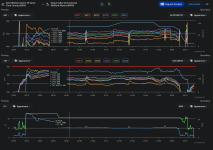
After the climb (which is at best power ROP), I always lean till the onset of engine roughness and usually do not run at more than 60% power in cruise. As recently as the previous weekend, I did a flight from the Bay Area to Oregon and I was able to go close to 45 degrees LOP (using #6 as my reference). I have attached a screenshot of the engine log data (with an expanded scale for EGT and CHT in the relevant ranges). CHT#2 is consistently lower in cruise and I know the plug was slightly oil fouled since I pulled it a couple of weeks ago and I guess I didn't clean it well enough before putting it back.

So, the sequence appears to be that when things are completely fine (say, right after a flush and with clean/new plugs), as long as I don't do pattern work, it stays fine. if I do pattern work, the plug gets fouled. If the fouling is not major, the engine runs LOP at cruise power with no issue (though there's a possibility that it is not producing the expected power) but with a lower CHT on #2. One thing I need to check is that if I put in a clean plug and then avoid doing pattern work, whether the issue continue to show up. Essentially, my question is once the issue occurs (due to pattern work), does the oil control ring continue to misbehave or is it a transient event that happens only during pattern work.

Any thoughts on why the oil control ring issue seems to manifest itself only with pattern work? Based on the scenario from @Cth6 , if it is a stuck or broken oil control ring, shouldn't the issue show up all the time?

Thanks,

Vas
 

Attachments

  • Screenshot 2024-07-08 at 10.48.13 AM.png
    Screenshot 2024-07-08 at 10.48.13 AM.png
    851.5 KB · Views: 25
Any thoughts on why the oil control ring issue seems to manifest itself only with pattern work? Based on the scenario from @Cth6 , if it is a stuck or broken oil control ring, shouldn't the issue show up all the time?

Thanks,

Vas
All of the rings help control oil useage. During normal operation some of the high pressure gases in the cylinder get behind the rings, and push them more firmly against the cylinder wall. During low power operation there’s less pressure on the rings, they don’t seal as well, so problems like this are more likely to show up.
 
All of the rings help control oil useage. During normal operation some of the high pressure gases in the cylinder get behind the rings, and push them more firmly against the cylinder wall. During low power operation there’s less pressure on the rings, they don’t seal as well, so problems like this are more likely to show up.
Sounds like you cracked an oil control ring, you'll need to pull the jug to confirm.
 
Thanks to everyone for your insights and suggestions! I am going to go ahead and get the cylinder pulled and get the oil control ring inspected. As simple as some folks make it sound, this is well beyond my current maintenance capabilities (or confidence) so I will work with an A&P on this project :-)!
 
I followed this thread with great interest because I have a lot to learn being a new aircraft owner.

On a slightly off topic, is there anything a person can do prevent the oil ring from fouling? Can running the engine at cruise at a regular basis prevent this? I just finished checking the compression as a part of the condition inspection. The spark plugs all have light ashy color so I think everything should be good. I want to operate the engine correctly so they remain "nominal".

Thanks
 
There is one theory (among many) that says that pulling the throttle to full closed idle with higher airspeed causes the rings to "flutter" back and forth in the grooves as the prop drives the engine, and this invites cracking. Sounds reasonable to me - but I know enough to know that I don't know. Nonetheless I try not to pull it back sharply from cruise speed to pattern speed. Part of me wonders if this is the origin of the old wives tale of "shock cooling", since a quickly dropping CHT is also the result.
 
There is one theory (among many) that says that pulling the throttle to full closed idle with higher airspeed causes the rings to "flutter" back and forth in the grooves as the prop drives the engine, and this invites cracking.
Sounds like an OWT to me... If that were true, wouldn't they flutter between power strokes too?
 
Sounds like an OWT to me... If that were true, wouldn't they flutter between power strokes too?
No, completely different set of forces - ring goes to bottom of land on up stroke and top of land on down stroke, assuming that the clearance is not filled with carbon.. Flutter is a rapidly repeating up/down movement of the ring inside the land.

ring flutter is a real problem during break in and why low MAP decents are strongly discouraged. Once the complete ring polishing is completed (around 25 hours), ring flutter is very rare in a healthy engine. Autos with manual transmissions go to closed throttle with the wheels pushing the engine (much stronger force than an AC engine going to idle with air force on prop) 10's or 100's of times per day with ZERO ring frlutter. diesel trucks routinely use engine braking and have almost double the compression forces.

Larry
 
Last edited:
No, completely different set of forces - ring goes to bottom of land on up stroke and top of land on down stroke, assuming that the clearance is not filled with carbon.. Flutter is a rapidly repeating up/down movement of the ring inside the land.

ring flutter is a real problem during break in and why low MAP decents are strongly discouraged. Once the complete ring polishing is completed (around 25 hours), ring flutter is very rare in a healthy engine. Autos with manual transmissions go to closed throttle with the wheels pushing the engine (much stronger force than an AC engine going to idle with air force on prop) 10's or 100's of times per day with ZERO ring frlutter. diesel trucks routinely use engine braking and have almost double the compression forces.

Larry
So ring flutter is a real thing, but realistically only applies during breakin?
 
do a wobble test, keep flushing the rings, keep bore scoping the cylinder walls, if comps are ok keep flying it till it tells you something that means to pull a cylinder.
 
Run it hard, 75% power for a few hrs keeping it leaned out for best power. Putting some fine wire plugs in the bottom will help. But while on the ground, lean to where it will hardly idle at much more than idle.
 
Would you have a chrome top? That in itself would be a contributing factor to the higher oil consumption and fouling on the bottom plugs.
 
So ring flutter is a real thing, but realistically only applies during breakin?
Didn't read it that way but maybe Larry will reply. The increased drag between the rings and cyl walls while those surfaces polish each other can only contribute to any flutter potential.

I've only scanned the thread but I'm with riobison plus a slight twist. I'd coinsider switching to break-in oil (not looking for a debate); then run the sh!t out of it for 10-20 hours and rescope; certainly before taking a wrench to anything.
 
No, completely different set of forces - ring goes to bottom of land on up stroke and top of land on down stroke, assuming that the clearance is not filled with carbon.. Flutter is a rapidly repeating up/down movement of the ring inside the land.

I get what flutter is. What I don't get is how the compression-ignition-expansion-exhaust cycle is different from the propellor back-driving the engine. The RPM isn't any different. The only difference is that there's less fuel because you're at idle. So a less strong power pulse? The cylinder still moves up and down, and if the ring can move it still moves up and down in the landing on every stroke. What forces would make it flutter?
 
I get what flutter is. What I don't get is how the compression-ignition-expansion-exhaust cycle is different from the propellor back-driving the engine. The RPM isn't any different. The only difference is that there's less fuel because you're at idle. So a less strong power pulse? The cylinder still moves up and down, and if the ring can move it still moves up and down in the landing on every stroke. What forces would make it flutter?
Its th forces. in normal coperation, combustion makes downstroke and combustion is strong and provides 100% of force. Pull the Throttle way back and point the nose down and combustion force goes way down and opposite pressure on the prop goes way up and the down force is now controlled by both combustion AND crank rotational force created from prop. Now add a bunch of friction at cyl wall and you get a bit of tug of war and flutter is the reult or could result (it doesn't happen that often). Once everything is all polished, no resisting force to create the flutter. Lot more details here, but unwilling to write paragraphs today.

Larry
 
Back
Top