I'm still learning my 2007 model. Listed in the POH, the Gross Weight is 2270 pounds (Normal Category). It also says 6 G's 1600 pounds and 5 G's 1800 pounds. Would I be legal to fly above 1800 lbs as long as the CG is not aft of 86.82 inches and limit the G's to 3.8 (the old Normal Category limit)? I have an AeroSport IO-390, 210 HP, CS prop. I just weighed it and it's 24 pounds heavier than in 2007. It was already on the heavy side, and now 1254 lbs.

Van's Air Force
You are using an out of date browser. It may not display this or other websites correctly.
You should upgrade or use an alternative browser.
You should upgrade or use an alternative browser.
RV-8 Gross Weight
- Thread starter FlyingFwyFreeman
- Start date


When in doubt, refer to Vans Aircraft. Also the aerobatic gross weight is 1600#. You may want to get a new W&B for your aircraft since the POH numbers are strange.
Link: https://www.vansaircraft.com/rv-8/
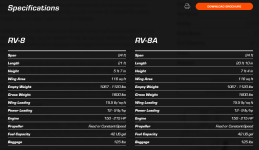
Link: https://www.vansaircraft.com/rv-8/
"Legal" in the experimental world is whatever you (or the builder) can get approved by the DAR. That being said, as a three time RV owner, twice with RV-8s, there is no way in heck I'd consider flying it anywhere near 2200#! Ask yourself, "Did the builder do ANY testing to verify structural loads at that weight or did they just pull a number out of the air?" Even true test pilots demand engineering verification before pushing the envelope. .

...there is no way in heck I'd consider flying it anywhere near 2200#! Ask yourself, "Did the builder do ANY testing to verify structural loads at that weight or did they just pull a number out of the air?"
He pulled it out of a much darker place....
BTW, 1254 lbs empty is a very heavy RV-8.

Another vote for complying with Van''s numbers. 1800 pounds for GW, 1600 for aerobatic weight. If you add a back-seater, the -8 trims out very nicely at cruise but the handling on the landing can get squirrely very fast, so pay even closer attention when you have a passenger. My personal goal for aerobatics is to keep maneuvers at about 3G max. That way if you screw up, you have plenty of room to recover. 6Gs? Nope. Save that for when you own an Extra 300 or Pitts. The previous owner appears to have taken great license with the word "experimental."
Chris
Chris

I'm sure I'll get hammered for this, but here goes. I'm 6'3" 250 lbs. I have flown my 8 many times over gross, 1850-1880 lbs with no issues. I would not do it at 2200 lbs. I'm careful about CG, always checking the numbers with minimum fuel as the CG moves aft as you burn fuel. Obviously no aerobatics and be careful in turbulent air.
I would at least get an updated W&B as other have said.
I would at least get an updated W&B as other have said.
Based on that written POH information, I’d meet with a well respected RV builder/DAR inspector/advisor (many on this forum) and REVIEW & REWRITE a new POH.
There might be other morsels of fanciful fiction in your document.
There might be other morsels of fanciful fiction in your document.


RV8Squaz
Well Known Member
Realize that the POH for an Experimental Amauteur Built aircraft is generally created by the builder. Sometimes they follow Vans, Lycoming, Hartzell, and FAA guidance and sometimes they don’t. They can put whatever they want in their POH. I wouldn’t consider a POH for an Experimental Amateur Built aircraft as an official document like I would for a certificated aircraft.I'm still learning my 2007 model. Listed in the POH, the Gross Weight is 2270 pounds (Normal Category). It also says 6 G's 1600 pounds and 5 G's 1800 pounds. Would I be legal to fly above 1800 lbs as long as the CG is not aft of 86.82 inches and limit the G's to 3.8 (the old Normal Category limit)? I have an AeroSport IO-390, 210 HP, CS prop. I just weighed it and it's 24 pounds heavier than in 2007. It was already on the heavy side, and now 1254 lbs.


Thanks for all the replies. It has been repainted over the original and 4.5-gallon tip tanks, but other than that what might be so heavy? Yes, the scales were accurate. How do you know dash one or non-dash one wing? Between 1600 and 1800 lbs it's stressed for 5 Gs, right?
RV8Squaz
Well Known Member
I’m not sure what makes your RV-8 so heavy. Mine is considered quite heavy at 1197 lbs. I have an angle valve IO-360A1A, a Hartzell constant speed prop, a full Christen inverted oil system, old school avionics and six pack, O2, a partial leather interior, and a Concorde RG-25XC battery. That’s about as heavy as they come.Thanks for all the replies. It has been repainted over the original and 4.5-gallon tip tanks, but other than that what might be so heavy? Yes, the scales were accurate. How do you know dash one or non-dash one wing? Between 1600 and 1800 lbs it's stressed for 5 Gs, right?

walkman
Well Known Member
Have you seen some people?How could you load a -8 to 2270#?
I'm not the most svelte any more, but damn!
I suspect the builder was a large person, possibly with a large spouse, and the inflated numbers were related to that.
One thing I was do if I was the OP, is to have a look at what might have been damaged or stressed by flying or bounding a landing at that weight.

Also don’t forget there is a maximum nose wheel weight on the vans construction manual.

Kahuna
Moderatoring
Easily and regularly.How could you load a -8 to 2270#?
One thing I was do if I was the OP, is to have a look at what might have been damaged or stressed by flying or bounding a landing at that weight.
Question from a non-builder for the more structurally inclined:
Let's say I go to look at a plane for sale, and I see a POH like this or other documentation that indicates it may have been flown significantly over the design weight on a regular basis.
What should I look for (or ask a mechanic to look for) during an inspection to identify whether there's been any long-term damage or fatigue that could lead to a failure down the line? Any particular components or symptoms to be aware of? Or is the whole thing a potential time bomb and you wouldn't touch it at all?

skylor
Well Known Member
I suspect that whoever wrote the POH for your aircraft used some overly-simplistic math when coming up with the 5G number by assuming a linear relationship between spar loading and aircraft weight (i.e. 1600 x 6 / 1800 = 5.3).Thanks for all the replies. It has been repainted over the original and 4.5-gallon tip tanks, but other than that what might be so heavy? Yes, the scales were accurate. How do you know dash one or non-dash one wing? Between 1600 and 1800 lbs it's stressed for 5 Gs, right?
Unfortunately this would be a very dangerous and poor assumption because structural loads often do not increase linearly with total aircraft weight.
Skylor
RV-8


Tip tanks were mentioned in this case, which explains both the empty weight and the gross weight increases. Doesn't justify them, but it does explain them.How could you load a -8 to 2270#?
You should look for the exit. Find another plane.Let's say I go to look at a plane for sale, and I see a POH like this or other documentation that indicates it may have been flown significantly over the design weight on a regular basis.
What should I look for...
Let's be realistic. It's not unusual to find 7's and 8's with 1900 lb max gross on the paperwork. It's ramp check protection. And sometimes they fly in excess of 1800, on purpose. Ever haul your wife to a wedding weekend?
That said, original builders are generally aware of the design numbers. If a bit heavy, they fly carefully.
The problem is obvious...where to draw the line? Opinions vary, and Lord knows, we have plenty of opinions.
That said, original builders are generally aware of the design numbers. If a bit heavy, they fly carefully.
The problem is obvious...where to draw the line? Opinions vary, and Lord knows, we have plenty of opinions.
Norman CYYJ
Well Known Member
Let's be realistic. It's not unusual to find 7's and 8's with 1900 lb max gross on the paperwork. It's ramp check protection. And sometimes they fly in excess of 1800, on purpose. Ever haul your wife to a wedding weekend?
That said, original builders are generally aware of the design numbers. If a bit heavy, they fly carefully.
The problem is obvious...where to draw the line? Opinions vary, and Lord knows, we have plenty of opinions.
That is why I put a decal on the baggage compartment wall saying "Max Baggage 60 PoundsLet's be realistic. It's not unusual to find 7's and 8's with 1900 lb max gross on the paperwork. It's ramp check protection. And sometimes they fly in excess of 1800, on purpose. Ever haul your wife to a wedding weekend?
That said, original builders are generally aware of the design numbers. If a bit heavy, they fly carefully.
The problem is obvious...where to draw the line? Opinions vary, and Lord knows, we have plenty of opinions.
This is a questionable airplane. Question is what else did this builder do that he was okey doke about?
91.323, not that it applies but 15% over gross is ok in Alaska. You’re at 26% Yikes!
Don’t forget braking. If you rotated and set back down at that weight, guaranteed you’ll need ~30% more brakes than what’s required of an 1800lb bird. Vans stock brakes won’t give you that.
What even is in the POH as a stall speed? Van’s published speeds are 50 mph at 1400lb and 58 at 1800lb. What did this guy say for 2270?
91.323, not that it applies but 15% over gross is ok in Alaska. You’re at 26% Yikes!
Don’t forget braking. If you rotated and set back down at that weight, guaranteed you’ll need ~30% more brakes than what’s required of an 1800lb bird. Vans stock brakes won’t give you that.
What even is in the POH as a stall speed? Van’s published speeds are 50 mph at 1400lb and 58 at 1800lb. What did this guy say for 2270?

Jjackh10
Well Known Member
The design weights have been addressed pretty thoroughly here. I think this sentence is where I would focus questions and effort if I were you. Your empty weight is 130+ heavier than vans numbers, and north of 50lbs heavier than a very well equipped example mentioned in this thread. That's a lot of weight to hide in a little plane. Tip tanks and paint would account for some. Did the builder add steel spar doublers trying to justify increasing the gross? Kidding but...It has been repainted over the original and 4.5-gallon tip tanks, but other than that what might be so heavy?

While it might be listed in the POH, there is no requirement to even have one for EAB.This is a questionable airplane. Question is what else did this builder do that he was okey doke about?
91.323, not that it applies but 15% over gross is ok in Alaska. You’re at 26% Yikes!
Don’t forget braking. If you rotated and set back down at that weight, guaranteed you’ll need ~30% more brakes than what’s required of an 1800lb bird. Vans stock brakes won’t give you that.
What even is in the POH as a stall speed? Van’s published speeds are 50 mph at 1400lb and 58 at 1800lb. What did this guy say for 2270?
ok fine, a placard or manual, or a sheet of paper. Whether or not there’s a POH wasn’t the point.While it might be listed in the POH, there is no requirement to even have one for EAB.

John RV8
Well Known Member
Have you seen some people? I'm not the most svelte any more…
My POH has a little bit different take on the weight increase. I list a ‘Max Gross weight’ of 1875 lbs, and it also says a Take-off above 1800lbs is only allowed on a smooth Paved runway. However! I also list a MAXIMUM LANDING WEIGHT OF 1800lbs and it also says “ Landing at weights above 1800lbs, should be considered only in an EMERGENCY “.
My plane has been flying for 14 years and I’ve only made two or three ‘heavy weight‘ Take-off’s. It turns of I didn’t really need that option with my typical kind of Operation. It was good if I wanted to launch with full tanks, my wife, and some baggage. However, our bladders and other considerations mean I don’t need that much fuel very often. Additionally, I am very strict about complying with the Van’s factory aerobatic weight and C.G. limits.
My POH has a little bit different take on the weight increase. I list a ‘Max Gross weight’ of 1875 lbs, and it also says a Take-off above 1800lbs is only allowed on a smooth Paved runway. However! I also list a MAXIMUM LANDING WEIGHT OF 1800lbs and it also says “ Landing at weights above 1800lbs, should be considered only in an EMERGENCY “.
My plane has been flying for 14 years and I’ve only made two or three ‘heavy weight‘ Take-off’s. It turns of I didn’t really need that option with my typical kind of Operation. It was good if I wanted to launch with full tanks, my wife, and some baggage. However, our bladders and other considerations mean I don’t need that much fuel very often. Additionally, I am very strict about complying with the Van’s factory aerobatic weight and C.G. limits.
Let's be realistic. It's not unusual to find 7's and 8's with 1900 lb max gross on the paperwork. It's ramp check protection. And sometimes they fly in excess of 1800, on purpose. Ever haul your wife to a wedding weekend?
Ramp check protection = pilots being lazy.
Hauling the wife = if her plus baggage is over gross, either she loses weight or her baggage does. Her call.

[edited to add the smile at the end... I thought I had it the first time]
Last edited:
Hauling the wife = if her plus baggage is over gross, either she loses weight or her baggage does. Her call.
I would pay to watch that conversation.


But then he won't have an airplane to worry about!I'm pretty sure he can deduct her entire body weight from the gross weight when she leaves.
walkman
Well Known Member
Good question, and a call to Vans might be in order. I'd certainly be looking at gear, gear attachment, tail wheel and structure, engine mount and attachment.Question from a non-builder for the more structurally inclined:
Let's say I go to look at a plane for sale, and I see a POH like this or other documentation that indicates it may have been flown significantly over the design weight on a regular basis.
What should I look for (or ask a mechanic to look for) during an inspection to identify whether there's been any long-term damage or fatigue that could lead to a failure down the line? Any particular components or symptoms to be aware of? Or is the whole thing a potential time bomb and you wouldn't touch it at all?
walkman
Well Known Member
For me, that's 17 more gallons of fuel I can carryI'm pretty sure he can deduct her entire body weight from the gross weight when she leaves.
... it already feels 'twitchy' on ground handling, definitely not as well-mannered as the -3 and -4 I previously owned.
See the recent thread on wheel alignment.

Ok - so now you go carefully into test pilot mode! Buy or borrow some bags of sand (or other weight) and carefully add to your backseat or baggage compartment a little at a time. Tie it down well! Go up and check stability and how it handles on touchdown. Make notes, learn, and sneak up on it carefully. The biggest hint you’re getting into trouble will be in the flare as you slow down - so slowly, slowly sneak up on it…..I have not yet carried a passenger, but I am concerned about this very thing. My -8 with the Catto prop and O-360 gets near the aft CG limit in a hurry when "what-if-ing" rear pax weight.
Plus, it already feels 'twitchy' on ground handling, definitely not as well-mannered as the -3 and -4 I previously owned. So, if it's already wanting to dart to the rhubarb with just me in it, I worry about how it's going to behave with a CG near the aft limit....aiiiyeeeee!!!
I owned a 8 with the exact same engine/prop configuration. The above statement couldn't be more accurate. I also echo the suggestion to sneak up on it be adding weight (in my case a portable, fold up plastic water container (Amazon) ) located in the baggage area. I bought a small, battery powered pump at Harbor Freight ($13) to empty it.The biggest hint you’re getting into trouble will be in the flare as you slow down - so slowly, slowly sneak up on it…..

My friend had some weights made to fit into the front baggage hold for just this eventuality.Running CG calculations, with anything more than a 180-190 lb rear seat pax, no baggage, I’m getting very close to the aft CG limit. No bueno.
The subject has been hashed a lot over the years. The light nose -8 enhances solo response, in particular stick force in pitch. A big angle valve and a metal Hartzell enhances hauling capacity, but has high pitch force when solo. There are lots of variations in the middle. Like any tandem, it's a planning decision.

If your battery is behind the rear baggage compartment, like many are, then perhaps moving it to the firewall or replacing it on the firewall with a LiFePo4 battery like the EarthX will help.
I usually carry a tool bag and move it between the front baggage compartment and the rear depending on load. No need for lead.
Bottles of water are great for gradually testing CG as recommended. And you can drink the water when you are done.
I usually carry a tool bag and move it between the front baggage compartment and the rear depending on load. No need for lead.
Bottles of water are great for gradually testing CG as recommended. And you can drink the water when you are done.
Hmmm. Interesting. I'm seeing a couple of possible issues to address: 1) CG, and 2) ground handling. They may be related, or may not.I have not yet carried a passenger, but I am concerned about this very thing. My -8 with the Catto prop and O-360 gets near the aft CG limit in a hurry when "what-if-ing" rear pax weight.
Plus, it already feels 'twitchy' on ground handling, definitely not as well-mannered as the -3 and -4 I previously owned. So, if it's already wanting to dart to the rhubarb with just me in it, I worry about how it's going to behave with a CG near the aft limit....aiiiyeeeee!!!
So first thing I would look at is the CG issue. When I built my -8, I purposely put the battery in the back (the old style big battery as the newer EarthX and similar weren't available yet) because the -8 was known to be nose-heavy if you were using a constant speed prop and even heavier if also using the 200HP angle valve engine. Mine is a standard O-360 and a constant speed prop. You might want to double check the CG numbers starting at the very basic point of verifying the datums you are using are correct; if you've installed anything different than Vans supplied equipment, e.g. a rocket style tailwheel steering mechanism or different tailwheel assembly these might affect the aft datum point. Be sure to weight the aircraft in level position using the cabin longeron as the level reference.
For the second item, ground handling. This can vary depending on the type of tailwheel steering you have installed and whether it is adjusted properly. For the standard kit-supplied chains make sure there is a little bit of play in them and they are not too tight. Also check that the Locking Pin and Spring are greased and engaging properly. I bought an assembly once that was nicely chromed but unfortunately the slot for the locking pin was too small (probably from the added layer of chrome) and the pin could not engage fully thus causing the pin to release too easily and the tailwheel swivel. It made taxiing feel like driving on ice (very sensitive). Once the slot for the locking pin was replaced with a proper sized slot, the ground handling was dramatically improved. I grease the tailwheel unit about every 25-30 hours and I make sure the locking pin remains smooth and without burrs. These are inexpensive, so keep a spare on hand.
I love the rocket style tailwheel steering, but also keep in mind that when landing the tailwheel follows the rudder. If you're landing with a crosswind and use cross-control to compensate, when the tail comes down the tailwheel will be in whatever position the rudder is, so be ready with the rudders to compensate during the transition when the tailwheel touches down. I always wheel land my -8 and try to keep the tailwheel off the ground until it naturally wants to settle as the speed slows. At that point it is much easier to correct any tendency to veer right or left when the wheel touches down.
There are a number of threads on -8 CG and landing techniques on this site. I've seen a few referred to in other responses to your comment. I'm assuming your new to the -8, so please seek out other -8 drivers at your airport or local EAA chapter. Most -8 guys have experienced similar issues and may have some valuable insight.
I didn't know any of this stuff when I first starting flying my -8 so I found the advice of some of my fellow -8 flyers to be invaluable.
Good luck,
Chris
I bought an 8 that came with a W&B that said the plane weighed 1125lb. I re-weighed the plane (twice, I didn’t believe it the first time) that clocked it in at 1196. C of G was way off as well. Smoke tank removed and Concord swapped for earthx it still comes in at 1158. We were way over weight and aft CofG on the flight home without knowing. Don’t think I’ll trust an experimental plane weight again. Good thing we came home on a fairly cold stretch.