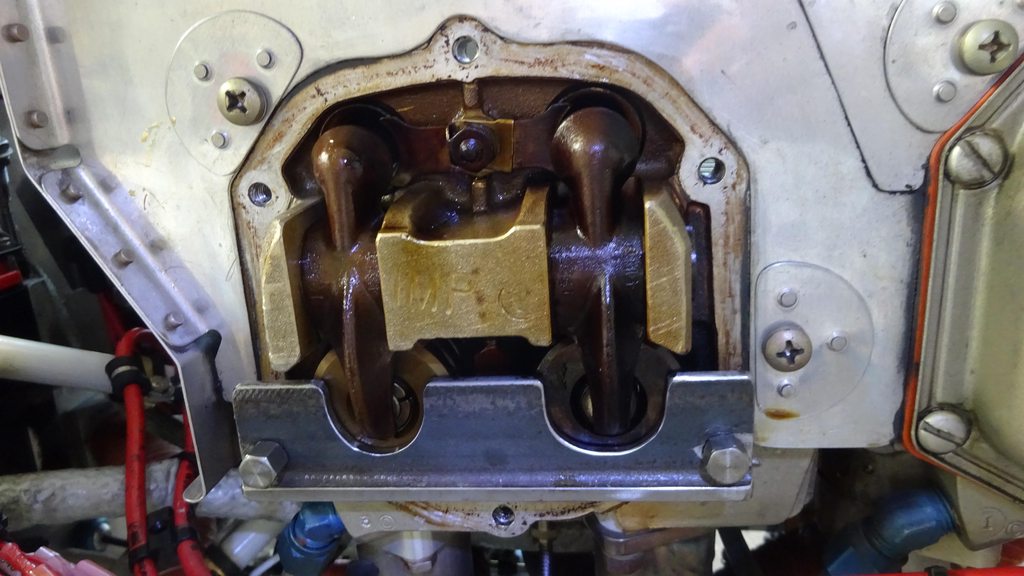
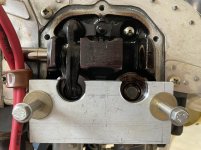
The above tool works great for compressing the springs just enough to slide the rocker shafts in and out...on a parallel valve. Unfortunately it won't work with an angle valve head, as the top of the spring assembly is below the gasket level. Here's a new homemade tool I was experimenting with earlier this week.
Same problem, different approach. Instead of compressing the spring in order to insert the rocker shaft, why not apply a little pressure to the hydraulic lash adjuster in order to make it bleed down?
The tool is a length of solid rod for the handle, a short length of 3/8" tube, and a very short length of 1/2" 0.58 wall. Drill and tap the end of the handle for a 10-32 screw or bolt. Machine a cup recess into the head of said bolt. Weld the 1/2' tube to the handle to form a hinge. Drill the 3/8" tube for two 1/4-20's.
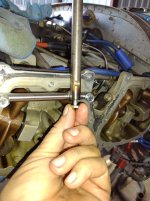
The cup recess fits over the tip of the pushrod. One finger, or just the weight of the handle if you're patient, bleeds the adjuster. Here the long handle is an
indicator; with slight pressure on the handle you can easily watch it drop, and it's obvious when the hydraulic assembly reaches empty.
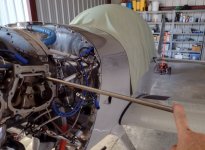
With the adjuster empty, the rocker shaft slides right in. Now for a bonus; the weight of the handle nicely compresses the little spring on the adjuster. So, screw in the cupped bolt and let the tool rest on the rocker arm while doing a tappet clearance check. No more sore thumb.
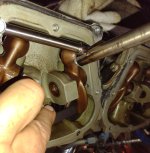
Caveat: the long handle and the small leverage ratio means it's possible to bend or break something if Mr. Gorilla gets stupid. Very little pressure is required, relatively speaking, to bleed the lifter or hold the rocker in for the clearance check.
Comments welcome. Foresee a problem? The above is a prototype of sorts. Offhand, the first improvement might be to use a brass bolt for the cupped socket, just eliminate the chance of scuffing the end of a pushrod.




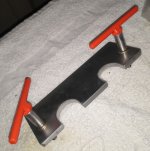
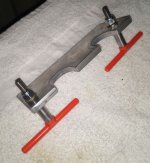
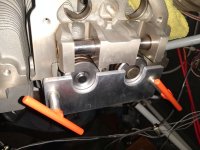


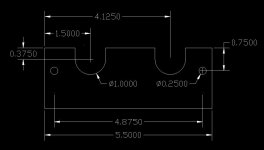

 before I can visualize the tool that I need to make.
 That sucker ain't going ANYwhere! 1000 years from now they will dig that up and think.....huh.....must have been a piece of jewelry something from some kind of a cult.......