Van's Air Force

The definitive Van's Aircraft support community! Buying, building or flying an RV? Join our exclusive family of mentors and enthusiasts!

Breaking News: tests on landing gear nuts and bolts

If your gear is steel it is factory gear.
If it is aluminum square section or airfoil shaped it is (was) grove gear. It wasn't an option to order from Van's, you just bought a different set of gear from Grove. I think Grove stopped producing the airfoil shaped gear a few years ago but I thought the still made the square gear. Could be wrong though.

There is a new company producing the airfoil shaped gear. Somebody chime in here because the name escapes me.
 
Easier test. If you threw your back out or felt the twinge of a hernia when lifting the gear out of the box, it is factory gear. I kid, but that is the reason for the Grove aluminum gear. It was something like 13 pounds lighter.
 
Easier test. If you threw your back out or felt the twinge of a hernia when lifting the gear out of the box, it is factory gear. I kid, but that is the reason for the Grove aluminum gear. It was something like 13 pounds lighter.

:D:D:D I didn’t build it but the magnet still clinging from it says it’s steel. Thank God for one thing turning out right, it’s been one of those days you can’t wait for it to be over, but I’m breathing and healthy so I won’t complain.
 
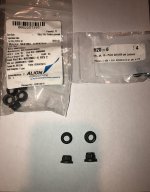
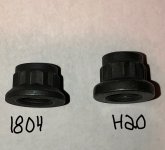
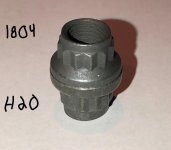
I check the torque on my -8 landing gear each time I change the oil. It's really one of my least favorite jobs. I'm tempted to reinstall the bolts from the top like other have done (with anti-rotation tabs) so I can check the torque from the bottom. At that time, I'll install new bolts/nuts. I'm planning on the NAS6606-36 bolts (I have Grove gear) and the NAS1804-6 nuts. While looking for some some of the 1804's, I stumbled on an H20-6 (also a 3/8x24 12 point rated at 220,000).
https://www.pegasusautoracing.com/productselection.asp?Product=H20

The H20's measure .45in in length, compared to the .37in for the NAS1804's. I like the idea of more thread length. Has anyone used the H20's and are the specs comparable?

Brian
 

Attachments

  • IMG-2960.jpg
    IMG-2960.jpg
    261.8 KB · Views: 177
  • IMG-2962c.jpg
    IMG-2962c.jpg
    777.2 KB · Views: 168
  • IMG-2963c2.jpg
    IMG-2963c2.jpg
    175.9 KB · Views: 174
I check the torque on my -8 landing gear each time I change the oil. It's really one of my least favorite jobs. I'm tempted to reinstall the bolts from the top like other have done (with anti-rotation tabs) so I can check the torque from the bottom. At that time, I'll install new bolts/nuts. I'm planning on the NAS6606-36 bolts (I have Grove gear) and the NAS1804-6 nuts. While looking for some some of the 1804's, I stumbled on an H20-6 (also a 3/8x24 12 point rated at 220,000).
https://www.pegasusautoracing.com/productselection.asp?Product=H20

The H20's measure .45in in length, compared to the .37in for the NAS1804's. I like the idea of more thread length. Has anyone used the H20's and are the specs comparable?

Brian

The H20 is a stronger nut, with more thread engagement. This means you will need NAS bolts that are longer, or with a longer threaded portion, so that you get a slight projection of the bolt threads beyond the end of the nut. (2 threads is often stated as std custom, but is really overkill - It is most important to be sure there are full threads engaging the locking feature of the nut). You will have to research bolt lengths.

I would say, however that the NAS1804 is completely adequate.

Putting the bolts in from the top has several advantages, but is difficult to do as a retro-fit. There are several screws and nuts from the assembly of the gear weldment, doublers and skin that are in the way and would have to be removed. It also means that the height and shape of the gear fairing on the belly will be different, but that is fairly minor.
 
The H20 is a stronger nut, with more thread engagement. This means you will need NAS bolts that are longer, or with a longer threaded portion, so that you get a slight projection of the bolt threads beyond the end of the nut. (2 threads is often stated as std custom, but is really overkill - It is most important to be sure there are full threads engaging the locking feature of the nut). You will have to research bolt lengths.

I would say, however that the NAS1804 is completely adequate.

Putting the bolts in from the top has several advantages, but is difficult to do as a retro-fit. There are several screws and nuts from the assembly of the gear weldment, doublers and skin that are in the way and would have to be removed. It also means that the height and shape of the gear fairing on the belly will be different, but that is fairly minor.

Thanks for the H20 info, Steve. They are nice, hefty nuts! I'm currently using the NAS6206-36 bolts. It looks like the NAS6606-36 would have the extra thread length needed should I decide to go with the H20 nuts.

I've looked at the retrofit obstacles for putting the bolts in from the top, and I think it's manageable. I'm just trying to evaluate a suitable anti rotation solution. W/out it, there isn't much benefit, and may make it more difficult to service with the 6 point bolt head inside the tower. Scott describes the process here. https://vansairforce.com/community/showthread.php?t=130904

Brian
 
Last edited:
Landing Gear Bolt Torque Check

I check the torque on my -8 landing gear each time I change the oil. It's really one of my least favorite jobs. ...snip

Why the inspection overkill? This is the RV-8 Manual recommendation:

Check these bolts and re-torqued after the first ten flying hours, then again
at 50 hours, and annually thereafter.

After initial "wearing in" of the gear attachment and wear-plate hardware, there shouldn't be much change of the fastener torque over time - unless you are really abusing the landing gear.

Skylor
 
Brian,
My bolts go in from the top. I cut short Allen wrenches and fit them in the bolt heads with glue. The tails of the allens are connected together with a short piece of steel tube and glue to prevent rotation when torquing from below.
 
Why the inspection overkill? This is the RV-8 Manual recommendation:

Check these bolts and re-torqued after the first ten flying hours, then again
at 50 hours, and annually thereafter.

After initial "wearing in" of the gear attachment and wear-plate hardware, there shouldn't be much change of the fastener torque over time - unless you are really abusing the landing gear.

Skylor

It probably is overkill. I fly around 100 hours a year and change my oil at 50 hours, so I'm probably checking it one extra time per year on average. I've just read or heard of a number of -8 owner who have found loose gear bolts, and it seems like a smart item to check more frequently - provided you don't get cut up in the process!
 
Brian,
My bolts go in from the top. I cut short Allen wrenches and fit them in the bolt heads with glue. The tails of the allens are connected together with a short piece of steel tube and glue to prevent rotation when torquing from below.

I'm having a hard time picturing Allen wrenches fit into the bolt heads with glue. Perhaps you are using different bolts? A picture would be helpful.
 
I used MS20006-30 bolts. They are a little long but work with two washers and are internal wrenching with an Allen. Be sure to use hard washers, MS20006-6 and MS20002C6. Glue the Allen wrenches to the head. I didn’t weld for fear of destroying the heat treatment. I think Steve or Bob had a post on this hwd. It is impossible for me to get in there for a picture. Just to tight and the tubes and wires going through the gear towers are n the way.
 
I used MS20006-30 bolts. They are a little long but work with two washers and are internal wrenching with an Allen. Be sure to use hard washers, MS20006-6 and MS20002C6. Glue the Allen wrenches to the head. I didn’t weld for fear of destroying the heat treatment. I think Steve or Bob had a post on this hwd. It is impossible for me to get in there for a picture. Just to tight and the tubes and wires going through the gear towers are n the way.

Interesting. Wasn't aware there was an allen alternative. I wasn't able to find any discussion on the MS20006-30 in this thread or elsewhere on VAF, but I trust you evaluated the specs. I appreciate your post and ideas. Very clever. Thanks.
 
Thoughts on MS20006 bolts. They are rated 160 ksi.
The normally used NAS6206 or NAS6606 bolts are rated 160--180 ksi.

The diameter range for the MS20006 bolts is 0.3727--0.3742
The diameter range for the NAS6206 bolts is 0.3735--0.3745

So they are not quite as strong, and are not quite as tight a fit in a 3/8" hole.

My engineering judgement would be that they are good enough. Especially given that the holes are hand-drilled, these joints probably work a little bit anyway.
 
Group Buy

Like most things this is cheaper in bulk.... I want 4 bolts and 4 nuts:
4 - NAS6606-27 bolts
4 - NAS1804-6 nuts

GAHco bolt price is ok, but nut price is very high.

I'm open to organizing a group buy [ed. Sorry Sir but group buys organized on the site through non-advertisers are discussed in the rules page at https://vansairforce.net/rules.htm over on the right side. v/r,dr]
 
Last edited by a moderator:
The NAS1804-6 nuts are $6.25 each at Aircraft Spruce. The "N" suffix just means they are cad plated. I've seen them silver plated, cad plated, black oxide coated. Doesn't matter, same nut, same specs.
 
Last edited by a moderator:
Like most things this is cheaper in bulk.... I want 4 bolts and 4 nuts:
4 - NAS6606-27 bolts
4 - NAS1804-6 nuts

GAHco bolt price is ok, but nut price is very high.

I'm open to organizing a group buy [ed. Sorry Sir but group buys organized on the site through non-advertisers are discussed in the rules page at https://vansairforce.net/rules.htm over on the right side. v/r,dr]

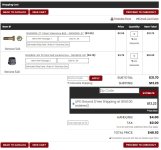
Monroe has the bolts for $2.55 each in quantitates of 5 and the nuts are $3.79 is quantities of 5. Get the 5 pack and carry a spare. Call it $49 with shipping and handling.

https://catalog.monroeaerospace.com/item/nas-bolts/nuts-1/nas1804-6-1
https://catalog.monroeaerospace.com/item/nas-bolts/nas-bolts-1/nas6606-27-1
 

Attachments

  • Capture b.JPG
    Capture b.JPG
    116.3 KB · Views: 135
Nuts and bolts.

Working up the nerve to replace my original nuts and bolts with the new ones with retainers (going to flip the bolt). My 8 does not have the gear tower mod and there's lots of stuff runnng through that area. Any words of wisdom or is it just bleed and cuss time? I am going to use my rivet gun with an offset to just bump them out. I know you have to modify the retainers slightly to clear one nut. Any other hints? I'm at the point in the condition inspection where I need to torque the nuts so, I guess, it's just time to dive in, do the mod, and be done with it.
 
Working up the nerve to replace my original nuts and bolts with the new ones with retainers (going to flip the bolt). My 8 does not have the gear tower mod and there's lots of stuff runnng through that area. Any words of wisdom or is it just bleed and cuss time? I am going to use my rivet gun with an offset to just bump them out. I know you have to modify the retainers slightly to clear one nut. Any other hints? I'm at the point in the condition inspection where I need to torque the nuts so, I guess, it's just time to dive in, do the mod, and be done with it.

Hi Rob,

Yes, some have done it w/out the gear mod. https://vansairforce.com/community/showthread.php?t=130904 Brush up on your yoga or shove your grandson up front under the panel!

I have a cheap bore scope, and that's been pretty helpful at seeing inside the towers. I think the biggest obstacle will be on the rear gear bolt and interference with the vent line coming through the fuselage. I believe it will have to be removed. If you want, send me an email and I'll send you some photos of the inside my towers.

Brian
 
I have spares

I have spare NAS6606-27 bolts and NAS1804-6 nuts. I purchased a 10-pack from Military Fasteners and only need four plus a spare.

My cost with was $9.74 for each nut plus bolt. Ping me if you want four or five at say $8 each plus postage.

Cheers,
Bob
 
I'm looking for a set of NAS6606-27 bolts and NAS1804-6 nuts. If there's some spares floating around, I'll take them off someone's hands.
 
I plan on installing NAS6606-27 bolts and NAS1804-6N nuts at my next condition inspection in June. Hopefully with the bolts in from the top. I expect friction drag added to the 240 inlb torque will probably be somewhat higher than the NAS679A6 nuts, since the NAS1804-6N is self locking and has longer thread engagement.

Anyone know what friction drag to expect?
 
Last edited:
You're expecting them to just lock up on top and not need to use a tool or anything to hold it from the top? If so then you're the first person I've read about who thinks this.

I bought some wedges someone made exactly to avoid the spin and not need a tool.

I have the bolts, nuts, and those wedges for sale if anyone needs them. I didn't need them and later sold my plane.
 
RV-8 outer gear bolts

I just swapped the original Vans supplied outer gear bolts & nuts and replaced with the NAS6606-27 bolts and NAS1804-6N nuts with hardened washers.

2-E7-FD950-1228-46-B7-A857-7072181291-BE.jpg


Boy what a royal pain that was and took most of an afternoon with a helper. I really wanted to use the clips and put the bolts in from the top but there was no way that was going to happen unless I disconnected the fuel vent lines and the brake lines that run through that same area. This would have been fairly difficult with one hand in such limited space to get wrenches in there on a finished airplane. Then I would have had to take out some outboard screws and locknuts that come through in that same area that prevented the bolt going in the hole straight.

After much cussing and scrapped knuckles the bolts went in from the bottom up eventually. My observation on the original supplied bolts is that they do in fact loosen and here’s why I know: Before last year’s condition inspection is when I found out about this issue so I checked the torque of 240 in/lbs and sure enough three of the bolts got a good bit of wrenching before hitting the torque. Once tightened the 805-1 wear plate gap of .030 was still good.

Before swapping the bolts yesterday I checked the torque out of curiosity and sure enough they took a bit of wrenching before hitting the torque again so I feel fairly certain the bolts were slipping in the nut threads or perhaps jumped a thread or two. The nuts that came out were the NAS679-6 nuts and compared to the NAS1804-6N nuts there wasn’t as much thread and the bigger size made getting them out problematic with the limited space inside the gear towers. Getting the bolts & nuts out was ridiculously difficult but the new bolts and nuts went in relatively painlessly.

A7-BFC859-C9-C6-4-E97-9001-CEE47-D3689-A9.jpg


This hardware is not cheap but now I have piece of mind that the gear is not an issue anymore. I remember reading an old post by Kahuna about knowing when to retorque the gear because he could hear it creaking during taxi and that’s exactly what mine was doing before last years inspection.

Kudos to Steve Smith for doing the gear bolt & nut testing and to Kahuna for posting his observations and especially to Karl Forehlich for letting me borrow his modified socket to shamelessly copy so I could grip the nuts from inside the towers. I had to modify and bend a wrench to get at a couple nuts because two of them weren’t accessible even with Karl’s tool.

While you’re in the cockpit you might as well check the torques of the three inboard gear bolts:

4-EBCF31-C-334-C-4-FB2-99-F4-4023-B5497770.jpg


With the new bolts & nuts installed I’m sure my squiggly landings will improve!! Now that I am finished if anyone needs 4 of those clips to put the bolts in from the top (if you can- good luck) let me know. Just send me a screenshot of a VAF Forum donation for what you think they’re worth and they’re yours, I’ll even pay postage as long as you don’t live halfway around the world.
 
Last edited:
...so I feel fairly certain the bolts were slipping in the nut threads or perhaps jumped a thread or two...

There is no torsional force here that would cause the NAS679 nuts to unscrew from the bolts. When you find these nuts loose, it is almost certainly because they have jumped threads.
 
I haven’t read this whole thread, so maybe someone has already mentioned it, but I would rather have a stripped nut/bolt than a torn out gear tower. 18 yrs and 1000hrs has not caused the nuts to move.
 
It’s a long thread but I read it. My takeaway:
There is evidence that the nuts come loose
They are jumping threads.
Replacing them decreases the possibility they will come loose.
The bolts/nuts are not the failure point in gear leg separation cases.
One of the best examples of engineering work with supporting theoretical and experimental data I have seen on VAF
 
Last edited:
I...I would rather have a stripped nut/bolt than a torn out gear tower...

If this fastener stack was a reliable fuse point, I'd be with you on that. But the service history has shown that the nut leapfrogging happens progressively, under loads within the normal operating envelope, and has strong potential for causing unexpected gear failure.

...18 yrs and 1000hrs has not caused the nuts to move.

It could be that your landings and ground operation are gentler than typical. Good on you!
 
Gear security

Regardless of the few people who may have reported that they have had no problems, the bottom line is that the nuts as supplied are stamped nuts, and not designed for a tension application. They should only be used in shear.
I don’t believe that the nuts can ‘jump’ threads, they are in fact stripping the threads. With relatively minor adjustments, longer bolts can be inserted from the top with the correct high tensile nuts fitted. Not only that, but when necessary the nuts are easily accessible for rechecking the torque. The bolt heads can be restrained by one of several methods that have been suggested previously.
 
I don’t believe that the nuts can ‘jump’ threads, they are in fact stripping the threads. .

We have actually watched in real time, with our own eyes, as the nut expands radially from from the wedge action of the contact faces of the threads, and leapfrogs to the next thread. The stamped nut does not have much radial stiffness/strength in the formed 'neck' that has the threads.

Further evidence that the threads are not stripping is that you can then disassemble the bolt and nut after the test and see no visible damage to either the bolt threads or the nut threads. They look normal. The nut turns easily and smoothly on the bolt. In the past, this has led people to conclude that the nut must have turned. Part of what launched me on this study years ago was that I know that the nut can not turn, so I wanted to see why/how it was getting loose. We found the answer.
 
NAS1804-6 vs NAS1804-6N

Reading through the thread, I noticed that the NAS1804-6 and the NAS1804-6N were both mentioned. Which would best for this application? Thanks!
 
Gear

Hi Steve, if you have seen the nut ‘jumping’ then that must be the case on some occasions, but whether jumping or stripping is totally unimportant. The bottom line is that the nut loosens, the gear leg is then not completely anchored, and a wobbly gear leg is the result which can result in a ground loop or worse. Quite aside from landing stresses, some of us operate from and into grass strips. Even the best maintained grass strips induce more stresses than a hard surfaced runway.

‘Nuther bottom line……. That nut is not designed for the function, otherwise we wouldn’t be reading about having to re torque the nuts.
 
Reading through the thread, I noticed that the NAS1804-6 and the NAS1804-6N were both mentioned. Which would best for this application? Thanks!

Hi Charlie, the N just refers to having no black molly lube coating I think. I have used them silver plated, cad-plated, and with the black molly coating. It really doesn't matter as far as strength goes. The corrosion resistance may be different.
 
I have been a little skeptical about the strength of the NAS679A6 nuts that Van's supplies for the main landing gear bolts on the RV-8. So, I decided to do some tests of various different nuts to see what the different strengths are.

We wanted to simulate the tension load that gets put on the bolt and nut when the landing gear gets a fore-and-aft load, which puts a twisting moment on the gear which tries to pry apart the mounting saddle ( U803) and puts the bolt and nut in tension.

I will describe the results here, then describe the test procedure in a second post.

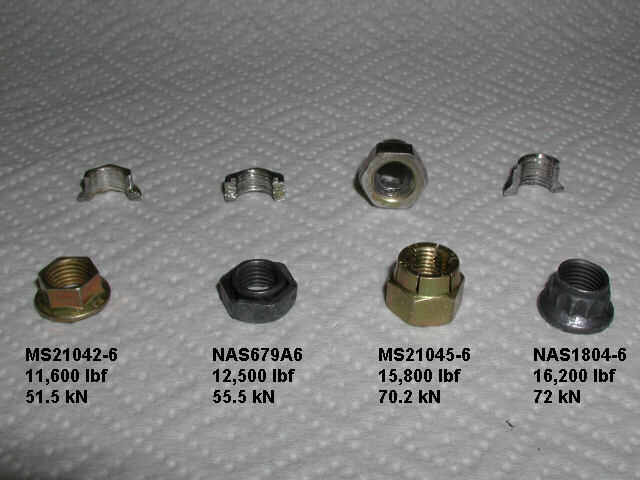
So, we tested four different nut types, as follows:

MS21042-6 low profile nuts with 7/16 wrench flats
NAS679A6 low profile nuts ( stock style) with 9/16 wrench flats
MS21045-6 full-height metal lock nuts with 9/16 wrench flats
NAS1804-6 mid-height nuts with 12-point 7/16 wrench flats

Below is a picture that shows each of the four nuts, and the cut-open failed nuts. The legend shows the breaking strength that we found. All the nuts failed by some or all of the threads stripping. The NAS679 tended to have a couple of threads un-stripped, as if they had radially stretched enough to leap-frog over the mating thread on the bolt. The MS21045 showed significant swelling of the base of the hex, so that a wrench would no longer fit on the flats. This was also true to a lesser extent with the MS21042.

In summary, the strengths were as follows:
MS21042-6 11,600 lb
NAS679A6 12,500 lb
MS21045-6 15,800 lb
NAS1804-6 16,200 lb

The expected strength of the 3/8-24 NAS close-tol bolts is about 14,000 lb. so only the last two types of nuts are capable of developing the full tensile strength of the bolts. We used Unbrako socket-head bolts (better than grade 8) to be sure that the nuts broke and not the bolts.
nut_test2b.jpg

here's the link too: http://www.hpaircraft.net/rv8/nut_test2b.jpg

A couple of other builders in other threads have mentioned using the MS21042 nuts in place of the ones Van's supplies. An advantage is that they take a smaller size socket which helps get a socket on them in the gear tower. But as you can see, they are not as strong. The same benefit of smaller socket can be gained using the high strength NAS1804 nuts. You can order them from GAHco, they are pretty pricey but worth it for the peace of mind in my view.

I'm starting the condition inspection on my RV-8, and ordered the recommended bolts and nuts to replace the ones that were originally supplied with the kit. In talking to some other RV-8 owners, who are NOT the original builders, they are curious if Van's ever put out a Service Bulletin or any other information about the originally supplied bolts and nuts. Does anyone have any insight on that? Also, I note that there were at least 4 cases where the nuts had slipped a thread. Is anyone aware of a failure that resulted in an accident?

For those of you who have replaced the nuts and bolts, do you have any "travel tips" that might make it easier, and avoid creating a new problem? Many thanks!
 
In talking to some other RV-8 owners, who are NOT the original builders, they are curious if Van's ever put out a Service Bulletin or any other information about the originally supplied bolts and nuts. Does anyone have any insight on that?
Doesn't look like it but go to the source:
 
I'm starting the condition inspection on my RV-8.....
Do yourself a favor and check ALL the service bulletins regarding the 8 and 8A even if you're told they don't apply. For example there's one about missing bolts in the wing spar but Van's only says it's for quick build kits. They know there were many slow build kits missing those bolts too but when I asked Van's why not make another bulletin or clarify the current one, they said they wouldn't. It's all a liability game for them, so make sure your bolts aren't missing, like mine were after 9 years getting inspected. Nobody bothered to check because my RV8 "wasn't a quick build so it didn't apply to mine". You can search this website, many discussions about this issue.
 

Attachments

  • Screenshot 2025-03-26 at 11.01.52 PM.png
    Screenshot 2025-03-26 at 11.01.52 PM.png
    909.6 KB · Views: 52
I'm starting the condition inspection on my RV-8, and ordered the recommended bolts and nuts to replace the ones that were originally supplied with the kit. In talking to some other RV-8 owners, who are NOT the original builders, they are curious if Van's ever put out a Service Bulletin or any other information about the originally supplied bolts and nuts. Does anyone have any insight on that? Also, I note that there were at least 4 cases where the nuts had slipped a thread. Is anyone aware of a failure that resulted in an accident?

For those of you who have replaced the nuts and bolts, do you have any "travel tips" that might make it easier, and avoid creating a new problem? Many thanks!
As far as I know, Van's has never done anything about the poor choice of nuts. I believe Grove did start supplying the stronger nuts with their gear leg kit.

Yes, I am aware of at least one RV-8 that ended up off a runway and damaged because the nut 'stripped' off. (note here that I put 'stripped' in quotes because it does not actually strip, it stretches enough circumferentially under tension to leapfrog a thread, and if the tension load is still there, it will leapfrog another thread, and another, until it comes off the end of the bolt. We have replicated this in the lab. Looking at the bolt, the threads do not appear damaged.
 
Sky Designs RV-8 Aluminum Airfoil Main Landing Gear Kits include NAS1804-6 nuts. This has been the status quo since August of 2023 and prior to that we offered the nuts as a "recommended option".

BTW: Grove does not offer gear legs for RV-8 and has not offered them for many years...just sayin'
 
Do yourself a favor and check ALL the service bulletins regarding the 8 and 8A even if you're told they don't apply. For example there's one about missing bolts in the wing spar but Van's only says it's for quick build kits. They know there were many slow build kits missing those bolts too but when I asked Van's why not make another bulletin or clarify the current one, they said they wouldn't. It's all a liability game for them, so make sure your bolts aren't missing, like mine were after 9 years getting inspected. Nobody bothered to check because my RV8 "wasn't a quick build so it didn't apply to mine". You can search this website, many discussions about this issue.
I know it's happened with other issues (blue vinyl inside the gas tank comes to mind) but I guess I don't see why you would need a service bulletin to tell you that you should build something to print. A service bulletin to tell people they shouldn't be building airplanes if they can't read might be helpful though :)
 
I guess I don't see why why you would need a service bulletin to tell you that you should build something to plan.
My generic answer would be : Because if I were a company selling a product that I want to be as safe as possible, and I KNOW there are customers missing something during the build that can hurt them, then changing a few words in a service bulletin that wouldn't cost me a single penny, would be the right thing to do for them and for me as a company to keep my good reputation.

But in this case specifically, when Van's knows that their quick build kits have a mistake, and they know that every day builders are also making the same mistake, you would think they would want to warn someone that if their expert builders, who are doing this every day missed it, someone who doesn't do this for a living and most likely who's never built one before, can easily miss it too. So instead of just saying the service bulletin is only for quick builds, they could say " HEY EVERYBODY, check this just in case". But that's just how I think.
 
A service bulletin to tell people they shouldn't be building airplanes if they can't read might be helpful though :)
If they can't read, why would the solution be to publish something else for them to read? They won't be able to read that service bulletin either.
 
Back
Top