Van's Air Force

The definitive Van's Aircraft support community! Buying, building or flying an RV? Join our exclusive family of mentors and enthusiasts!

Why are there far fewer RV9s vs 9As?

Wow, glider tows in a Champ. Must have been an experience! I did the TW endorsement in a Champ, and flew a Pawnee with 235 hp towing gliders for a few years. When it came time to choose an RV model, I wanted to build a -14. Definitely some disadvantages like insurance but for me, more fun, which is my main mission.
Gliders were all I could afford to fly back in college 50 years ago but I did volunteer to fly the Champ tow plane. We had a Schiebe single seat glider and a Schliecher KA7. The Champ only towed the Schiebe. My recollection was that it wasn't particularly problematic, although it would overheat on a 3000-foot tow on a hot Nebraska day. In those days, endorsements weren't required for either glider tow or tail wheel. In later years I found that I had to have the TW endorsement anyway to fly conventional gear. I was "grandfathered" in, but I couldn't get insurance on that alone.
 
What you noticed in the Citabria is a real thing, but it still has nothing to do with being a tailwheel. This is one of the misunderstandings that props up the myths about tailwheel pilots. The Citabria has more adverse yaw than whatever else you have experience in. This comes from the design of the aircraft wings and control surfaces, not where the wheels are mounted. The most common aircraft used for tailwheel instruction also happen to have more adverse yaw than the rest of the training fleet, leading to this poor correlation.

I think you'll find your RV with a tailwheel to be an aircraft that you should fly coordinated like any other, but it won't require nearly the busy feet that the Citabria does


Watch Trent Palmers episode on youtube called "the groundloop monster". I guess the more accurate way to describe the tailwheel challenge would be that constant rudder input are required to counter the effects of aft gear CG instability coupled with gyroscopic precession when the tail lifts up and down. A cool demo of this is to take off a bike wheel, rotate it fast, and then move it in a up and down motion to feel the yaw force it generates to be counteracted. Pretty cool.

You are correct Dave that to fly coordinated is independent of gear type. But you did concede the correlation that most tailwheel designed aircraft require more attention and input to fly coordinated. Good point
 
Last edited:
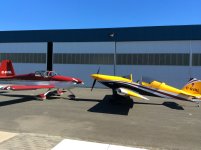
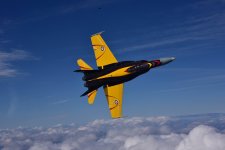
In 2014, when I wanted to paint the Rocket, my original plan was to copy the blue and gold RCAF demonstation CF-18. I contacted the RCAF, requesting the paint color codes. I received a letter back from the Brigadier General that I would have to file an Access to Information Request ( and presumably wait 10 years).

Instead, I chose the paint scheme shown above for my Rocket. Two years later, here is what I saw.

Note: I was once intercepted by an an EA-18G, that came this close to my RV-9A. Not this one though.

 
Last edited:
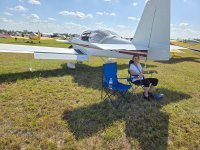
"Here's a good reason to build a 9A instead of a 9. The 9A gives you a place to set up your lawn chairs in the shade to watch the airshow when it's 90 degrees out.

Taken at Sun and Fun yesterday."

That's what friends are for.
 
Rv-9 with 200hp constant speed prop here. Full throttle, say one thousand one, one thousand two, one thousand three and you are climbing like a banshee. Pattern altitude by 3/4 down the runway, then pull power back and let that wing do its thing. No it’s not a tail-sliding acrobatic beast, but it’s stable and efficient. It don’t sit on its tail above 12,000 ft like a rv-6 and will stall at c-152 speeds. What’s not to like?
 
Back
Top