Van's Air Force

The definitive Van's Aircraft support community! Buying, building or flying an RV? Join our exclusive family of mentors and enthusiasts!

Why a CCR-264SS-3-2 here?

Cessnadog

Well Known Member
Sponsor
Working on section 32-05. Baggage floors.
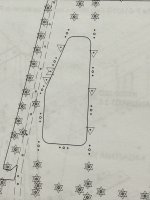
The inspection holes back where the steps bolt in call for one CCR264SS-3-2 (the small hourglass shape in the picture). When I search them on line I see they are mostly designated as “nut plates rivets” which implies to me that they are not designed to be structural.
I originally thought it was because it would be impossible to get a solid rivet in there. But now that I have all of those nut plates in place I am certain I can easily squeeze a solid rivet in that spot.

Is there a structural reason for this tiny cherry rivet?
IMG_0265.jpeg

 
Well...at the risk of sticking my nose in....it appears it is not a nut plate rivet, and the hole has another purpose (or a squeezer access issue) . My experience is that Van's usually (actually about 99.999 percent of the time) has a good reason for their rivet choice. The reason may not be obvious now, but at some point, it will. Van's is not prone to including cherries for no reason due to expense, and since they provide one, I would not worry about it, put in the cherry, and press forward. :) Sometimes I feel we are not meant to understand everything in the kit....ymmv.
 
Last edited:
Working on section 32-05. Baggage floors.
The inspection holes back where the steps bolt in call for one CCR264SS-3-2 (the small hourglass shape in the picture). When I search them on line I see they are mostly designated as “nut plates rivets” which implies to me that they are not designed to be structural.
I originally thought it was because it would be impossible to get a solid rivet in there. But now that I have all of those nut plates in place I am certain I can easily squeeze a solid rivet in that spot.

Is there a structural reason for this tiny cherry rivet?

View attachment 80730

Are you installing the steps?

I couldn’t get a squeezer yoke or a bucking bar in there due to the step support weldment shape. I just used the rivet they called for - don’t know why they didn’t used a stronger one 🤷🏼‍♂️

Looking at my image of that area, I used one on the other side of the weldment too, on one of the nutplate holes, for the same reason.

 
I ended up putting the called for rivet in there even though I am sure I could have squeezed it.
This might be handy for others…

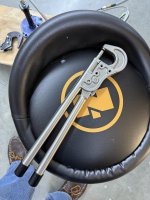
I bought a used “old fashioned” squeezer from a local guy. It has a really small yoke built onto it and will say that every once in a while it comes in REALLY Handy. It will fit in holes that my Main squeeze and Numatix squeezer just cant go.

All part of the fun, right?IMG_0257.jpeg
 
I'm not a big fan of those nut-plate rivets, esp. where there is no nut plate. I prefer a MK-319-BS rivet or a Cherry 'N' rivet, CCC-32. The CCR264SS-3-2 is a stainless-steel rivet with a shear strength rating of 105 lbs and a tensile strength rating of 155 lbs, and a grip range of 0.063" to 0.125". See https://www.cherryaerospace.com/docs/catalogs/CA-1036.pdf. Thus this rivet seems like an odd choice, because the F-01423B-L&R Outboard Baggage Ribs are 0.025" thick and the F-01447-L&R Baggage Floors are also 0.025" thick, for a total of 0.050", outside the published grip range of the CCR264SS-3-2. The CCC-32 is a stainless-steel rivet with a shear strength rating of 230 lbs and a tensile strength rating of 280 lbs, and a grip range of 0.020" to 0.125". The MK-319-BS has about the same strength as a CCC-32, and a grip range of 0-0.090", and has a Monel sleeve for better compatibility with aluminum, but requires a slightly larger (1/64" larger, #34 drill) hole.

Maybe someone with more info can explain why Van's chose the nut plate rivet for this location.
 
Back
Top