Van's Air Force

The definitive Van's Aircraft support community! Buying, building or flying an RV? Join our exclusive family of mentors and enthusiasts!

What's my oil cooler?

bjdecker

Well Known Member
Ambassador
I've never been clear on how to count or interpret the rows on an oil cooler ( the engineer in me prefers Model/Serial numbers). Also, in my engineering career, I've discovered that I suffer from the "Off by 1" syndrome, so counting things is sometimes problematic for me. :D

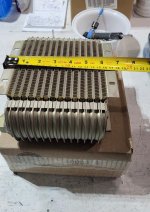
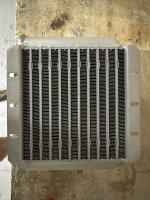
Submitted for your feedback, is a picture of a beautifully refurbished oil cooler of the SouthWind/SW/Troy/Meggitt variety (it's in the LCHX data sheet.). How many "Rows" is it?
IMG_6730.jpeg

p.s.
I count 11, but I can see an argument for 10...

>Discuss<

Brian
 
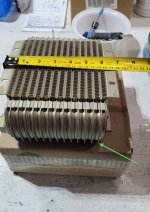
The red arrows point out the "rows" that the oil passes through. Everything else is just cooling fins. You have a 10 row cooler.
 

Attachments

  • 1000008085.jpg
    1000008085.jpg
    1.3 MB · Views: 35
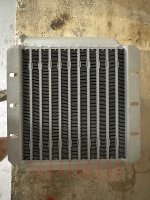
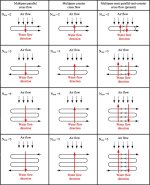
Passes are the number of times the fluid passes between headers. These are single pass HExs’. Multiple passes can be very thermally efficient to the point where the temperature approach (delta exit temp between the two fluids) can be single digits F. Passes are almost universally “stacked” -> the cooling medium (air here) leaving one pass is then cools or heats the fluid in the next pass. The added complexity and costs don’t make sense otherwise. If I can find some engineering pictorial references, I’ll edit/add tomorrow.

The above is the type of engineering approach for high volume/low margin ($) applications where efficiency rules; electrical power generation being a good example.

Edit = Couldn't find my HEx application books but stole this from the web. This is a simple pictorial of x passes for a cross flow heat exchanger (i.e. like our oil coolers). Heat exchanger efficiency is to power generation as modern transmissions are to cars. The more recent (combined cycle) power plant efficiency gains are more related to the boilers than to the turbines. Similarly. modern 7/8 speed automatic transmissions vs engine efficiency gains were the bigger step forward in car efficiency a decade or so back. Repackaged/reapplied old tech still has merit especially when weight isn't a significant design parameter.
 

Attachments

  • 1-s2.0-S0017931011005692-gr3.jpg
    1-s2.0-S0017931011005692-gr3.jpg
    92.2 KB · Views: 8
Last edited:
Back
Top