Van's Air Force
You are using an out of date browser. It may not display this or other websites correctly.
You should upgrade or use an alternative browser.
You should upgrade or use an alternative browser.
What Shop Lights to Buy?
- Thread starter blueflyer
- Start date


I'm looking at some 96", 5000K color temp, 15000-20000 lumen LED fixtures on Amazon for my hoped-for hangar. Some are designed to be mounted directly to the ceiling and others can be either direct-mounted or hung. I would suspend them from the hangar ceiling about 10' above the floor. They typically advertise beam widths of 270 degrees, which should help reduce shadows when you install multiple fixtures. (But I'm not sure how it's possible to achieve a beamwidth of 270 degrees from a flush-mounted ceiling fixture. Maybe some of the light bounces off the ceiling.) They can be daisy-chained, usually up to three (sometimes four) per string. I've found power cords up to 10' long on Amazon. They are typically < $250 for an 8, 10, or even 12-pack. Even the ones that are designed to hang, and therefore have a sturdier frame, typically weigh less than 3 pounds each. They typically consume 80-120 Watts of 120 VAC. I like 5000K, which is on the warmer side of direct sunlight, better than 6000-6500K, which to me is too blue (nothing personal, OP). And anything 4000K or below looks too yellow to me.

Check out the Green Light Depot (greenlightdepot.com)
These are the ones I bought. I haven't installed them yet (too COLD!) and I need a 14 foot ladder. A friend has similar lights in his hangar and they are more than adequate. He has a higher ceiling than I but really light his floor up. His are plug-in; mine are hard-wired to replace the LONG florescent lights there now, of which half have stopped working. SOON!!

 greenlightdepot.com
These are the ones I bought. I haven't installed them yet (too COLD!) and I need a 14 foot ladder. A friend has similar lights in his hangar and they are more than adequate. He has a higher ceiling than I but really light his floor up. His are plug-in; mine are hard-wired to replace the LONG florescent lights there now, of which half have stopped working. SOON!!
LED High Bay - 150W - 4 Pack - 16,500 Lumens - Slim UFO - Hook Mount - UFO Series - UL
Shop LED High Bay 150W - 4 Pack, 16,500 Lumens, Slim UFO design with Hook Mount. Ideal for industrial spaces. UL certified for safety & efficiency
greenlightdepot.com
Last edited:

Here's a link to the type of lights I've installed both in my hanger and shop. https://www.amazon.com/PVILUB-High-Bay-Shop-Lights/dp/B0CGDVZNSV?th=1 I didn't install this particular brand and just an example. As the previous poster mentioned around 5000k (colour) is about right. These lights work best on a higher ceiling. Six lights in a 24' by 24' shop would be more than adequate.
I bought a bunch of 4' LED lights from Harbor Freight, and they've proved reliable and bright.
Dave
Dave

I recently sprang for 8 foot Phillips LED tubes, drop-ins for the standard single pin fluorescent fixtures I already had. Just remove the ballast, re-wire the sockets to line, and insert the bulbs. Certainly not as cheap as the Amazon variety, but so far, bulletproof.
40 x 26 shop, 12 fixtures, 24 tubes. I can see very well, and as an unexpected benefit, they are silent, both to the ear and to my shop radio.
40 x 26 shop, 12 fixtures, 24 tubes. I can see very well, and as an unexpected benefit, they are silent, both to the ear and to my shop radio.

If plan on recording your work with action cameras, I recommend you buy 1 light fixture and test it first for video frequency interference. I had a lot of issues having nice videos using GoPro because it would capture the light fixture flickering .... just a side note for considerationI have a new 24x24 shop, but I need to install lights. Will this fast track my RV build? We will see....What are your recommendations for shop lights?
I just recently purchased a T-hangar. 1000 square feet. I installed 4 of the below lights after a lot of research. 24000 lumins at 165 watts. Adj between 3500, 4000,5000 for light color. Lumins are adj as well between 18000,21000,24000. They took my breath away when I turned them on for the first time.
I'm very happy with them.
A

I'm very happy with them.
A
Metalux 2 ft. 400-Watt Equivalent LED Highbay with Adjustable Optics, Selectable 18K/21K/24K Lumens and 3500/4000/5000 Sel CCT HBLAOS-1824C3R - The Home Depot
Provide protection and coverage to your light bulb with the use of this Metalux Equivalent LED Highbay with Adjustable Optics Selectable Lumens and CCT.
www.homedepot.com

When I’m out working the hangar, I like to listen to the local air traffic on a scanner and found that some of the LED lights produce a ton of RFI that will wipe out radio reception in your hangar.
With that in mind, and the goal of improving the lighting, I purchased a single 150 watt high bay LED from the big A to test and check for RFI and found it was clean.
Thinking I had the RFI problem squared away, I purchased 3 more of the same type and discovered 2 of the 3 had RFI problems. With a bit of work I was able to clean up the RFI with clip-on Ferrite Ring Core Noise Suppressors on the offenders and all is well.
With that in mind, and the goal of improving the lighting, I purchased a single 150 watt high bay LED from the big A to test and check for RFI and found it was clean.
Thinking I had the RFI problem squared away, I purchased 3 more of the same type and discovered 2 of the 3 had RFI problems. With a bit of work I was able to clean up the RFI with clip-on Ferrite Ring Core Noise Suppressors on the offenders and all is well.
I have a couple of screw-in LED bulbs in a ceiling fixture in my garage that do a very good job of blocking my garage door remote. I've been meaning to replace them, but the question is, with what? Every 120 VAC LED bulb or fixture I know of has an AC-DC switching power supply in it, and many of them are noisy at VHF and UHF frequencies. If you can't hear ATIS/AWOS or Clearance Delivery or Ground from your hangar with the door open, that's a problem that I thought the FCC was supposed to nip in the bud.When I’m out working the hangar, I like to listen to the local air traffic on a scanner and found that some of the LED lights produce a ton of RFI that will wipe out radio reception in your hangar.
With that in mind, and the goal of improving the lighting, I purchased a single 150 watt high bay LED from the big A to test and check for RFI and found it was clean.
Thinking I had the RFI problem squared away, I purchased 3 more of the same type and discovered 2 of the 3 had RFI problems. With a bit of work I was able to clean up the RFI with clip-on Ferrite Ring Core Noise Suppressors on the offenders and all is well.

Toobuilder
Well Known Member
I just re did my 25 x 40 garage and replaced the 6 fluorescent tube fixtures (the typical 2 tube, 4 foot units) with 6 of these flat panel assemblies. INCREDIBLE improvement in output. I buy these in 10 packs now and use them everywhere. Clean, cheap and easy to install.

These or equivalent from Lithonia. They are major brands and not typically junk.I just recently purchased a T-hangar. 1000 square feet. I installed 4 of the below lights after a lot of research. 24000 lumins at 165 watts. Adj between 3500, 4000,5000 for light color. Lumins are adj as well between 18000,21000,24000. They took my breath away when I turned them on for the first time.
I'm very happy with them.
A
Metalux 2 ft. 400-Watt Equivalent LED Highbay with Adjustable Optics, Selectable 18K/21K/24K Lumens and 3500/4000/5000 Sel CCT HBLAOS-1824C3R - The Home Depot
Provide protection and coverage to your light bulb with the use of this Metalux Equivalent LED Highbay with Adjustable Optics Selectable Lumens and CCT.www.homedepot.com
5000k is way to blue for my taste.
The key spec is their color rendering. 90 is good, less than that and colors in things like wiring harnesses may not show well.

I recently put Qty 9 of the Prime Lights 8ft BOLT 6 lamp LED fixtures in my 48' x 40' hangar . Probably only needed 6 but I like it as bright as the sun in any space I work in.
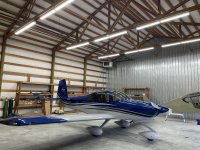
Not bad. 85 CRI, but not great. 18000 lumens is typical.I recently put Qty 9 of the Prime Lights 8ft BOLT 6 lamp LED fixtures in my 48' x 40' hangar . Probably only needed 6 but I like it as bright as the sun in any space I work in.
View attachment 84305
These are basically one in the thousands of aftermarket assemblers who use a drop in led like Dan put in his strip fixtures. Components are readily available and you too can be in the lighting fixture business tomorrow.
5000K is very blue. I prefer 3500, 4000.
Why 5000k? It’s cheaper. LED’s naturally are blue. Getting the softer colors into the red spectrum requires more expensive and thicker phosphor coatings. That costs more in phosphor and more LED’s in the array for the same light output.
Folks settle for 5000k due to price and, primarily, they are usually going from really crappy lighting to this, and it is a huge improvement.
I used to preach against the drop in LED tubes. They were crap! However, over the past 5 years they have e become much better. This even has a 5 year warranty and a life rating of 50,000 hours.
I think you did well.
For those that want to do their own design, Acuity Brands has a free design program. You can download it from their website, plug in a fixture, and calculate what you should expect.
I will typically use 70/30/10 for reflectances, 2.5’ work plane, and shoot for a 3-1 uniformity but will accept 5-1.
My target average foot candle level is 50FC.
I have lit dozens, perhaps hundreds, of hangars over my 30 year career in lighting industry. I traded my RV’s paint job for lights and did the same for my Bucker check out.
I quit doing layouts for VAF’rs when the free software for them to DIY came out but happy to field questions or give feedback. (Whether you want it or not
 )
)
Color rendering is more important than color temperature, although they are both important. While 5000K is closer to sunlight in perception, sunlight is full spectrum. Most 5000k products have a very narrow spectrum. They are targeted to end users who don’t know the specs and jump at higher lumen outputs and the lower price.I'm looking at some 96", 5000K color temp, 15000-20000 lumen LED fixtures on Amazon for my hoped-for hangar. Some are designed to be mounted directly to the ceiling and others can be either direct-mounted or hung. I would suspend them from the hangar ceiling about 10' above the floor. They typically advertise beam widths of 270 degrees, which should help reduce shadows when you install multiple fixtures. (But I'm not sure how it's possible to achieve a beamwidth of 270 degrees from a flush-mounted ceiling fixture. Maybe some of the light bounces off the ceiling.) They can be daisy-chained, usually up to three (sometimes four) per string. I've found power cords up to 10' long on Amazon. They are typically < $250 for an 8, 10, or even 12-pack. Even the ones that are designed to hang, and therefore have a sturdier frame, typically weigh less than 3 pounds each. They typically consume 80-120 Watts of 120 VAC. I like 5000K, which is on the warmer side of direct sunlight, better than 6000-6500K, which to me is too blue (nothing personal, OP). And anything 4000K or below looks too yellow to me.
It will typically cost you more for 3500-4000k products but they won’t “look yellow”, if they have a CRI of 90 or better.
We wouldn’t have even been talking about 4000k products with high CRI a few years ago as it was just too cost prohibitive due to the expensive phosphors and additional LED’s it took to equal the lumen outputs and get a high CRI.
At night, or if the room has zero daylight, take a color swatch, or a bundle of different colored wires and note the colors under those lights. Then take a painting you like and do the same.I prefer daylight (6500). I installed 4' LEDs.
Then look at them in daylight.
You should notice a difference. But, the only important thing is if that difference, makes enough difference to you for the tasks you’re doing.
We’re also human animals. Each person not only perceives things differently, but we all have difference physiological make ups. I’m color blind, according to the FAA, but I see colors fine. I need more light as I have aged, but at the same time I’m more sensitive to glare. We’re all different. We all see a bit differently.
So, there’s nothing wrong with liking 6500K.

I use these, I know they're 3' but incredibly bright, very ($15.00) inexpensive, and most HD stock them. I've probably bought 30 of them and had two fail in 4 years. I haven't found anything as bright in the price range.

Commercial Electric 3 ft. 30-Watt 4000K Bright White 1-Light 3000 Lumens White Integrated LED Hanging Shop Light Fixture with Power Cord SHOP/3X1/840/HD - The Home Depot
Bring a new dimension to your living space with this Commercial Electric 1-Light Equivalent White Integrated Utility LED Shop Light with Power Cord.
www.homedepot.com
Just Google up IES (Iluminating Engineers Society) for all kinds of recommendations, application guides, etc….Excellent conversation, I am learning so much.
I believe recommended color temperature is 3500-5000 for a shop. You can find recommended foot candle levels also.
This is the professional organization for lighting engineers, designers, architects, manufacturers, etc….
I was a sustaining member for over 25 years.
I installed recessed prismatic panels, drop in replacements for my recessed ceiling flourescents in my basement workshop. They're 4k color temp, 5000 lumens, 4 foot length with prismatic panels by Metalux, got em at Home Depot.
Not expensive, but pretty big step up for my workshop. I didn't realize how bad the flourescents really were.

Not expensive, but pretty big step up for my workshop. I didn't realize how bad the flourescents really were.
Metalux GPT Series 2 x 4 ft. 5000 Lumens Integrated LED General Prismatic LED Panel 4000K 24GPT5040R - The Home Depot
The Metalux GPT Panel uses back-lit LED technology combined with a prismatic lens. Equipped with thoughtful features, like easy installation and durable, lightweight steel construction. This back-lit LED panel light delivers 5000 (2x4) lumens at 39W and replaces 96W fluorescent lamps. The GPT...
www.homedepot.com
I have four Commercial Electric 4000K lights and two Feit 4000K shop lights, all with a stated CRI of 80 in my 700 sf garage with a 9' ceiling, and they provide most of the light I need. I took my X-Rite (now Calibrite) Color Checker Passport (I'm an amateur photographer) out to the garage and looked at the color swatches with just the Commercial Electric lights on and with just the Feit lights on, and with all of the lights on. The colors all looked pretty normal to me under all combinations of the Commercial Electric lights and Feit shop lights. I photographed the Color Checker 18% neutral gray card with my Nikon DSLR set for a color temp of 4000K and looked at the file in Adobe Lightroom using the eyedropper tool. The R, G, and B values were 62.7%, 63.8%, and 61.3%. Solar radiation also peaks in green and falls off on the red and blue ends of the spectrum.Color rendering is more important than color temperature, although they are both important. While 5000K is closer to sunlight in perception, sunlight is full spectrum. Most 5000k products have a very narrow spectrum. They are targeted to end users who don’t know the specs and jump at higher lumen outputs and the lower price.
It will typically cost you more for 3500-4000k products but they won’t “look yellow”, if they have a CRI of 90 or better.
We wouldn’t have even been talking about 4000k products with high CRI a few years ago as it was just too cost prohibitive due to the expensive phosphors and additional LED’s it took to equal the lumen outputs and get a high CRI.
Why did I think everything looked yellow at 4000K and under? Might have been the cataracts I had when I installed the lights.
I like the specs on the Metalux fixtures with the adjustable tilt on the "light engines," but I wish they were longer to distribute the light more broadly.
The Metalux Low Bays wouldn’t be a good fit for 9’ ceiling.I have four Commercial Electric 4000K lights and two Feit 4000K shop lights, all with a stated CRI of 80 in my 700 sf garage with a 9' ceiling, and they provide most of the light I need. I took my X-Rite (now Calibrite) Color Checker Passport (I'm an amateur photographer) out to the garage and looked at the color swatches with just the Commercial Electric lights on and with just the Feit lights on, and with all of the lights on. The colors all looked pretty normal to me under all combinations of the Commercial Electric lights and Feit shop lights. I photographed the Color Checker 18% neutral gray card with my Nikon DSLR set for a color temp of 4000K and looked at the file in Adobe Lightroom using the eyedropper tool. The R, G, and B values were 62.7%, 63.8%, and 61.3%. Solar radiation also peaks in green and falls off on the red and blue ends of the spectrum.
Why did I think everything looked yellow at 4000K and under? Might have been the cataracts I had when I installed the lights.
I like the specs on the Metalux fixtures with the adjustable tilt on the "light engines," but I wish they were longer to distribute the light more broadly.
It’s easy to look up IES standards the professional lighting industry uses. They recommend 80CRI for home use and 90CRI for commercial use and when high visual acuity for color is required. Kelvin temps are recommended to be between 3500-5000K.
These are just recommendations and what a professional would design a spec building, factory, school, etc….to.
As I mentioned, if it works for your tasks, that’s all that matters. You’re building an airplane, not exhibiting fine art, although some folks airplanes qualify in my book!
I agree. But I'm looking at the Metalux High Bay lights, Model # HBLAOS-1824C3R. The hangar ceiling is around 20'.The Metalux Low Bays wouldn’t be a good fit for 9’ ceiling.

I purchased these: https://www.amazon.com/dp/B0D1TV3PR3 based on a previous thread. Having a home assist controlling the outlet that they're plugged into, but haven't really figured out all the cabling (having six extension cords seems/feels gross to me).
Gotcha.I agree. But I'm looking at the Metalux High Bay lights, Model # HBLAOS-1824C3R. The hangar ceiling is around 20'.
I would recommend going to the Cooper Lighting web site, and find the actual cut sheet and product info for this series. You can then see what available options there are. Then call your local electrical wholesaler, like CED in Prescott, most will sell retail, and get a price for exactly what you want. Then you can decide if it’s worth it.
Manufacturers will typically sell a “dumbed down” version of their spec products to the big box and online retailers. It’s a price, not feature, driven market. Sometimes, you can get the exact, or very similar product, but normally it’s a very limited feature set.

I rent, but the owner installed six or eight pairs of 4' LEDs. The ceiling is pretty high. I would love more, but it's ok. I use a local light to see the work. 20' is way up there. I would consider more light than you think you need.I agree. But I'm looking at the Metalux High Bay lights, Model # HBLAOS-1824C3R. The hangar ceiling is around 20'.
By the way, my degree is PhotoJournalism. Not a career, but I've been active since high school. 35mm, 4x5, 6x6, 6x7 and now digital Nikon. I still have my Nikon F2 from college. Love to see your work some time. I recently started organizing and printing older work. MPIX prints beautiful Chromaluxe on aluminum. Last one is 20x30.