Van's Air Force

The definitive Van's Aircraft support community! Buying, building or flying an RV? Join our exclusive family of mentors and enthusiasts!

What is considered 75% power?

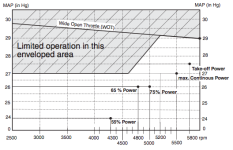
If only life was so simple. The power is approximately proportional to rpm and manifold pressure. 4350 rpm would be 75% power only if the throttle was full in at sea level. But with a fixed pitch prop that won’t work. Surely you have an engine power chart showing power at various MP and RPM.
 
I don’t think 4350 is correct. 4300 will maintain altitude at 70kts, I don’t think anyone is cruising at that speed. The 912is from what I have read has a cruise sitting that is 75%, maybe someone with a 912is could say what RPM that is.
 
I'ce been having fun with Grok lately. Here's what is says for your query. I have no basis to comment otherwise.

For the Rotax 912ULS engine, which is a 100 hp, carbureted version of the Rotax 912 series, achieving 75% power depends on RPM, manifold pressure (MP), and environmental conditions like altitude and temperature. Here’s the answer based on available data:


  • RPM for 75% Power: Approximately 5000–5200 RPM.
    • The Rotax 912ULS Operator’s Manual and user discussions indicate that 75% power is typically achieved around 5000 RPM at sea level with a fixed-pitch propeller under standard conditions. For a general estimate, 75% power corresponds to about 91% of the maximum continuous RPM (5800 RPM), which calculates to roughly 5275 RPM. In practice, pilots often cruise at 5000–5200 RPM for 75% power, balancing performance and fuel efficiency.
  • Manifold Pressure (MP) for 75% Power: Approximately 26–27 inches Hgat sea level.
    • The 912ULS manual suggests that 75% power at 5000 RPM aligns with a manifold pressure of around 26–27 inches Hg under standard conditions. MP varies with altitude; at higher altitudes (e.g., 10,000 ft), MP may drop significantly (e.g., 20–22 inches Hg), making it harder to maintain 75% power without full throttle.

Key Considerations:​


  • Fixed-Pitch Propeller: With a fixed-pitch prop, power output is primarily controlled by RPM. The cube root rule applies, so 75% power requires approximately 91% of max RPM (5800 RPM), or ~5275 RPM. Actual RPM depends on prop pitch and load, with 5000–5200 RPM being common for 75% power in many light sport aircraft.
  • Altitude and Density Altitude: At higher altitudes or in high-density altitude conditions, available MP decreases, and you may need full throttle to approach 75% power. For example, at 10,000 ft, 5500 RPM might not achieve 75% power due to reduced air density.
  • Carbureted Engine: Unlike the fuel-injected 912iS, the 912ULS relies on carburetors, so mixture control (if adjustable) and carburetor balance affect performance. Ensure carbs are properly tuned for accurate power output.
  • Aircraft-Specific Settings: Propeller type, pitch, and airframe (e.g., Tecnam P2002, RV-12) influence exact RPM and MP. Check your aircraft’s Pilot Operating Handbook (POH) for precise settings.
 
Back
Top