Van's Air Force

The definitive Van's Aircraft support community! Buying, building or flying an RV? Join our exclusive family of mentors and enthusiasts!

Weighing procedure & measuring the wheel axle positions? (W&B)

PaulvS

Well Known Member
Patron
There are quite a few posts on VAF about weighing the aircraft and the importance of leveling the fuselage to get accurate readings on the scales. I couldn't however find any discussion about how to best measure the position of each of the wheels relative to the datum. (This is for an -A model.)

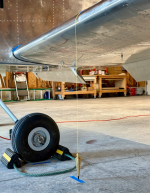
I'm thinking of first marking the position of the wing leading edge (as datum) on the hangar floor with a plumb bob. Then mark the wheels' axle centers on the floor and measure each of these to the datum. Does the fuselage need to be perfectly level during this process?

I think the measuring step needs to be done off of the scales otherwise it is going to be difficult to project the axle positions onto the floor if the scales are in the way.
 
You outline the process perfectly. The 'A' model sitting on the gear is close enough for the plumb bob.
 
I'm thinking of first marking the position of the wing leading edge (as datum) on the hangar floor with a plumb bob. Then mark the wheels' axle centers on the floor and measure each of these to the datum. Does the fuselage need to be perfectly level during this process?

That's how I did it, and yes I did level the fuselage (taildragger). I seem to recall that I rolled the airplane out of the way after dropping plumb lines for the wing LE and axle positions, makes it easier to connect the dots on the floor! I also marked the LE position from the same rib station on both wings, to keep things symmetrical.

1754440816355.png

(edit: clarity)
 
Last edited:
In order to keep all the numbers positive I would use a datum in front of the spinner. That's why Vans uses 60" in front of the wing LE as datum for the 6A. Easier for the math. For my 7 I used 70" as per the Vans sample W&B. I think the trikes are close enough to level on the gear that any error would be negligible. YMMV.
 
I marked for both sides of the nose wheel axle and split the difference.
The rest of your procedure is how I did mine
 
In order to keep all the numbers positive I would use a datum in front of the spinner. That's why Vans uses 60" in front of the wing LE as datum for the 6A. Easier for the math. For my 7 I used 70" as per the Vans sample W&B. I think the trikes are close enough to level on the gear that any error would be negligible. YMMV.
Op is building a 6. It sits 4-5* nose up on the gear. This will create a significant error. The plane must be level to produce figures consistent with van’s provided envelope numbers. Also, many concrete floors are pretty far from level. This is not an area to take shortcuts. 6’s are typically tail heavy and you don’t want to go past the aft limit, as the elevator gets really light.
 
There are quite a few posts on VAF about weighing the aircraft and the importance of leveling the fuselage to get accurate readings on the scales. I couldn't however find any discussion about how to best measure the position of each of the wheels relative to the datum. (This is for an -A model.)

I'm thinking of first marking the position of the wing leading edge (as datum) on the hangar floor with a plumb bob. Then mark the wheels' axle centers on the floor and measure each of these to the datum. Does the fuselage need to be perfectly level during this process?

I think the measuring step needs to be done off of the scales otherwise it is going to be difficult to project the axle positions onto the floor if the scales are in the way.
Yes, measuring done without scales. Be sure that you rock the plane to settle the wheels and avoid ruts or depressions that can push one leg fore or aft. Would be a good idea to recheck nose wheel on the scales. Once you level the plane, the weight will move forward and this will compress the leg a bit more.
 
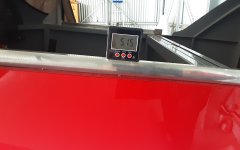
Thanks for the help, I should probably have stated this is an older model -6A; @lr72 is correct, the fuselage sits up about 5 degrees at the moment without the engine cowl weight.

20250806_132627.jpg

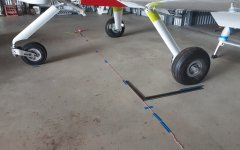
I did a trial run to measure the axle positions and it wasn't too difficult. I used the wing leading edge as the datum and then added to or subtracted from 60 inches to convert to the datum that is specified by Van's. The longitudinal distance between the nose wheel and main gear axles is about 54 inches and some basic trig indicates that it will take about 4.7 inches of packing under the main wheels to level the fuselage. When it is level the main wheels will theoretically move forward 0.20" relative to the datum, I'm nof sure if this is significant but I will include it when calculating CG after weighing to see if it makes much difference.

20250806_105526.jpg
 
Back
Top