Van's Air Force

The definitive Van's Aircraft support community! Buying, building or flying an RV? Join our exclusive family of mentors and enthusiasts!

Weeping Rivet Tool?

petehowell

Well Known Member
Patron
Well 20 years after my QB tanks were built - I got me a weeping rivet. Before I cut the tank open - I think I will try the "force some goo in from the outside" method. I read about the syringe method, but what if we could make that in to a power tool? Rocket Bob mentioned a buddy forcing the goo in with a blow gun. I like this idea and have a blow gun. I also have a 3d printer and highly suspect cad skills. All of this led me to this:

AP1GczPrwyUYNnWQIu-CR_oWuMk4GO7ULhRwJl3SRD-ktO-lAFnLecUrORm3kNFDvyqnKhItPfIrD-CtZ6DDUfvnT6abY1sSfd_s4BbTz_bLUjFE7a2o0yBH72F6TR0_OJuPoBhO6ESImWoJLXtScpc-2tm5TA=w984


It will screw into a cheapie DG-4 blow gun and has an o-ring seal for the skin. Crank up the compressor and force in some goo? Thoughts? Improvements? Favorite goo?

Yes, I know this is Tinkercad and grade school kids are better at it than me........

Thx - Pete
 
The other option is to drill off the head of the leaking rivet. Punch the tail back into the tank. Goop up a cherrymax rivet with tank sealant and pop it in.
 
Just go buy one of those kits to repair windshield chips. Basically a syringe and a suction cup. Just thin up some proseal and push it into the rivet, and possibly pull a slight vacuum on the tank?
 
Well 20 years after my QB tanks were built - I got me a weeping rivet. Before I cut the tank open - I think I will try the "force some goo in from the outside" method. I read about the syringe method, but what if we could make that in to a power tool? Rocket Bob mentioned a buddy forcing the goo in with a blow gun. I like this idea and have a blow gun. I also have a 3d printer and highly suspect cad skills. All of this led me to this:

AP1GczPrwyUYNnWQIu-CR_oWuMk4GO7ULhRwJl3SRD-ktO-lAFnLecUrORm3kNFDvyqnKhItPfIrD-CtZ6DDUfvnT6abY1sSfd_s4BbTz_bLUjFE7a2o0yBH72F6TR0_OJuPoBhO6ESImWoJLXtScpc-2tm5TA=w984


It will screw into a cheapie DG-4 blow gun and has an o-ring seal for the skin. Crank up the compressor and force in some goo? Thoughts? Improvements? Favorite goo?

Yes, I know this is Tinkercad and grade school kids are better at it than me........

Thx - Pete
I have not done it, but understand from comments on the forum that green loctite can be pulled into the rivet by applying a slight vacuum to the tank. Worth trying.
 
I've done a couple of these on weeping rivets on the QB tanks on the -10 by drilling out and reinstalling one of the blind pop rivets (don't have part number in front of me, but those used for Z-bracket install) after coating it in proseal. No leaks from those yet. Of course, they don't look the same as a driven rivet...
 
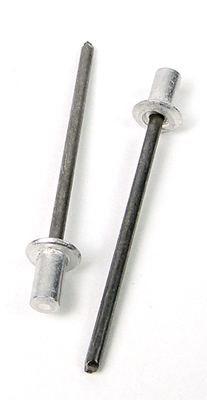
Closed end countersink rivets are available. The same type as go in the back baffle but flush heads. I have been experimenting with putting the shop head end in to a drill press and turning down the countersink end till it's the same diameter as an AN3. Drill out the rivet in the tank and enlarge the hole to an 1/8", goop it it up with sealant and put it in.

I haven't quite got it perfected yet but with a little practice I think a nice fitting rivet could be made.
 
Closed end countersink rivets are available. The same type as go in the back baffle but flush heads. I have been experimenting with putting the shop head end in to a drill press and turning down the countersink end till it's the same diameter as an AN3. Drill out the rivet in the tank and enlarge the hole to an 1/8", goop it it up with sealant and put it in.

I haven't quite got it perfected yet but with a little practice I think a nice fitting rivet could be made.
Might be visualizing this wrong; but,
wouldn't a #4 blind rivet installed in the existing CS then shaved flush have the same form/fit/function as the aforementioned approach?
 
Sort of …

The included angle of “Pop” type rivets is 120* & the angle of an AN dimple is 100*. Now you have two problems to overcome while still sealing the hole - contact faces don’t match & the head on the rivet is too big.

HFS
 
Sort of …

The included angle of “Pop” type rivets is 120* & the angle of an AN dimple is 100*. Now you have two problems to overcome while still sealing the hole - contact faces don’t match & the head on the rivet is too big.

HFS
Was only comparing shaved versus the previously mentioned reduced diameter; not to aerospace spec rivets.

BTW. Aren't you the one who posted the method for "reforming" blind rivets to 100 deg?
 
I used one of these to fix a weeping tank rivet. Drill out the offending rivet using a #30 bit. Gently countersink the tank skin to accept the larger head of this rivet. Add pro-seal in the hole as well at the rivet. Set the rivet. Don’t use aggresseive solvents when cleaning up the excess proseal.

The 0.032” tank skins will take this slight countersink to the dimple. Once done no one ever noticed this rivet.

Weeping rivets are one reason to fly then paint…..

Carl
 
Hey Pete - as much as I like your ingenuity with the tool….if you find your rivet still weeping/seeping after a couple more years, here’s the process I finally used and wrote about to (hopefully) stop a leak for good. It’s been a few years, and this particular rivet (on teh bottom of the RV-8 tank) is still tight.


(Can’t claim complete originality - was advised by wise RV’ers who have gone before….I just wrote it up!)

Paul
 
Was only comparing shaved versus the previously mentioned reduced diameter; not to aerospace spec rivets.

BTW. Aren't you the one who posted the method for "reforming" blind rivets to 100 deg?
Yes - I "re-manufacture" them to the correct head size/dimple angle to be a direct replacement for the -3 bucked rivets in the rib/skin interface, as well as slightly longer ones for the skin/rear baffle interface. I "give" them away as needed ...

HFS
 
The AK42H rivet is a flush Sealed rivet that works great for replacing weeping tank rivets. Remove the leaker with a #40 in the traditional way, enlarge to #30, machine countersink slightly with 120 degree tool with #30 pilot, proseal and pop the rivet in. Takes minutes and permanently fixes the problem. Hardest part is draining the tank.

Rivet: https://www.aircraftspruce.com/catalog/hapages/blindcloseendomehdrivets3.php
Tool: https://www.aircraft-tool.com/Detail?id=1000-120-30
To be correct - the rivet to use (lengthwise) for the skin to rib interface is actually a AK41H; and the one for the rear baffle to skin interface is the AK42H. But most people don't make that distinction.

HFS
 
I used one of these to fix a weeping tank rivet. Drill out the offending rivet using a #30 bit. Gently countersink the tank skin to accept the larger head of this rivet. Add pro-seal in the hole as well at the rivet. Set the rivet. Don’t use aggresseive solvents when cleaning up the excess proseal.

The 0.032” tank skins will take this slight countersink to the dimple. Once done no one ever noticed this rivet.

Weeping rivets are one reason to fly then paint…..

Carl
How long do you wait to paint? 6 months…. 6 years ?
 
To the OP -- Pete, if you do give your tool a try, one design modification to think about: The diameter of the O-ring determines how much force there is trying to lift the tool up off the surface for a given pressure. The smaller the diameter of the o-ring circle, the higher pressure you will be able to hold the tool down while you pressurize it, allowing higher injection pressure.

The green Loctite method works on virgin tanks. I don't know if it would work on a tank that has fuel residue in the leak path that may interfer with bonding of the Loctite. Might work, I don't know. The blind rivet approach seems best to me.
 
To the OP -- Pete, if you do give your tool a try, one design modification to think about: The diameter of the O-ring determines how much force there is trying to lift the tool up off the surface for a given pressure. The smaller the diameter of the o-ring circle, the higher pressure you will be able to hold the tool down while you pressurize it, allowing higher injection pressure.

The green Loctite method works on virgin tanks. I don't know if it would work on a tank that has fuel residue in the leak path that may interfer with bonding of the Loctite. Might work, I don't know. The blind rivet approach seems best to me.
Good call Steve. I'll try it with a smaller O ring, and not much lost if I have to install the rivet. I agree the residue is an issue. Great discussion here - thanks everyone!

To anyone who needs a reason to donate yearly - this exchange of ideas is exactly why I do.
 
  • Like
Reactions: 9GT
Back
Top