
Thought the group might enjoy his take on it so far (spoiler: he's experienced a fuel pump failure already).

Van's Air Force
You are using an out of date browser. It may not display this or other websites correctly.
You should upgrade or use an alternative browser.
You should upgrade or use an alternative browser.
Vic Syracuse bought an RV-12iS
- Thread starter subpar_bucker
- Start date


Vic commented he didn’t want to wait until the next flight to discover a pump had failed. With that same concern , I added a step to my shut-down checklist to turn one pump off before shutting down. If I see a small pressure drop I know both were working. It doesn’t eliminate the possibility's one might fall after shutdown, but that eliminates not knowing if one failed in flight.

Vic commented he didn’t want to wait until the next flight to discover a pump had failed. With that same concern , I added a step to my shut-down checklist to turn one pump off before shutting down. If I see a small pressure drop I know both were working. It doesn’t eliminate the possibility's one might fall after shutdown, but that eliminates not knowing if one failed in flight.
Exactly! Doing this with a shut-down checklist also eliminates an engine stoppage in flight!
And what if the pump you turned off while flying is the one that fails? You haven't identified anything.
Rotax guidance is both pumps for takeoff and landing so I'm not going to argue there is a problem if someone wants to cruise on a single pump, but the logic completely fails.
Is there a problem with the 12 that does not show up with all of the other RV models.... gear box?Rotax guidance is both pumps for takeoff and landing so I'm not going to argue there is a problem if someone wants to cruise on a single pump, but the logic completely fails.
I'm not sure what you're asking about when quoting and emphasizing some of my text. I was only speaking to questions about the dual electric fuel pumps on 912is equipped RV-12is.Is there a problem with the 12 that does not show up with all of the other RV models.... gear box?
You are correct that the RV-12 also has a gear box. As RVs go that gear box is unique to the -12. Like any component of an aircraft engine, that gearbox has maintenance requirements and there will be some that experience premature wear and/or failure.
Not meant to confuse..I'm not sure what you're asking about when quoting and emphasizing some of my text. I was only speaking to questions about the dual electric fuel pumps on 912is equipped RV-12is.
You are correct that the RV-12 also has a gear box. As RVs go that gear box is unique to the -12. Like any component of an aircraft engine, that gearbox has maintenance requirements and there will be some that experience premature wear and/or failure.
If running two electric pumps (one for backup) wouldn't you treat the aircraft same as one with mechanical fuel pump?
If not, why?
Well, it's kind of a rabbit hole that splinters off into a lot of separate sub-arguments. There is also a whole lot of builder/pilot discretion on this topic so I'm not intending to tell other operators what they should do. I am a 'by the book' type builder, operator, and maintainer so that is the perspective I give. I am speaking holistically about the 912is engine and the RV-12is and fuel system.Not meant to confuse..
If running two electric pumps (one for backup) wouldn't you treat the aircraft same as one with mechanical fuel pump?
If not, why?
First, I think that your question/comment starts from a bad assumption that takes this subject off the rails from the very start. The RV-12is with a 912is engine isn't the same as one with a mechanical pump. In these aircraft there are two identical electric pumps, these pumps are designed to run continuously. IMO it is not appropriate to ask 'why not' run this system the same as something else. Treating systems that are of a different design and use different equipment is a bad approach to technical questions. This is probably the leading cause of confusion on this subject, that people take something new and different and force-fit that into the wrong shoebox.
If the core of the analysis is that an 'engine-driven-mechanical fuel system with an electric boost/backup' is the exact same things as a 'dual electric continuous operation fuel pump system' and thus the latter should be operated the same as the former, then there isn't anything I can say that would be convince someone otherwise.
As I mentioned to start with, I go by the book and the published RV-12is procedures are to fly with both pumps on. A running pressure check for each pump is part of the run-up procedure. This is the opportunity to verify that both pumps are operating before the flight.
There are arguments made that it is better to run on a single pump "so that you know if you have a pump failure". This seems silly to me. This eliminates the redundant property of the fuel system. Let's play that hypothetical scenario out. We are cruising with one pump on, one pump off. A pump has just failed. You are now flying under one of two scenarios:
- The pump that fails the is "ON" pump. In this scenario the engine just died.
- The pump that fails is the "OFF" pump. You won't know anything. The goal of using fuel pumps as a gauge instead of a pump isn't telling you a thing.
- The engine keeps running regardless of which pump failed. That's it, you just keep flying at full power
- You might notice a drop of 2-3psi fuel pressure if monitoring things closely.
- You will identify the failed pump while doing your next run-up.
So by running on a single pump, the supposed benefit is that in the event a fuel pump fails you will have an engine failure instead of reduction in fuel pressure. In my book, I'd prefer that the engine just keep running. I'd rather find out the pump failed while on the ground than in the air.
Running both pumps simplifies operating the aircraft and this mitigates risk. By eliminating the need to turn a pump back on for landing, you eliminate the risk of missing that step concurrent with a pump failure during landing. We're all familiar with the 'Swiss cheese' model, so it's good when you can eliminate one of the holes in the Swiss cheese. You also eliminate the chance that you 'dumb thumb' the switch procedure and accidentally turn them both off when meaning to turn off just one. The switches are identical and very close to each other, accidents happen. This is especially helpful in a training scenario which is a target market for the RV-12.
Last edited:

DanFrazer
Active Member
Well said. I was reaching the same conclusion. If one pump fails, and they're both switched on, a discerning pilot will notice a drop in fuel pressure and be alerted something is up and would cause them to investigate more closely when they land. In that case, the engine is still running and you're flying unaffected and there is no self-induced "emergency." Not seeing a lot of benefit to the self-induced emergency that running on 1 pump could create.Well, it's kind of a rabbit hole that splinters off into a lot of separate sub-arguments. There is also a whole lot of builder/pilot discretion on this topic so I'm not intending to tell other operators what they should do. I am a 'by the book' type builder, operator, and maintainer so that is the perspective I give. I am speaking holistically about the 912is engine and the RV-12is and fuel system.
First, I think that your question/comment starts from a bad assumption that takes this subject off the rails from the very start. The RV-12is with a 912is engine isn't the same as one with a mechanical pump. In these aircraft there are two identical electric pumps, these pumps are designed to run continuously. IMO it is not appropriate to ask 'why not' run this system the same as something else. Treating systems that are of a different design and use different equipment is a bad approach to technical questions. This is probably the leading cause of confusion on this subject, that people take something new and different and force-fit that into the wrong shoebox.
If the core of the analysis is that an 'engine-driven-mechanical fuel system with an electric boost/backup' is the exact same things as a 'dual electric continuous operation fuel pump system' and thus the latter should be operated the same as the former, then there isn't anything I can say that would be convince someone otherwise.
As I mentioned to start with, I go by the book and the published RV-12is procedures are to fly with both pumps on. A running pressure check for each pump is part of the run-up procedure. This is the opportunity to verify that both pumps are operating before the flight.
There are arguments made that it is better to run on a single pump "so that you know if you have a pump failure". This seems silly to me. This eliminates the redundant property of the fuel system. Let's play that hypothetical scenario out. We are cruising with one pump on, one pump off. A pump has just failed. You are now flying under one of two scenarios:
Alternatively, if running the system as designed with both pumps on and one of them fails
- The pump that fails the is "ON" pump. In this scenario the engine just died.
- The pump that fails is the "OFF" pump. You won't know anything. The goal of using fuel pumps as a gauge instead of a pump isn't telling you a thing.
- The engine keeps running regardless of which pump failed. That's it, you just keep flying at full power
- You might notice a drop of 2-3psi fuel pressure if monitoring things closely.
- You will identify the failed pump while doing your next run-up.
So by running on a single pump, the supposed benefit is that in the event a fuel pump fails you will have an engine failure instead of reduction in fuel pressure. In my book, I'd prefer that the engine just keep running. I'd rather find out the pump failed while on the ground than in the air.
Running both pumps simplifies operating the aircraft and this mitigates risk. By eliminating the need to turn a pump back on for landing, you eliminate the risk of missing that step concurrent with a pump failure during landing. We're all familiar with the 'Swiss cheese' model, so it's good when you can eliminate one of the holes in the Swiss cheese. This is especially helpful in a training scenario which is a target market for the RV-12.
I understand the engine could be restarted while in flight, but I will consider anytime the prop stopping while the wheels aren't on the ground an emergency.
I understand the engine could be restarted while in flight, but I will consider anytime the prop stopping while the wheels aren't on the ground an emergency.
For pilots transitioning to the RV-12 from typical GA aircraft this restart procedure absolutely must be rehearsed. Because of the electrical design of the RV-12 a restart procedure has additional steps that could very easily be lost under the pressure of an emergency. The context of this thread, a fuel pump failure, is exactly the kind of scenario where it would be easy for the lizard brain to take over and miss the power cycling necessary to get things running again.
Again, the training role of the airframe matters. A scenario where highly experienced pilots are likely to stay cool and figure things out but your student pilot building solo time is better off if the engine just keeps running.

YouTube comment section is a terrible place for a technical discussion. I still have questions and posted one, don't expect much of an exchange. I'm going to also post it here since at least a few of us are interested in hashing this out further. Vic doesn't seem to participate much here so it's a bit awkward, coming across as arguing against someone who is absent...but I feel like this forum is a better place for some of these questions or ideas.
He's posted an update video where he talks more about his thoughts on the fuel pump.
I think that adding another check before shutdown is a fine idea. This will allow for taking action against a pump failure proactively, which is much better than doing a restart and taxi-back from the run-up area on your next trip out.
Pump check at higher RPM also makes more sense than 2,000. In this case, Van's is taking the recommendation from Rotax as that 2,000 RPM is called for in the OM. Why that check is done near idle power is a very good question, but probably better answered by Rotax than Van's. Van's could certainly recommend the higher power check instead or in addition.
Thinking about the procedure for cruising on both pumps, with a pump check done on the descent. Presuming this descent is for the purpose of landing, what would you plan to do differently if you discover a failed pump on the descent? What decision and action would follow the dead engine and restart, that would make this procedure safer than just descending under power and identifying the pump failure on the ground?
I don't see how the airline model mentioned supports a change to procedure for the RV-12. Maybe Vic is aware of someone having lost both fuel pumps, resulting in an accident. That would certainly justify a closer look at the procedure. I'm unaware of whatever incident Vic might be referring to that would support that airline model. To the contrary, he had a pump failure and landed without incident following the current procedure. It worked exactly as intended.

Yes - using engine failure to determine if you have lost a fuel pump inflight is not the best idea.
Checking the fuel pressure in the before takeoff check and approach check IS a good idea.
During your fuel pump test on the ground you will see the single pump pressure (usually 43 to 45 for me) and the pressure with both pumps operating (usually 48 to 50 for me). So if I see 43 to 45 inflight (both pumps on) I would suspect one pump is not operating and I certainly would not turn off a pump to see which one it is.
Checking the fuel pressure in the before takeoff check and approach check IS a good idea.
During your fuel pump test on the ground you will see the single pump pressure (usually 43 to 45 for me) and the pressure with both pumps operating (usually 48 to 50 for me). So if I see 43 to 45 inflight (both pumps on) I would suspect one pump is not operating and I certainly would not turn off a pump to see which one it is.
We've created a monster


I don't understand the reasoning to operate the fuel pumps contrary to the aircraft manufacturer's instructions. The POH instructs you to operate both pumps during flight, end of story!
Are you trying to "save a buck" and possibly extend the life of one of the pumps? Why? I haven't been able to find a SINGLE replacement Rotax fuel pump, you have to buy them as an assembly of two pumps. Therefore, if one fails you are going to replace both pumps anyway, I know I would.
In this very through video presentation by Ron Singh about a vapor lock problem in an RV-12iS (which you should watch if you run Mogas). Towards the end of the video Rian Johnson explains the false economy of shutting off the boost pump in a Lycoming powered RV, like his RV-7A. A couple minutes later he shows you why they released SL-00070, to inspect the finger screen in the fuel tank. This information goes to show that POH procedures and Service Bulletins are often established based on critical lessons learned from previous incidents.
RTFM - Read the Flight Manual!
Are you trying to "save a buck" and possibly extend the life of one of the pumps? Why? I haven't been able to find a SINGLE replacement Rotax fuel pump, you have to buy them as an assembly of two pumps. Therefore, if one fails you are going to replace both pumps anyway, I know I would.
In this very through video presentation by Ron Singh about a vapor lock problem in an RV-12iS (which you should watch if you run Mogas). Towards the end of the video Rian Johnson explains the false economy of shutting off the boost pump in a Lycoming powered RV, like his RV-7A. A couple minutes later he shows you why they released SL-00070, to inspect the finger screen in the fuel tank. This information goes to show that POH procedures and Service Bulletins are often established based on critical lessons learned from previous incidents.
RTFM - Read the Flight Manual!
Vic is a wealth of knowledge, and someone I pay close attention to. To that point I have paid very close attention to all three of his videos on this subject. Between the three videos he contradicts himself and uses shifting logic. The one thing that he sticks to is expressing that he's just not comfortable with the Rotax system. He's "just not that guy". It's not the same as his Lycoming equipment and procedures, but he wants it to be the same. In second video his exact words are "I'm going to chase it down to an ending that I'm comfortable with". Hacking for a particular outcome is a bad way to go into a test, but that's what we're seeing through this series of videos. His testing does not support his original points, so he changes them. The only solution he is comfortable with is treating it like his Lycoming, so he will rationalize any test result or argument to fit what makes him comfortable.
In the first two videos his thesis was that you can not tell if a pump has failed. "How do you know when you have a pump failure, turns out you don't". "Right now we have no indication". “See if we can tell if we have a pump failure in flight because right now we can’t. That’s my uncomfortable issue”.
Vic also says that in his flight with the failed pump, it did not perform well on a single pump. “It didn’t perform as well on one pump...I will duplicate that and share with everybody”. He did not. I'm not questioning Vic's perception from the failure flight, but this supposition was not demonstrated as he said it would be. We are left to wonder whether he just did not test that after all, or he tested and chose not to share additional results that did not support his thesis. This is less relevant than the pressure test but still would have been good food for thought.
Unrelated to the testing, it's interesting to see he has advocated opposite strategies along the way. In the first video he says that he will 'turn off the aux pump, that way we are not putting the same hours so they don't fail close to one another'. After the test, he goes the other direction and says that he will alternate which pump he turns off, to keep the hours the same. Shifting logic here, probably because the differences in systems with electric vs mechanical primary pumps rule out his ability to make something the same as the Lycoming he is comfortable with.
His conclusion is that the current operation left him exposed. He wants to reduce the risk of "a pump failure in flight affecting the outcome of that flight in a negative way". "It's nice to have redundancy".
In the first two videos his thesis was that you can not tell if a pump has failed. "How do you know when you have a pump failure, turns out you don't". "Right now we have no indication". “See if we can tell if we have a pump failure in flight because right now we can’t. That’s my uncomfortable issue”.
- Vic flew and tested the airplane. His test showed that his thesis was false. You can tell that a pump has failed by looking at the fuel pressure. The indication is resolute enough that he could even see a difference in pressure between the two pumps. His test proved that you can just look at the gauges and determine pump status. This is fairly predictable and some pointed it out to him but he did not believe it. A test was necessary to prove you can't tell. His test did not support his belief.
Vic also says that in his flight with the failed pump, it did not perform well on a single pump. “It didn’t perform as well on one pump...I will duplicate that and share with everybody”. He did not. I'm not questioning Vic's perception from the failure flight, but this supposition was not demonstrated as he said it would be. We are left to wonder whether he just did not test that after all, or he tested and chose not to share additional results that did not support his thesis. This is less relevant than the pressure test but still would have been good food for thought.
Unrelated to the testing, it's interesting to see he has advocated opposite strategies along the way. In the first video he says that he will 'turn off the aux pump, that way we are not putting the same hours so they don't fail close to one another'. After the test, he goes the other direction and says that he will alternate which pump he turns off, to keep the hours the same. Shifting logic here, probably because the differences in systems with electric vs mechanical primary pumps rule out his ability to make something the same as the Lycoming he is comfortable with.
His conclusion is that the current operation left him exposed. He wants to reduce the risk of "a pump failure in flight affecting the outcome of that flight in a negative way". "It's nice to have redundancy".
- The system as designed and documented has redundancy, as established by having two pumps running. In the event of a pump failing, there is a second pump already running which reduces the risk of engine failure or degraded performance. This is the negative outcome to be avoided. It's simple to understand that running without a second pump increases the risk of a negative outcome.
Thank-you Nate, once again folks need to realize a Rotax is NOT a Lycoming.Vic is a wealth of knowledge, and someone I pay close attention to. To that point I have paid very close attention to all three of his videos on this subject. Between the three videos he contradicts himself and uses shifting logic. The one thing that he sticks to is expressing that he's just not comfortable with the Rotax system. He's "just not that guy". It's not the same as his Lycoming equipment and procedures, but he wants it to be the same. In second video his exact words are "I'm going to chase it down to an ending that I'm comfortable with". Hacking for a particular outcome is a bad way to go into a test, but that's what we're seeing through this series of videos. His testing does not support his original points, so he changes them. The only solution he is comfortable with is treating it like his Lycoming, so he will rationalize any test result or argument to fit what makes him comfortable.
In the first two videos his thesis was that you can not tell if a pump has failed. "How do you know when you have a pump failure, turns out you don't". "Right now we have no indication". “See if we can tell if we have a pump failure in flight because right now we can’t. That’s my uncomfortable issue”.
Now it's no longer about being able to determine a pump has failed, it's just about what makes him comfortable. That is "Turning off a pump in cruise, kinda like we do with Lycoming". Not because the testing verified his thesis, but because he's just that guy.
- Vic flew and tested the airplane. His test showed that his thesis was false. You can tell that a pump has failed by looking at the fuel pressure. The indication is resolute enough that he could even see a difference in pressure between the two pumps. His test proved that you can just look at the gauges and determine pump status. This is fairly predictable and some pointed it out to him but he did not believe it. A test was necessary to prove you can't tell. His test did not support his belief.
Vic also says that in his flight with the failed pump, it did not perform well on a single pump. “It didn’t perform as well on one pump...I will duplicate that and share with everybody”. He did not. I'm not questioning Vic's perception from the failure flight, but this supposition was not demonstrated as he said it would be. We are left to wonder whether he just did not test that after all, or he tested and chose not to share additional results that did not support his thesis. This is less relevant than the pressure test but still would have been good food for thought.
Unrelated to the testing, it's interesting to see he has advocated opposite strategies along the way. In the first video he says that he will 'turn off the aux pump, that way we are not putting the same hours so they don't fail close to one another'. After the test, he goes the other direction and says that he will alternate which pump he turns off, to keep the hours the same. Shifting logic here, probably because the differences in systems with electric vs mechanical primary pumps rule out his ability to make something the same as the Lycoming he is comfortable with.
His conclusion is that the current operation left him exposed. He wants to reduce the risk of "a pump failure in flight affecting the outcome of that flight in a negative way". "It's nice to have redundancy".
It's not about testing, or redundancy, or pump wear or any of that. It's just about what Vic is comfortable with because that's what he has an incredible amount of experience with. It's something different.
- The system as designed and documented has redundancy, as established by having two pumps running. In the event of a pump failing, there is a second pump already running which reduces the risk of engine failure or degraded performance. This is the negative outcome to be avoided. It's simple to understand that running without a second pump increases the risk of a negative outcome.


CessnaTPA
Well Known Member
It would need to be more than just a light indicating voltage is being sent to the pump.A bit of my thoughts on the fuel pump issues. It might be nice to have two idiot lights which indicate that the pumps are on. At this point if one of the pumps fails, he would instantly know because of the idiot like Rotax is definitely a unique engine turbo out.
I did some research ways to monitor both fuel pumps, and it looks like it’s definitely doable. The Dynon system has spare general-purpose 0–5V inputs, so you could use Hall effect current sensors to monitor each pump. You could then set up a widget to display that data on screen, showing the current draw so you know the pump is running and actually under load.
I focused on Dynon since that’s what I have, but I’d imagine a Garmin setup could accomplish something similar.
But IMO knowing your normal fuel pressure you can monitor if you're having a pump issue.

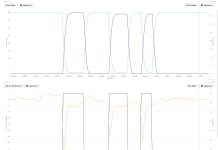
It's very easy to do. I have hall effect sensors on both my fuel pumps (wrapped 10 times to give better resolution) so I can monitor amp draw. Note: this is not an RV-12 but a EFI system and only run one pump at a time with automatic pump switch-over if a pump goes below 25 psi. I also monitor voltage on pump 2 and get a CAS alert if pump 2 turns on as pump 1 is my primary pump. This is a Garmin GEA but I'm sure Dynon can do the same. Below is my pulling the breaker on pump 1 (In flight) to see how the switch-over and recovery to pump 2 operates.It would need to be more than just a light indicating voltage is being sent to the pump.
I did some research ways to monitor both fuel pumps, and it looks like it’s definitely doable. The Dynon system has spare general-purpose 0–5V inputs, so you could use Hall effect current sensors to monitor each pump. You could then set up a widget to display that data on screen, showing the current draw so you know the pump is running and actually under load.
I focused on Dynon since that’s what I have, but I’d imagine a Garmin setup could accomplish something similar.
But IMO knowing your normal fuel pressure you can monitor if you're having a pump issue.
Last edited:
