Van's Air Force

The definitive Van's Aircraft support community! Buying, building or flying an RV? Join our exclusive family of mentors and enthusiasts!

Upper Firewall Weldment Problems. Need Some Ideas. WD-1002R

N787KV

Active Member
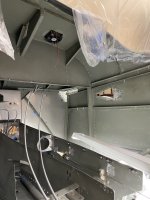
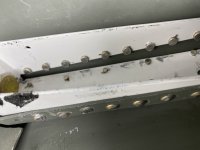
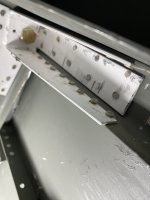
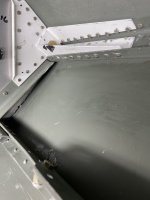
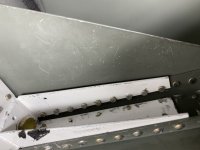
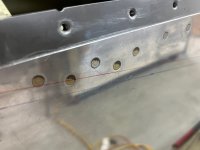
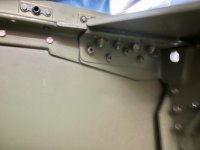
This is a new to me project and I missed this little tidbit. In the pictures is RV-10 weldment WD-1002R. It is located on the cockpit side, upper right corner and bolts to the engine mount. As you can see, the edge clearance we normally expect, is not there. To make matters more difficult, the top and windshield are already installed making access to the rivets challenging at best. Any thoughts?


IMG_5023.jpegIMG_5022.jpegIMG_5021.jpegIMG_5020.jpegIMG_5019.jpeg
 
So you have the cabin top permanently attached, the glareshield and the windshield as well?
Were the plans followed in this build or did you take over from someone else? It looks to me like you have some major deconstruction to do. To even access the weldmets will be major work. I wish you good luck.
 
Not a good place to be, can I offer my thoughts on a fix. Could I first suggest to have an Approved Inspector or an experienced RV builder have a look at this and be in no rush until you decide a practical solution. This is what I think may be necessary, there is obviously a lot of work to do and while its not pleasant I think it's doable.

Your problem stems from an on-going quality issue with the four weldments, WD-1002-L-PC, WD-1002-R-PC on top and WD-1003-L-PC, WD-1003-R-PC on the bottom.
I had to replace both the lower-left and upper-left weldments at different stages in my build. I do not have the Upper Forward Fuselage Assembly attached yet but I understand that you have both it and the Canopy Cover installed.

The issue is with the weldments themselves, as the F-1001B Upper Angle (on the top of the Firewall) and the F-1040-R (Upper Fuselage Channel) have been pre-punched and cannot be out of line (the F-1040-R does incorporate a slight twist but the pre-punched holes should align perfectly). I replaced the lower weldment during installation as the side skin had not been fitted and replacement was not a problem at that stage. The upper weldment had to be replaced recently for a different reason but since the fuselage side-skin and F-1013 Longeron had now been installed, drilling out the lower line of AN470-4 rivets on the Left-Upper Weldment were a problem due to restricted access (the F-1013-L Longeron is in the way).

On to your issue. Due to rivet edge issues you need to replace the upper-right weldment (WD-1002-R-PC) and the rivets need to be removed. The Firewall AN470's, the Weldment Side-flange AN426-3's and the Lower flange AN470-4's can be drilled out and removed without too much difficulty. The bottom rivets on the Lower flange of the weldment will require the use of an angle drill, carefully drill to remove the head (as per standard procedure) and use a spring-punch to remove the rivet. Be very careful not to enlarge the holes in the F-1040-R Channel and do not simply try to drill through.

The main problem you have is that you don't have access to the row of AN470's on the Upper flange of the weldment between the F-1001-B Upper Angle, WD-1002-R-PC, and the F-1040-R Channel. Unfortunately, I think it will be necessary to remove the Upper Forward Fuselage Assembly (this in itself would not be too difficult, a row of AN426-3's either side along the F-1040-R Channel, the Upper edge of the firewall and the three flanges of the brackets that attach to the firewall). To remove the Upper Forward Fuselage assembly, the Cabin Cover will also have to be removed.

I had a look at my plans and the most difficult task would be undoing the built-up joint between the windscreen base and the Forward Fuselage Assembly. I do not have my Cabin Cover installed, but I think it may be possible to remove the Cabin Cover and the Forward Fuselage Assembly as one unit thus keeping this joint intact. There is some sealant and filler around the edges of the Cabin Cover and it should be possible to remove the areas of filler carefully, don't forget you will be replacing it afterwards on re-assembly.

Replace the WD-1002-R-PC Weldment with one that fits properly, I got a replacement from Van's that didn't fit at all (like what you've got installed) - I had to replace this one as well and its replacement fitted very well. As I said earlier quality issues. The RV-10 plans should emphasize to test-fit the weldment before any drilling (mark the flanges through the F-1040 Channel with a sharpie to check where the drilled holes will end up, if the weldment is out of spec you haven't done any damage). With the side-skins and the F-1013-R in place, you will have difficulty setting the rivets on the Lower flange of the weldment. I opted to use CherryMax CR3213-4 here.

If you only need to replace the Upper-Right (and Upper-Left) Weldment I think the above is a possible plan. If the Lower Weldments need replacing as well then the side -skins will probably have to be removed as far as they 'wrap-around' the fuselage at the bottom.

Leo Murray
RV-10 #40699
 
If it was me I might try a doubler of 4130, same thickness as the weldment flange. This doubler would match radius of the adjacent longeron angle to allow to give max edge distance to the holes already in the weldment when nested into the longeron. That first rivet forward looks good and appears to have a correct manufactured head size. The others appear over sqeezed or just had long tails so it makes the problem look worse than is possibly. This doubler would be shot in through the locations of the removed rivets with edge issues. This doubler should
also catch the open tooling hole in the flange of the weldment. That added hole would get the same fastener as adjacent structure and the back side would likely need to be shimmed to the skin.
That is what I would have suggested to a qualified stress engineer. The stress person would need very very close measurements of holes and edge distances to possibly sign
off on something like that.
Or the doubler could be welded on of the removed weld assembly.
This is all just a wild guess, please treat as such.
 
Can I add, if that’s representative of the standard of riveting on this project you may need to look over the rest of it with a suspicious eye.

I don’t mean the edge distance issue, I mean the overall quality of riveting. Some of those have been totally mashed.
 
All the suggestions seem to ignore the fact that the firewall portion and the side portion are welded together. Similar to other models the edge distance is compromised by the radius in the longeron angles. The rivets are inconsistent, a few are over driven but I would just leave it alone. Anyone ever look inside a $600k spam can?
 
Call Vans. The edge distances in question are on a steel part, not aluminum. Not saying that makes it ok, but it certainly changes the equation. We have seen this issue with this part many times and it may not be as bad as you fear.
 
I have sent Vans the same pictures with the same question. I hope to hear from them next week. I have drilled out all of the floor and seat pans, nearly a 1,000 rivets, so I could remove sticky back insulation. I can see everything and the rest of the build is not too bad. This one, I just missed. Thanks for the feed back.
 
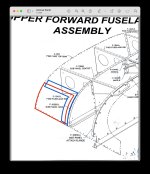
Vans said that I should replace WD-1002R, which is not a surprise. The challenge is how. To get the lower rivets out, I'll use a center punch on the rivet heads and start drill with a #40. Then sneak up on it with a #30 bit. For the top row, I was thinking of cutting an access area in the top skin (red in attached pic) to complete the work. Note, the pic shows the left side, but it would be preformed on the right side. I would add a .032 doubler (blue line) and re-skin with .032. As for riveting in the new weldment, I was thinking of using Cherry Max rivet for the top and bottom. Thoughts and comments would be appreciated. Thanks.

access.jpg
 
Vans said that I should replace WD-1002R, which is not a surprise. The challenge is how. To get the lower rivets out, I'll use a center punch on the rivet heads and start drill with a #40. Then sneak up on it with a #30 bit. For the top row, I was thinking of cutting an access area in the top skin (red in attached pic) to complete the work. Note, the pic shows the left side, but it would be preformed on the right side. I would add a .032 doubler (blue line) and re-skin with .032. As for riveting in the new weldment, I was thinking of using Cherry Max rivet for the top and bottom. Thoughts and comments would be appreciated. Thanks.

View attachment 74050
Peter

just a reminder, to drill out the top row of AN470-4's, you only need to remove the first 9 rivets (from the firewall back), the remaining 4 don't go into the weldment and they can stay in place. Likewise, the double row of AN426-3's, you only need to remove the first 5 rivets in the top and bottom rows (again from the firewall back), the remainder can stay. On your lower flange, again only the first 9, or 8 as I think the one nearest the firewall wasn't done.

You may not have to cut out too much of the F-1071 Fwd Fuse Top Skin to gain access to the top row of AN470's, maybe up as far as the 3rd hole on the firewall/hinge. Replacing those rivets with AN470-4's (if you had full access) a 4" yoke works, with your restricted access you could use the RV-10/RV-14 Long Bucking bar inside the weldment and universal set/rivet gun on top, a 2 person job. If you are using CherryMax CR3213-4's top and bottom, then I think you will have no issue with your restricted access. The 14 AN470-4's in the firewall are no issue, and replacing the 10 (two rows of 5) side AN426-3's can be bucked with a standard tungsten bar. Agree, use caution when drilling out the lower row with an angled drill and punch. Bear in mind that the holes in the C-Channel were pre-punched before match-drilling and are aligned correctly for the new weldment.

As I mentioned earlier, I don't have the Upper Fwd Fuse Assembly in place, I can take a photo or two tomorrow which might be useful and take any measurements you may need.

Leo
RV-10 #40699
 
I would recommend pulling the entire top from the forward fuselage. Sure, it is a bunch of -3 rivets, but probably an hour's work. That would give you good access to do the work and get it right. One concern I have is "Why will the next set of weldments be any different than this set?" I'd have the new weldments in hand before I started pulling stuff apart. No sense drilling everything apart to learn that the new weldments will fit exactly the same. Alternately, I guess you could take your existing weldments and have a local welder weld on new flanges. Either way, the holes in the longerons are set, so you're left finding a way to make an adjustment to the weldments...
 
I would recommend pulling the entire top from the forward fuselage. Sure, it is a bunch of -3 rivets, but probably an hour's work. That would give you good access to do the work and get it right. One concern I have is "Why will the next set of weldments be any different than this set?" I'd have the new weldments in hand before I started pulling stuff apart. No sense drilling everything apart to learn that the new weldments will fit exactly the same. Alternately, I guess you could take your existing weldments and have a local welder weld on new flanges. Either way, the holes in the longerons are set, so you're left finding a way to make an adjustment to the weldments...
Thanks Kyle. Unfortunately, the cabin top and windshield are installed, so taking that skin off is much less of an option. As for the weldment, Vans said that there has been a design change. We'll see.
 
Peter

just a reminder, to drill out the top row of AN470-4's, you only need to remove the first 9 rivets (from the firewall back), the remaining 4 don't go into the weldment and they can stay in place. Likewise, the double row of AN426-3's, you only need to remove the first 5 rivets in the top and bottom rows (again from the firewall back), the remainder can stay. On your lower flange, again only the first 9, or 8 as I think the one nearest the firewall wasn't done.

You may not have to cut out too much of the F-1071 Fwd Fuse Top Skin to gain access to the top row of AN470's, maybe up as far as the 3rd hole on the firewall/hinge. Replacing those rivets with AN470-4's (if you had full access) a 4" yoke works, with your restricted access you could use the RV-10/RV-14 Long Bucking bar inside the weldment and universal set/rivet gun on top, a 2 person job. If you are using CherryMax CR3213-4's top and bottom, then I think you will have no issue with your restricted access. The 14 AN470-4's in the firewall are no issue, and replacing the 10 (two rows of 5) side AN426-3's can be bucked with a standard tungsten bar. Agree, use caution when drilling out the lower row with an angled drill and punch. Bear in mind that the holes in the C-Channel were pre-punched before match-drilling and are aligned correctly for the new weldment.

As I mentioned earlier, I don't have the Upper Fwd Fuse Assembly in place, I can take a photo or two tomorrow which might be useful and take any measurements you may need.

Leo
RV-10 #40699
Pictures would be great, thanks. I've drilled out the skin rivets and the firewall rivets and so far, so good. As per my earlier cut out diagram , I agree, I don't need to take out as much material.
 
Pictures would be great, thanks. I've drilled out the skin rivets and the firewall rivets and so far, so good. As per my earlier cut out diagram , I agree, I don't need to take out as much material.
Peter

I attach some photos and made some measurements which may be of help. Sufficient Drill Clearance can be achieved to drill and remove the AN470-4's along the top flange of the weldment with the following:

A fore-aft cut beginning between Rivets 5 & 6 on the Firewall (this is about 4 3/4") up from the corner of the Upper Fwd Fuse Assembly skin).
A lateral cut going up between the top row of AN426-3 Rivets 6 & 7 (counting from the firewall) on the side channel, (this is about 5 3/4").

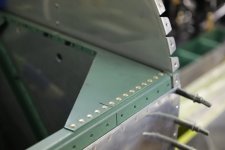
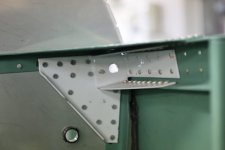
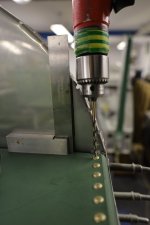
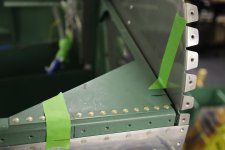
The General View shows the structure without the Upper Forward Fuselage Assy in place. The black line is as far as the Weldment goes along the C-Channel. The Right Upper Weldment shows how it sits against the side skin, its not a right angle which requires the use of the angle-drill. Sufficient Drill clearance can be achieved with the fore-aft cut from the firewall in line with Rivet 5 on the firewall, but you probably need to go between Rivets 5 & 6 for the joint not to be at a rivet.

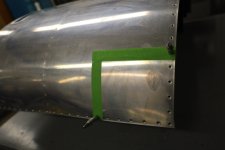
I marked the Upper Forward Fuselage Assembly with the above lines, (the inside edge of the green tape). The depth of the cut-out looks a lot but the skin tends curves more tightly when in place. The red mark shows where 4 3/4" comes to at the aft end, the whole thing tapers but it gives you the idea. You may get away with lees of a cut-out using the angle drill to remove the rivets but may have difficulty getting an 1/8 punch in to remove the rivet head.

Hope this makes sense!

Leo

General View.JPGRight Uppr Weldment.JPGDrill Clearance.JPGAccess.JPGUpr Fwd Fuse Assy.JPG
RV-10 #40699

END
 
What you might consider is where ever a rivet is difficult to buck use the high shear rivets that are installed with a allen wrench. Not suitable on the outer skins but should work everywhere else.
Do you understand that the steel components are welded together creating a one piece unit? The replacement parts may have the same problem you are trying to fix.
 
Peter

I attach some photos and made some measurements which may be of help. Sufficient Drill Clearance can be achieved to drill and remove the AN470-4's along the top flange of the weldment with the following:

A fore-aft cut beginning between Rivets 5 & 6 on the Firewall (this is about 4 3/4") up from the corner of the Upper Fwd Fuse Assembly skin).
A lateral cut going up between the top row of AN426-3 Rivets 6 & 7 (counting from the firewall) on the side channel, (this is about 5 3/4").

The General View shows the structure without the Upper Forward Fuselage Assy in place. The black line is as far as the Weldment goes along the C-Channel. The Right Upper Weldment shows how it sits against the side skin, its not a right angle which requires the use of the angle-drill. Sufficient Drill clearance can be achieved with the fore-aft cut from the firewall in line with Rivet 5 on the firewall, but you probably need to go between Rivets 5 & 6 for the joint not to be at a rivet.

I marked the Upper Forward Fuselage Assembly with the above lines, (the inside edge of the green tape). The depth of the cut-out looks a lot but the skin tends curves more tightly when in place. The red mark shows where 4 3/4" comes to at the aft end, the whole thing tapers but it gives you the idea. You may get away with lees of a cut-out using the angle drill to remove the rivets but may have difficulty getting an 1/8 punch in to remove the rivet head.

Hope this makes sense!

Leo

View attachment 74147View attachment 74148View attachment 74146View attachment 74145View attachment 74149
RV-10 #40699

END

Thanks! That visual confirms my plan. Very helpful.
 
What you might consider is where ever a rivet is difficult to buck use the high shear rivets that are installed with a allen wrench. Not suitable on the outer skins but should work everywhere else.
Do you understand that the steel components are welded together creating a one piece unit? The replacement parts may have the same problem you are trying to fix.
Are you referring to Rivnuts? And I realize I could have the same problem. Vans told me that they have changed the weldment since this one. I will try and if not, find a welder and see what they can do. Or maybe find a welder first. Any thoughts?
 
No, rivets. I think they used to be made by Hi Shear and referred to as such. They have been around since late 40's as they were used on Navion's. Kind of like a pop rivet but much stronger. They are installed with a very small allen wrench.
 
No, rivets. I think they used to be made by Hi Shear and referred to as such. They have been around since late 40's as they were used on Navion's. Kind of like a pop rivet but much stronger. They are installed with a very small allen wrench.
Just google high shear rivets. Wide variety. The Navion style use a collar that uses an aluminum portion that is squeezed in place with a special rivet set. i didn't find the allen screw type but they are out there somewhere.
 
No, rivets. I think they used to be made by Hi Shear and referred to as such. They have been around since late 40's as they were used on Navion's. Kind of like a pop rivet but much stronger. They are installed with a very small allen wrench.
Not rivets - Hi-Lok fasterners. Look them up on YouTube for a better "tutorial". Been using them since the 1980's for different things. The smallest they make is an 8-32 shank (~.161" dia.), so a direct replacement for a -4 rivet is not possible. All manner of head "shapes" are available - Protruding, Shear Head; Protruding, Tension Head; Countersunk, Shear Head & Countersunk, Tension Head. Know the differences, and pick the correct one for your particular need. Typically they are installed with a hex "collar" that has a frangible stem that "releases" at the correct torque spec. for the size being installed. The problem with this system is, it's "one way - one time". Once the hex part of the collar separates, you are left with a truncated cone shaped "nut" with no way (other than Hi-Lok's proprietary removal tool). Looks nice but doesn't leave a bunch of maintenance opportunities if needed in the future. What I have done instead is to use MS21042/43 steel stop nuts, torqued to the correct value for the size - allowing removal/replacement if needed, at some point in the future.

Don't confuse Hi-Shear & Hi-Lok fasteners - different "animals".

HFS

FWIW - If you don't have one - Genuine Aircraft Hardware Co.'s "resource" catalog is an absolute must for "investigating" all manner of AN/NAS fastening systems, as well as a wonderful place to order from. I knew the owner when he started the company in a little strip "mall" building in Paso Robles, CA in 1984. Tom has since passed, but the business is now in Montana, and operated by his daughter, Tamera Nunley and her (mostly women) staff. Very knowledgeable & helpful whenever you call. GAHCo. - get their catalog & use their services.
 

Attachments

  • Hi-Loks Installed .jpg
    Hi-Loks Installed .jpg
    2.7 MB · Views: 64
  • Hi-Lok Tool.jpg
    Hi-Lok Tool.jpg
    3.3 MB · Views: 64
  • Hi-Lok (inside pic).jpg
    Hi-Lok (inside pic).jpg
    1.9 MB · Views: 60
Last edited:
So, lots to plan out before cutting my access port. Right now it's the patch. My plan is to use a .032 doubler and the piece of skin section I take out, oh so carefully. If I read AC 43.13-1B, chapter 4, page 4-27, "Splicing of Sheets" correctly and using Table 4-10 and Figure 4-5, this is what I come up with. The total length of the splice will be 11". Table 4-10 shows for .032 skin, using 1/8" rivets, I need 4.9 rivets per inch. Adjusted for note C, that comes to 3.675 per inch. Multiply that by 11", I come up with just shy of 41 rivets (round up to 42) per side, of the doubler. Total of 84 rivets. Is that right?
 
Ok, I don’t know RV-10s, and this is probably a really dumb idea.

But could you not turn it into an access hatch? Looks like a good spot to be able to access in the future, down into the foot well, and you could make it look like it was always supposed to be there, rather than a repair.
 
I had the misfortune of a misaligned engine mount hole on my first RV7 which require a new lower weldment. I swear I almost cried. But removing it all and redoing it is now a distant memory (almost 20y ago).
I do also recall that a lot of clamping and manipulation was required to get an acceptable alignment of the upper RV10 weldment to longeron channel.

All that said, have you considered engaging a professional (or fellow builder) second set of hands to spend a day in the footwell upside down helping you replace the weldments rather than cutting a hole?

That’s a tough place to put a hole in the skin. Itll be very hard to make it inconspicuous.

Best of luck.
 
Peter

something worth considering that may require no cutting of the Upper Forward Fuselage Skin. You've drilled out the side and firewall rivets holding the weldment. Would it be worth taking out a number of the Firewall to Upper Forward Fuselage rivets and a few more of the side rivets back as far as you can without disturbing the windscreen joint.

With the Upper skin of the attachment free, it may give you enough access to drill out the 9 weldment Upper Flange rivets using the angle drill which does not need much clearance. You may have to make a short version of a 1/8" drift to remove the rivet heads and punching the remainder of the rivet out may be awkward. You only have to remove the first 9 rivets. If you can do this, you can replace the upper weldment rivets with CherryMax CR3213-4's, the Cherrymax tool doesn't need much clearance, you could also try an 'Alligator' Pneumatic Squeezer to put in AN470's on both the top and bottom weldment flanges, if that isn't practical then use CherryMax.

If you don't achieve sufficient access and you do decide to cut a section out, you may only have to go up to between rivets 3 and 4 on the firewall if you use the angle drill to remove the rivets etc.

RV-10 #40699
 
Peter

something worth considering that may require no cutting of the Upper Forward Fuselage Skin. You've drilled out the side and firewall rivets holding the weldment. Would it be worth taking out a number of the Firewall to Upper Forward Fuselage rivets and a few more of the side rivets back as far as you can without disturbing the windscreen joint.

With the Upper skin of the attachment free, it may give you enough access to drill out the 9 weldment Upper Flange rivets using the angle drill which does not need much clearance. You may have to make a short version of a 1/8" drift to remove the rivet heads and punching the remainder of the rivet out may be awkward. You only have to remove the first 9 rivets. If you can do this, you can replace the upper weldment rivets with CherryMax CR3213-4's, the Cherrymax tool doesn't need much clearance, you could also try an 'Alligator' Pneumatic Squeezer to put in AN470's on both the top and bottom weldment flanges, if that isn't practical then use CherryMax.

If you don't achieve sufficient access and you do decide to cut a section out, you may only have to go up to between rivets 3 and 4 on the firewall if you use the angle drill to remove the rivets etc.

RV-10 #40699
That is differently worth taking a look at. Thanks.
 
I had the misfortune of a misaligned engine mount hole on my first RV7 which require a new lower weldment. I swear I almost cried. But removing it all and redoing it is now a distant memory (almost 20y ago).
I do also recall that a lot of clamping and manipulation was required to get an acceptable alignment of the upper RV10 weldment to longeron channel.

All that said, have you considered engaging a professional (or fellow builder) second set of hands to spend a day in the footwell upside down helping you replace the weldments rather than cutting a hole?

That’s a tough place to put a hole in the skin. Itll be very hard to make it inconspicuous.

Best of luck.
Thanks. I do have a fellow builder and I will put him to good use. As far as the looks goes, the previous builder was going for show plane and skimmed the rivets. So I can make the repair disappear if I go that route.
 
Vans said that I should replace WD-1002R, which is not a surprise. The challenge is how. To get the lower rivets out, I'll use a center punch on the rivet heads and start drill with a #40. Then sneak up on it with a #30 bit. For the top row, I was thinking of cutting an access area in the top skin (red in attached pic) to complete the work. Note, the pic shows the left side, but it would be preformed on the right side. I would add a .032 doubler (blue line) and re-skin with .032. As for riveting in the new weldment, I was thinking of using Cherry Max rivet for the top and bottom. Thoughts and comments would be appreciated. Thanks.

View attachment 74050
I'd suggest NOT working up to #30. At 1/8" you should have removed the majority of the rivet and it should drive out easily - don't risk damaging the hole because the Cherry, unlike a solid, offers zero radial expansion. You might want to consider the Cherry 'oversize' CR3242-4 which is 1/64 larger (drill #27) and will guarantee the blind rivet has a clean hole to work in.
 
Back
Top