Van's Air Force

The definitive Van's Aircraft support community! Buying, building or flying an RV? Join our exclusive family of mentors and enthusiasts!

Unusual Dynon EMS-D120 Ammeter Display

jherzog

Well Known Member
Sponsor
With a load, the ammeter display of my EMS will show a few amps with a numerical value before engine start, as expected. But with the engine started and alternator on, the meter shows a zero numerical value, and the display bar is pegged to the bottom (see side by side before and after photos -- left is engine off, right is engine running). The voltmeter typically shows around 14v with the engine running, and the battery appears to charge normally.


Any thoughts on why I'm seeing the 0 amps and a pegged indicator after engine start? Apologies, the plane is fairly new to me, and I haven't traced the wiring from the shunt yet.

Thanks,

Jordan

 

Attachments

  • D-120 Ammeter .jpg
    D-120 Ammeter .jpg
    48.1 KB · Views: 21
The two small wires on the shunt are reversed (alt->buss is negative and vice versa, but should be the opposite.) alao your dynon is likely set to read only positive, so any negative input will read as 0. Fyi, ammeter should read 0 with your config or negative 3 when configured to show that. with power on and engine off. You likely have an alternator that uses the b lead to power the internal regulator. So before engine start, 3 amps are going backawardsfro the battery to the alternator. However, because you got the wires wrong, it is showing as positive instead of negative . Swap the two wires and all will be good.
 
Last edited:
Maybe I'm misreading the display and the vertical bar shows 0 rather than pegged. Similar question though, why no amps shown when the alternator is on?
It is peggeged at 0, as he likely set0 as the end of the range. The dynon is seeing like -20 amps, but the display is likely set to 0-60, so it shows 0 as that as far negative as it is programmed to to. Some people don’t realize that shunts are polarity sensitive based upon the direction of flow.
 
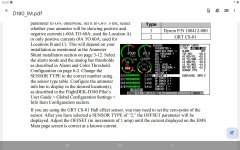
There are three possible ways of electrically installing the shunt, depending on where in the circuit it is connected. The Dynon installation manual identifies the locations as A, B or C.
The D120 needs to be configured to match the location of the shunt. It is relatively easy to go into the setup menu for "current" and check what is the "Type" setting; if you change this to "-60A to 60A" the display will probably be corrected. There should be no need to touch any wiring, although the color coded ranges may need to be changed, per the installation manual.
Good luck!

Screenshot_20250224-165948_Drive.jpg
 
There are three possible ways of electrically installing the shunt, depending on where in the circuit it is connected. The Dynon installation manual identifies the locations as A, B or C.
The D120 needs to be configured to match the location of the shunt. It is relatively easy to go into the setup menu for "current" and check what is the "Type" setting; if you change this to "-60A to 60A" the display will probably be corrected. There should be no need to touch any wiring, although the color coded ranges may need to be changed, per the installation manual.
Good luck!
Thanks, From the Dynon forums, I also got a suggestion about changing the analog bar and alarm thresholds:

There are three main ways of installing a shunt that indicate current:
  1. In between Alternator and Main Bus - this will show alternator output. So generally, this will be the sum of the current used to run the electrical bus on the plane and the charging current to the battery. Since it's obvious that the alternator is on and that your battery stays charged, this is NOT your setup.
  2. In between the main bus and the alternator/battery - this will show main bus load - IOW, what the airplane is using for current. Could be coming from the battery; could be coming from the alternator - we don't know - but it's what the airplane is using. Since you have stuff on (presumably - you don't indicate what's turned on when you took the picture) and we're seeing zero current, this is also probably NOT your setup
  3. In between the battery and the alternator, but NOT between the battery and the starter. This will show the battery current flow to the main bus when the alternator is off, and the alternator current flow to the battery when the alternator is on. This is my preferred setup, as it shows battery health (you already know alternator health by looking at the voltmeter).
Assuming you have setup #3, when the alternator is off, this setup will show the current flowing out of the battery, so in this case, your airplane is using 3A prior to engine start. Once the alternator is on and the battery is recharged from the starting losses, there will be 0 - 1A flowing from the alternator to the battery, hence the indication of "0". So #3 is consistent with what you're seeing, but the voltage levels and alarms are set very poorly - I'm assuming you just purchased this plane and didn't build it or do the setup of the D120 (again, you gave us essentially zero information).

I would suggest that you set the levels on the screen to be from some large positive level (current out of battery) maximum, but with a yellow starting maybe at 2A and red at 4A so that if your alternator isn't working and you're draining the battery, you're warned about it. And that you set the negative current to be yellow at some reasonable charging current once the battery is charged - say 2A, with a red at some high # that will be dependent upon the type of battery you have and the alternator maximum output. You may need to play with the levels until you find something that warns you when actual bad things (battery continuously taking too much current or battery outflow too high) are happening, but NOT false alarming just because you haven't flown in two weeks and are now doing the 3rd hot-start of the day and have drained the battery a lot so it's taking a lot of charging current for a few minutes until it's fully charged. This last issue ls particularly of interest if you have a lithium battery with very low internal resistance and will take all of the current your alternator can put out.
 
Back
Top