Van's Air Force

The definitive Van's Aircraft support community! Buying, building or flying an RV? Join our exclusive family of mentors and enthusiasts!

Understanding Battery limitations - Help please

Freemasm

Well Known Member
Patron
Background

There was a thread about a main bus (starting) battery application here:

https://vansairforce.net/threads/39...out-of-my-o470-yesterday.226634/#post-1766688

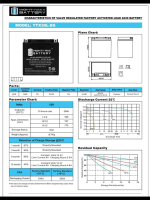
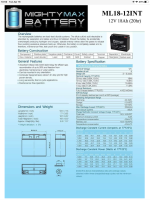
Discussion followed regarding suitability related to some specs, specifically max charging current. (reference attachment below) OK, fine. I won't rehash the EE based arguments.

Question

I will rehash my unanswered question/theory. After looking at all of the related specs:

Short circuit current 850A. - Assumed time ~ instantaneous
Max discharge current 225A. - Time listed as 5s and a 25C operating temp
Max charging current 6.8A. - No time listed (assume infinite) or operating temp

It seems to me this limits are more likely due to materials of construction related limits versus the EE limits/discussions that followed:

Amps + ohms = heat. Power (not energy) is a function of time
Guessing the associated battery materials have "time at condition" limits for heat/temperature which seems to be reinforced by the stated/assumed times related to charging rates. I also assume the pass/fail is a moving target probably ranging from contained damage to no measurable degradation.

It appears that the other read has wrapped up. While theories are welcome, does anyone have answers to the basis for these limitations?

FYI. The battery that was used for comparison as being an acceptable application did not list these parameters/values, at least as far as i could find on their website.

Help a EE challenged brother out, here. Please.

Edit = Point of clarity. I'm not advocating any battery model vs another. Trying to get smarter.
Mighty Max Battery.png
 
Last edited:
I posted the other thread, because of the great experience I have had with these Mighty Max batteries, below is the one I installed in my plane in 2015, 9 years ago and is still in it and cranking well, and that has never had a tender on it and also has sat for a few months during the winter in sub zero F temps over the past 9 years. Never skipped a beat when I started. I have another plane now and decided to put Mighty Max in it after having a very bad experience with Gill customer service. The battery I put in was the one you posted and it is a powerhouse, I believe these are not Chinese but are made in Vietnam, if that makes a difference. All I know is I have a 9 year old battery still in one plane and confident it will start if I go out there today.
 

Attachments

  • 4B284F4E-B45B-472E-8C94-BA953BE2835B.png
    4B284F4E-B45B-472E-8C94-BA953BE2835B.png
    1.9 MB · Views: 38
My eyes glazed over as well with the EE debate in the other thread. I don't know what limits these low-priced batteries have but do know they have been used in RVs for at least 25 years. This goes back to when Bob Nuckols was the go-to guy for us wiring RVs in the pre-RV forum days and followed his guidance in email posts and his widely circulated book, AeroElectric Connection. Bob's model was to use inexpensive batteries and replace them every two years so the emergency bus would have a reliable source of power in case of alternator failure. There was a lot of discussion about alternators dying but we have never seen a pattern of in-flight failures of the inexpensive batteries.

I've used several of these batteries in the past 25 years from various "brands" and they've been reliable. Some have lasted longer than others but none have suffered sudden death and $40 gets me a replacement. Guess I'm more of pragmatic type rather than theoretical. :)
 
More information from my EE mentor: The 6.8A limit is for power -> heat reasons. This battery isn’t meant to operate in a constant voltage system like airplanes (alternator always puts out 14.6V) but a system with a constant current charger - like an alarm system, or exit sign/emergency lighting or similar. The 6.8A spec drives a wattage/power dissipation specification to keep the lead plates whole and the electrolyte from boiling off.

Using this battery in an aircraft (or car, or other constant voltage system) will shorten its service life.

Good questions and enjoyed the problem presented!
 
This sounds like an excellent battery for an airplane without an alternator...?
Proven by me to be an Excellent battery for a plane with a 40 amp denso alternator, 9 years 500ish hours and still going. Never been on a battery tender or battery charger at all since installed in 2015, only the Denso alternator… I imagine one of these springs it will die and I will have to buy a new one…. but still cranking fine this year. What I could not believe was the cranking power it had after sitting for 4 months in the -10F temps we had in jan and feb a couple years ago while not on a battery tender, she cranked it right over in march or april when I pulled the plane out of the hangar. Leads me to believe cold is good for AGM batteries, have heard hot is not good for them, but cold must be great for them, unlike regular wet cell lead batteries.
 
Last edited:
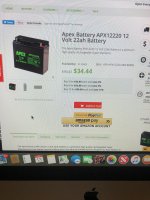
Several years back I switched from the very poor performing, (even when brand new), Odyssey PC 680 to this APEX. (I think they were bought out by battery sharks so this same battery looks different now). Anyway... this battery was far superior in everyway over the Odyssey. Steller cranking power even after 5 years of use. I did replace it after 5 years since the price was so reasonable. It was still performing good as new when removed, (I now use it at home for 12 V stuff). I actually have put two of them in in parallel. Did this to help shift CG forward just a bit. The cranking power is unbelievable! I switch the second battery off after 15 mins or so of flying and turn it back on about 10 mins before landing.
Never ever have used a trickle charger or any of that stuff. I think the Odyssey is nearly $175 now. These are running around $40ish. Just my experience. Sorry for the poor quality of the photo. It's a picture taken of my computer screen.
 

Attachments

  • IMG_0603.jpeg
    IMG_0603.jpeg
    4.1 MB · Views: 46
Several years back I switched from the very poor performing, (even when brand new), Odyssey PC 680 to this APEX. (I think they were bought out by battery sharks so this same battery looks different now). Anyway... this battery was far superior in everyway over the Odyssey. Steller cranking power even after 5 years of use. I did replace it after 5 years since the price was so reasonable. It was still performing good as new when removed, (I now use it at home for 12 V stuff). I actually have put two of them in in parallel. Did this to help shift CG forward just a bit. The cranking power is unbelievable! I switch the second battery off after 15 mins or so of flying and turn it back on about 10 mins before landing.
Never ever have used a trickle charger or any of that stuff. I think the Odyssey is nearly $175 now. These are running around $40ish. Just my experience. Sorry for the poor quality of the photo. It's a picture taken of my computer screen.
Thats why I switched to more affordable Mighty Max, my expensive odyssey j16 didnt make it one year, it got drained down to 12.2 volts with a usb chrger plugged in, I started the plane and the alternator hit the odyssey with 18 amps for 15 minutes and slowly decreased the amps to normal 2 or so, but the battery was toast after that and never held a charge.
 
I put two Odysseys in my Lancair, first flight March 2022. One failed after 2 years, now the the second one has failed after 2 1/2 years. I do have 400 hours in that time, which is probably 150 or so starts. But I'm thinking about going back to the <$50 (e.g., MightyMax), replace one each year procedure.
 
The only caution with this type of battery is the capacity at the one hour rate, that is the rate that matters if your alternator quits. Where as the sticker says 18 amp hours it provides under 12 amp hours if discharged in an hour. For a slightly used battery that might be down to 9 or 10 amp hours. It sounds like a great battery for starting the engine, but anticipate some load shedding to keep the lights on in get-you-home mode.
 
Background

There was a thread about a main bus (starting) battery application here:

https://vansairforce.net/threads/39...out-of-my-o470-yesterday.226634/#post-1766688

Discussion followed regarding suitability related to some specs, specifically max charging current. (reference attachment below) OK, fine. I won't rehash the EE based arguments.

Question

I will rehash my unanswered question/theory. After looking at all of the related specs:

Short circuit current 850A. - Assumed time ~ instantaneous
Max discharge current 225A. - Time listed as 5s and a 25C operating temp
Max charging current 6.8A. - No time listed (assume infinite) or operating temp

It seems to me this limits are more likely due to materials of construction related limits versus the EE limits/discussions that followed:

Amps + ohms = heat. Power (not energy) is a function of time
Guessing the associated battery materials have "time at condition" limits for heat/temperature which seems to be reinforced by the stated/assumed times related to charging rates. I also assume the pass/fail is a moving target probably ranging from contained damage to no measurable degradation.

It appears that the other read has wrapped up. While theories are welcome, does anyone have answers to the basis for these limitations?

FYI. The battery that was used for comparison as being an acceptable application did not list these parameters/values, at least as far as i could find on their website.

Help a EE challenged brother out, here. Please.

Edit = Point of clarity. I'm not advocating any battery model vs another. Trying to get smarter.

View attachment 62367
As I understand it, the ML18-12INT is not intended as a starter battery for a car or an aircraft engine. Construction is light weight.
It's designed for cycle (14,4-14,9 V) use and stand by (13,6-13,8 V) use with a max charge current of 6,8 A.
This means that if the battery is depleated and you charge it with the alternator, the current may go abowe 6,8 A for a long perod of time and this can hurt the battery.
However if the battery is more or less fully charged and you start the engine, the current may go abowe 6,8 A for a few minutes but this does not heat up the battery
to cause damage. This type of battery does not have high amps capacity in cold weather and it does not deliver high cranking amp in comparison with a starter battery.
But if it works well in your plane, be happy.

Good luck
 
Short circuit current 850A. - Assumed time ~ instantaneous
Max discharge current 225A. - Time listed as 5s and a 25C operating temp
Max charging current 6.8A. - No time listed (assume infinite) or operating temp
Looks like a plain old sealed lead/ acid battery to me. Lead acid batteries charge at constant voltage variable current. I suspect the 6.8A "limit" is just stating how much current the battery can absorb. In other words if it was discharged 100 watt/hrs it would take a little over an hour to reach full charge no matter how big your alternator is.

Lithium type batteries (Li/Po, Li/ion, Li/nano, etc) charge at a constant current, and variable voltage. You can damage them by supplying too many amps.
 
Looks like a plain old sealed lead/ acid battery to me. Lead acid batteries charge at constant voltage variable current. I suspect the 6.8A "limit" is just stating how much current the battery can absorb. In other words if it was discharged 100 watt/hrs it would take a little over an hour to reach full charge no matter how big your alternator is.

Lithium type batteries (Li/Po, Li/ion, Li/nano, etc) charge at a constant current, and variable voltage. You can damage them by supplying too many amps.
As I understand it, the charging limit of 6,8 A is related to the battery internal resistance.
When starting charging the battery is cold and the internal resistance is high.
The charging current times the internal resistance warms the battery during charging.
If the initial charging is higher than the 6.8 A limit the battery may be damaged.
When the battery is charging, it gets warm and the internal resistance is reduced. As a result less heat is produced.
This means that a warm battery will accept a higher current than the 6.8 A limit.
If the battery is depleted the current (A) will be higher with an alternator and constant voltage charging as in an aircraft or a car.
One way to safely charge this battery, if not fully charged, is to use a 5 A charger in the hangar.

Good luck
 
Back
Top