Van's Air Force

The definitive Van's Aircraft support community! Buying, building or flying an RV? Join our exclusive family of mentors and enthusiasts!

UL power fuel system

Blain

Well Known Member
Patron
First, I hold Vans engineering in the highest regard. I also understand any modifications of a fuel system can be risky. This is why I'm looking for educated thoughts on a couple of things Vans has used in the Is fuel system.

I'm going off script and installing a UL 350 powerplant.

The UL guidelines suggest fuel return to the tank should be submerged in the body of fuel some distance from the pickup. They suggest "cascading" could induce foaming and/or vapor. Vans Is tank takes the return to the top of the tank and releases it in what could be considered "cascading".

The next suggestion from UL is when using a gascolator, which I'm not, is to use a screw type drain valve and not a spring loaded. Should the "O" ring leak there could be air pulled into the system by the 3 Bar pumps. The Is system uses a push to drain valve in line before the pumps. Just what UL is warning about. I think everyone has replaced a drain valve O ring at some time so this is a valid concern in my mind.

I don't want to trigger the whole sump/gascolator discussion. But....I do think there should be a drain near the tank.

So, what if, I removed the return line and riser from the bottom of the tank and put a sump drain valve in its place? Then, place a new bung at the top of the tank and use the return and riser to return fuel into the body of the tank?

Thoughts?
 
Note that if you return warmer fuel to the top of the tank, it will tend to stay there rather than sink to the bottom where the pickup is. You are not going to get the cascade of hot fuel running from the return at the top of the tank down to the pickup.
 
If memory serves, the return line to the gas tank enters from the top but is quite long, extending to almost the bottom of the tank.
 
On the IS fuel tank the feed and the return both enter at the bottom of the tank, the return has a long tube almost to the top of the tank and the feed pulls through a finger strainer at the bottom. Fig 1 on 27iS-07.
 
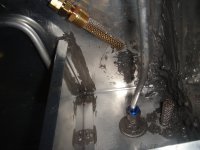
I went through this years ago when I also went off script and installed a fuel injected engine in a legacy RV-12. First concern was the volume of fuel being pumped out and returned by the pressure regulator to the tank. Testing showed it was possible to pump all the fuel out of the tank baffle sump if the return line dumped the fuel in the main part of the tank (per the RV-12 KAI) when the tank level got down to just under 4 gallons. I ended up routing the return line outlet into the baffle sump and I added a screen to act as a diffuser for the fuel stream coming out. The photo shows the final setup. If you want to see the test videos, they are posted at https://www.youtube.com/@johnsalak6923.

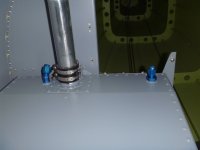
I have been using a spring-loaded drain/sump valve just off the tank outlet and have never had any problem with air leaking into the fuel line, I expect it would take quite a vacuum to overcome the spring-loaded seal. If the seal is bad, it is going to be dripping fuel on the ground. I added a separate tank drain with the AN fitting access point on top of the tank (right side in the photo). The pipe on the inside of the tank goes down to the tank bottom at the outlet baffle. The main use is to drain the tank for maintenance, although it could be used with an aux tank to carry more fuel.
 

Attachments

  • DSC02175.JPG
    DSC02175.JPG
    1.4 MB · Views: 30
  • P1000160.JPG
    P1000160.JPG
    1.1 MB · Views: 30
I went through this years ago when I also went off script and installed a fuel injected engine in a legacy RV-12. First concern was the volume of fuel being pumped out and returned by the pressure regulator to the tank. Testing showed it was possible to pump all the fuel out of the tank baffle sump if the return line dumped the fuel in the main part of the tank (per the RV-12 KAI) when the tank level got down to just under 4 gallons. I ended up routing the return line outlet into the baffle sump and I added a screen to act as a diffuser for the fuel stream coming out. The photo shows the final setup. If you want to see the test videos, they are posted at https://www.youtube.com/@johnsalak6923.

I have been using a spring-loaded drain/sump valve just off the tank outlet and have never had any problem with air leaking into the fuel line, I expect it would take quite a vacuum to overcome the spring-loaded seal. If the seal is bad, it is going to be dripping fuel on the ground. I added a separate tank drain with the AN fitting access point on top of the tank (right side in the photo). The pipe on the inside of the tank goes down to the tank bottom at the outlet baffle. The main use is to drain the tank for maintenance, although it could be used with an aux tank to carry more fuel.flow is quite
Hey John
What engine did you go with? That return flow is quite high.
 
The return flow is high compared to Facet/Carb setup on the 912ULS. I am running a pair of Walbro GSL393 pumps that are rated at 41 gph @ 45 psi. The engine is only using 4-6 gph, so about 35 gph is bypassed back to the tank. I started out with a pair of Airtex E8228 pumps which have a similar rating. I did consider adding a PWM controller to reduce the bypass flow, however these are gerotor pumps and Walbro said a PWM controller would damage the pump. My pumps, LP filters, and pressure regulator are located in the tailcone, similar to what Van's did for the iS.

I am running a Honda Viking 110 engine, 530 hours on it so far. Changed the Sensenich 2-blade to a 3-blade e-Prop in January, and I'm very happy with the results.
 
Back
Top