

Van's Air Force
You are using an out of date browser. It may not display this or other websites correctly.
You should upgrade or use an alternative browser.
You should upgrade or use an alternative browser.
UAT for additional ADS-B out
- Thread starter Amadeus
- Start date

That would be interesting , 2 separate outputs with no connection for timing. Dont know the details of reception and rebroadcast, but I would bet it would screw something up for the aircraft output. Send a note to the UAvionix guys and see what they say. Let us know, interesting question.The Garmin avionics package for the RV-12 reports ADS-B via 1090ES. Has anyone added a UAvionix unit to also report ADS-B via UAT in order to have dual out?
Absolutely correct. Simultaneous adsb-out on both frequencies is not allowed by the FAA. It could confuse the system. Of course you may listen to adsb-in on both frequencies.I have to believe that dual out is not kosher with the faa. Don’t believe they have the capability to deal with two discrete signals from one aircraft. Proceed with caution.

If one navigates to the FAA PAPR request site it requires that you identify the "ADS-B OUT Data Link(s)." The drop down for ADS-B OUT Data Link(s) are "1090ES, UAT or DUAL OUT." If DUAL OUT is selected then in the "ADS-B OUT Transmitter Configuration" you are prompted, required, to select the equipment Manufacturer and Model for both the 1090ES Transmitter and the UAT Transmitter. "Note: Select the "DUAL OUT" option if the aircraft is equipped with both 1090ES and UAT ADS-B transmitters."That would be interesting , 2 separate outputs with no connection for timing. Dont know the details of reception and rebroadcast, but I would bet it would screw something up for the aircraft output. Send a note to the UAvionix guys and see what they say. Let us know, interesting question.
This DUAL OUT option is what prompted me to ask if anyone actually does this?
Last edited:

Per FAA Advisory Circular 90-114C, operators must ensure they do not broadcast on both frequencies. If an aircraft is equipped with both systems (for example, a 1090ES transponder and a UAT transceiver), the UAT must be configured to "receive-only" or have its "Out" broadcast disabled. I had read the prohibition on both frequencies being used for transmit back before the mandate went into effect.
So it beats me why they have the dual option in the PAPR report form.
However, the FAA does state that dual-frequency ADS-B "In" is highly encouraged.
So it beats me why they have the dual option in the PAPR report form.
However, the FAA does state that dual-frequency ADS-B "In" is highly encouraged.

I’m pretty sure the Garmin receives on the UAT freq, just doesn’t TX. that is how it tracks UAT ADSB traffic when outside of UAT gnd station coverage and gets WX which is only on the UAT Freq. I have seen ADSB traffic that shows up as 2 separate aircraft at the same location with same ID. ATC always calls them out and ask the pilot to check his system and try stop one of the returns. But this system problem (usually military traffic) I don’t think is from dual systems.
Anyway the UAT ADSB system was originally designed with the assumption that UAT equipped and 1090 equipped aircraft could not see the other systems ADSB data directly, so a 1090 ADSB track is retransmitted on the UAT freq, and vice versa for for UAT tracks being retransmitted on the 1090 freq. This function is dependent on the distance between the aircraft and is all TX from the ADSB gnd station. I think dual ADSB RX systems have to deconflict the self and ADSB gnd station self track internally.
Bottom line is I would believe having 2 separate systems on at the same time would be noticed and would generate FAA interest you might not like. In the early days of ADSB I remember getting several phone calls from the FAA ADSB office in DC about some parameter they didn’t like about my ADSB system. Those days are long gone but the FAA has folks who watch the ADSB system and they do get computer print outs with phone numbers if needed. Canada I’m pretty sure only has the 1090 ADSB and they get no weather on their system.
Anyway the UAT ADSB system was originally designed with the assumption that UAT equipped and 1090 equipped aircraft could not see the other systems ADSB data directly, so a 1090 ADSB track is retransmitted on the UAT freq, and vice versa for for UAT tracks being retransmitted on the 1090 freq. This function is dependent on the distance between the aircraft and is all TX from the ADSB gnd station. I think dual ADSB RX systems have to deconflict the self and ADSB gnd station self track internally.
Bottom line is I would believe having 2 separate systems on at the same time would be noticed and would generate FAA interest you might not like. In the early days of ADSB I remember getting several phone calls from the FAA ADSB office in DC about some parameter they didn’t like about my ADSB system. Those days are long gone but the FAA has folks who watch the ADSB system and they do get computer print outs with phone numbers if needed. Canada I’m pretty sure only has the 1090 ADSB and they get no weather on their system.
Not quite. Your (one frequency only!) adsb-out signal tells the ground stations that you are listening on 978, 1030 (or is it 1090?), both, or neither, for adsb-in. The ground station then sends up the data you are missing, e.g., if you have dual frequency ‘in’ you get sent radar data from non adsb aircraft, only.I think dual ADSB RX systems have to deconflict the self and ADSB gnd station self track internally.
Honest question here. So if the system links up and sends us ground-based radar data why can't we see primary target aircraft?e.g., if you have dual frequency ‘in’ you get sent radar data from non adsb aircraft, only.
the target needs to have at least a Mode C transponder to be included in the TIS-B feed.Honest question here. So if the system links up and sends us ground-based radar data why can't we see primary target aircraft?
AZSteve053
Well Known Member
Can you have Two Transmitters: 1090 + UAT ?, this is a Question for the FAA to answer and they have an Email to send your question to: [email protected]
Why not ask the authorities as opposed to the internet ? You'll get an honest answer and they don't "bite".
If you have a real reason to Transmit on both frequencies, explain your need in the Email and ask for the proper way to address it.
Why not ask the authorities as opposed to the internet ? You'll get an honest answer and they don't "bite".
If you have a real reason to Transmit on both frequencies, explain your need in the Email and ask for the proper way to address it.

Are you saying that ground stations are broadcasting information tailored specifically to the aircraft within range? I don't think that's correct. I understood that all data is broadcast all the time, and your equipment decides what to do with it if it can.Not quite. Your (one frequency only!) adsb-out signal tells the ground stations that you are listening on 978, 1030 (or is it 1090?), both, or neither, for adsb-in. The ground station then sends up the data you are missing, e.g., if you have dual frequency ‘in’ you get sent radar data from non adsb aircraft, only.
yes this is correctAre you saying that ground stations are broadcasting information tailored specifically to the aircraft within range? I don't think that's correct. I understood that all data is broadcast all the time, and your equipment decides what to do with it if it can.
Client aircraft receive TIS-B targets that are within a 15 NM radius and +/- 3500 feet altitude of the client aircraft.
It's cryptic but the way I read https://www.faa.gov/sites/faa.gov/f...ce_change_summary_final_508_5-13-15-webV2.pdf is that you must advertise ADSB-IN capability to have the TIS-B customized for you
also some info here
As Ve0 said above, what I said is almost correct. The exception is weather, which is sent all the time to anyone listening on 978 MHz (only). If you have receive only capability on both frequencies, then you should receive via direct from the aircraft traffic info if they have ADSB-out. You might get radar/non-adsb traffic, but only if a nearby (15 nm) aircraft with adsb_out has quieried the ground station. Same for single frequency "in". You'll get that traffic only if the ground station has been interrogated by a nearby aircraft who also is the same single frequency "in".Are you saying that ground stations are broadcasting information tailored specifically to the aircraft within range? I don't think that's correct. I understood that all data is broadcast all the time, and your equipment decides what to do with it if it can.
This mess is all an attempt to keep from saturating the frequency (which is why the US has 2 frequencies in the first place). BTW, this is also why, when you set up ADSB-out, one of the banks to fill in is, "What "in" frequencies do you monitor?
Edit: I don't know, does Canada use a different system? I think they don't have 978 MHz, so maybe yes.
I'm probably speaking out of turn as an Arizonan, but when I worked in DC and was involved in technical review of certain exotic radiocommunication systems, one of the things we worked on was an ADS-B receiving system that flies on Iridium satellites. More specifically, NAV CANADA partnered with Aireon, which operates ADS‑B receivers mounted on the Iridium NEXT satellite constellation. These satellites listen for 1090 MHz Extended Squitter (1090ES) ADS‑B Out transmissions from aircraft and relay them to NAV CANADA’s automation systems. If you fly in Canada, you need to have an ADS-B out antenna mounted so that it can "see" the sky, so its transmissions reach the Aireon ADS-B receivers on the Iridium satellites, in addition to antennas that can "see" ground-based ADS-B receivers. Canada has a lot of mostly uninhabited areas (ignoring wildlife) where it isn't technically or economically feasible to have a ground-based ADS-B network, hence the space component. Double their pleasure, double your money. The uAvionix Tail Beacon is one example of an ADS-B out transmitter that meets those requirements, somewhat or mostly, ignoring shadowing. (I'm not associated with that company.) I'm sure folks who live north of the border can correct and elaborate on the above.Edit: I don't know, does Canada use a different system? I think they don't have 978 MHz, so maybe yes.
AZSteve053
Well Known Member
"Dual Antenna" systems (upper + lower) for Transponders are common to enhance TCAS coverage and also ADSB coverage in some aircraft and in places like Canada (minimizes or eliminates airframe shadowing). These are termed "Diversity" Transponder installations and require a special Transponder. That said - both antenna's are connected to the SAME emitter so that there is no confusion relating to source or timing of transmission. A tail beacon mounting helps in the vertical axis but has other shadowing issues in the horizontal.I'm probably speaking out of turn as an Arizonan, but when I worked in DC and was involved in technical review of certain exotic radiocommunication systems, one of the things we worked on was an ADS-B receiving system that flies on Iridium satellites. More specifically, NAV CANADA partnered with Aireon, which operates ADS‑B receivers mounted on the Iridium NEXT satellite constellation. These satellites listen for 1090 MHz Extended Squitter (1090ES) ADS‑B Out transmissions from aircraft and relay them to NAV CANADA’s automation systems. If you fly in Canada, you need to have an ADS-B out antenna mounted so that it can "see" the sky, so its transmissions reach the Aireon ADS-B receivers on the Iridium satellites, in addition to antennas that can "see" ground-based ADS-B receivers. Canada has a lot of mostly uninhabited areas (ignoring wildlife) where it isn't technically or economically feasible to have a ground-based ADS-B network, hence the space component. Double their pleasure, double your money. The uAvionix Tail Beacon is one example of an ADS-B out transmitter that meets those requirements, somewhat or mostly, ignoring shadowing. (I'm not associated with that company.) I'm sure folks who live north of the border can correct and elaborate on the above.
Last edited:
the thread drifted quite a bit but hey we are learning something new! My belly mounted ADSB is frequently shadowed and close range traffic disappears from the Dynon's screen. I have a GDL on the glareshield and that helps. The disappearing targets alternate between the Dynon screen and the Garmin Pilot on the Ipad which uses the GDL feed. When a ground station is in view things are better, but it may not show traffic below the MVA. this sure is not a bullet proof system.
Glossed over the thread so forgive if this is out of place or already answered, but to interject opinion. To answer OP you do not NEED or want dual ADS-B out,
Avoid UAT. It has been tried on a club plane I fly. So spotty and inconstant... Changed over to 1090ES. Go with 1090ES, first and only choice, even if it cost more. ES works so much better for FIS-B (traffic), NEXTRAD WX, and most important, being seen by other planes & ground stations. Just my experience and opinion UAT is poor substitute. If you plan on going South or North of the boarder, ES only.
UAT was developed as a stop gap to allow pilots to comply with less extensive avionics change (using existing transponder) and meet deadline. UAT is weak sauce for the most part compared to UAT, but it was a great way back in the early days to comply. If starting from scratch forget UAT and go 1090ES.
Avoid UAT. It has been tried on a club plane I fly. So spotty and inconstant... Changed over to 1090ES. Go with 1090ES, first and only choice, even if it cost more. ES works so much better for FIS-B (traffic), NEXTRAD WX, and most important, being seen by other planes & ground stations. Just my experience and opinion UAT is poor substitute. If you plan on going South or North of the boarder, ES only.
UAT was developed as a stop gap to allow pilots to comply with less extensive avionics change (using existing transponder) and meet deadline. UAT is weak sauce for the most part compared to UAT, but it was a great way back in the early days to comply. If starting from scratch forget UAT and go 1090ES.
The two types of ADS-B Out systems are 1090 MHz Extended Squitter (1090ES) and 978 MHz Universal Access Transceiver (UAT). While 1090ES is required for high-altitude (above 18,000 ft) or international flights, UAT is allowed for general aviation operating below 18,000 ft within the U.S.
Last edited:
Just a few comments.Glossed over the thread so forgive if this is out of place or already answered, but to interject opinion. To answer OP you do not NEED or want dual ADS-B out,
Avoid UAT. It has been tried on a club plane I fly. So spotty and inconstant... Changed over to 1090ES. Go with 1090ES, first and only choice, even if it cost more. ES works so much better for FIS-B (traffic), NEXTRAD WX, and most important, being seen by other planes & ground stations. Just my experience and opinion UAT is poor substitute. If you plan on going South or North of the boarder, ES only.
UAT was developed as a stop gap to allow pilots to comply with less extensive avionics change (using existing transponder) and meet deadline. UAT is weak sauce for the most part compared to UAT, but it was a great way back in the early days to comply. If starting from scratch forget UAT and go 1090ES.
The two types of ADS-B Out systems are 1090 MHz Extended Squitter (1090ES) and 978 MHz Universal Access Transceiver (UAT). While 1090ES is required for high-altitude (above 18,000 ft) or international flights, UAT is allowed for general aviation operating below 18,000 ft within the U.S.
I am pretty sure simultaneous use of UAT and mode S-ES for ADSB-out is not allowed. The whole reason the US went to two frequencies was to avoid frequency congestion.
You are the first pilot I have heard complain about UAT working poorly. I would guess you got a poor installation or antenna location.
Note that ADSB weather is continually broadcast on 978 MHz (UAT frequency). It is completely independent of what type of ADSB-out you have (including none).
UAT was never intended as a stop gap measure. Rather, the FAA guessed that most GA pilots would keep their mode C transponders and add UAT, because it was cheaper. They wanted to get a 50-50 split between the 2 frequencies to avoid frequency congestion. But for all-new installations, including a new transponder, going mode S-ES is less expensive.
NORDO Industries LLC
Well Known Member
Canada went all-in on space-based ADS-B and it's just not been reliable enough, so they're now working on installing ground stations.More specifically, NAV CANADA partnered with Aireon, which operates ADS‑B receivers mounted on the Iridium NEXT satellite constellation. These satellites listen for 1090 MHz Extended Squitter (1090ES) ADS‑B Out transmissions from aircraft and relay them to NAV CANADA’s automation systems. If you fly in Canada, you need to have an ADS-B out antenna mounted so that it can "see" the sky, so its transmissions reach the Aireon ADS-B receivers on the Iridium satellites, in addition to antennas that can "see" ground-based ADS-B receivers. Canada has a lot of mostly uninhabited areas (ignoring wildlife) where it isn't technically or economically feasible to have a ground-based ADS-B network, hence the space component.
The way that traffic data in the US works: in order to save bandwidth, the ground network aggregates traffic from UAT, 1090ES, Mode C-only, and no-transponder targets. If it identifies any aircraft that can only receive UAT or 1090, it will re-broadcast position data from the other frequency in a chunk 30nm and 3500' above/below that aircraft. If an aircraft reports it can receive both frequencies, then the ground network will only broadcast info about non-ADS-B equipped aircraft, and won't bother with cross-band repeating. As mentioned previously, FIS-B is only broadcast over UAT.
In Canada, CIFIB is a nonprofit that's stepping in where NavCanada has declined to, and is broadcasting weather info over UAT in certain areas. They're always looking for more site hosts to increase coverage – anyone on good terms with their airport should reach out.
I wonder if limited coverage of the UAT tracks on flightaware and adsbexchange is adding confusion. There is a low participation of 978MHz volunteer receivers feeding data to these sites, but I don't think it's any indication of ground station coverage or reception quality in the air.You are the first pilot I have heard complain about UAT working poorly.
I don't doubt it may have been Freq or data congestion, but it can also be true the reason UAT using Mode C transponders was a less expensive way to comply with FAA mandate.Just a few comments.
I am pretty sure simultaneous use of UAT and mode S-ES for ADSB-out is not allowed. The whole reason the US went to two frequencies was to avoid frequency congestion.
You are the first pilot I have heard complain about UAT working poorly. I would guess you got a poor installation or antenna location.
Note that ADSB weather is continually broadcast on 978 MHz (UAT frequency). It is completely independent of what type of ADSB-out you have (including none).
UAT was never intended as a stop gap measure. Rather, the FAA guessed that most GA pilots would keep their mode C transponders and add UAT, because it was cheaper. They wanted to get a 50-50 split between the 2 frequencies to avoid frequency congestion. But for all-new installations, including a new transponder, going mode S-ES is less expensive.
The capacity of ADS-B is fairly high per ground station. There is air-to-air ADS-B. The ground-to-air ADS-B ground stations can typically track 400 to 500+ aircraft simultaneously in high-density areas, limited primarily by line-of-sight, signal interference, and message processing capability. Stations handle hundreds of aircraft transmitting simultaneously. So I think we are OK.
UAT was a boon to uAvionix with their ADS-B Out solution to satisfy FAA mandate. Their wingtip-mounted skyBeacon and tail-mounted tailBeacon were fairly easy to install. It is only game in town with UAT, with this form factor I know of. If I am not mistaken FAA got involved due to many improperly installed wing and tail beacons or some paired to a Mode S transponders, which does not work.
As most know when you fly your newly installed ADS-B out system, you have to fill out an on-line form saying what equip you have, and when and where you flew. You get a performance report. You must pass this to call it good.
All the electronics in a tiny unit hanging off the tail. Not only is it a NAV light, it is a has a ADS-B transmitter/antenna, GPS receiver/antenna, and processor to read your 1970's Mode C transponder codes with "Power Transcoder" technology and transmit UAT on 978Mhz. What is "Power Transcoder"? It senses the transponder's interrogation reply codes through the aircraft's power system. OK. There is no data cable. Clever. I can't help but think this is a bit of a compromise from a stand alone ES transponder hardwired to air-data and WAAS GPS, with a belly antenna on end of a coaxial. There is no NAV light involved. For new installations I don't see using a tail beacon is best choice for a new clean sheet system.
Back to OP question, if you have ES ADS-B out, UAT is irrelevant. You can't use UAT together with ES as was said. Case closed. Even if you could you do not need or want to use UAT. It's just not as effective as ES. Congestion on the airwaves is not an issue. I do know my ADS-B in receiver has both 1090 and 978 Mhz receivers however.
uAvionix's new product (well 5 yrs or more old) is tailBeaconX. a TSO-certified 1090MHz Mode S Extended Squitter (ES) ADS-B OUT transponder and WAAS GPS that replaces the rear position light. The antenna is a dipole and longer. I am sure it has improve performance. Talking to uAvionix 5 yrs ago the selling point tailBeaconX is it's also compatible with satellite-based ADS-B (the Aireon network) using iridium satellites. Reading post above, about Canada not happy with the space based ADS-B scheme is interesting. I doubt the ES ground-to-air and air-to-air based ADS-B system will go away in my life time.
I looked at it tailBeaconX but having a clean slate to build my panel I went Trig TT22 mode S-transponder working with my GRT EFIS (air data) and WAAS GPS. I am going to say this works better, based on the fact it's 1090Mhz ES, and WAAS GPS and air data are very robust, all in or behind the panel. The antenna is in clear air (more or less) on the belly. Transponder has higher output.
Last edited:

Your post is equally weak. The thread is not about one or the other, which serve their purpose. It's about BOTH. And both is not needed or advised.UAT is weak sauce for the most part compared to UAT
I am sorry you think my post is "weak". Why? What is the point of your comment? However as far as weak, your reading of my post is weak. I clearly state NOT only do you NOT need UAT, you CAN NOT have both. That is a fact. OP's question is moot, can't combine ES with UAT. Done.Your post is equally weak. The thread is not about one or the other, which serve their purpose. It's about BOTH. And both is not needed or advised.
So my comment about UAT being "weak" is also an additional reason to to add UAT even if you could (and you can't). So my post is NOT a massive thread drift. It is in the ball park. I think my post was awesome.
 However your post Sir, about "weak" comments hurt my feelings. Have a nice day, really.
Last edited:
Reqouting you from post #18.UAT is weak sauce for the most part compared to UAT
You basically said x is bad compared to itself. I think I've read your post accurately.
That is weak sauce.
Last edited:
A contraire. DON'T AVOID UAT OUTGlossed over the thread so forgive if this is out of place or already answered, but to interject opinion. To answer OP you do not NEED or want dual ADS-B out,
Avoid UAT. It has been tried on a club plane I fly. So spotty and inconstant... Changed over to 1090ES. Go with 1090ES, first and only choice, even if it cost more. ES works so much better for FIS-B (traffic), NEXTRAD WX, and most important, being seen by other planes & ground stations. Just my experience and opinion UAT is poor substitute. If you plan on going South or North of the boarder, ES only.
UAT was developed as a stop gap to allow pilots to comply with less extensive avionics change (using existing transponder) and meet deadline. UAT is weak sauce for the most part compared to UAT, but it was a great way back in the early days to comply. If starting from scratch forget UAT and go 1090ES.
The two types of ADS-B Out systems are 1090 MHz Extended Squitter (1090ES) and 978 MHz Universal Access Transceiver (UAT). While 1090ES is required for high-altitude (above 18,000 ft) or international flights, UAT is allowed for general aviation operating below 18,000 ft within the U.S.
I totally disagree with your analysis of UAT out. Sorry that your club plane had a bad installation or equipment. But the balance of your post is mainly opinion and said troubles have not been borne out in the 3 dozen UAT installations I have personally done. Don't get Nexrad and traffic data quality confused with the frequency of the type of compliant "out" transmitter (or transmitter portion for all-in-one solutions). The only thing I agree with is going 1090ES out for 18K flight levels and above and flights North of the border. As a point of fact I live on the Southern border and have a small fleet of aircraft at an international Class C airport of entry. I am also invested with a number of fire fighting aerial tankers, and we just had to upgrade their ADS-B out from straight 1090ES to 1090ES with diversity. Because we have occasion to fly through Canada enroute to Alaska. But back here on the border many US and Mexican registered aircraft fly across the border both ways with either UAT or ES.
Mode C with UAT has been my "go to" for compliant ADS-B out and still is. Remember that in-cockpit weather and most traffic come in on this same 978 UAT frequency, not 1090. An added benefit of UAT out is actual real anonymous mode when squawking VFR. I also like to separate my ADS-B "out" device from my ADS-B "in" device. I don't care for the all-in-one boxes. But that's just a personal thing.
I do agree that the Uavionix brand nav light "Beacons" are particularly cheesy in every way. Had a Mexican Cessna 210 customer who constantly had SkyBeacons go bad due to moisture condensation. But don't let the Beacon design affect the reputation of the very capable UAT based system. In fact I love the Echo UAT from Uanionix.
In the end to each his own but I find anonymous capable compliant UAT out to be rock solid with no degradation of transmission signal vs 1090ES.
Last edited:

rmartingt
Well Known Member
Typical FAA thinking... "people will do what we want, not what they want". Go see how the original Light Sport rule played out vs. what the FAA expected. Like you note, everyone doing new installation or a major upgrade is going to go for one box vs. two because it's cheaper and simpler.Rather, the FAA guessed that most GA pilots would keep their mode C transponders and add UAT, because it was cheaper. They wanted to get a 50-50 split between the 2 frequencies to avoid frequency congestion. But for all-new installations, including a new transponder, going mode S-ES is less expensive.
Perhaps the FAA wouldn't have so many concerns about frequency congestion on 1090 if they hadn't required 978-eligible aircraft to keep the Mode C transponder.
Especially in light of the DC collision and NTSB recommendations and all that, it seems the whole ADS-B thing has been a giant half-baked [insert crude metaphor here] from the beginning. IMHO it seems like "they" saw a proof-of-concept system being tested in Alaska and liked it so much they said "make it work like that and make everyone have it" and didn't really think through potential security or implementation issues.
So now here we are 6 years and counting past the mandate. We're still stuck needing a Mode C or Mode S output because ATC doesn't seem to use ADS-B much, and the airlines (who seemed to be the biggest "customer" pushing for everyone else to have Out) don't have In capability and still rely on existing Mode C/S for TCAS functions. And so that really begs the question, why the mandate if they aren't bothering to actually use it in the places and situations it's needed most?
And back to the collision fallout... there's talk of requiring In for everyone required to have Out. It's amazing to me that airlines and such don't already have it... but what does that do to us? GA (especially on the light end) probably has the highest In equip rate of anyone thanks to portable units. But if a mandate drops, what does that do? Because we all know the FAA; once something is Required then it must be Approved, and to be Approved it has to be TSO blessed and permanently installed at 10-100x the cost.
I'm not sure what can be done at this point. But if we're going to see In mandates, I think those requred to have TCAS should be required to upgrade to ACAS X, piston GA should be able to meet the In mandate with portable units, and the Mode C requirement should be dropped for aircraft using 978 Out.
My personal experience. I flight instruct in dozens of GA planes, including club and privately owned planes. I use ADS-B out and flightaware to review flights with students to debrief sometimes. Very helpful for students doing pattern work. IFR shows hold entries and how well final approach was tracked. I can tell you planes with Mode-S ES are 100% sold without fail. UAT planes are spotty, drop off at lower altitudes or just do not register the flight completely or at all. The base airport is a little over 30 nm from a class B airport outside the mode C vail.A contraire. DON'T AVOID UAT OUT
I totally disagree with your analysis of UAT out.
In the end to each his own but I find anonymous capable compliant UAT out to be rock solid with no degradation of transmission signal vs 1090ES.
My opinion if starting from scratch, need to buy Mode-S transponder with ES. You likely will have "glass" with air data and TSO'ed GPS source suitable for ADS-B position. WHY would you use a wing or tail beacon. Well may be it makes sense? TailBeacon X with AV-20-E MFD may do the trick. The Tailbeacon X looks like it performs better than the original tailbeacon.
Let us use facts and logic, no personal experience or reading the mix reviews on line. I have no dog or ADS-B in the fight.
1) Yes possible to install both UAT and ES ADS-B out in one plane if installed and configured per TSO. HOWEVER both systems cannot broadcast simultaneously; the UAT must be configured to "receive-only" or have its "Out" broadcast disabled if the 1090ES is active, and vise verse. WHY WOULD YOU DO THIS. There is zero advantage or need. ES has far more capability.
2) (Repeat) FAA or Federal Aviation Administration (.gov) (FAA) does not allow you to have both 1090 MHz Extended Squitter (1090ES) and Universal Access Transceiver (UAT) ADS-B "Out" transmitting simultaneously. You can install BOTH as long as they meet. Please do research this is fact.
3) UAT (978 MHz) is known both by empirical community experience and FAA crack down that has identified large numbers of under or faulty performing ADS-B out systems. Often it is a fault of installation and often it was a UAT systems not ES, according to FAA.
4) UAT may not trigger ADS-B in, of other aircraft. Not all ADS-B receivers for traffic are dual-band (978 MHz UAT and 1090 MHz ES).
My conclusion is you have UAT, happy with it, keep it. In our club we replaced all UAT out setups with ES and never looked back.
2020 mandate for ADS-B out, to fly in some USA controlled airspace, Class A, B, and C airspaces; above 10,000 feet MSL (excluding below 2,500 feet AGL); inside 30-nautical-mile "Mode C Veil" of major airports; over Gulf of Mexico, at/above 3,000 feet MSL within 12 nm of the coast. The cost was a burden to owners.
uAvionix's wing and tail beacon that come out 2019 to meet the 2020 mandate, and kept the cost of compliance down in flying airplanes. The plane owner had to replace a Wing or Tail Nav light, which provided the power to the new beacon, which also doubled as the NAV light. COOL! You could use your Mode C transponder and did not have to touch the wiring! COOL. Also no need to install another antenna! COOL! The communication of the tail beacon required no wiring harness, connector pins. The beacon and transponder used aircrafts power wire to sense pulses! COOL! Everything the GPS and it's antenna, transmitter and it's antenna, microprocessor was all in a small package, with a NAV LIGHT! This is ALL GREAT and very clever. NOTE Not all UAT systems are beacons, there are other systems, but uAvionix I think by far was most popular... FreeFlight Systems: Produces the FDL-978-TXL was a small 2.25" panel mounted united that I think had UAT 978 Mhz built in?
However, let's compare to a dedicated Mode S transponder with high power output, WAAS GPS (capable of RNAV approaches and a dedicated GPS antenna), and dedicated antenna on the belly for transmitting, with a large ground plane. This system is not burred in with NAV light and all the other components hanging off a fiberglass fairing (not a great ground plane a compromise in range). Just saying the transmitting antenna is better a mode S ES system verses a tail beacon. The tail beacon is proved and certified, and makes you legal. However it does not mean it works the same.
Reasons UAT specifically tail wing beacons do not have the same range (cut and paste from web)
- Frequency and Power: The tailBeacon operates on 978 MHz (UAT), which has a lower, shorter-range signal compared to the 1090 MHz Extended Squitter (ES) used by airliners and high-performance aircraft.
- Pairing Issues (Mode S conflict): Pairing a tailBeacon with a Mode S transponder can lead to erroneous ADS-B performance parameters, as they are designed to pair with Mode A/C transponders.
- Signal Integrity/Mounting: Poor antenna bonding, grounding, or shadowing from the tail can cause signal loss, particularly if not properly installed in a vertical orientation.
- Squawk Code Synchronization: The tailBeacon may not correctly display the squawk code if it is not properly "hearing" the transponder in the airframe, requiring careful installation of the antenna.
- GPS Reception: Being located on the tail, the unit may experience GPS fade, requiring stable flight to pass FAA performance reports.
FAA recommends you test your UAT OR ES ADS-B out once a year you do a performance report. At minimum look at flight aware after a flight from time to time. I do. As I said the UAT planes are terrible at least on the planes I fly. To debrief students the ADS-B track, altitude, speed is a great debrief tool VFR or IFR.
Starting from scratch avoid UAT and tail beacons, get a Mode S transponder with ES and a single transponder antenna. If you already have glass panel with TSO'ed GPS, is all you need. Adding a UAT tail beacon does not make sense. Sure you could ADD it and have both. However you will have to add a power switch to turn the UAT off when ES is on, and vice verse. That is a must. Again WHY?
 I can not think of a reason to do that.
Yes my opinion, story and sticking to it, UAT 978Mhz performance compared to ES 1090 Mhz is poor. uAvionix's move to a 1090 Mhz TailbeaconX with DUAL longer dipole antennas acknowledges the limitations of the original. With that said I'm glad the product exist which helped many budget minded owners to comply with 2020 mandate. As long as you stay in USA (UAT is no good anywhere else) and below 18,000 ft, you're in compliance (IF YOUR SYSTEM PASSES A PERFORMANCE TEST)
Last edited:
UAT planes are spotty, drop off at lower altitudes or just do not register the flight completely or at all.
I think you are complaining about flightaware's lack of coverage of the UAT band. It is not related to avionics or FAA radar and ground station performance.
you can try this:
- Grab one of the UAT-out airplanes and file and fly an IFR flight plan over the "spotty" area. Alternatively, get flight following with a non 1200 squawk.
- go back to flightaware and check the "coverage". I'm willing to bet a quarter that you will see a perfect track.
With the assigned squawk Flightaware will use FAA data to fill-in the "missing" volunteer's receiver data.
in any case for flight debrief it's better to use the tracks recorded by the EFB as opposed to flightaware. They are much higher resolution than what you ever see online.
No it is not a lack of coverage is it is lack of RANGE... we are talking 3 watts and antenna that is less than ideal with typical UAT installation. Verses a higher power Mode S transponder with no handshake between the Mode C transponder via electrical wiring in the plane to the ADS-B tail/wing beacon. It "WORKS" but it is obviously not going to have the range of a higher power Mode S transponder with ES integrated, single antenna on belly with big old ground plane.I think you are complaining about flightaware's lack of coverage of the UAT band. It is not related to avionics or FAA radar and ground station performance.
you can try this:
- Grab one of the UAT-out airplanes and file and fly an IFR flight plan over the "spotty" area. Alternatively, get flight following with a non 1200 squawk.
- go back to flightaware and check the "coverage". I'm willing to bet a quarter that you will see a perfect track.
With the assigned squawk Flightaware will use FAA data to fill-in the "missing" volunteer's receiver data.
in any case for flight debrief it's better to use the tracks recorded by the EFB as opposed to flightaware. They are much higher resolution than what you ever see online.
The uAvionix products and company are amazing. They have a corner on the ADD ON ADS-B out min installation market. Accept it is not going to have the range of a Mode S ES system, BUT it checks the BOX to fly within Mode C vail, above 10,000 ft MSL (more than 2500 ft AGL). FAA knows this limitation (now). They have started to crack down. I suspect some or most issues are installation issues or failure to configure properly. Granted I am or had UAT issues outside a Mode C vail where ADS-B was not needed. But I still want to see my flight as I said for training reasons. Kind of fun to see pattern work for consistency. IFR approach, holding, final apch tracking. ES can do that and work to the ground, UAT below 2500ft AGL forget it, spotty at best. Some may say, hey, I don't want FAA to see me. OK. BUT if you want to avail yourself to the FULL ADS-B Traffic, See and Be Seen and WX, I think ES is the only way to go.
FAA issued STC's approving these UAT products to comply with 2020 mandate. Nothing has changed. So that is that. They are good with it. However if you fly around with a UAT (or ES for that matter) in airspace that requires ADS-B Out and their computers detect you are "stealth" because your installation is bad, you are getting a letter. So check flightaware and do the FAA performance report. I did one for my friends RV and had to go back twice to adjust settings to get an all green report.
What is ADS-B out doing? It is sending out a 24 bit ICAO address unique to that aircraft. It is sending your tail number, precise position (GPS), speed direction over the ground, VSI, ground or airborne, along with Mode C squawk code. Mode S transponders are also Mode C, which is still a thing.
With an integrated Mode S ES transponder that all comes out one antenna (on a proper ground plane) at 250 watts, you know what you are getting. Also nothing is hanging out in the weather with a NAV light, it is all behind the panel, WAAS TSO'ed GPS and Air Data, Attitude and Heading Reference System (ADAHRS), which integrates all the needed information, altitude encoder, heading, magnetometer is likely to be more robust than a standalone tiny package on the wingtip or rudder. It seems from my experience and others this is the case. If you are starting from scratch UAT is not the way to go. If you are adding onto a flying plane, steam gauges, Mode C TXP, want the easiest installation lowest cost solution UAT uAvionix is the only game in town.
UAT add on has one antenna for Mode C (still a thing and required and gives your squawk, altitude), same old nothing changes. Then the add on UAT transmitter reads through the power line Mode C code, and through a separate antenna and separate transmitter (3 watts) send out a ADS-B information with internal GPS speed, position, tail number). It has to copy the Mode C squawk and altitude I believe (the UAT may have it's own altitude encoder?). With that said it makes up a full 24 bit message. It is complex and the hand shake between a Mode C transponder via the airplanes wiring, is clever but I assume there is some lag or hysteresis. I COULD BE WRONG. Again uAvionix are clever bunch to even design and implement this. However fact is there is no way 3 watts hanging off the rudder with a mono pole antenna without a good ground plane (plus masking of aircraft fuselage and wing) is going to have the same performance as a belly mounted antenna with 250 watts. There is the difference.
Price of Mode S transponders are not bad, and to fix an old Mode C transponder may be impossible (cavity tubes are no longer made, everyone now has gone full solid state) or prohibitively expensive to repair. Upgrade to a Mode S ES Txpr may still be best even for an older plane with Mode C TXPR. It really is not that bad cost wise. You still need a TSO'ed GPS source (GRT Safefly under $500 is TSO WAAS). You need a digital Alt encoder that is compatible if you don't already have one. Existing Mode C antenna is good enough. The final cost may not be much more than a UAT. The issue in 2019 and 2020 was there were very few Mode S ES transponders available. The ones that were around were very expensive (gouge much?). The prices are not that bad now, and the used market for Mode S ES Txpr has them available at reasonable price. I think UAT will fade out, and even uAvionix sees this and came out with a 1090Mhz ES tailbeaconX, that requires a control head (hardwired) in the panel. Again very clever. For me a Trig TT22 Mode S ES (remote) TXPR, with my GRT EFIS, GRT FlySafe GPS did the trick. I ended up with a Garmin WAAS GPS175. I could have the Garmin for GPS source for ADS-B. I like the redundancy. The GRT GPS does the EFIS #1, ADS-B. The Garmin does Flight Nav/Approaches. A G5 EFIS has it's own ADAHRS, magnetometer and GPS, but will get GPS from the Garmin GPS175. So I have two (or three) of everything for IFR.
Last edited:
Jack, I agree with some of your points, disagree with others.No it is not a lack of coverage is it is lack of RANGE... we are talking 3 watts and antenna that is less than ideal with typical UAT installation. Verses a higher power Mode S transponder...
I think it's true: Today, for an all-new installation (new transponder, new ADSB-out), mode S-ES is cheaper than mode C+UAT. But there are lots of variables. For a while the used market was saturated with good (non-cavity tube) mode C transponders for $500. And there are the privacy individuals who want UAT solely for its 'stealth' ability (turn off N number). Remember the FAA doesn't care at all about ADSB-in, it's not required anywhere. And there are a surprising number of older aircraft with no means of displaying ADSB-in data. For these, the required range of a UAT is maybe 5 miles. Anything more is superfluous. But apparently, when properly installed, they have the range to reach FAA ground stations, if they didn't the post office would be overwhelmed with FAA letters going out. Most of the letters are due to a mis-configuration issue. BTW, the GRT GPS designed for ads-out use is NOT TSO'd. It meets 'the performance standards' which, in a fit of common sense unusual for the FAA, they deemed sufficient. But then, of course, the same FAA would not approve its use in GRT's RNAV (gps) set up. Go figure.
Slightly off topic: Does anyone know, is there any US airport which has automated ground control (using ADSB data)? This is certainly an area where there is a large cost savings to be had, but I know of no where where it's happened. It seems the FAA got the whole system half-way there, and has now stopped short of its original goals.
According to Google automated ground control (using ADSB data) is at 150 airports. It lists ATL, ORD, DFW, LAX, DEN, and ORD. I never flew a plane that showed me traffic on the ground, but I am sure it is possible. At least with ADS-B in flight we have some WX (if in range of ground station) and TIS traffic.Slightly off topic: Does anyone know, is there any US airport which has automated ground control (using ADSB data)? This is certainly an area where there is a large cost savings to be had, but I know of no where where it's happened. It seems the FAA got the whole system half-way there, and has now stopped short of its original goals.
What I would like, is what we have at the airlines with Pre-Departure Clearance PDC and Data Comm. It is available at major hubs ATL, LAX, ORD, DFW, DEN, JFK, SFO, IAD, IAH, LAS, PHX via ARINC. Smaller airports clearances are still via radio voice communication with clearance delivery.
you can have PDC with the top foreflight subscription at no addtl cost. https://foreflight.com/support/pdc/What I would like, is what we have at the airlines with Pre-Departure Clearance PDC and Data Comm
But how is it related to ADSB?
Also still curious if your IFR UAT tracks are showing clearly on flightaware compared to 1200 flights in the same airplane.
I know atl uses it. Was waiting for someone there in the middle of a t storm. Foreflight showed me the exact position of about 75 - 100 different Planes and their movements across the field. Every taxiway was packed. Most stood still for hours as they cleared the towers. It was crazy that they let them all land but refused to move them on the taxiways. I was able to tell when my plane started moving.According to Google automated ground control (using ADSB data) is at 150 airports. It lists ATL, ORD, DFW, LAX, DEN, and ORD. I never flew a plane that showed me traffic on the ground, but I am sure it is possible. At least with ADS-B in flight we have some WX (if in range of ground station) and TIS traffic.
What I would like, is what we have at the airlines with Pre-Departure Clearance PDC and Data Comm. It is available at major hubs ATL, LAX, ORD, DFW, DEN, JFK, SFO, IAD, IAH, LAS, PHX via ARINC. Smaller airports clearances are still via radio voice communication with clearance delivery.
If it was automated ground control why did it stop when the tower was cleared?I know atl uses it. Was waiting for someone there in the middle of a t storm. Foreflight showed me the exact position of about 75 - 100 different Planes and their movements across the field. Every taxiway was packed. Most stood still for hours as they cleared the towers. It was crazy that they let them all land but refused to move them on the taxiways. I was able to tell when my plane started moving.
Sorry, not saying it was automated; only that it had to be adsb data to have that kind of resolution on the grouind. It could be automated; don't know. We were told the tower was emptied, so all grd movement was stopped. Certainly can't have an automated system moving plaqnes around with no human supervision. Also nowhere to move them to as all grd/ramp personnel were sent inside. If they had automation, I am sure they would have had to override it, as there were planes everywhere. No way a comp system could deal with that mess.If it was automated ground control why did it stop when the tower was cleared?

Here’s an example of the typical range I see from my ground based receiver site. The antennas for 978 and 1090 MHz are at the same elevation and several feet apart.No it is not a lack of coverage is it is lack of RANGE...
The data was collected over a 6 month period.
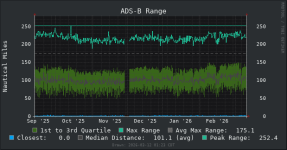
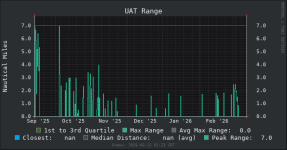
I see an opportunity here to add the reported altitude chart on the second Y axis. Many UAT planes stay low AGL and often obsucred by trees/terrain around the rx site.. There can be no UAT ping for days until the weather is VFR again and GA goes back in the air (at least in my area, I have a feeder on both bands also) .
Many GA planes fly low. I concur low altitude shortens range (well understood RF theory, line of sight VHF and UHF signals). The planes we had with UAT (all gone now upgraded to ES) were useless below 2500-3000 agl around base airport. ES? The ADS-B stations near me are both +32-34 nm away, one at major class B airport, the other class D airport. Fun fact I did not know:
"ADS-B ground stations are not exclusively located at major airports. While many are placed at busy airports* for surface tracking, the FAA has installed over 600 ground stations across the U.S., including on mountaintops and along coastal areas, to provide widespread coverage similar to radar, including over the Gulf of Mexico."
* Busy (Class B) - looked at ADS-B station airport list. Some airports are smaller, regional airports, all D or Class C. Total of about 100 ADS-B at airports. If you want to see where the other ones are Flightaware is one source. Yes, significant gaps exist in ADS-B ground station coverage, particularly in mountainous regions (e.g., US Rocky Mountains), remote areas like Alaska, and over oceans. There are limitations for ADS-B, but air to air is still in play. The further the range the planes ADS-B out has better.
3 Watts, small monopole antenna in less than ideal location (aligned with trailing edge of rudder), without a ground plane at right angles, that affects range. UAT was what the doctor ordered to get legal in 2020 for many. Still "works". A typical ES system of course is better (not withstanding bad installations). uAvionix went ES 1090mhz tailbeconX with dipole antenna (does not need ground plane), hard wired to cockpit control head, and 250 watts. I am sure range will be better than the original tailbeacon. Plus it has satellite connectivity apparently (not sure see their webpage for specs).
"ADS-B ground stations are not exclusively located at major airports. While many are placed at busy airports* for surface tracking, the FAA has installed over 600 ground stations across the U.S., including on mountaintops and along coastal areas, to provide widespread coverage similar to radar, including over the Gulf of Mexico."
* Busy (Class B) - looked at ADS-B station airport list. Some airports are smaller, regional airports, all D or Class C. Total of about 100 ADS-B at airports. If you want to see where the other ones are Flightaware is one source. Yes, significant gaps exist in ADS-B ground station coverage, particularly in mountainous regions (e.g., US Rocky Mountains), remote areas like Alaska, and over oceans. There are limitations for ADS-B, but air to air is still in play. The further the range the planes ADS-B out has better.
3 Watts, small monopole antenna in less than ideal location (aligned with trailing edge of rudder), without a ground plane at right angles, that affects range. UAT was what the doctor ordered to get legal in 2020 for many. Still "works". A typical ES system of course is better (not withstanding bad installations). uAvionix went ES 1090mhz tailbeconX with dipole antenna (does not need ground plane), hard wired to cockpit control head, and 250 watts. I am sure range will be better than the original tailbeacon. Plus it has satellite connectivity apparently (not sure see their webpage for specs).
Last edited:
