


Van's Air Force

The definitive Van's Aircraft support community! Buying, building or flying an RV? Join our exclusive family of mentors and enthusiasts!

Tunnel Cooling Flap - electric

KeithB

Well Known Member
Patron
In another thread on EXP-119 equipped 14s, a question was asked about converting the Tunnel Cooling Flap to electric operation. I mentioned in another thread that I had done this and got multiple PMs inquiring, so I am posting for the general audience.

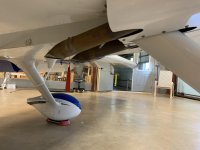
My engine is an IO-390 (Thunderbolt build) - not an EXP 119. However, my engine is equipped with a Vetterman 2 x 2-in-1 trombone exhaust that does not use the tunnel. This picture shows the exhaust before installation of the Tunnel Cooling Flap.
IMG_1840.jpg

This results in even more excess cooling capacity than a standard build and enables installation of the Tunnel Cooling Flap designed for the EXP-119. (The Tunnel Cooling Flap goes by several names, even within Van's instructions - "Exit Door", Tunnel Cowl Flap, Tunnel Cooling Flap).

My original motivation was the quest for speed or efficiency, but I actually needed the increased engine temperatures to deal with a sticking exhaust valve (discussed in another thread). Ultimately, I believe I gained 2 or 3 knots in mid altitude cruise (9-10k). My CHTs are about 30 deg F higher and oil temps about 10 degrees higher in cruise with the flap closed. These results are consistent with what some others have also reported.

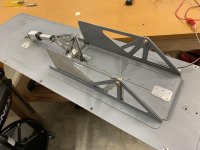
Most of the installation was straightforward, but adding the push-pull activation cable was going to require a new firewall penetration. This prompted me to look into electric operation. I selected an actuator made by Progressive Automations - their model PA-07. I wanted the entire cover, flap and mechanism to be a single unit with only electrical connections to the plane to facilitate removal, so I redesigned the activation to the aft end of the flap using a geometry similar to that used by AntiSplat's cowl flaps. It took some planning with cutouts, and a little bit of iteration to get the desired range of movement. I have a momentary 2-way rocker switch in the cockpit (similar to one used by many for electric trim). I opted not to have an indicator - up to down or reverse takes about 4 seconds and the actuator auto-stops at the limits.

Here are shots of the mechanism on the bench:
IMG_8762.jpg
IMG_8763.jpg

Builders planning on the EXP-119 engine might consider this modification.
 
In another thread on EXP-119 equipped 14s, a question was asked about converting the Tunnel Cooling Flap to electric operation. I mentioned in another thread that I had done this and got multiple PMs inquiring, so I am posting for the general audience.

My engine is an IO-390 (Thunderbolt build) - not an EXP 119. However, my engine is equipped with a Vetterman 2 x 2-in-1 trombone exhaust that does not use the tunnel. This picture shows the exhaust before installation of the Tunnel Cooling Flap.
View attachment 33879

This results in even more excess cooling capacity than a standard build and enables installation of the Tunnel Cooling Flap designed for the EXP-119. (The Tunnel Cooling Flap goes by several names, even within Van's instructions - "Exit Door", Tunnel Cowl Flap, Tunnel Cooling Flap).

My original motivation was the quest for speed or efficiency, but I actually needed the increased engine temperatures to deal with a sticking exhaust valve (discussed in another thread). Ultimately, I believe I gained 2 or 3 knots in mid altitude cruise (9-10k). My CHTs are about 30 deg F higher and oil temps about 10 degrees higher in cruise with the flap closed. These results are consistent with what some others have also reported.

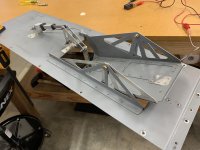
Most of the installation was straightforward, but adding the push-pull activation cable was going to require a new firewall penetration. This prompted me to look into electric operation. I selected an actuator made by Progressive Automations - their model PA-07. I wanted the entire cover, flap and mechanism to be a single unit with only electrical connections to the plane to facilitate removal, so I redesigned the activation to the aft end of the flap using a geometry similar to that used by AntiSplat's cowl flaps. It took some planning with cutouts, and a little bit of iteration to get the desired range of movement. I have a momentary 2-way rocker switch in the cockpit (similar to one used by many for electric trim). I opted not to have an indicator - up to down or reverse takes about 4 seconds and the actuator auto-stops at the limits.

Here are shots of the mechanism on the bench:
View attachment 33877
View attachment 33878

Builders planning on the EXP-119 engine might consider this modification.
Would you by any chance have any drawings of those brackets / arms to control the door?
 
My original motivation was the quest for speed or efficiency, but I actually needed the increased engine temperatures to deal with a sticking exhaust valve (discussed in another thread). Ultimately, I believe I gained 2 or 3 knots in mid altitude cruise (9-10k). My CHTs are about 30 deg F higher and oil temps about 10 degrees higher in cruise with the flap closed. These results are consistent with what some others have also reported.
Just FYI if you are doing this mod to decrease cooling and lower the chance of a sticky valve probably need to do more research. A friend on the east coast of Florida did this mod and his frequency of sticking valves increased. I believe Keith does a ream now at every annual. I have 0ver 700 hours on my 390 and keep CHT's (through LOP) below 320 F in cruise and to date no valves stuck. Maybe just luck. I also have an original IO390 210 hp version with EFII and Vetermans exhaust which probably does not make a difference. I have been using Aeroshell 15-50 last 500 hours and seems to keep the valve guides look "cleaner" but again very speculative. No cooling flap.

Never saw what oil Keith was using but would be good to add to this list, seems a higher % of Phillips 66 users experiencing the issue but again no data just speculation.

Note operating temp limitations of the linear servo.

Screenshot 2026-04-03 195446.png
 
Last edited:
In another thread on EXP-119 equipped 14s, a question was asked about converting the Tunnel Cooling Flap to electric operation. I mentioned in another thread that I had done this and got multiple PMs inquiring, so I am posting for the general audience.

My engine is an IO-390 (Thunderbolt build) - not an EXP 119. However, my engine is equipped with a Vetterman 2 x 2-in-1 trombone exhaust that does not use the tunnel. This picture shows the exhaust before installation of the Tunnel Cooling Flap.
View attachment 33879

This results in even more excess cooling capacity than a standard build and enables installation of the Tunnel Cooling Flap designed for the EXP-119. (The Tunnel Cooling Flap goes by several names, even within Van's instructions - "Exit Door", Tunnel Cowl Flap, Tunnel Cooling Flap).

My original motivation was the quest for speed or efficiency, but I actually needed the increased engine temperatures to deal with a sticking exhaust valve (discussed in another thread). Ultimately, I believe I gained 2 or 3 knots in mid altitude cruise (9-10k). My CHTs are about 30 deg F higher and oil temps about 10 degrees higher in cruise with the flap closed. These results are consistent with what some others have also reported.

Most of the installation was straightforward, but adding the push-pull activation cable was going to require a new firewall penetration. This prompted me to look into electric operation. I selected an actuator made by Progressive Automations - their model PA-07. I wanted the entire cover, flap and mechanism to be a single unit with only electrical connections to the plane to facilitate removal, so I redesigned the activation to the aft end of the flap using a geometry similar to that used by AntiSplat's cowl flaps. It took some planning with cutouts, and a little bit of iteration to get the desired range of movement. I have a momentary 2-way rocker switch in the cockpit (similar to one used by many for electric trim). I opted not to have an indicator - up to down or reverse takes about 4 seconds and the actuator auto-stops at the limits.

Here are shots of the mechanism on the bench:
View attachment 33877
View attachment 33878

Builders planning on the EXP-119 engine might consider this modification.
Very nice installation. Thank you for this. I assume the actuator has no issue closing the flap door at cruise? Others have said it can be rather difficult and require quite a bit of force.
 
Would you by any chance have any drawings of those brackets / arms to control the door?
I’m afraid the documentation is lacking, especially in this universe of engineers with CAD, etc. I did this as a very iterative experiment that happened to work - paper, then cardboard, then metal. I’ve posted some of my scratchpad notes, but dimensions should be taken as ideas, not specs. It has been in service now for over 4 years and over 400 hours without issue, and I’ve replicated it on my new build without changes.
 

Attachments

Very nice installation. Thank you for this. I assume the actuator has no issue closing the flap door at cruise? Others have said it can be rather difficult and require quite a bit of force.
I have had no issues with the actuator being strong enough, though I did not attempt to work out the physics (force required).
 
Just FYI if you are doing this mod to decrease cooling and lower the chance of a sticky valve probably need to do more research. A friend on the east coast of Florida did this mod and his frequency of sticking valves increased. I believe Keith does a ream now at every annual. I have 0ver 700 hours on my 390 and keep CHT's (through LOP) below 320 F in cruise and to date no valves stuck. Maybe just luck. I also have an original IO390 210 hp version with EFII and Vetermans exhaust which probably does not make a difference. I have been using Aeroshell 15-50 last 500 hours and seems to keep the valve guides look "cleaner" but again very speculative. No cooling flap.

Never saw what oil Keith was using but would be good to add to this list, seems a higher % of Phillips 66 users experiencing the issue but again no data just speculation.

Note operating temp limitations of the linear servo.

View attachment 114135
I’m not sure the debate on sticking valves will be resolved in my lifetime - hotter vs cooler vs sign-of-the-zodiac. I’ve not had a sticking valve in hundreds of hours, but it’s because as you say, I ream at annual - the preventative effort is worth no recurrence. As for oil, I use Phillips 66 - another debate unlikely to be resolved.
 
I’m afraid the documentation is lacking, especially in this universe of engineers with CAD, etc. I did this as a very iterative experiment that happened to work - paper, then cardboard, then metal. I’ve posted some of my scratchpad notes, but dimensions should be taken as ideas, not specs. It has been in service now for over 4 years and over 400 hours without issue, and I’ve replicated it on my new build without changes.
This is great, thanks!

What wire routing did you take? (And does that actuator have position feedback?)
 
Last edited:
I’m not sure the debate on sticking valves will be resolved in my lifetime - hotter vs cooler vs sign-of-the-zodiac. I’ve not had a sticking valve in hundreds of hours, but it’s because as you say, I ream at annual - the preventative effort is worth no recurrence. As for oil, I use Phillips 66 - another debate unlikely to be resolved.
Keith, thanks for the response and I agree. It seems with #2 typically the hottest of the 4 and the one more likely to stick (more likely) might be telling us something. I have been running my IO390 LOP with CHT's in cruise below 300 F and if that is not root cause to stick a valve I think to low CHT's is not an issue. Since you have probably reamed your engine more than anyone and done annually IF you ever decide to change to Aeroshell 15-50W (including anti-wear additives already in the oil) it would be great if you can let the forum know if you see more or less (stuff) that you find after reaming. My spidey since "feels" this might be true but just an assumption. Maybe 90% of IO390 operators are using Phillips 66 and thus that is why 90% are reporting stuck valves but I don't think so and of course no data. When I talk to someone who has seen a stuck valve in a IO390 the answer is ALMOST always Phillips 66 is the oil they are using.

Again, thanks.....700 hours running LOP and CHT's below 300 F and no stuck valves. 🤞

Don't give up! Get data!
 
This is great, thanks!

What wire routing did you take? (And does that actuator have position feedback?)
I put a pair of spade connectors on the wires (2) at the base of the firewall exiting the tunnel (remove cowl, disconnect wires, remove tunnel flap assembly), up the firewall to an existing wire wall wiring penetration, to a rocker switch on the panel (Mom-Off-Mom). In the interests of cost and complexity, no position sensing - it’s about 4 seconds full open to full closed with motor protection at stops.
 
it would be great if you can let the forum know if you see more or less (stuff) that you find after reaming.
My last reaming was at annual last May with almost negligible “crud”. However, it was only 75 hours since the previous ream. Did something change? Is it a progressive thing (longer, tighter, builds faster)? Like I said, I doubt I’ll find out in my lifetime. I have a new TB390 on order for my new build (if it ever comes, after 3 years on order) that should fly in 2027. Maybe the new one will do better.
 
I’m not sure the debate on sticking valves will be resolved in my lifetime - hotter vs cooler vs sign-of-the-zodiac. I’ve not had a sticking valve in hundreds of hours, but it’s because as you say, I ream at annual - the preventative effort is worth no recurrence. As for oil, I use Phillips 66 - another debate unlikely to be resolved.
Keith,

What do you see at your annual reaming? Do you do all cylinders or just # 2?

Thanks
 
Back
Top

