Van's Air Force

The definitive Van's Aircraft support community! Buying, building or flying an RV? Join our exclusive family of mentors and enthusiasts!

Tru Trak pitch servo circuit board

dougweil

Well Known Member
Friend
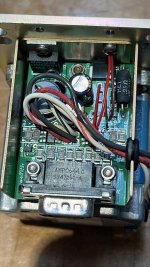
Several weeks ago I had concluded the pitch servo on my TruTrak Digiflight II was going bad. I finally found a replacement and bought it and all is fine. An engineer buddy of mine loves to take things apart so I said go ahead and see what you see inside my old servo. Here are some photos of the circuit board and it is obvious that several of the resistors got hot and it appears the solder began to melt and the resistors slid out of position. 1250 hours on the airframe. Just thought some of you might be interested.
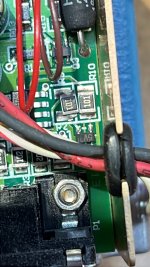
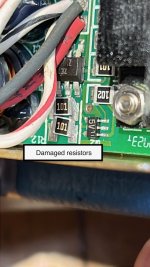
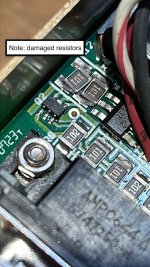
IMG_5996.jpeg

1747764965789.jpeg

1747765002384.jpeg

1747765024284.jpeg
 
My guess would be too much strain or binding on the servo. Resistors get hot because of too much voltage or current.
For the entire life of my TT autopilot (1250 hrs) I had the vertical torque set to the maximum of 12. My engineer buddy who is very familiar with the operation of stepping motors at his work, surmised that this results in higher voltage than lower vertical torque setting and maybe this caused the heat. I’m ignorant about such technical things. Maybe so???
 
I have seen circuit boards with a short circuit where components got so hot they actually fell of the PCB. It's hard to tell if your situation is from over heating in operation though, at least from these pictures. I can't tell the package size of these resistors maybe 0603 or 0805. That would mean that they are rated for 1/16 or may 1/8W max. If there was enough current to heat those resistors to melt the solder I don't think the resistors themselves would still be in tact. It's also possible that the board was bumped during assembly, moving the resistors and just barely not shorting and then later it did.
 
I had what appears to be exactly the same issue on my pitch servo (twice actually). I have a stubborn streak set out to reverse engineer that board and repair it.

The two small ICs next to those resistors are what had failed in my case. The hardest part was figuring out what that those chips are an H bridge driver and a dual PNP transistor. In my case it was just one side (single phase of stepper motor) in this case it appears to be both.

I purchased a cheap hot air rework station, head magnifier, some solder paste and got after it. Figuring i had nothing to lose. Much to my surprise I was successful in fixing it. If anyone else has this issue and want's to attempt the same repair the parts are:

H bridge Diodes inc ZHB6718TA mouser part 522-ZHB6718TA
Dual PNP transistor 50v 100ma in SOT-25 package mouser part 755-FMA5AT148

I think my failure was caused by the through hole connections on the 4 stepper wires contacting the case. After the second failure i trimmed those very close to the board and put a thin piece plastic between board and case. The servo has been working for a while now (>100hrs). It could fail tomorrow who knows but it was a "fun" puzzle to solve and I got some extra milage from an otherwise dead servo.

Todd Anderson
Bondurant Iowa
RV6 ultra slow build
 
Back
Top