Van's Air Force

The definitive Van's Aircraft support community! Buying, building or flying an RV? Join our exclusive family of mentors and enthusiasts!

Tracking down what seems to be an electrical issue

b_raf

Member
A few months ago, I noticed that my oil temperature occasionally seemed high. Recently, during a flight, the temperature spiked to over 250°F. I decided to turn back to the airport, and during the steep turn, the temperature dropped to normal levels, only to spike back up once I leveled out.

After reading through some forums, I found that someone with the same avionics (AFS 3500) had experienced a similar issue. It was suggested they pull the alternator fuse to see if that was contributing to the problem. On my next flight, I tried this—pulled the fuse—and watched the oil temperature drop from 250°F to 170°F.

However, during that same flight, my CHT started reading high. Pulling the fuse caused the CHT to drop by a few hundred degrees, but it still showed elevated readings for the rest of the flight and taxi. When I toggled the master switch while shutting down, the CHT readings returned to normal.

I initially suspected a grounding issue but haven’t found any problems there. I’m wondering if anyone else has experienced this or has any insights into what might be causing it?
 
A few months ago, I noticed that my oil temperature occasionally seemed high. Recently, during a flight, the temperature spiked to over 250°F. I decided to turn back to the airport, and during the steep turn, the temperature dropped to normal levels, only to spike back up once I leveled out.

After reading through some forums, I found that someone with the same avionics (AFS 3500) had experienced a similar issue. It was suggested they pull the alternator fuse to see if that was contributing to the problem. On my next flight, I tried this—pulled the fuse—and watched the oil temperature drop from 250°F to 170°F.

However, during that same flight, my CHT started reading high. Pulling the fuse caused the CHT to drop by a few hundred degrees, but it still showed elevated readings for the rest of the flight and taxi. When I toggled the master switch while shutting down, the CHT readings returned to normal.

I initially suspected a grounding issue but haven’t found any problems there. I’m wondering if anyone else has experienced this or has any insights into what might be causing it?
I would check if OIL, CHT transmitters require a GND on the engine and if so the engine GND-wire need to be checked.
Engine GND should be connected to firewall, battery negative and GND-bus.
The OIL and CHT transmitters use low voltage signals usually 0-5 V. Low voltage wire shoud not run parallel to the alternator wire or engine GND wire for any length.
It´s because large current in the alternator circuit may cause induction and hence false readings.
High oil temperature can also be the result of using wrong type of oil. Shell100 W straight oil has a low surounding air temperature limit of 61 F.
If surrounding air temp is 40 F, this may reduce oil flow in the oil cooler and result in high oil temperature readings.

Good luck.
 
To borrow from the line on Anchorman, 90% of the time a bad ground will do that every time.

You can test for continuity and still not have a good ground. Those little buggers are tricky, especially if you're based in an environment near the coast or with high humidity--or both. Unbolt, unplug, or otherwise disconnect the affected grounds, then clean and re-attach them. You can even use a little dielectric compound or something like Corrosion X on the connection to prevent corrosion from forming.
 
Generally speaking, if you see changes in measured values that would require new-physics to explain (e.g. Oil Temp goes from 180 to 375 in under 10 seconds) you probably have a grounding issue.

As a caution for all, pulling the alternator "fuse" is a really good way to damage the rectifier & regulator -- don't do it. If you want to remove the alternator from the buss in an attempt to isolate an electrical issue, just turn off the field current - either by the dedicated switch or the 5A CB.

Further, when you remove the alternator from the buss, the buss voltage will decrease from the ~14.5Vdc Alternator output voltage to the battery voltage of ~12.8Vdc (AGM/VRLA) or ~13.2Vdc (LiFePO+). A reduction in the buss voltage *may* affect certain transducers & sensors that operate on unregulated buss voltage.

Check the grounds - are all the connectors/terminations at the wire ends solid & clean? Is the ground path itself "low resistance" -- check the grounding from the probe/case to the [-] terminal on the battery. It should measure under a 100 milliohms or less (.1ohm).

Check the connectors at the transducers - Are they neatly crimped, soldered, or otherwise attached firmly and corrosion free?

Curious to know what you find -- good luck!

B
 
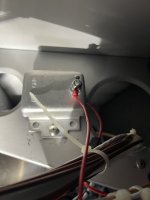
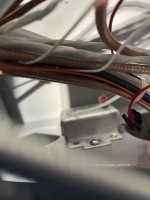
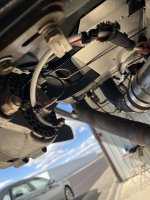
I’m having a high voltage caution with 14.5 volts on my RV10, O-540. Then it will go down to 14.2 in the top of the green. Local mechanics are saying voltage regulator. Is this the voltage regulator under my panel?
 

Attachments

  • IMG_5640.jpeg
    IMG_5640.jpeg
    1.8 MB · Views: 180
  • IMG_5638.jpeg
    IMG_5638.jpeg
    1.7 MB · Views: 1,004
Last edited:
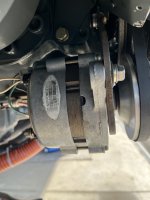
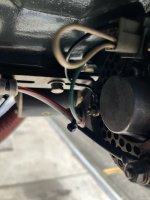
Unsure what that is. Can you show picture of alternator front & back. Some alternators have internal regulators.
Also do you have dual alternators?
 
14.5 to 14.2 don't sound like high enought to set off a high voltage alarm. That s fairly tight range and says to me the regulator is doing it's job.. not 540 but my 320 will indicate 14.8 when charging heavily and down to 12.5 when not charging
 
Unsure what that is. Can you show picture of alternator front & back. Some alternators have internal regulators.
Also do you have dual alternators?
Yes thank you. One alternator.
 

Attachments

  • IMG_5642.jpeg
    IMG_5642.jpeg
    1.7 MB · Views: 125
  • IMG_5643.jpeg
    IMG_5643.jpeg
    1.7 MB · Views: 53
  • IMG_5644.jpeg
    IMG_5644.jpeg
    1.6 MB · Views: 1,363
Nippondenso alternator. Most likely regulator is built right into it. Easiest way to trouble shoot would be to remove & take it to your local ‘auto electric’ shop. They can put on their test stand to see if its working right.
 
14.5 to 14.2 don't sound like high enought to set off a high voltage alarm. That s fairly tight range and says to me the regulator is doing it's job.. not 540 but my 320 will indicate 14.8 when charging heavily and down to 12.5 when not charging
Thanks. I’m trying to figure out if it’s an issue or not. My local mechanic says that’s high.
 
A follow up report: The alternator does not have an internal regulator. There is an external generic auto regulator which is adjustable under the panel. I turned it down and that lowered the voltage to 13.9 or so, so I'm happy.
 
Back
Top