Van's Air Force

The definitive Van's Aircraft support community! Buying, building or flying an RV? Join our exclusive family of mentors and enthusiasts!

Tire Pressure Monitoring System (TPMS) experience updates?

Since my last update I have returned the automotive FOBO TIRE LITE sensors and purchased the FOBO Bike 2 Trike sensors because I was unable to set the pressure limits in the FOBO TIRE LITE software to be within the range specified for the RV-12 tires. After doing this, I learned that by selecting the “Off-Road Mode” that the pressure limits can be set down to as low as 5 psi.

The FOBO Bike 2 Trike sensors are installed on all three wheels and working.

The clearance between the outside of the sensor and the inside of the nose wheel fork is 1/8 inch. But, if one gently moves the end of the tire tube valve stem it is possible to get the sensor to touch the inside of the nose wheel fork. To fix this I have threaded a nylon spacer onto the valve stem that is positioned to be aligned with the hole in the nose wheel. The spacer is slightly smaller than the hole in the nose wheel and thus, limits how far the valve stem can move preventing the sensor from touching the nose wheel fork.

I think that I now have a workable solution for putting a TPMS on all three wheels.

Brett H
Columbus, IN
RV-12 N4BH

View attachment 100677View attachment 100678View attachment 100679View attachment 100680


Now that I have had experience using the FOBO Bike 2 Trike TPMS, I wanted to share what I have learned.

Whenever I have needed to add air to the tires I have set it to just below the Van's POH maximum air pressure limit. Initially, I set the FOBO maximum air pressure alarm to the Van's POH air pressure limit. So, the initial time that I went flying the FOBO maximum air pressure alarm was activated due to the tires being warmed up from taxiing and landing. The solution was to move the high pressure alarm up and out of the way. After all, the concern is pressure loss and not pressure gain.

The tire air pressure changes more with temperature than I anticipated.

Since I am no longer using a mechanical gage to check air pressure before flying, I am adding air to the tires less often.

Adding air to tires is slightly more involved than it used to be because as one screws the FOBO TPMS sensor onto the valve stem it depresses the valve just before it seals on the end of the valve stem. This causes a slight loss of air. So, one has to put a bit more air into the tire to account for this loss.

In summary, the FOBO Bike 2 Trike TPMS is working on all three tires and I be continuing to use it.

Brett H
RV-12, N4BH
Columbus, IN
 
Brett H -- thanks for the PIREP. I think I found a new gadget to add to my RV. It looks like it might fit inside the wheel pants of my other plane, so you may have saved me double the trouble! :D
 
My trial of the “FOBO TIRE LITE TPMS Sensor” set (bought from Amazon) on my 2015 Sienna has gone well. Bluetooth signal is surprisingly strong. Overall, much better than the old Toyota OEM TPMS solution, which didn’t tell you which tire was low. Also probably easier & cheaper than replacing the old OEM sensors, which of course reside inside the tires and have long-dead batteries.

I’ll be trying them on the RV, assuming they fit inside the wheelpants okay.
 
Now that I have had experience using the FOBO Bike 2 Trike TPMS, I wanted to share what I have learned.

Whenever I have needed to add air to the tires I have set it to just below the Van's POH maximum air pressure limit. Initially, I set the FOBO maximum air pressure alarm to the Van's POH air pressure limit. So, the initial time that I went flying the FOBO maximum air pressure alarm was activated due to the tires being warmed up from taxiing and landing. The solution was to move the high pressure alarm up and out of the way. After all, the concern is pressure loss and not pressure gain.

The tire air pressure changes more with temperature than I anticipated.

Since I am no longer using a mechanical gage to check air pressure before flying, I am adding air to the tires less often.

Adding air to tires is slightly more involved than it used to be because as one screws the FOBO TPMS sensor onto the valve stem it depresses the valve just before it seals on the end of the valve stem. This causes a slight loss of air. So, one has to put a bit more air into the tire to account for this loss.

In summary, the FOBO Bike 2 Trike TPMS is working on all three tires and I be continuing to use it.

Brett H
RV-12, N4BH
Columbus, IN
What valve stems do you use? I wonder if the rapid wheel acceleration on landing could stress the valve stem with this added weight on it.
 
What valve stems do you use? I wonder if the rapid wheel acceleration on landing could stress the valve stem with this added weight on it.

I am using the Classic Aero Inner Tubes. The same that Van’s supplies.

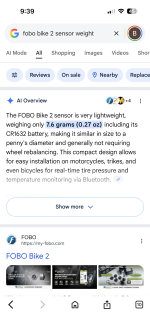
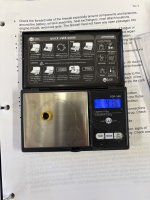
The FOBO Bike 2 TPMS sensor weighs 7.6 grams and the valve stem cap that it replaces weighs 4.8 grams. So, only a slight increase.

Brett H
Columbus, IN N4BH

IMG_3856.png
IMG_3859.jpeg
 
Correct.... not installed on nose wheel because interference with fork.

I have a computer and a Raspberry Pi in my hangar (and a wifi connection). I realized one of the two might happen to have Bluetooth built in. The RPi does.. so then I got to thinking.. It'd be nice to get an e-mail or something when my tires fall below 20 psi.. I'd rather find out when it happens rather than the morning I show up to the airport with my propeller hat on, ready to fly.

Attached is a python program (you'll need the python-bleak package installed to do bluetooth things) that will listen to BLE advertisement packets and log them to a file. What you do with the data after that is up to you.. shoot out an email, display it on a screen in the hangar, etc. The goal was to just get the data out of the sensors...

Run:
python tpms.py --wheel left=81:EA:CA:22:18:2F --wheel right=83:EA:CA:42:C9:07 --csv /tmp/csv.log --print

Sample output:

[2026-01-08T23:58:36] right 83:EA:CA:42:C9:07 RSSI=-73 P=145.213 kPa (21.061 psi) T=1C (fine 1.98C) Batt=76% raw=83 ea ca 42 c9 07 3d 37 02 00 c6 00 00 00 4c 00
[2026-01-09T00:01:24] left 81:EA:CA:22:18:2F RSSI=-80 P=172.453 kPa (25.012 psi) T=0C (fine 0.92C) Batt=78% raw=81 ea ca 22 18 2f a5 a1 02 00 5c 00 00 00 4e 00
 

Attachments

Last edited:
Back
Top