


Van's Air Force
You are using an out of date browser. It may not display this or other websites correctly.
You should upgrade or use an alternative browser.
You should upgrade or use an alternative browser.
Thread sealant on my fuel lines?
- Thread starter nohoflyer
- Start date

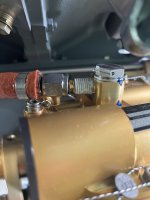

Correct! You should NOT have thread sealant on the threads of a flare fitting. The seal is the flare itself.I know that the nipple of the connection should be free of sealant but I thought that as long as it was just on the threads I’d be ok. I got some feedback that I shouldn’t have thread sealant on the bellow part and I got concerned.
Thoughts?
Actually this could mask a fuel leak. What if the flare developed a small leak and the thread sealant "hid" that leak?Thank you Mel. I’m just paranoid of a fuel leak. No excuse for not understanding though.

Playing devils advocate, It’s hard to fault someone for following the manufacturer’s recommendation for Loctite sealants.
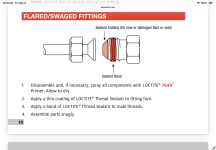
I posted that on another thread some time ago and got somewhat spirited debate.Playing devils advocate, It’s hard to fault someone for following the manufacturer’s recommendation for Loctite sealants.

pazmanyflyer
Well Known Member
This is for the NPT side of the fitting. They are talking about the flared end.found on VAF
Wouldn’t that be a “non-leak”…?Actually this could mask a fuel leak. What if the flare developed a small leak and the thread sealant "hid" that leak?
I'm not sure what you are saying. The image states that all fittings on RVs are NPT and to use sealant.This is for the NPT side of the fitting. They are talking about the flared end.
What kind of fitting do you see sealant on in the photo?
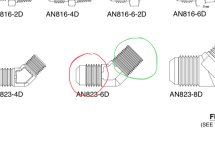
In the interest of learning, I’d love to find primary source material for thisI’m going to try to summarize with this one photo. Green is yes (NPT) and red is no (flare).
View attachment 117027

There may be other industries where this is a good idea, but on aircraft fluid systems it is a hard no.Playing devils advocate, It’s hard to fault someone for following the manufacturer’s recommendation for Loctite sealants.
View attachment 117020
Aircraft have far too many small passages that even a small amount of sealant that got away, could restrict.
Aside from that, I am confused why this would ever be recommended, because sealant on the threads doesn't completely provide a secondary seal. There is still a potential leakage path between the line and the hole for the line in the "B" nut.
Again, I don’t disagree but would like a primary source for this.There may be other industries where this is a good idea, but on aircraft fluid systems it is a hard no.
Aircraft have far too many small passages that even a small amount of sealant that got away, could restrict.
Aside from that, I am confused why this would ever be recommended, because sealant on the threads doesn't completely provide a secondary seal. There is still a potential leakage path between the line and the hole for the line in the "B" nut.
Online answers seem to refer back to vaf and kiplanes. I’d like better.
The best I can find is something similar for flared OXYGEN fittings from chapter four, paragraph 89 from ac43.13 2b
Since I wrote that section you can blame me if you think it is unclear....I'm not sure what you are saying. The image states that all fittings on RVs are NPT and to use sealant.
What kind of fitting do you see sealant on in the photo?
In the context of airplane building, and writing technical info in regards to that endeavor, There are many instances (maybe almost always) where when some info is being provided, there is often an expectation of additional knowledge that is expected to have been gained elsewhere.
So in this case the reader is expected to know what a flared end of a fitting is (details of connecting those are in another area of Section 5). Additionally, the title of the section is Pipe Thread Fittings. With that title the expectation is that if someone doesn't know what a "Pipe Thread Fitting" is, that they would do some research and gain some knowledge from other resources such as standard aircraft handbook, etc.
Remember, Section 5 of the construction manual specifically states that it is not the all inclusive resource for information to build an RV kit airplane. It is meant to be a source of details to fill in the gaps, and / or provide some clarity for specific details as applicable to building an RV specifically (such as this case here where there is some industry documentation indicating that sealant on threads of a "non-NPT" end of a fitting is a good idea.
BTW, I admit that the statement "all threaded fittings used on an RV are NPT" is a bit incorrect. It is correct in regards to all of the fittings supplied in the RV airframe kit are NPT. There are a few instances where a fitting (the fittings for the engine driven fuel pump are a good example) uses a crush gasket or an o-ring seal to provide the seal for the fitting, because these fittings have straight (non tapered) threads that do not develop an interference fit when the fitting is tightened.
Hopefully that clears up any confusion
Have you looked at FAA advisory circular AC43.13, and /or the Standard Aircraft Handbook?Again, I don’t disagree but would like a primary source for this.
Online answers seem to refer back to vaf and kiplanes. I’d like better.
The best I can find is something similar for flared OXYGEN fittings from chapter four, paragraph 89 from ac43.13 2b
These both are considered authoritative for excepted practice on all things related to aircraft construction and maintenance, and the info in them aligns with what is being stated in this thread.
Thanks.Since I wrote that section you can blame me if you think it is unclear....
In the context of airplane building, and writing technical info in regards to that endeavor, There are many instances (maybe almost always) where when some info is being provided, there is often an expectation of additional knowledge that is expected to have been gained elsewhere.
So in this case the reader is expected to know what a flared end of a fitting is (details of connecting those are in another area of Section 5). Additionally, the title of the section is Pipe Thread Fittings. With that title the expectation is that if someone doesn't know what a "Pipe Thread Fitting" is, that they would do some research and gain some knowledge from other resources such as standard aircraft handbook, etc.
Remember, Section 5 of the construction manual specifically states that it is not the all inclusive resource for information to build an RV kit airplane. It is meant to be a source of details to fill in the gaps, and / or provide some clarity for specific details as applicable to building an RV specifically (such as this case here where there is some industry documentation indicating that sealant on threads of a "non-NPT" end of a fitting is a good idea.
BTW, I admit that the statement "all threaded fittings used on an RV are NPT" is a bit incorrect. It is correct in regards to all of the fittings supplied in the RV airframe kit are NPT. There are a few instances where a fitting (the fittings for the engine driven fuel pump are a good example) uses a crush gasket or an o-ring seal to provide the seal for the fitting, because these fittings have straight (non tapered) threads that do not develop an interference fit when the fitting is tightened.
Hopefully that clears up any confusion
My interest in this is one of curiosity, but also as a new Lsrm.Have you looked at FAA advisory circular AC43.13, and /or the Standard Aircraft Handbook?
These both are considered authoritative for excepted practice on all things related to aircraft construction and maintenance, and the info in them aligns with what is being stated in this thread.
My understanding is that I should follow source material as I work, not online comments.
I’ve done though chapter 8 on fuel and quoted it and also used ai to try and find a primary source. It tried to quote oxygen info, I can’t find fuel specific.
This is why I ask. I’ll try and look elsewhere and await further replies
There may be other industries where this is a good idea, but on aircraft fluid systems it is a hard no.
Aircraft have far too many small passages that even a small amount of sealant that got away, could restrict.
Aside from that, I am confused why this would ever be recommended, because sealant on the threads doesn't completely provide a secondary seal. There is still a potential leakage path between the line and the hole for the line in the "B" nut.
It’s contrary to my training too. When I first saw the instructions I was horrified. It seemed silly to apply it to the threads as that is not the sealing surface and putting it on the flare face would result in contamination. I made a short section of 3/8 tubing and put varying amounts of sealant on the face of the male fitting, tightened and then removed and inspected for sealant. Unless you put a stupid amount of sealant on so that it was over the edge of the tube no sealant made its way into the tube.
I also thought the sealant on the threads may lubricate and affect the tightening torque of the fitting. I flared short sections of tube and fitted new nuts, ferrules and male fittings. Tightened them finger tight, marked the fittings and used a torque wrench to tighten them to a 1-1/2 flat engagement. With or without sealant the torque required was within a few inch pounds.
Maybe they are just trying to sell more sealant and It may not help but I don’t think it’s a deal breaker. NPT fittings are theoretically intended to be metal to metal joints too but the sealant does wonders compared to dry.
Last edited:
I do not have the standard aircraft handbook. Is this covered there?Have you looked at FAA advisory circular AC43.13, and /or the Standard Aircraft Handbook?
These both are considered authoritative for excepted practice on all things related to aircraft construction and maintenance, and the info in them aligns with what is being stated in this thread.
I do not see this covered in the asa book by dale crane
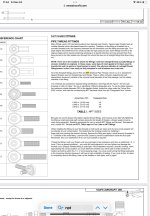
screen shots from this source
So leave contact between metal flare fittings but use something on the threads? Leaving but rereading, this is just about a lubricant, not a sealant.
Attachments
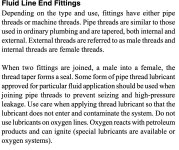
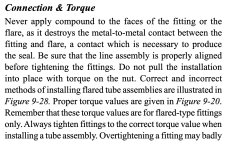
Last edited:
I respect your need for a primary source. Contamination of the fuel system with sealant is a topic worthy of deep thought. Please Understand also the principle behind the standard that has been communicated. I spent 30 minutes looking for a reference. I gave up.
I did not find it in Vans Section 5 General Information. Its not in AC43.13. AI lied to me saying it was there. I called AI out and got him to confess that he lied to me. So, Build the way that you want and makes YOU feel comfortable. You might survey us and see how we feel about this topic.
The Industry Best Practices says 37 degree flare fittings depend on a metal to metal contact for sealing. We all leave them dry, and tighten them carefully so we dont crush the aluminum tubing under the flare. I practiced crushing the tubing at home. By intentionally crushing the alumimum tubing I could see it and feel it and helped me to know how to tighten the fittings. I have probably 50 of them on my Bearhawk Patrol, no leaks.
There is a standard for tightening them that uses a "Flats past finger tight" standard. The number of flats is dependent on the fitting size.
The industry best practice in aviation for sealing hose connections is this: Sealant is always used on tapered pipe threads and we never use teflon tape. Fill one thread of a tapered fitting 3/4 of its radius with sealant. Do not use sealant on Flared Fittings or ORB fittings.
A concern is Contamination of the fluids with sealant squeez-out will cause internal fuel system orifaces to get plugged with sealant. At best it leads to a poor performance when a carb jet gets contaminated, or at worse leads to engine stoppage. Put some sealant in a cup of gasoline and time it to see how long it takes for the gasoline to dilute the sealant. Get yourself a good sealant . Many of like Permatext High Performance thread sealant. Fuel Lube or Easy Turn would also be a good one to test. This is Experimental Aviation.
I did not find it in Vans Section 5 General Information. Its not in AC43.13. AI lied to me saying it was there. I called AI out and got him to confess that he lied to me. So, Build the way that you want and makes YOU feel comfortable. You might survey us and see how we feel about this topic.
The Industry Best Practices says 37 degree flare fittings depend on a metal to metal contact for sealing. We all leave them dry, and tighten them carefully so we dont crush the aluminum tubing under the flare. I practiced crushing the tubing at home. By intentionally crushing the alumimum tubing I could see it and feel it and helped me to know how to tighten the fittings. I have probably 50 of them on my Bearhawk Patrol, no leaks.
There is a standard for tightening them that uses a "Flats past finger tight" standard. The number of flats is dependent on the fitting size.
The industry best practice in aviation for sealing hose connections is this: Sealant is always used on tapered pipe threads and we never use teflon tape. Fill one thread of a tapered fitting 3/4 of its radius with sealant. Do not use sealant on Flared Fittings or ORB fittings.
A concern is Contamination of the fluids with sealant squeez-out will cause internal fuel system orifaces to get plugged with sealant. At best it leads to a poor performance when a carb jet gets contaminated, or at worse leads to engine stoppage. Put some sealant in a cup of gasoline and time it to see how long it takes for the gasoline to dilute the sealant. Get yourself a good sealant . Many of like Permatext High Performance thread sealant. Fuel Lube or Easy Turn would also be a good one to test. This is Experimental Aviation.
Last edited:
Boeing BAC 5001
Section 5001.2223 and 5001.2224 allow the use of AN-C-52 Anti-Seize only, on the threads of flare fittings, but states that there is to be none on the flare itself due to the possible contamination of the interior of the fitting and the fluid system it is part of.
Oxygen systems have their own standard for tube nut installations.
The company that I work, for has engineering standards as well that are similar to the Boeing standard, but are not publicly available.
Section 5001.2223 and 5001.2224 allow the use of AN-C-52 Anti-Seize only, on the threads of flare fittings, but states that there is to be none on the flare itself due to the possible contamination of the interior of the fitting and the fluid system it is part of.
Oxygen systems have their own standard for tube nut installations.
The company that I work, for has engineering standards as well that are similar to the Boeing standard, but are not publicly available.
pazmanyflyer
Well Known Member
AC43.13-2B Chapter 6 Section 610 Thread compound paragraphs (a) and (c), Page 54. https://www.google.com/url?sa=i&source=web&rct=j&url=https://www.faa.gov/documentlibrary/media/advisory_circular/ac%2043.13-2b.pdf&ved=2ahUKEwj2p6-fnaqUAxW0lu4BHa_CELIQy_kOegQIARAB&opi=89978449&cd&psig=AOvVaw2KXNenyPI6ON94gGtzbr3s&ust=1778348149912000In the interest of learning, I’d love to find primary source material for this
That is about oxygen systems, not fuelAC43.13-2B Chapter 6 Section 610 Thread compound paragraphs (a) and (c), Page 54. https://www.google.com/url?sa=i&source=web&rct=j&url=https://www.faa.gov/documentlibrary/media/advisory_circular/ac%2043.13-2b.pdf&ved=2ahUKEwj2p6-fnaqUAxW0lu4BHa_CELIQy_kOegQIARAB&opi=89978449&cd&psig=AOvVaw2KXNenyPI6ON94gGtzbr3s&ust=1778348149912000
Sure, except the FAA pub screenshot that says to not put it on the flare, contrary to your product directions. NEVERAgain playing devils advocate. AC43-13 is not a requirements document. It is a guideline when no manufacturer data is available. Here we have a case where there is manufacturer instructions.
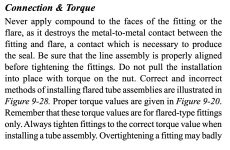
The reference You give to put sealant on a flare fitting that you sight is not a best practice.
I did not give a reference to put it on the flare, just the threads.
pazmanyflyer
Well Known Member
(a) "Do not use compound on aluminum alloy flared tube fittings having straight threads. Proper flaring and tightening should be sufficient to make a flared tube connection leakproof."That is about oxygen systems, not fuel

Auburntsts
Well Known Member
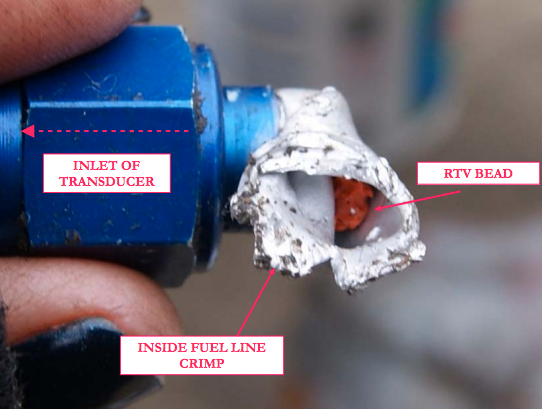
All I know is we had an RV-10 fatal crash due to a fuel system failure caused by blockages attributable to his use of RTV on the flared fittings. The risk just isn't worth the squeeze since these fittings were designed to work without sealant.
If you do end up with a leak on your flared fitting, and for some reason can't replace it, these come in handy: https://www.aircraftspruce.com/catalog/hapages/del37fittings.php

All good info until you mentioned fuel lube. Fuel lube or easy turn is NOT a sealant, and over time, the goop will migrate though the thread root leak path, and will leak. It’s a lubricant, not a sealant. I’ve had excellent results with Locktite 565 or the higher temp 567 as a sealant.I respect your need for a primary source. Contamination of the fuel system with sealant is a topic worthy of deep thought. Please Understand also the principle behind the standard that has been communicated. I spent 30 minutes looking for a reference. I gave up.
I did not find it in Vans Section 5 General Information. Its not in AC43.13. AI lied to me saying it was there. I called AI out and got him to confess that he lied to me. So, Build the way that you want and makes YOU feel comfortable. You might survey us and see how we feel about this topic.
The Industry Best Practices says 37 degree flare fittings depend on a metal to metal contact for sealing. We all leave them dry, and tighten them carefully so we dont crush the aluminum tubing under the flare. I practiced crushing the tubing at home. By intentionally crushing the alumimum tubing I could see it and feel it and helped me to know how to tighten the fittings. I have probably 50 of them on my Bearhawk Patrol, no leaks.
There is a standard for tightening them that uses a "Flats past finger tight" standard. The number of flats is dependent on the fitting size.
The industry best practice in aviation for sealing hose connections is this: Sealant is always used on tapered pipe threads and we never use teflon tape. Fill one thread of a tapered fitting 3/4 of its radius with sealant. Do not use sealant on Flared Fittings or ORB fittings.
A concern is Contamination of the fluids with sealant squeez-out will cause internal fuel system orifaces to get plugged with sealant. At best it leads to a poor performance when a carb jet gets contaminated, or at worse leads to engine stoppage. Put some sealant in a cup of gasoline and time it to see how long it takes for the gasoline to dilute the sealant. Get yourself a good sealant . Many of like Permatext High Performance thread sealant. Fuel Lube or Easy Turn would also be a good one to test. This is Experimental Aviation.
All I know is we had an RV-10 fatal crash due to a fuel system failure caused by blockages attributable to his use of RTV on the flared fittings. The risk just isn't worth the squeeze since these fittings were designed to work without sealant.
RTV is a whole other beast than the non-hardening sealants recommended for NPT connections. Even when misused on flare fittings. If some paste gets into the lines it's likely to be picked up by the filters or passed through without issues. A ball of RTV won't. Same reason teflon tape is not allowed.
Playing devils advocate, It’s hard to fault someone for following the manufacturer’s recommendation for Loctite sealants.
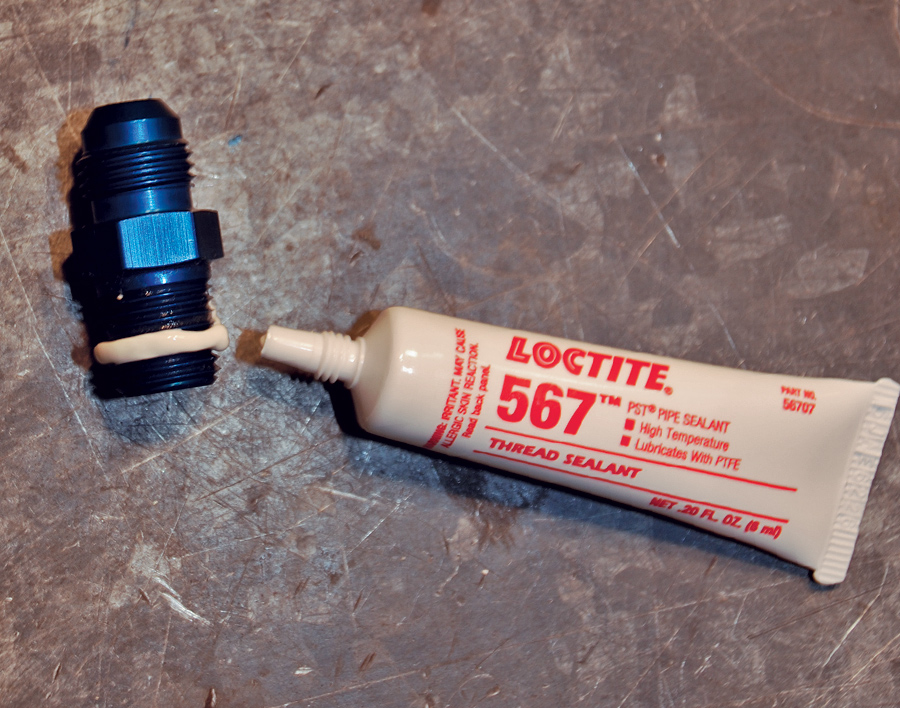
I've put some 567 on the face of a flared fitting in my mini-split to fix a small factory defect that let it leak. Works great. Better than the "no leak" washers did. I don't see any reason to put it on the threads other than corrosion protection.
I would not do the same for an AN fuel line.

I know that the nipple of the connection should be free of sealant but I thought that as long as it was just on the threads I’d be ok. I got some feedback that I shouldn’t have thread sealant on the bellow part and I got concerned.
Thoughts?
Auburntsts
Well Known Member
Valid point on the RTV but for me the risk of putting any kind of sealant on a flare fitting isn’t worth it. YMMV ….RTV is a whole other beast than the non-hardening sealants recommended for NPT connections. Even when misused on flare fittings. If some paste gets into the lines it's likely to be picked up by the filters or passed through without issues. A ball of RTV won't. Same reason teflon tape is not allowed.
I've put some 567 on the face of a flared fitting in my mini-split to fix a small factory defect that let it leak. Works great. Better than the "no leak" washers did. I don't see any reason to put it on the threads other than corrosion protection.
I would not do the same for an AN fuel line.
Last edited:
Agreed.Valid point on the RTV but for me the risk of putting any kind of sealant on a flare fitting isn’t worth it. YMMV ….
That said there is a decent chance to get some sealant past the threads on the NPT fittings. Especially if they've ever been reinstalled. All it takes is getting a tiny daub on the female threads from human factors and it'll get pushed ahead of the fitting. Buttering the face of a flare fitting would all but guarantee to get some in the line!
All I know is we had an RV-10 fatal crash due to a fuel system failure caused by blockages attributable to his use of RTV on the flared fittings. The risk just isn't worth the squeeze since these fittings were designed to work without sealant.
Is this the incident you are talking about?
Van's Aircraft Sued for $35 Million over RV-10 Crash - KITPLANES
The family of a 4-year old girl and her mother are suing kit maker Van’s Aircraft over the death of the girl and injuries to the mother sustained in the May 2014 crash of an RV-10 built by the girl’s step-grandfather. The family is asking for $35 Million in damages. The NTSB investigation...
 www.kitplanes.com
Auburntsts
Well Known Member
Yes. I knew the builder, even helped him move his fuse to our mutual EAA Chapters hangar at the time. Never saw the completed plane, unfortunately .Is this the incident you are talking about?
Van's Aircraft Sued for $35 Million over RV-10 Crash - KITPLANES
The family of a 4-year old girl and her mother are suing kit maker Van’s Aircraft over the death of the girl and injuries to the mother sustained in the May 2014 crash of an RV-10 built by the girl’s step-grandfather. The family is asking for $35 Million in damages. The NTSB investigation...

As a fluidline supplier to the industry, we say yes to sealer on NPT threads, and no to sealer on the flare threads. If it were on the flare threads, there is a possibility that the torque value could ne reached before a proper metal to metal seal. May not leak immediately, but over time that possibility exists. Object lesson is to have the male and female flares mate, and with proper torque compress into each other. Use 2 new fittings, connect and torque them. The disassemble them and check the seal ring made by the connection. Sealer on the threads may inhibit that seal ring.Yes. I knew the builder, even helped him move his fuse to our mutual EAA Chapters hangar at the time. Never saw the completed plane, unfortunately .

Also, do not use teflon tape on NPT or any other fitting. It leaves strings of teflon that can migrate into the lines.
This is made very clear in 43-13.Also, do not use teflon tape on NPT or any other fitting. It leaves strings of teflon that can migrate into the lines.
For those not familiar with the acronym ORB… O-Ring Boss…. per an SAE “J” standard.… Do not use sealant on Flared Fittings or ORB fittings….
ORBs have an o-ring that pushes into a tapered cavity. They are good for high pressure, 5,000 psi for 3/8” (-06) size that we commonly use, because there is no o-ring extrusion gap as installed.
Used on Lycoming fuel pumps. Elbows and Tees are clockable.
Last edited:

Thanks for that table. Adding to my documentation.For those not familiar with the acronym ORB. These are O-ring Boss. There is an SAE “J” standard for these. They have an o-ring that pushes into a tapered cavity. They are good for high pressure, 5,000 psi for 3/8” (-06) size that we commonly use, because there is no o-ring extrusion gap as installed. Used on Lycoming fuel pumps. Elbows and Tees are clockable.
