Van's Air Force

The definitive Van's Aircraft support community! Buying, building or flying an RV? Join our exclusive family of mentors and enthusiasts!

The Nearly Perfect Rocket II

RWoodard

Well Known Member
Sponsor
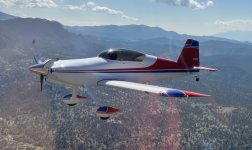
I am fortunate to own one of the best examples of a Harmon Rocket II ever constructed. It won a Silver Lindy at Oshkosh in 2002 and I'm convinced it would've won Grand Champion if there was a way to show all the hidden innovation and features. The builder, David Howe, is an absolute genius. He sees innovation and opportunities for improvement us mere mortals will never imagine. Jack Cox described this plane thusly "David Howe’s Harmon Rocket II is indeed one of the closest reaches toward perfection in the art and science of aircraft homebuilding any of us have had the privilege of seeing and admiring." in a December, 2003 article in Sport Aviation.

I'm very proud of the plane and see myself almost as a museum curator. My job is to preserve the plane in the condition I received it except that mine is a flying museum. I don't have the net worth to justify owning something that just sits in the corner of a hangar for viewing purposes only. My situation requires that I make regular use of the gem AND keep it as perfect as the day I took possession.

I'll use this thread to document any modifications and make note of any maintenance findings that may help other Rocket or RV owners. So it's not a "build" project, it's a "maintain and modify" process. More and more RV and Rocket owners fit this description, so I'm hoping this thread is relevant and helpful. I'm a bit more technically capable and really consider myself more of a builder than a buyer, but here we are. Comments and critique welcomed. That's how I learn.

IMG_7084.jpeg
 
I am fortunate to own one of the best examples of a Harmon Rocket II ever constructed. It won a Silver Lindy at Oshkosh in 2002 and I'm convinced it would've won Grand Champion if there was a way to show all the hidden innovation and features. The builder, David Howe, is an absolute genius. He sees innovation and opportunities for improvement us mere mortals will never imagine. Jack Cox described this plane thusly "David Howe’s Harmon Rocket II is indeed one of the closest reaches toward perfection in the art and science of aircraft homebuilding any of us have had the privilege of seeing and admiring." in a December, 2003 article in Sport Aviation.

I'm very proud of the plane and see myself almost as a museum curator. My job is to preserve the plane in the condition I received it except that mine is a flying museum. I don't have the net worth to justify owning something that just sits in the corner of a hangar for viewing purposes only. My situation requires that I make regular use of the gem AND keep it as perfect as the day I took possession.

I'll use this thread to document any modifications and make note of any maintenance findings that may help other Rocket or RV owners. So it's not a "build" project, it's a "maintain and modify" process. More and more RV and Rocket owners fit this description, so I'm hoping this thread is relevant and helpful. I'm a bit more technically capable and really consider myself more of a builder than a buyer, but here we are. Comments and critique welcomed. That's how I learn.

View attachment 99014
John Harmon knew what he was doing when he originated this design, truly a magnificent example of his genius also...
 
Well, I’ve done it now.

I bought the most perfect Harmon Rocket II in existence and now I’ve modified it. They say the definition of perfection is when, if you do anything else, you make it worse, not better. As Jack Cox said in his December, 2003 Sport Aviation article, David Howe’s 2002 Silver Lindy winning HRII comes as close as you can get to perfection.

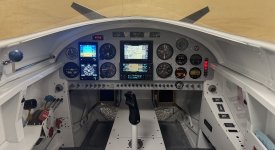
I agree, and that’s why I bought it! But 2002 is a long time ago and it’s light years ago in terms of avionics. The panel consisted of a King KMD 150 GPS, a King KLX 135A, and an Apollo SL 70 transponder. It used an EchoUAT for ADS-B. All the radios were state of the art and very high dollar in 2002, but were a bit long in the tooth as compared to modern equipment.

I’m a tinkerer and sort of a perfectionist at heart, so I just couldn’t help myself and jumped in for an upgrade. My work is ABSOLUTELY NOT a knock on David Howe, the genius who built the airplane. There is absolutely NO WAY I could ever match the work he did. It was just time for a refresh and my ultimate goal was to Do No Harm, as the doctors say.

It started about a month ago when I promised myself that ALL I was going to do is install the GMU11 in the tail and run a wiring loom to the panel. A daylong project at most… maybe just a few hours. Hah.

David ran a clear PVC tube from near the pilot’s control stick to the back of the plane. I started with a fiberglass wire fish rod, but it hung up somewhere along the line, so I started taking floor panels out. Before I knew it, I had the entire interior removed. David is well-deserving of his “HFS” moniker. It stands for Hell for Stout. After removing about 627 #8 screws holding down the floorboards, I came to appreciate and understand the HFS designation.

At this point, I decided, it would be a waste of time to remove the interior again in a few weeks to finish my “little” radio upgrade project, so I dove in with both feet. Heck, it’ll take me a week, maybe. Hah.

What followed was a series of “Well, I’m here, I might as well [blah, blah, and infinitely more BLAH]…”

The CAN bus made its way right past the elevator bellcrank behind the baggage compartment, so I wired up the plug for a Garmin pitch servo and capped it for now with a service plug. From there, I made a big CAN bus and wire bundle loop near the pilot’s control stick in anticipation of installing the roll servo.

While in that general vicinity, I removed the now-extraneous ADS-B antenna. The SL70 was due for a transponder cert, so I might as well go ahead and install the GNX 375 I had sitting on the shelf. No sense in spending $$ for a transponder cert when it’s going to be replaced, after all. Heck, I’m *saving* money by installing the 375, right?!?

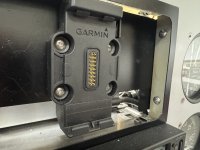
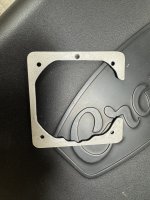
I had two G5s sitting on the shelf, so it only made sense to get rid of the vacuum system by removing the old DG and AI. The only problem is that I have already installed the Garmin G5 mounting plate in my unfinished Glasair panel upgrade project. I’m too cheap to pay for a new Garmin mounting plate, so I made my own.

I wanted TAS, wind readout, and Density Altitude on the G5, so I needed a GAD 13 aaand a new temperature probe. The 375 needed to talk to the G5s, so I needed a GAD 29. I lost my comm when I removed the KLX 135A, so I bought a 205x. I never liked relying on my iPhone for navigation and traffic, so I bought a used Aera 660 and hardwire harness for a GPS display. I bought an Airgizmo 660 mount, but it was 1/4” too tall to fit into the existing hole, so I fabricated my own mounting bracket and bezel for the 660.

Then comes the wiring…

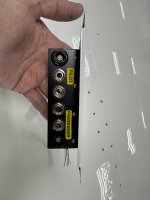
Everything [can/could] talk to everything, so there’s Airinc 429, RS-232, CANbus, and Bluetooth to consider. On top of this, I needed to add LEMO plugs to the headset plug panel, so that required a minor bit of fabrication. Believe it or not, *almost* everything worked on the first try!

Among the lessons learned:

(1) Configuration Modules are not optional. I thought all they did is act as an external non volatile memory chip to save your settings in case of a radio swap-out or hard reset. Oh contraire… Install them. My issue is that I bought both the 375 and the 205x used and ended up with only 1 configuration module between the both of them. To make it worse, the configuration module I had was defective out of the box. Of course my warranty expired several years ago and Garmin G3x support was zero help. I ended up calling Jason at Aerotronics—where I bought all my Glasair radios 6 years ago—and he hooked me up with one config module. I bought another one off an eBay seller. Both those modules fired right up and solved my problems.

(2) All the various RS-232 output formats aren’t available on all the GNX 375 RS-232 channels. MapMX and Connext are only available on #1 and #2. My initial wiring harness had something connected to #4 because “why not” rather than splicing 2 into 1. Ended up doing a window splice or two.

(3) Make the darned wiring harness longer! I really shot myself in the foot by making my wiring runs exactly long enough. The pros leave a service loop. I’ll do better the next time.

And speaking of the next time, I’ll have plenty of practice. I now have 3 planes and I have grand plans for full Garmin systems in all 3. The Glasair is well underway and is pretty much down to wiring. When my checking account stops smoking, I’ll finish the upgrade on the Rocket by adding autopilot servos, a 507 autopilot control panel, and a 10” touchscreen. In the meantime, I’ll work on finishing the Glasair because that shouldn’t cost me much because I already own all that stuff. When all that dust settles, I think it would be really cool to treat my wonderful little 1998 RV-3 to a full Garmin upgrade.

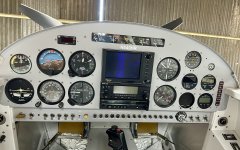
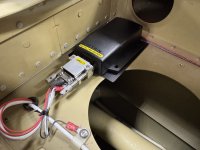
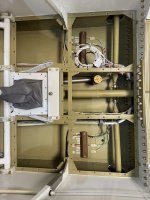
Exactly a month later, it’s finished and I’m ready to go taxiing and calibrate the magnetometer. Here are some photos of my recent work.
IMG_1574.jpeg
The original panel as of the time I purchased it.
IMG_1623.jpeg
GMU 11 where the VS and HS come together under the fiberglass fairing.
IMG_2010.jpeg
Floorboard removed under the pilot seat.
IMG_1638.jpeg
My homemade G5 mounting plate.

IMG_1995.jpeg
My homemade mounting bracket for the Aero 660.
IMG_1686.jpeg
New headset plug panel.

IMG_1997.jpeg
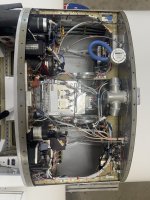
Behind the panel before the Halon bottle and electronic ignition box were installed.

IMG_2026.jpeg
The finished product.
 
I would like to see some of these innovations if you could possibly post them in the Rocket Section. My Dads Rocket is circa late 1990's and needs some TLC soon when it lands in my hanger and he hangs up his wings. I have a new cowling, fairings and other goodies to re-do some of the older, worn out items on the plane. Needs an autopilot as well so there will be some retrofitting to do. Your new bird is amazing. I will try to get to those high standards.
 
Terminal strip covers? (never liked the open contacts)
Thanks.
That’s a good observation. I’ll correct that next time I have the front skin off (a/k/a “the foreskin”). I forgot to plug in the signal wires to the digital tach readout, so I’ll be removing the skin in the near future.
 
From the G3x Installation Manual:
View attachment 99025

I’m not too worried about ground loops interference from a 200mah load.
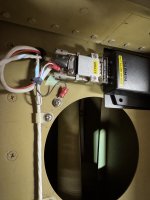
My only criticism would be that I prefer the ring terminal to directly contact the structure, in your current installation it's relying on the screw for the ground path. There is also the possibility that the nylon clamp cracks and breaks away from the screw, leaving the ring terminal loose. Should be fine for now, but might be worth just drilling another hole for a dedicated fastener for the ground attachment at the next CI.
 
My only criticism would be that I prefer the ring terminal to directly contact the structure, in your current installation it's relying on the screw for the ground path. There is also the possibility that the nylon clamp cracks and breaks away from the screw, leaving the ring terminal loose. Should be fine for now, but might be worth just drilling another hole for a dedicated fastener for the ground attachment at the next CI.
OK. That’s a great observation. I’ll correct it ASAP.
 
OK. That’s a great observation. I’ll correct it ASAP.
Other than that it looks great to me! I just installed a nearly identical suite of avionics in my -6 (GNX375, GTR205x, Dual G5s, GFC500) so I'm very familiar with what you just went through lol. I am curious how well your G5 bracket works without the receptacle for the pin at the top of the G5. I always assumed it was just for alignment, so it should be fine without it.
 
Dang, this is looking great! You should bring that puppy a couple minutes north to 18V when you get it finished. I'd love to see if I can borrow any of those amazing HFS details on my 4 fastback rebuild.
 
My only criticism would be that I prefer the ring terminal to directly contact the structure, in your current installation it's relying on the screw for the ground path. There is also the possibility that the nylon clamp cracks and breaks away from the screw, leaving the ring terminal loose. Should be fine for now, but might be worth just drilling another hole for a dedicated fastener for the ground attachment at the next CI.
Fixed it this afternoon… (Yes, the primer has been removed under the ring terminal for a good connection to the airframe.)

IMG_2035.jpeg
 
In my continuing efforts to make my new additions live up to the standard set by the original builder, I've been doing some test flying to confirm the accuracy of the airspeed indications. I mentioned this in a different thread and @DanH was kind enough to share a link to a spreadsheet to calculate TAS based on GPS groundspeed from 3 different tracks. We have nearly perfect flying conditions here in the Denver area today, so I went out to gather some data.

Based on what I'm seeing, my airspeed is reading approximately 10 knots low at roughly 24 squared. This causes the wind direction and velocity calculations to be wildly inaccurate as the Garmin formula tries to square a higher than expected groundspeed compared to a lower than accurate true airspeed due to a lower than accurate indicated airspeed. Everything relies on an accurate indicated airspeed.

I had wind readouts showing 160 @ 8; 280 @ 16; and 360 @ 16. The spreadsheet calculated actual winds of 287.5 @ 5.4

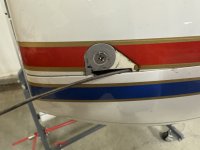
The static ports on my plane are absolutely flush. They're so perfectly flush, in fact, that they're almost impossible to see from more than about 5' away! They're mounted in the stock location, so I'm hoping the actual positioning is fine, but I'm wondering if they could use a little domed action directly over the port... something to simulate the old tried and true practice of using a pulled rivet with the center pin punched out.

In the process of reading everything I could on the topic of airspeed and static system installations, I found where someone drilled out the center of an AN470 rivet and glued it over the static port. I'm going to give this a try. I'll report back with my findings...
 
Your research on a domed static port will prove accurate. Alternatively you can achieve positive results with a dam made from 1/2 an AN 6ish washer in front of the port.
Also, what TAS did you calculate and at what altitude and fuel flow?
Thanks!!
 
Your research on a domed static port will prove accurate. Alternatively you can achieve positive results with a dam made from 1/2 an AN 6ish washer in front of the port.
Also, what TAS did you calculate and at what altitude and fuel flow?
Thanks!!
I'll see how it goes with the head of an AN470 rivet first, but I'll hang on to the washer idea in case the rivet head doesn't work out.

I ended up with 198.7 knots true airspeed based on the spreadsheet calculations. I set the fuel flow to 13.5gph because I wasn't concerned with making max power or most efficient power or anything like that. I just wanted to make sure I wasn't damaging the engine when I was busy looking at other stuff. The power settings were in the neighborhood of 24 or 23-squared, but I wasn't real careful about being exactly perfect with this, either. I just wanted to *maintain* a certain power throughout the test runs. I was at 6,700' MSL at 30.14 Hg and 67 degrees F. The handy dandy density altitude calculator says this equates to about 8,550 density altitude. Honestly, I just picked an in-between altitude for collision avoidance. All the flight schools are running around on 500' increments.
 
I’ve had another busy week tinkering with the Rocket.

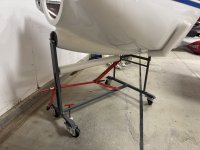
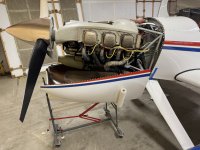
It was time for an oil change, so that meant it was time for me to remove the cowling for the first time all by myself. David Howe (@HFS) went to great lengths to avoid damaging the paint in this process and I was determined to do the same. With the help of a bunch of little tape-on protective pieces and a really cool custom lift to support the bottom cowling, I’m happy to report that I didn’t create a single scratch!

With the cowling off, I performed a normal oil and filter change. VERY straightforward and not a drop spilled. I appreciated the quick drain valve and the amount of room behind the engine. Much easier to work with as compared to my RV3!

Then the “while I’m here” stuff started…

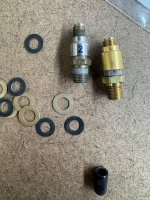
I have removed all the vacuum instruments from the panel, so I might as well remove the vacuum pump. I had to make a few new modifications to my special wrench designed specifically for that one darned bolt at the 7:30 position on the vacuum pump. Turns out the accessory case shape is ever so slightly different as compared to my Glasair’s IO320. Of course this also meant that I needed a blanking plate for the now empty hole. I first made it out of .032” material and didn’t use a new seal, so it leaked. A quick trip over to the local aluminum supplier and I had a square of .250” material to work with. Done, and a fresh gasket installed an no more leaks.

Next on the agenda was an engine heater. The local engine shop uses the simple EZHeat product and it seems to be working well on my RV3, so I went with that. It’s installed, but the silver epoxy around the perimeter looks like it was done by a 3rd grader using his non-dominant hand…. Which is kinda where I’m at due to some nerve damage to my dominant hand. It’s functional, but it’ll bug me until I fix it. I may have to bring in some help to make the detail work better. I installed an AC plug port in the bottom, of the right cowling inlet. I’m very sorry to cut into such a perfect inlet structure, but this is Colorado, not central California, and I’d rather sacrifice a bit to improve functionality in my climate.

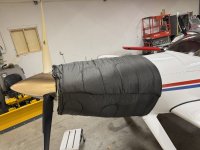
To maximize the efficiency of the sump heater, I worked with my Mom to fabricate an insulated cowling cover. She’s 88-1/2 years old and still stubborn as ever, so my role in the process was limited to materials procurement and lifting heavy objects. Otherwise, I just sat there like a bump on a pickle watching her work and waiting for my next assignment. I bought sleeping bags from Amazon for material. She removed all the trim and zippers and we used them like a big piece of insulated material. They were $30 each on Amazon and we used the better part of 3 bags. The Rocket cowling is surprisingly large and we have a double layer of sleeping bags on the top where most of the heat loss is likely to occur. For scale in the photo, my Mom is only 4’11” tall. Stubborn little German fireplug! People who think I learned to argue in Law School just haven’t met my Mother!

I attempted a prop balance, but wasn’t entirely happy with the results. I only achieved .010 IPS, but gave up because there was enough wind that I was getting inconsistent readings. I will try again another day, but this is significantly better and noticeably smoother than where I started at .090 IPS.

I also installed new injectors from GAMI. It may just be wishful thinking on my part, but I believe the engine was way smoother right away as a result. I’ll have to do some test flights to gather objective data, but I’m optimistic.

My #1 cylinder EGT was somewhere between intermittent and non-functional, so I replaced it with new from Aircraft Spruce. I had an extra probe lying around from my old Glasair system. I tried that first and it didn’t work, so I just bought a real Electronics International probe from Spruce.

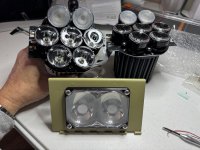
Looking back through my pictures, I think that pretty well wraps up my latest endeavors. Still to come are updated landing lights and a new mounting solution for my Aera 660. The RV3 needs an oil change and has a fuel tank leak [again] that I need to address in the near future, so I’m still not lacking for things to do!

IMG_2443.jpeg

IMG_2465.jpeg

IMG_2466.jpeg

IMG_2445.jpeg

IMG_2515.jpeg

IMG_2540.jpeg

IMG_2553.jpeg
 
I love your one man lower cowling support!!!
A couple of questions:
-which MT prop are you running?
-what are your basic cruise nos.?
Alt
RPM
FF (lop, p, or rop)
TAS?
I’m about to pull the trigger on a new prop for my HRII. I’m interested in what folks are running and how well it runs for them.
Thanks!!!
 
Last edited:
You're gonna love those lights, I have a pair on my -6, and I honestly feel like I'm shorting myself when I log night currency with them. It's like cheating, I can see the ground clearly 1/2 mile from the runway.
 
@andoman

My prop is an MTV-9-B/198-52. I have nothing to compare it to so I can’t help there. I had an opportunity to sit and talk with John Harmon a few months ago and he said he’s done testing and is convinced that the fastest prop is the Hartzell 2 blade. I honestly don’t remember if he said the Hartzell is the composite or aluminum. I think it’s the composite.

I have actually considered selling my recently IRANed MT prop and spending the difference to buy the new Hartzell. My MT is probably worth as much as it’ll ever be worth because it only has 40-ish hours since being serviced. My biggest issue is the money timing situation. I’ve been spending like a drunken sailor these days and need to back off for a bit.

As for cruise numbers, I almost hate to say anything because I haven’t taken time to do statistically relevant flying. As a general number, I can say that maximum power at 2400 rpm and roughly 8,000’ density altitude gets me a 4 way GPS average of 201knots. I haven’t tried max speed because I haven’t been anywhere near sea level since the day I picked it up in Central California.

@lucas2696

I looking forward to trying out the lights. I have the 4 LED version in my RV3 and it’s already impressive. 7 LEDs will certainly be even better! The residential fly-in community has great runway lighting, but zero taxiway lighting. I can land in the dark without much problem, but taxiing is out of the question. I’ve also been told that the bright lights in conjunction with my wig-wag function makes me VERY easy to find in even daytime hours. We have a ridiculous amount of training aircraft along the front range of northern Colorado, so I need every advantage I can get!
 
I did a little more tinkering with the Rocket yesterday. I completed a new weight and balance. As far as I’m concerned, it compares favorably to the old weight and balance from 2002. She’s a little chubby at 1303# empty. Still performs better than anything piston driven plane I’ve ever flown, so I’m not complaining.

I took off from breakfast this morning and wanted no part of the 8 training airplanes doing landings in 3 different directions, so I held full power (from 5000’ MSL) and about 85kts indicated and was doing a sustained 3200fpm. This was at about 1825#. Absolutely beastly.

After getting well clear of the airport area, I did a few stalls… clean, power off was 59KIAS. Full flaps, power off was 49KIAS. Clean, power on was something less than 30KIAS. I gave up at 30 degrees nose up pitch and just pushed the nose over and flew out of it. Again, beastly.

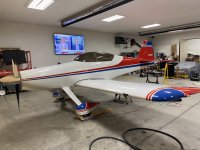
Anyway, here’s a pic of the plane up on scales. My portable Eastwood welding table plus the height of my Intercomp scale worked out perfectly to level the plane to within 0.1 degree.

If anybody in the Denver area wants to weigh their plane, just shoot me a PM and come on over to VanAire. Free and gratis. Same thing with a prop balance. I’ve got the equipment.

IMG_2883.jpeg
 
"The sheriff doesn't have any surveillance video to share," so a picture of the Rocket being weighed will do. Nice newscast backdrop! 😉 Happy to see David's "beast" in the right hands.
 
Outstanding!!
I covet your dark canopy!!!
A couple of questions:
-what FF was your 201 TAS at 8000’ ?
-what do you attribute the “portly” (it’s not that portly…) empty weight to? Mine is 1225 and it sports the 60 lb Hartzell 2 blade paddle.
-how much wt. on the tailwheel in the 3 point stance?
 
I did a little more tinkering with the Rocket yesterday. I completed a new weight and balance. As far as I’m concerned, it compares favorably to the old weight and balance from 2002. She’s a little chubby at 1303# empty. Still performs better than anything piston driven plane I’ve ever flown, so I’m not complaining.

I took off from breakfast this morning and wanted no part of the 8 training airplanes doing landings in 3 different directions, so I held full power (from 5000’ MSL) and about 85kts indicated and was doing a sustained 3200fpm. This was at about 1825#. Absolutely beastly.

After getting well clear of the airport area, I did a few stalls… clean, power off was 59KIAS. Full flaps, power off was 49KIAS. Clean, power on was something less than 30KIAS. I gave up at 30 degrees nose up pitch and just pushed the nose over and flew out of it. Again, beastly.

Anyway, here’s a pic of the plane up on scales. My portable Eastwood welding table plus the height of my Intercomp scale worked out perfectly to level the plane to within 0.1 degree.

If anybody in the Denver area wants to weigh their plane, just shoot me a PM and come on over to VanAire. Free and gratis. Same thing with a prop balance. I’ve got the equipment.

View attachment 109113
That’s some nice performance!
I can’t speak for my F1 Rocket’s climb rate at 5,000’ (heck, I haven’t even flown it as low as 6,000’), but at 9,000’ PA (where I did my testing), it’ll sustain just over 1,500 fpm from 90 to 115 KIAS at about 1970 lb GW. I chose 105 KIAS as my Vy, because it’s the high end of the “plateau” in the data.
My clean stall speed is almost exactly the same as yours, but full flaps only lowers the stall speed by 4-6 kts, depending on the weight.
My power-on stall speed is 45 KIAS, and doesn’t seem to vary with weight.
It’s certainly interesting to compare notes. May I ask where your CG was during this process?
 
That’s some nice performance!
I can’t speak for my F1 Rocket’s climb rate at 5,000’ (heck, I haven’t even flown it as low as 6,000’), but at 9,000’ PA (where I did my testing), it’ll sustain just over 1,500 fpm from 90 to 115 KIAS at about 1970 lb GW. I chose 105 KIAS as my Vy, because it’s the high end of the “plateau” in the data.
My clean stall speed is almost exactly the same as yours, but full flaps only lowers the stall speed by 4-6 kts, depending on the weight.
My power-on stall speed is 45 KIAS, and doesn’t seem to vary with weight.
It’s certainly interesting to compare notes. May I ask where your CG was during this process?
I was at approximately 90.52” and right at 1800#.
 
Fuel flow at 201 KTAS @ 24 squared was right around 13.5 for that run.

The guy who built my plane goes by @HFS on this forum. HFS stands for Hell For Stout. The aircraft lives up to this moniker. It has probably 20 pounds worth of carpeting, 20 pounds worth of Halon systems, about a bazillion nutplates and #8 screws holding down the floorboards, each landing light has its own servo for tilting, the landing light lense has a frame holding the lens in and then the frame is attached to the wing with about a dozen screws and nutplates, etc., and more etc.!

I AM NOT COMPLAINING!

I love this mentality and style of construction and am extremely pleased that the Rocket airframe can handle it AND provide outrageous performance.

I don’t have a true empty weight tailwheel weight as I weighed it with fuel in the tanks and then subtracted the known quantity of fuel and moment to derive my 1303# empty weight. I can say that with full fuel the weight on the tail in the 3 point stance was 109# and in the level attitude it was 52#.

Outstanding!!
I covet your dark canopy!!!
A couple of questions:
-what FF was your 201 TAS at 8000’ ?
-what do you attribute the “portly” (it’s not that portly…) empty weight to? Mine is 1225 and it sports the 60 lb Hartzell 2 blade paddle.
-how much wt. on the tailwheel in the 3 point stance?
 
Back
Top