Van's Air Force

The definitive Van's Aircraft support community! Buying, building or flying an RV? Join our exclusive family of mentors and enthusiasts!

Testing vernatherm question

sansoneservices

Well Known Member
It's been years since I heated one of these. When working for a shop we just replace if in question. On my personal Lycoming I'm considering removing and testing since my oil temp is high. I've already flushed the cooler which changed nothing and cylinder compressions are good eliminating blow-by as the cause. How definitive is heating/inspecting? or am I just being a cheap bas**rd 😝
 
There are plenty of threads on this forum about testing vernatherms...when to do it, how to do it, etc. It's a relatively easy test to do, and why replace it if it's not bad? You're not being cheap.
 
Some of us have been experimenting with the installation of a viscosity valve plunger and spring as an approach to checking vernatherm operation in situ. It's possible to run both the valve plunger and the vernatherm at the same time if you're using a standard Lycoming filter adapter. When the oil is hot (i.e. low viscosity) the plunger fully blocks the vernatherm bypass port in the accessory case. So, drop in a plunger and spring assembly, and go fly. If oil temperature is reduced from previous, it says the vernatherm wasn't blocking the port when hot as effectively as it should. If no change, the cooling problem is elsewhere, like cooler size or airflow.

I definitely got a temperature drop, so the vernatherm installation needs some investigation.

I did leave the plunger in there all winter, just to see if it resulted in over-cooling. Result was some flights with OT down around 165F in cruise with OAT in the 40's. Not bad, but do remember this is a 390 with piston squirters. A parallel valve without squirters would exhibit low oil temperature.

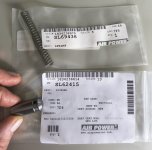
Part Numbers.jpg
 
Last edited:
Thanks dan (and others) for digging into this. Many of the oil cooler gyrations that we do in the majority of our operations seem unnecessary if we just had modern mechanical metering nailed. When delta T across CHT is lower, who cares if we dump overboard through the oil cooler.... oh, wait, things get complicated fast when we want to squeak every .5 kt of forward motion (humbug), and we are all running modern lubricants right (that don't turn into a block of ice)?
Pick the more reliable system; temp or viscosity.
 
Some of us have been experimenting with the installation of a viscosity valve plunger and spring as an approach to checking vernatherm operation in situ. It's possible to run both the valve plunger and the vernatherm at the same time if you're using a standard Lycoming filter adapter. When the oil is hot (i.e. low viscosity) the plunger fully blocks the vernatherm bypass port in the accessory case. So, drop in a plunger and spring assembly, and go fly. If oil temperature is reduced from previous, it says the vernatherm wasn't blocking the port when hot as effectively as it should.

I definitely got a temperature drop, so the vernatherm installation needs some investigation.

I did leave the plunger in there all winter, just to see if it resulting in over-cooling. Result was some flights with OT down around 165F in cruise with OAT in the 40's. Not bad, but do remember this is a 390 with piston squirters.

View attachment 116305

Thanks Dan.. I like the plunger idea
 
Some of us have been experimenting with the installation of a viscosity valve plunger and spring as an approach to checking vernatherm operation in situ. It's possible to run both the valve plunger and the vernatherm at the same time if you're using a standard Lycoming filter adapter. When the oil is hot (i.e. low viscosity) the plunger fully blocks the vernatherm bypass port in the accessory case. So, drop in a plunger and spring assembly, and go fly. If oil temperature is reduced from previous, it says the vernatherm wasn't blocking the port when hot as effectively as it should.

I definitely got a temperature drop, so the vernatherm installation needs some investigation.

I did leave the plunger in there all winter, just to see if it resulting in over-cooling. Result was some flights with OT down around 165F in cruise with OAT in the 40's. Not bad, but do remember this is a 390 with piston squirters.

View attachment 116305

Do you remove the vernatherm to install plunger? How can both be in place at the same time?
 
Do you remove the vernatherm to install plunger?

No. Installing both at the same time indicates if the vernatherm is actually doing the job.

How can both be in place at the same time?

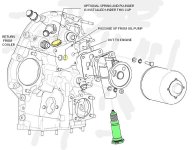
Two different locations. The viscosity valve plunger and spring are installed in the passage under the yellow cap. The vernatherm goes in the bottom of the Lycoming filter adapter.

Accessory Case Ports.jpg

The only prohibition against installing both at the same time would be the use of a filter adapter (or old school Lycoming screen housing) with a horizontal vernatherm. A common example would an angle adapter from B&C, ECI, etc. The horizontal vernatherm extends directly into the bypass hole in the accessory case, and the tip can potentially foul the plunger in its bore.
 
Last edited:
You can have too issues causing limited flow to the cooler. Either the VT isn’t extending as far as it should or there is wear or an alignment issue between VT cone and adapter seat. The former can be definitively test by measuring end to end at room temp then after sitting in 185* oil. Minimum growth is .160”. The second can sometimes be identified by observing witness marks on the VT cone. Dans approach tells you flow to cooler is not maximized, above helps identify the cause.
 
You can have too issues causing limited flow to the cooler. Either the VT isn’t extending as far as it should or there is wear or an alignment issue between VT cone and adapter seat. The former can be definitively test by measuring end to end at room temp then after sitting in 185* oil. Minimum growth is .160”. The second can sometimes be identified by observing witness marks on the VT cone. Dans approach tells you flow to cooler is not maximized, above helps identify the cause.
You can also have limited flow within the cooler. Passages are small and oil goes to the cooler before the filter. Carbon chunks or metal debris can easily block passages. Most home flushing is not effective in removing that debris lodged in the tight clearances.
 
You can also have limited flow within the cooler. Passages are small and oil goes to the cooler before the filter. Carbon chunks or metal debris can easily block passages. Most home flushing is not effective in removing that debris lodged in the tight clearances.
Your advice is sound, Dan as well. McFarlane has a new certified cooler for $760 (on the way) mine is 30yrs old and the rebuild shop quote was 600 so no-brainer. Dan's plunger idea is great for trouble shooting the vernatherm and less than $40 so another no-brainer. My sincere thanks for the exceptional advice
 
Thanks Dan for posting this. I'm on my 3rd Vernatherm so far and upgraded the oil cooler to a SW 10610R on the back of #3 baffle. Still getting higher oil temps than i'd like on the 390. CHT's are actually too low so probably not a baffling issue. 160hours or so. Looking forward to trying this.

Any downside in leaving the spring and plunger in year round if oil temps get hot enough in cold weather?
 
FYI: anyone ordering the spring and plunger, Spruce has them in stock, but it’s $59 including their cheapest shipping. AirPower has the plunger on back order but Supposedly Superior has them in stock and will re supply AirPower within a week. Comes out to $37 for both including shipping from AirPower.
 
Thanks Dan for posting this. I'm on my 3rd Vernatherm so far and upgraded the oil cooler to a SW 10610R on the back of #3 baffle. Still getting higher oil temps than i'd like on the 390. CHT's are actually too low so probably not a baffling issue. 160hours or so. Looking forward to trying this.

Any downside in leaving the spring and plunger in year round if oil temps get hot enough in cold weather?

Not in theory, nor have I found any practical problem.

When ordering the spring and plunger, be sure to also order two gaskets for under the plug, 06E19769-0.63. One to install the plunger, another for when you remove it.

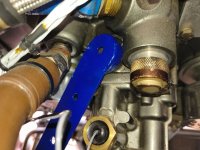
The plug is in a tight spot. A custom wrench makes life easy. Lathe a short hex section off a pawn shop socket and weld on a handle.

Wrench Use.jpg
 
DanH and lr172 cured my high oil temperature. Dan suggested I try the bypass plunger and spring. lr172 said flushing My old oil cooler won't really get the solids out.. I ended up buying a new cooler AND installing the bypass plunger with spring. Problem solved 👍 except now I don't know which component cured the problem because I changed all the parts same day 😁.. this winter I will remove the vernatherm and boil it

 
DanH and lr172 cured my high oil temperature. Dan suggested I try the bypass plunger and spring. lr172 said flushing My old oil cooler won't really get the solids out.. I ended up buying a new cooler AND installing the bypass plunger with spring. Problem solved 👍 except now I don't know which component cured the problem because I changed all the parts same day 😁.. this winter I will remove the vernatherm and boil it
Good news. If the VT fails the test try taking it apart and clean the sludge out. I have saved 2 that way. It is a quasi hydraulic system, so fairly tight clearance between piston and bore that can seize up from carbo deposits.
 
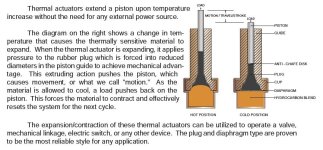
From the Rosta catalog:

Linear Actuators.jpg

If we could find a source for part #5027, the wax actuator, our expensive aviation vernatherms could be easily rebuilt. This kind of actuator is used in all kinds of thermal valves.

Parts.jpg
 
No. Installing both at the same time indicates if the vernatherm is actually doing the job.


Two different locations. The viscosity valve plunger and spring are installed in the passage under the yellow cap. The vernatherm goes in the bottom of the Lycoming filter adapter.

View attachment 116334

The only prohibition against installing both at the same time would be the use of a filter adapter (or old school Lycoming screen housing) with a horizontal vernatherm. A common example would an angle adapter from B&C, ECI, etc. The horizontal vernatherm extends directly into the bypass hole in the accessory case, and the tip can potentially foul the plunger in its bore.
I’m running the superior oil filter adapter. Do you know if I can run the plunger at the same time as the VT with that setup? I can’t remember what direction the VT is located but believe it was vertical.
 
I’m running the superior oil filter adapter. Do you know if I can run the plunger at the same time as the VT with that setup? I can’t remember what direction the VT is located but believe it was vertical.
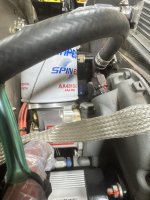
Yes the vernatherm is vertical. I believe the hex is 1.25" and you remove and install from the bottom. Long extension enable access from the bottom
 
I’m running the superior oil filter adapter. Do you know if I can run the plunger at the same time as the VT with that setup? I can’t remember what direction the VT is located but believe it was vertical.
If it's an SL 2157, yes you can.
 
For those considering or already installed the plunger AKA viscosity valve, understand it allows flow through the cooler all the time. What you will see is the heat load typical during initial climb is being shed earlier than with the vernatherm. The vernatherm will allow the heat to build before shedding heat. So, with a viscosity valve on a marginal oil cooling system you may not get too high oil temp before leveling off in cruise with more airflow to cool. This is expected behavior. I ran a viscosity valve for years and it definitely helped maintain cooler temps in climb out. With the marginal cooling I had it was better to level out in cruise at 210 rather than 225.
 
For those considering or already installed the plunger AKA viscosity valve, understand it allows flow through the cooler all the time. What you will see is the heat load typical during initial climb is being shed earlier than with the vernatherm. The vernatherm will allow the heat to build before shedding heat. So, with a viscosity valve on a marginal oil cooling system you may not get too high oil temp before leveling off in cruise with more airflow to cool. This is expected behavior. I ran a viscosity valve for years and it definitely helped maintain cooler temps in climb out. With the marginal cooling I had it was better to level out in cruise at 210 rather than 225.
Yes.. in winter months you may need to block off the oil cooler with the viscosity plunger and spring installed. It was explained to me here the plunger is removed when a vernatherm is installed. The vernatherm controls the oil temp like the thermostat in your car.. when winter comes I will install a new vernatherm and remove the viscosity plunger and spring
 
Installed the plunger and spring today. The washer was a different one than Dan mentioned on my Barrett engine. It was a AN900-10 or MS35769-11. When the weather cleared we’ll see how she cools.
 
I installed the plunger and MS35769-11 copper crush washer (5/8 id) .. my oil temp dropped considerably but I installed a new oil cooler the same day so I don't know if the plunger was needed. This winter I'm removing the plunger and if the oil temp climbs it means the vernatherm is faulty. The vernatherm is $300 so installing a $30 plunger is a great troubleshooting aid. Another winter fix for cold oil is to block-off the oil cooler but I would rather install a new vernatherm and not fool with the cooler airflow. The seat the vernatherm contacts when extended gets worn and may need grinding too
 
I installed the plunger and MS35769-11 copper crush washer (5/8 id) .. my oil temp dropped considerably but I installed a new oil cooler the same day so I don't know if the plunger was needed. This winter I'm removing the plunger and if the oil temp climbs it means the vernatherm is faulty. The vernatherm is $300 so installing a $30 plunger is a great troubleshooting aid. Another winter fix for cold oil is to block-off the oil cooler but I would rather install a new vernatherm and not fool with the cooler airflow. The seat the vernatherm contacts when extended gets worn and may need grinding too
Just exercise some caution there. The plunger sends all oil to the cooler, at least when the viscosity is low enough, while the VT only does so once it reaches 185. Therefore you cannot compare oil temp across them unless those temps are above 185. Pulling the plunger will raise oil temps compared to a VT below 185.
 
Last edited:
Back
Top