Van's Air Force

The definitive Van's Aircraft support community! Buying, building or flying an RV? Join our exclusive family of mentors and enthusiasts!

Teach me about Dynon autopilot use during approaches

FORANE

Well Known Member
I have a brand new dual screen Dynon HDX system with the skyview autopilot control panel coupled to a Garmin GTN650xi. I've been flying a number of instrument approaches trying to gain comfort and familiarity with the system that's still relatively new to me. I've watched numerous videos Dynon has available and some done by other pilots. I've searched this forum and picked up some tidbits here. I've read the Dynon manual. In spite of that I cannot find much in the way of videos or information on setting the autopilot for approaches, especially VNAV.

I've learned the autopilot will not capture (please pardon my use of that term if I have used it incorrectly) a NAV course or set altitude unless you have the plane pointed towards those. I've learned it will not capture a glideslope unless you drive into it from below. What does one do with the autopilot when they are cleared for a LPV above the glideslope? I've learned the Dynon autopilot allows one to turn off an individual servo while leaving the other servo active, but when I've tried turning off the elevator servo I wasn't reliably able to do so. Can anyone direct me to any videos or instructional material focused on autopilot buttonology during approaches?
 
Ou will find the information you are looking for in the Dynon operation manuals for the Certified HDX

I have the dual HDX screen set up with the Avidyne IFD540 and just love it.
 
Every autopilot system requires a vertical intercept from below. If you're above the calculated descent path you'll have to use a different vertical mode. Vertical speed or IAS, in order to get down to intercept.

There is no approach mode, just have to arm VNAV to get it to couple whether it is an ILS/LNAV/VNAV/ LPV approach.

If you fo direct a fix etc you can just hit direct to and arm nav, if vectors to final activate that and they'll give you a heading and then arm nav/vnav and it'll couple.

Biggest thing is to make sure your hsi source is selected to the 650.


Ive never been able to just couple one axis, pitch and I'll engage/disengage together. No need to one way or another. Do you have CWS programmed?
 
You should never dive onto a glide slope and you shouldn't be cleared that way, I never have anyway. But to get below it slow down a heap and us VS to get below it, then hit VNAV and it will capture it.

This is also my personal opinion I do not like disconnecting one servo only, although you can. If you get distracted and in cloud, you have a potential to forget one axis is not being flown by the AP and you could if you are not disciplined at following the FMA get into trouble. So for me its all on or all off.
 
There's a possibility that you don't have expert mode enabled. Read up on that in the manual as well. I have a GPS175 coupled to Dynon and approaches and holds are easy.
 
IMHO this is a safety of flight issue and should be addressed prior to any further use.
So it will turn on/off the AP every time I hit the AP button. It's just when I have tried to turn off the elevator servo alone that I have been unable to accomplish 100% of the time.
Every autopilot system requires a vertical intercept from below. If you're above the calculated descent path you'll have to use a different vertical mode. Vertical speed or IAS, in order to get down to intercept.

There is no approach mode, just have to arm VNAV to get it to couple whether it is an ILS/LNAV/VNAV/ LPV approach.

If you fo direct a fix etc you can just hit direct to and arm nav, if vectors to final activate that and they'll give you a heading and then arm nav/vnav and it'll couple.

Biggest thing is to make sure your hsi source is selected to the 650.


Ive never been able to just couple one axis, pitch and I'll engage/disengage together. No need to one way or another. Do you have CWS programmed?
This is helpful, thank you. By CWS I presume you are referring to control wheel steering allowing intermittent turning off/on the AP with a momentary switch whereby the AP resumes pitch and roll at time of button release. If so, then yes, I have that button on the stick and it works well.
You should never dive onto a glide slope and you shouldn't be cleared that way, I never have anyway. But to get below it slow down a heap and us VS to get below it, then hit VNAV and it will capture it.

This is also my personal opinion I do not like disconnecting one servo only, although you can. If you get distracted and in cloud, you have a potential to forget one axis is not being flown by the AP and you could if you are not disciplined at following the FMA get into trouble. So for me its all on or all off.
On my last plane I had a Trio Pro Pilot autopilot. The Trio was designed for turning on/off the servos independently. I routinely flew approaches with the roll servo active while I hand flew the elevator. The Dynon does not appear to be capable of simply engaging the roll servo independently; it appears one needs to turn on both then turn off the pitch servo by holding the ALT button. Some times when I hold the ALT button it turns off that servo and other times it has not turned it off.
There's a possibility that you don't have expert mode enabled. Read up on that in the manual as well. I have a GPS175 coupled to Dynon and approaches and holds are easy.
No, expert mode is enabled.
 
I have virtually the same set up as you (single HDX and GTN650 Xi) and have had many of your same questions. Dynon has failed to produce a video directly dealing with various approaches and I feel that is a significant omission on their part. I think the above deals with your initial questions but it doesn't address how to use VNAV to follow the published or entered altitudes on the GTN flight plan or procedure as can be done on the G1000. Anyone know how that is done?
 
What does one do with the autopilot when they are cleared for a LPV above the glideslope?
Coming in to an approach I try and stay aware of what altitude is going to work, around here ATC looooves to keep you higher than necessary so I negotiate lower with them. Intercepting glideslope from below is standard practice so if you are high you have to VS mode down and then arm VNAV until it captures. You have probably also figured out that you can't arm VNAV until you have a glideslope indication, usually when the "FAF" leg is active. There are tricks to be able to do that earlier but it doesn't always apply. When I'm coming into an approach I arm the NAV if not already done. The second I cross the fix where my next one would be the FAF/glideslope intercept fix I arm VNAV and intercept the glideslope.
 
You mention turning off ‘servos'. Are you turning off a single axis of the AP per the SkyView HDX Pilots Users Guide, shown below?

View attachment 96047
yes but I've only tried turning off the servo about a half dozen times. Thinking back the times I was unable were during approach on a LPV. I may have been on ALT or VNAV at that time and likely above the glidepath. If I was on VNAV, would hitting ALT turn off the elevator servo? or would I have to hit VNAV (to cancel VNAV) then ALT (to turn off the servo)? Or would I have to hit ALT to go back to ALT then ALT again to turn off the servo?

I will have to experiment with it some more when I get that plane back; it's getting some work done now and I'm flying my old plane with the rudimentary (but easy to operate) trio pro pilot.
 
Last edited:
Dynon has failed to produce a video directly dealing with various approaches and I feel that is a significant omission on their part.
Exactly. I watched one video where they stated they would address this in the next video, but the next video never came. It's on us the users to figure it out apparently.
 
Exactly. I watched one video where they stated they would address this in the next video, but the next video never came. It's on us the users to figure it out apparently.
This user has failed, so far, to figure out VNAV other than the GS or GP.
 
yes but I've only tried turning off the servo about a half dozen times. Thinking back the times I was unable were during approach on a LPV. I may have been on ALT or VNAV at that time and likely above the glidepath. If I was on VNAV, would hitting ALT turn off the elevator servo? or would I have to hit VNAV (to cancel VNAV) then ALT (to turn off the servo)? Or would I have to hit ALT to go back to ALT then ALT again to turn off the servo?

I will have to experiment with it some more when I get that plane back; it's getting some work done now and I'm flying my old plane with the rudimentary (but easy to operate) trio pro pilot.
If you are running the latest software, you will have to push and hold the button for 2 full seconds to get it to drop the control on that axis. This is to prevent people accidentally doing what you are trying to do on purpose.

I do this frequently with my young son wanting to fly the plane from the right seat, I'll set altitude hold and release the nav (aileron servo) so he can bank left/right to his hearts content. It works just fine the other way also.

Dynon has their own forum as well - great source of info - https://forum.flydynon.com/
 
I am not familiar with your avionics or autopilot setup. I will just add that you need to protect yourself when intercepting a glide path or glide slope
from above by having an altitude selected that will be captured if you do not intercept. 1000AGL is often used as if you have not captured by then
the approach most likely is not stabalized and a go around should be executed if not visual. Do not engage a vertical mode and start decent until
the lateral mode is captured.
 
If you are running the latest software, you will have to push and hold the button for 2 full seconds to get it to drop the control on that axis. This is to prevent people accidentally doing what you are trying to do on purpose.

Dynon has their own forum as well - great source of info - https://forum.flydynon.com/
Yes, I believe I'm running the latest software. I just went back and re-read the entire autopilot section of the Skyview HDX user guide. Nowhere in it can I find any mention of "hold the button for 2 full seconds". Is that printed somewhere, or just something you discovered?

Regarding the forum, I'm not sure what's going on there either. Despite having a valid login Since April and having bought HDX screens from Dynon directly I still get the following message after logging in:
Your account is currently awaiting approval by an administrator. You will receive an email when a decision has been taken.
 
Your account is currently awaiting approval by an administrator. You will receive an email when a decision has been taken.
it took several months to approve mine. @Dynon used to be active in their own forum but they haven't posted anything since Summer 2024, except one short announcement about the HDX training academy. It seems like something happened with Dynon's online relations. I hope this is temporary

1756431973375.png
 
I have a brand new dual screen Dynon HDX system with the skyview autopilot control panel coupled to a Garmin GTN650xi. I've been flying a number of instrument approaches trying to gain comfort and familiarity with the system that's still relatively new to me. I've watched numerous videos Dynon has available and some done by other pilots. I've searched this forum and picked up some tidbits here. I've read the Dynon manual. In spite of that I cannot find much in the way of videos or information on setting the autopilot for approaches, especially VNAV.

I've learned the autopilot will not capture (please pardon my use of that term if I have used it incorrectly) a NAV course or set altitude unless you have the plane pointed towards those. I've learned it will not capture a glideslope unless you drive into it from below. What does one do with the autopilot when they are cleared for a LPV above the glideslope? I've learned the Dynon autopilot allows one to turn off an individual servo while leaving the other servo active, but when I've tried turning off the elevator servo I wasn't reliably able to do so. Can anyone direct me to any videos or instructional material focused on autopilot buttonology during approaches?
S
 
Send me your contact info and I will be glad to call you to discuss how do it with my HdX and the Avidyne IFD 540.
 
i have a HDX system without a navigator. i am learning ifr at the moment. ive seen several folks use the HDX while having a psudo glide path appear without the navigator. i want to enable this feature in order to practice approaches with my instructor and soon there after purchase my navigator any tips? currently my seattle charts are out of date will be updating soon. ive been told there should appear a proc when i click FPL but i dont see it.
 
... What does one do with the autopilot when they are cleared for a LPV above the glideslope? ...

I'm curious, I haven't yet flown approaches with Dynon. And it's been awhile since I flew approaches with the Garmin GFC500. But, wouldn't you just bug the appropriate altitude and select the appropriate VS to be at the step down altitude prior to the glide slope intercept point (lighting bolt on profile view)? I've been told that RNAV/GPS coupled approaches will not capture the glide slope prior to the glide slope intercept point (unlike a coupled ILS approach).
 
I'm curious, I haven't yet flown approaches with Dynon. And it's been awhile since I flew approaches with the Garmin GFC500. But, wouldn't you just bug the appropriate altitude and select the appropriate VS to be at the step down altitude prior to the glide slope intercept point (lighting bolt on profile view)? I've been told that RNAV/GPS coupled approaches will not capture the glide slope prior to the glide slope intercept point (unlike a coupled ILS approach).
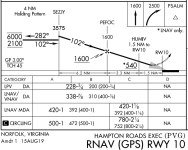
Tell me what altitude is the glide slope intercept at SEZJY on the GPS 10 at kpvg. https://aeronav.faa.gov/d-tpp/2509/05870R10.PDF

If you're cleared to cross SEZJY at 6000, you will be above the glide slope.

How do you make the dynon HDX system autopilot intercept it at that point? I have no idea.
 
Tell me what altitude is the glide slope intercept at SEZJY on the GPS 10 at kpvg. https://aeronav.faa.gov/d-tpp/2509/05870R10.PDF

If you're cleared to cross SEZJY at 6000, you will be above the glide slope.

How do you make the dynon HDX system autopilot intercept it at that point? I have no idea.
Glide slope intercept is not at SEZJY though. It's an altitude (1,600') which you cannot descend through until passing the FAF at PFOC. And, as I understand it, on a GPS approach, the AP will not capture glide slope prior to this point (designated by a lighting bolt in profile view). Its a computer thing, unlike a coupled ILS approach which is an analog thing (or so I've been told).

Are you really not able to make the autopilot descent by bugging an altitude and descent rate prior to the glide slope intercept point?

Looks to me like if you're at SEZJY at 6,000 and you're cleared for the approach, you've got 6.2 miles to get to 1,600 at PFOC which is the glide slope intercept point and FAF. That looks like about a 1,300fpm rate of descent required. But, I'm curious though, would ATC really hold you at 6,000 all the way to SEZJY?
 
Last edited:
Glide slope intercept is not at SEZJY though. It's an altitude (1,600') which you cannot descend through until passing the FAF at PFOC. And, as I understand it, on a GPS approach, the AP will not capture glide slope prior to this point (designated by a lighting bolt in profile view). Its a computer thing, unlike a coupled ILS approach which is an analog thing (or so I've been told).

Are you really not able to make the autopilot descent by bugging an altitude and descent rate prior to the glide slope intercept point?

Looks to me like if you're at SEZJY at 6,000 and you're cleared for the approach, you've got 6.2 miles to get to 1,600 at PFOC which is the glide slope intercept point and FAF. That looks like about a 1,300fpm rate of descent required. But, I'm curious though, would ATC really hold you at 6,000 all the way to SEZJY?
they'll let you ... circle once or twice to lose altitude in that holding pattern..
 
Glide slope intercept is not at SEZJY though. It's an altitude (1,600') which you cannot descend through until passing the FAF at PFOC. And, as I understand it, on a GPS approach, the AP will not capture glide slope prior to this point (designated by a lighting bolt in profile view). Its a computer thing, unlike a coupled ILS approach which is an analog thing (or so I've been told).
ok, so even though one can pickup the glide slope, the autopilot is unable to capture it prior to PEFOC? If so, I've been expecting more from "George".
Are you really not able to make the autopilot descent by bugging an altitude and descent rate prior to the glide slope intercept point?

But, I'm curious though, would ATC really hold you at 6,000 all the way to SEZJY?

Yes, I am bale to make it descend, but being cleared for the approach with a crossing restriction above the glideslope is not uncommon. And, the Dynon requires one to drive into that glideslope from below...
 
It's an altitude (1,600') which you cannot descend through until passing the FAF at PFOC. And, as I understand it, on a GPS approach, the AP will not capture glide slope prior to this point (designated by a lighting bolt in profile view).
In practice the GP will appear at some point between SEZJY and PEFOC. Cleared for the approach and passing SEZJY command the AP to make a high rate of descent but not below 1600'. Once the GP appears AND you are below it (but above 1600') level the plane, arm the approach. The AP will take over from there. (Or just descend all the way to 1600', arm the approach, ...).
And, in the future, ask for lower prior to SEZJY. Even if that means an extra turn in the hold. I've noticed that some controllers, when asked for practice approaches, seem to think you'll just fly whatever altitude you want. Be direct, ask for lower before SEZJY.
 
ok, so even though one can pickup the glide slope, the autopilot is unable to capture it prior to PEFOC? If so, I've been expecting more from "George".


Yes, I am bale to make it descend, but being cleared for the approach with a crossing restriction above the glideslope is not uncommon. And, the Dynon requires one to drive into that glideslope from below...

Maybe this'll help:
 
ok, so even though one can pickup the glide slope, the autopilot is unable to capture it prior to PEFOC? If so, I've been expecting more from "George".


Yes, I am bale to make it descend, but being cleared for the approach with a crossing restriction above the glideslope is not uncommon. And, the Dynon requires one to drive into that glideslope from below...
Pretty much all certified autopilots with flight directors require intercept from below. For an ILS, intercepting from above has associated hazards from glideslope mirroring when above.
 
Here's a good article by Max Trescott in "Flying" ( :sneaky:) on what I'm talking about: https://www.flyingmag.com/magenta-m...dont-understand-about-rnav-glidepath-capture/

It brings up a good point about the AP not capturing glide slope until the hollow white diamond turns magenta, which is usually the last IF before the FAF. Since there is no IF between the initial and the FAF, i'm betting it'll be someplace between SEZJY and PFOC. But that also leads me to believe that approach is specifically designed so that ATC has you descend in holding to 2,100 (or there about) prior to crossing SEZJY inbound.
 
Last edited:
Here's a good article by Max Trescott in "Flying" ( :sneaky:) on what I'm talking about: https://www.flyingmag.com/magenta-m...dont-understand-about-rnav-glidepath-capture/

It brings up a good point about the AP not capturing glide slope until the hollow white diamond turns magenta, which is usually the last IF before the FAF. Since there is no IF between the initial and the FAF, i'm betting it'll be someplace between SEZJY and PFOC. But that also leads me to believe that approach is specifically designed so that ATC has you descend in holding to 2,100 (or there about) prior to crossing SEZJY inbound.
I will read the article.
That approach may be designed that way, but it is not common practice to be cleared that way.
 
I will read the article.
That approach may be designed that way, but it is not common practice to be cleared that way.
Are you saying that ATC routinely keeps you at 6,000 till crossing the IAF inbound? I wonder why that is.
 
Tell me what altitude is the glide slope intercept at SEZJY on the GPS 10 at kpvg. https://aeronav.faa.gov/d-tpp/2509/05870R10.PDF

If you're cleared to cross SEZJY at 6000, you will be above the glide slope.
The glidepath crosses the SEZJY IAF at 3,575 ft, so crossing at any altitude below that will put you in position to intercept the glidepath without further descent.

Each and every time you cross the FAF-1 waypoint on an RNAV approach, which in this case is SEZJY, the GTN will immediately provide glidepath guidance and you should see this vertical guidance on your PFD.

Steve

KPVG RNAV 10.png
 
ok, so even though one can pickup the glide slope, the autopilot is unable to capture it prior to PEFOC? If so, I've been expecting more from "George".
You should investigate this before assuming that your autopilot has this serious limitation of only being able to capture the glidepath at the FAF.

I use all Garmin equipment, but I routinely intercept and capture the glidepath miles in advance of the FAF (PEFOC in this example) on an RNAV approach.

For example, on the KPVG RNAV 10 approach you reference, if you cross the SEZJY IAF at the minimum crossing altitude of 2,100 ft, and stay at that altitude, you will intercept the glidepath 1.6 nm in advance of the FAF. If your system will not capture the glidepath at that point and begin the descent in advance of reaching the FAF, it will blow right through the glidepath (at that altitude) and never capture. That would be a serious system limitation.

Steve
 
You should investigate this before assuming that your autopilot has this serious limitation of only being able to capture the glidepath at the FAF.

I use all Garmin equipment, but I routinely intercept and capture the glidepath miles in advance of the FAF (PEFOC in this example) on an RNAV approach.

For example, on the KPVG RNAV 10 approach you reference, if you cross the SEZJY IAF at the minimum crossing altitude of 2,100 ft, and stay at that altitude, you will intercept the glidepath 1.6 nm in advance of the FAF. If your system will not capture the glidepath at that point and begin the descent in advance of reaching the FAF, it will blow right through the glidepath (at that altitude) and never capture. That would be a serious system limitation.

Steve

https://ifr-magazine.com/avionics/watch-your-stepdown/ said:
The final segment of an approach with vertical guidance starts at the point at which the glidepath passes through the glidepath intercept altitude, known as the precise FAF (PFAF). This point is identified on AeroNav charts by the lightning bolt symbol, and by the beginning of the feather symbol on Jeppesen charts. Even though the glidepath can be received outside of the PFAF, it effectively only exists between the PFAF and the runway.
 
That IFR magazine article also says: "If there are no intermediate stepdown fixes or air traffic instructions to the contrary, there’s no harm in joining the glidepath early and enjoying a stabilized descent all the way down. "

If you are flying an RNAV approach with one or more mandatory waypoint altitudes, then those must be adhered to.

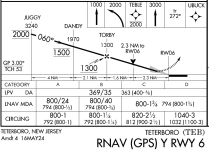
Here is an RNAV approach at Teterboro that contains mandatory altitudes (lines above and below) for JUGGY and DANDY. After passing DANDY at 1500 ft, you can fly level to intercept the glidepath prior to the FAF or descend to 1300 ft for that glidepath interception.

KTEB RNAV 06.png
Steve
 
That IFR magazine article also says: "If there are no intermediate stepdown fixes or air traffic instructions to the contrary, there’s no harm in joining the glidepath early and enjoying a stabilized descent all the way down. "

If you are flying an RNAV approach with one or more mandatory waypoint altitudes, then those must be adhered to.

Here is an RNAV approach at Teterboro that contains mandatory altitudes (lines above and below) for JUGGY and DANDY. After passing DANDY at 1500 ft, you can fly level to intercept the glidepath prior to the FAF or descend to 1300 ft for that glidepath interception.

View attachment 97280
Steve
Are you saying your AP will automatically fly the descent with vertical guidance as you cross JUGGY? You don't have to bug the step down altitude? Or, are you saying you bug the step down altitude, the AP descends toward the bugged altitude, where it will capture the glide slope at some point and the hollow white diamond turns solid magenta at DANDY?

The reason I ask is that sounds contradictory to Mr. Trescott's article that I mentioned earlier.
 
Are you saying your AP will automatically fly the descent with vertical guidance as you cross JUGGY? You don't have to bug the step down altitude? Or, are you saying you bug the step down altitude, the AP descends toward the bugged altitude, where it will capture the glide slope at some point and the hollow white diamond turns solid magenta at DANDY?

The reason I ask is that sounds contradictory to Mr. Trescott's article that I mentioned earlier.
Ken,

Yes, I would use autopilot coupled Baro-VNAV to descend from 2000 ft at JUGGY to 1500 ft at DANDY. That's what the VNAV button is for on the GMC 507.

The G3X Touch system supports multiple armed/active vertical modes, so you can arm for glidepath capture (GP) outside the IAF and continue to use VNAV for step downs as needed. When the FAF leg is active, the glidepath (GP) capture is already armed and ready for capture.

Steve
 
Last edited:
Ken,

Yes, I would use autopilot coupled Baro-VNAV to descend from 2000 ft at JUGGY to 1500 ft at DANDY. That's what the VNAV button is for on the GMC 507.

The G3X Touch system supports multiple armed/active vertical modes, so you can arm for glidepath capture (GP) outside the IAF and continue to use VNAV for step downs as needed. When the FAF leg is active, the glidepath (GP) capture is already armed and ready for capture.

Steve

I understand Garmin VNAV function will do that. But, does that really address the problem the OP is looking to solve? I don't know the G3X system or the GFC507, but I don't think the VNAV descent is the same as capturing the glide slope on an LPV approach.
 
the AP descends toward the bugged altitude, where it will capture the glide slope at some point and the hollow white diamond turns solid magenta at DANDY
this is exactly how HDX appears to work. Any method of descending to the altitude where the VNAV activates and GP can be captured between FAF-1 and FAF is the responsibility of the pilot. I had missed that altitude on a couple of practice approaches and there was a temptation to dive to salvage the approach. a good ADM probably would be to break off and start over.
 
Back
Top