
New-to-me RV6 with O320-E2A. About 100 hours on cylinders with 1700 on lower end. At full throttle all four egt's are pretty similar. If I reduce throttle a tad, say 90% open, cylinder 3 and 4 egt's jump up while 1 and 2 stay cold. All new spark plugs at annual now have 35 hours on them. Cylinder 1 and 2 are quite black, sooty. Cylinder 3 and 4 are very clean. I removed all four intake tubes and bore scoped plenum. No cracks, blockage or anything abnormal found. Replaced with new gaskets and new intake hoses. I'm thinking possible carburetor issue. Perhaps carb is not atomizing fuel well but that's just a guess. What else can I check before replacing carburetor?

Van's Air Force
You are using an out of date browser. It may not display this or other websites correctly.
You should upgrade or use an alternative browser.
You should upgrade or use an alternative browser.
Suspected uneven fuel/air mixture between cylinders.
- Thread starter Fugitive
- Start date


A carburetor cannot always supply an even fuel/air mixture to all 4 cylinders equally (this is fuel injection’s biggest advantage).
One possible explanation is that at WOT the airflow through the sump is such that a relatively even mixture is going to each cylinder and when the throttle butterfly valve gets turned (eg 90% throttle) it disrupts the airflow through the sump. This might also be affected by coming out of the “enrichment valve/economizer” circuit.
Another possibility is an induction leak at the intake gaskets on those two cylinders. However, that would show up more as problems at idle or very low power.
If your cylinders are running fairly evenly at WOT, one option would be to lean the mixture until LOP and control RPM that way. LOP produces less heat (CHT) and less power, and with a fixed pitch propeller, if you can reduce rpm and still have a fairly smooth running engine… congratulations, you’re LOP. This is how I fly my other aircraft with a fixed pitch prop (the RV-6 has a constant speed prop and the procedure is mildly different).
In the other aircraft (Cessna 140) I takeoff, climb, cruise and descend at full throttle and I adjust the RPM with the Mixture.
Hope this helps
As always YMMV
One possible explanation is that at WOT the airflow through the sump is such that a relatively even mixture is going to each cylinder and when the throttle butterfly valve gets turned (eg 90% throttle) it disrupts the airflow through the sump. This might also be affected by coming out of the “enrichment valve/economizer” circuit.
Another possibility is an induction leak at the intake gaskets on those two cylinders. However, that would show up more as problems at idle or very low power.
If your cylinders are running fairly evenly at WOT, one option would be to lean the mixture until LOP and control RPM that way. LOP produces less heat (CHT) and less power, and with a fixed pitch propeller, if you can reduce rpm and still have a fairly smooth running engine… congratulations, you’re LOP. This is how I fly my other aircraft with a fixed pitch prop (the RV-6 has a constant speed prop and the procedure is mildly different).
In the other aircraft (Cessna 140) I takeoff, climb, cruise and descend at full throttle and I adjust the RPM with the Mixture.
Hope this helps
As always YMMV
The carb 0 320's probably have the worst fuel distribution of the 320/360 series engine. There are at least three different style sump/intake tube configurations on the 320's. Good luck finding any definitive information on this. At least one of the E series has the carb mounted further aft and uses smaller intake pipes.
Trying to improve the mixture distribution on these engines is a waste of time with one exception. Some claim that wrapping the intake tube with exhaust wrap on the lean cylinder(s) will help. Lots pf heat in that area and theoretically the wrap keeps the intake cooler and slightly richer.
Trying to improve the mixture distribution on these engines is a waste of time with one exception. Some claim that wrapping the intake tube with exhaust wrap on the lean cylinder(s) will help. Lots pf heat in that area and theoretically the wrap keeps the intake cooler and slightly richer.
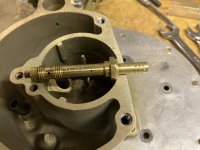

Who did you have do that? Did you take it to a machine shop? What size holes did you end up using?Do a search on the topic. Several threads on the issue. Perforating the main jet worked for me. Not a “waist of time”.View attachment 74713
My engine does the same, as do most other O320s I’ve seen. The butterfly valve position between maybe 90% and 65% throttle seems to just point the fuel towards the front cylinders. The rest of the range is fine for me, and when WOT at altitude I can get the engine properly lean of peak too.

Very interesting! So if I’ve got a carbureted O-320 and a CS prop, with an engine monitor, and I’m at (say) 8,000 feet WOT, what’s the procedure for trying to get it to run lean of peak?My engine does the same, as do most other O320s I’ve seen. The butterfly valve position between maybe 90% and 65% throttle seems to just point the fuel towards the front cylinders. The rest of the range is fine for me, and when WOT at altitude I can get the engine properly lean of peak too.

The old-school "lean it until it runs rough, then richen just enough to smooth out" will probably get you somewhat LOP at WOT. I used to do that with my Citabria (7KCAB, AEIO-320-E2B) and my partners always wondered why I used so little gas. That engine ran 3200 hrs on its original set of cylinders and looked like new inside when we overhauled it.Very interesting! So if I’ve got a carbureted O-320 and a CS prop, with an engine monitor, and I’m at (say) 8,000 feet WOT, what’s the procedure for trying to get it to run lean of peak?
this is what i try to do at 65% power. There is a very slight barely perceptible vibration as I lean and I wonder if I stop too early. May be the vibration is from the small rpm change that i mistake for engine roughness. When you say rough does it mean ROUGH?lean it until it runs rough
Original poster here. At wide open throttle at altitude I can lean to lean of peak...but if I close throttle just a smidge it runs very rough and I have to richen....alot. I've been reading about and updated main jet but am still unclear on part number and applicability. Zero4Zulu do you have any documentation or a link?
I'm running a Marvel-Schebler 4SPA, Part # 10-3678-32.
I'm running a Marvel-Schebler 4SPA, Part # 10-3678-32.

Zero4Zulu
Well Known Member
Drilling the side holes in the nozzle end of the main jet is similar to the “Mooney Mod”. You can research that. There is more involved in the Mooney mod but that’s a different carb. I own a machine shop so I did this myself. Drilled .030” holes at three and four hole patterns at 45 degree rotations.Original poster here. At wide open throttle at altitude I can lean to lean of peak...but if I close throttle just a smidge it runs very rough and I have to richen....alot. I've been reading about and updated main jet but am still unclear on part number and applicability. Zero4Zulu do you have any documentation or a link?
I'm running a Marvel-Schebler 4SPA, Part # 10-3678-32.
This worked very well for my engine, which is O320 with 10:1 compression. My climb CHT’s are much improved and cruise temps are perfect.
Leaning at full throttle then pulling the throttle back is probably not a good plan. You are transitioning from the full power circuit and getting very lean, quickly. Richen first.
My flame suit is on…
Last edited:
I've been reading about and updated main jet but am still unclear on part number and applicability. Zero4Zulu do you have any documentation or a link?
I'm running a Marvel-Schebler 4SPA, Part # 10-3678-32.
I've seen it referred to as a "pepperbox" nozzle or an "atomizing nozzle". I've seen mention of it on other forums such as the Cessna C-120/C-140 owners forum. Most comments are that it evens out the mixture distribution among the cylinders, but tends to run lean.
Zero4Zulu
Well Known Member
Along with drilling the nozzle holes I opened the main jet diameter to .1095".I've seen it referred to as a "pepperbox" nozzle or an "atomizing nozzle". I've seen mention of it on other forums such as the Cessna C-120/C-140 owners forum. Most comments are that it evens out the mixture distribution among the cylinders, but tends to run lean.

This thread:
talks about the pepper box nozzle and around post 24 gives some part numbers. Whole thread is a good read.
Engine stumble
0320/E2G with 30 hrs SMOH. almost every flight it will momentarily stumble for a split second. It can best be described as a (bump). After that it runs fine the rest of the flight. It will only do it once. We changed both mags, wires, and plugs and it still does it. I cant figure out what could...
vansairforce.net
talks about the pepper box nozzle and around post 24 gives some part numbers. Whole thread is a good read.

I have a 0-320 D1A with a CS prop and the 10-5217 carb - it has a pepper box nozzle, but with a slightly diff hole pattern, It runs well LOP at full throttle and I can get balanced temps by using a combination of partial carb heat (knob out 1.25") and cracking the throttle just off of WOT. 150 KTAS on 5.9GPH Mogas. #3 is my leanest and has an intake wrap - I think it helps a little. The engine runs smooth and cool like this for hours. Small tweaks in the carb heat position can be seen changing the mixture distribution by watching the EGTs go up and down. It is futzy, but worth it!This thread:
Engine stumble
0320/E2G with 30 hrs SMOH. almost every flight it will momentarily stumble for a split second. It can best be described as a (bump). After that it runs fine the rest of the flight. It will only do it once. We changed both mags, wires, and plugs and it still does it. I cant figure out what could...vansairforce.net
talks about the pepper box nozzle and around post 24 gives some part numbers. Whole thread is a good read.
Experiment- It can be done!

