Van's Air Force

The definitive Van's Aircraft support community! Buying, building or flying an RV? Join our exclusive family of mentors and enthusiasts!

Sump Casting Number / Part Number

TASEsq

Well Known Member
Patron
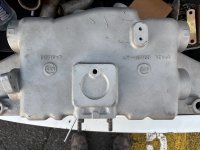
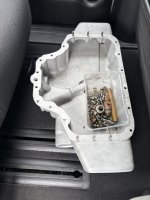
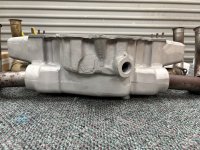
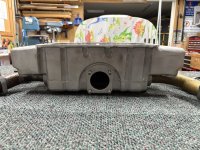
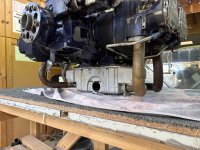
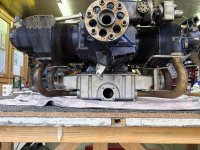
I have a sump which came with my core engine (for overhaul). The engine is a C1E6 which had rear facing injection, but it came with a cold air forward facing lycoming? sump.

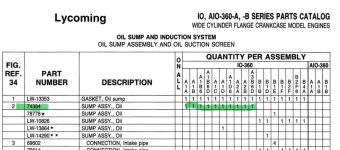
The part number on it (I think!) is just the casting number LW-13783, but this is not a part number I can find another in the io360 a, b IPC, or in the io360 C IPC.

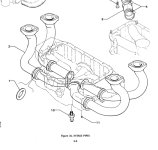
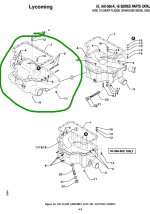
It certainly looks like a sump in the IPC image, but I can’t definitively tie it to a part number. They don’t label which sump images are which part numbers! They are all labelled (2). The most common seems to be 74384 and a Google of that shows sumps which look like mine.

Anyone know how I go about properly identifying this sump other than “it looks like the one on google”?
 

Attachments

  • IMG_6031.jpeg
    IMG_6031.jpeg
    272.4 KB · Views: 43
  • IMG_6029.jpeg
    IMG_6029.jpeg
    143.4 KB · Views: 39
  • IMG_5995.jpeg
    IMG_5995.jpeg
    7.5 MB · Views: 43
  • IMG_5979.jpeg
    IMG_5979.jpeg
    3.6 MB · Views: 47
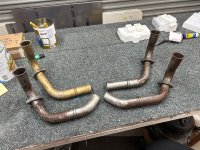
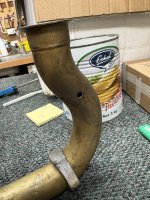
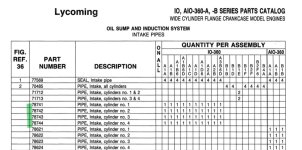
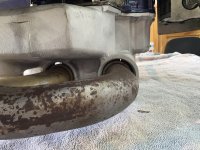
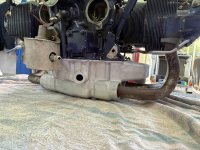
I’m also trying to identify the intake tubes - they certainly look like a set from an A Series engine, but again, no part numbers identifiable.

And for some reason there’s a hole (and a dent) in the #2 pipe.
 

Attachments

  • IMG_6036.jpeg
    IMG_6036.jpeg
    8.1 MB · Views: 25
  • IMG_6035.jpeg
    IMG_6035.jpeg
    189.3 KB · Views: 30
  • IMG_6037.jpeg
    IMG_6037.jpeg
    2 MB · Views: 27
  • IMG_6038.jpeg
    IMG_6038.jpeg
    207 KB · Views: 28
I have a sump which came with my core engine (for overhaul). The engine is a C1E6 which had rear facing injection, but it came with a cold air forward facing lycoming? sump.

The part number on it (I think!) is just the casting number LW-13783, but this is not a part number I can find another in the io360 a, b IPC, or in the io360 C IPC.

It certainly looks like a sump in the IPC image, but I can’t definitively tie it to a part number. They don’t label which sump images are which part numbers! They are all labelled (2). The most common seems to be 74384 and a Google of that shows sumps which look like mine.

Anyone know how I go about properly identifying this sump other than “it looks like the one on google”?
Can you provide photos of the front and rear of the sump? That is definitely a Lycoming angle valve sump. Send me a direct message with your email address. I will email you photos of my IO-360-A1A sump and intake tubes. My tubes look different than yours.
 
Last edited:
I’m also trying to identify the intake tubes - they certainly look like a set from an A Series engine, but again, no part numbers identifiable.

And for some reason there’s a hole (and a dent) in the #2 pipe.
That hole looks like it was drilled to accept an EGT probe
 
Can you provide photos of the front and rear of the sump? That is definitely a Lycoming angle valve sump. Send me a direct message with your email address. I will email you photos of my IO-360-A1A sump and intake tubes. My tubes look different than yours.
If these are not the correct tubes, a new set is about $3600. For $4800 I can get a superior cold air sump and tubes.
 
Contact Vetterman Exhaust. They also make intake tubes and for a lot less money.
I didn’t know that! The thing holding up my exhaust order with Clint, is working out what sump I’m going to use.

Overhauling an engine is a bit like doing an escape room combined with detective work.
 
I didn’t know that! The thing holding up my exhaust order with Clint, is working out what sump I’m going to use.

Overhauling an engine is a bit like doing an escape room combined with detective work.
Lycomings are like Chevy small block V8 engines. There are an amazing number of parts that are common to many years and engine displacements.
 
What hasn’t been mentioned is to send a note - with pictures - to Lycoming. I have been pleasantly surprised in the past at just how quickly their engineering staff can research and answer questions. And then you’re not guessing - you’re getting it straight from the guys that built it!
 
What hasn’t been mentioned is to send a note - with pictures - to Lycoming. I have been pleasantly surprised in the past at just how quickly their engineering staff can research and answer questions. And then you’re not guessing - you’re getting it straight from the guys that built it!
Thanks Paul. I just assumed that would lead to a dead end!

There is a rep here in Australia I can ask, or do they have an email over there which I can go to? [email protected]?
 
Update: I haven’t been able to ascertain the actual part number of the sump, but it sure looks like it fits! (As do the intake tubes).
 

Attachments

  • IMG_6077.jpeg
    IMG_6077.jpeg
    5.2 MB · Views: 33
  • IMG_6078.jpeg
    IMG_6078.jpeg
    5.7 MB · Views: 42
  • IMG_6076.jpeg
    IMG_6076.jpeg
    3.2 MB · Views: 28
  • IMG_6074.jpeg
    IMG_6074.jpeg
    5.9 MB · Views: 34
The sump will fit. the same forward facing sump is used on both the 200 hp version and the 180hp version. The intake tubes are however different between the two installations. The pipes in the picture I think are form a 200hp engine by the looks and memory but not 100% sure. The hole in the one pipe was for a stand by vacuum system pickup.
Good Luck, Mahlon
 
The sump will fit. the same forward facing sump is used on both the 200 hp version and the 180hp version. The intake tubes are however different between the two installations. The pipes in the picture I think are form a 200hp engine by the looks and memory but not 100% sure. The hole in the one pipe was for a stand by vacuum system pickup.
Good Luck, Mahlon
There you go! Learn something new everyday. Our local master welder says he can weld that hole, and pull the dint out at the same time.
 
There you go! Learn something new everyday. Our local master welder says he can weld that hole, and pull the dint out at the same time.
When Dad restored his Stinson in late ‘70’s he made it full IFR, but had to retain the venturi’s for vacuum as the Franklin doesn’t have provision for a pump. So he could spin up the gyros before takeoff, he plumbed the intake manifold via a valve to get the vacuum to spin up the gyros during the taxi. When he’d finished his run-up and pre-takeoff checks he’d switch back to the venturis and go.

Don H
 
When Dad restored his Stinson in late ‘70’s he made it full IFR, but had to retain the venturi’s for vacuum as the Franklin doesn’t have provision for a pump. So he could spin up the gyros before takeoff, he plumbed the intake manifold via a valve to get the vacuum to spin up the gyros during the taxi. When he’d finished his run-up and pre-takeoff checks he’d switch back to the venturis and go.

Don H
That approach sucks!
 
Closure:

Heard back from our local lycoming rep:
“I have checked the drawings this morning and can provide the information below.

74384 was superseded by part#: LW-13864

Looking at the drawing for the LW-13864 it lists casting LW-13783.

Based on that information we can assume that the sump assembly you have is either Part#: 74384 or LW-13864”

I looked into these 2 part numbers - LW-13864 seems to be only installed on the AEIO series of engines. The original engine shop where this sump came from mentioned “it is probably one of the old partenavia sumps we had”. Basing on this, the IPC says the 74384 gets fitted to an -A1B6 (partenavia). So I would say this is the PN for this sump. Certainly looks like the eBay pictures when i google that number 🤣

This would make the tubes #1 74781, #2 74782, #3 74783 & #4 78744
 
Back
Top